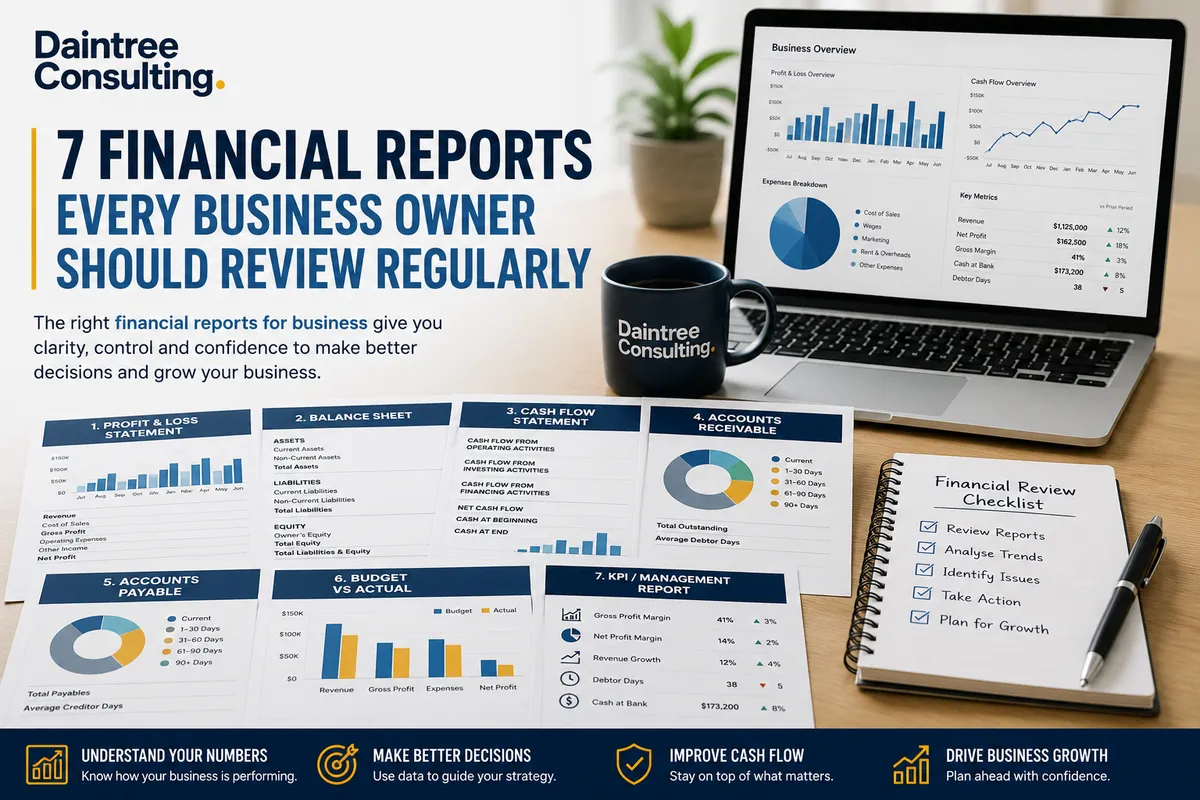
7 Financial Reports Every Business Owner Should Review Regularly
Running a business without regularly reviewing your financial reports is a little like driving without checking the dashboard.
You may know how much you have sold, but you may not know whether the business is actually profitable, where cash is going, which customers owe you money, or whether your costs are getting out of control.
Want expert help? Daintree Consulting's accounting services can take this off your plate. Book a free consultation.
The right financial reports for business give owners a clearer picture of what is happening financially and, more importantly, where the business may be heading.
For Australian business owners, regular financial reporting can help with cash-flow management, budgeting, tax planning, pricing decisions, hiring, investment and long-term growth.
You do not necessarily need dozens of reports every month. For most small and medium-sized businesses, a focused set of reports reviewed consistently can provide the information needed to make better decisions.
This guide explains the 7 financial reports every business owner should review regularly, what each report tells you and what to look for when reviewing them.
Quick Answer: What Financial Reports Should a Business Owner Review?
The seven most useful reports for many Australian businesses are:
1. Profit and Loss Statement — Shows revenue, expenses and profitability.
2. Balance Sheet — Shows what the business owns, owes and the owner's equity.
3. Cash Flow Statement — Shows where cash is coming from and where it is going.
4. Accounts Receivable Report — Shows who owes your business money and how overdue those amounts are.
5. Accounts Payable Report — Shows what your business owes suppliers and other creditors.
6. Budget vs Actual Report — Compares financial performance against your budget or forecast.
7. KPI or Management Report — Tracks the operational measures that drive financial performance.
The important point is not simply generating these reports.
You need to review them regularly and understand what they are telling you.
1. Profit and Loss Statement
The Profit and Loss Statement, often called the P&L or income statement, is one of the most important financial reports for business owners.
It shows the financial performance of the business over a particular period.
Depending on how your accounts are structured, the report will generally show:
Sales or revenue
Cost of goods sold
Gross profit
Operating expenses
Other income and expenses
Net profit or loss
The P&L answers a fundamental question:
Is the business making money?
But simply looking at the final net profit figure is not enough.
You should also look at how that profit was produced.
What should you look for?
Compare the current period with previous months, quarters or years.
For example:
Is revenue increasing?
Is gross margin improving or declining?
Are wages growing faster than revenue?
Are rent and overheads increasing?
Are marketing costs producing sufficient returns?
Are certain expenses unexpectedly high?
Is net profit improving as revenue grows?
A business can have strong revenue growth while becoming less profitable.
That is why revenue alone is not a reliable measure of business health.
How often should you review the P&L?
For most established businesses, monthly is a good starting point.
A fast-growing business or one experiencing financial pressure may benefit from more frequent management reporting.
2. Balance Sheet
The Balance Sheet provides a snapshot of the business's financial position at a specific point in time.
It generally includes three major areas:
Assets — what the business owns or controls.
Liabilities — what the business owes.
Equity — the owner's or shareholders' interest in the business.
The basic accounting relationship is:
Assets = Liabilities + Equity
While the P&L tells you about performance over a period, the Balance Sheet tells you about the financial position of the business at a particular date.
This distinction is important.
A business can report a profit and still have serious cash-flow or balance-sheet problems.
What should you look for?
Pay attention to changes in:
Cash balances
Accounts receivable
Inventory
Loans and borrowings
Trade creditors
Tax liabilities
Employee-related liabilities
Owner's equity
For example, if accounts receivable are growing significantly faster than sales, customers may be taking longer to pay.
If liabilities are increasing rapidly, the business may be becoming more dependent on debt or delayed payments.
Why does the Balance Sheet matter?
It helps answer questions such as:
Can the business meet its obligations?
Is debt increasing too quickly?
Is working capital under pressure?
Is the business becoming financially stronger over time?
For business owners considering expansion, borrowing, investment or a future sale, a clean Balance Sheet becomes particularly important.
3. Cash Flow Statement
Profit and cash are not the same thing.
This is one of the most important concepts for business owners to understand.
A business can report a profit while experiencing cash-flow problems.
Why?
Because revenue recorded in the accounts does not necessarily mean the money has already been received.
For example, imagine your business invoices customers $100,000 during a month but only collects $70,000.
The accounting records may show substantial revenue, but only $70,000 has actually entered the bank account.
At the same time, wages, suppliers, rent, tax and other expenses may still need to be paid.
A Cash Flow Statement helps you understand these movements.
It generally separates cash movements into areas such as:
Operating activities
Investing activities
Financing activities
What should you look for?
Review:
Cash generated from normal operations
Large cash outflows
Loan repayments
Asset purchases
Owner distributions
Financing received
Changes in cash reserves
The key question is:
Is the business generating enough cash from its normal operations to support itself?
If the answer is consistently no, increasing revenue may not solve the underlying problem.
You may need to look at pricing, margins, debtor collection, inventory, supplier terms or overheads.
Cash flow deserves regular attention
Cash-flow management should not be something you think about only when the bank balance becomes uncomfortable.
For many businesses, monthly cash-flow reporting combined with a forward-looking forecast provides much better visibility.
4. Accounts Receivable Report
Your Accounts Receivable report shows money that customers owe your business.
This report is particularly important for businesses that sell on credit or issue invoices after providing their services.
Revenue can look excellent on the P&L while cash remains stuck in unpaid invoices.
The Accounts Receivable report helps identify that problem.
It commonly groups outstanding invoices by age, such as:
Current
1–30 days overdue
31–60 days overdue
61–90 days overdue
90+ days overdue
What should you look for?
Do not only look at the total amount outstanding.
Look at how old the debt is.
For example, $100,000 of receivables may be manageable if most invoices are current.
The same $100,000 could be a significant concern if a large percentage is more than 90 days overdue.
Review:
Total outstanding invoices
Largest customer balances
Overdue amounts
Long-outstanding debts
Average collection time
Customers repeatedly paying late
Why does this matter?
Slow-paying customers can create a cash-flow squeeze even when the business appears profitable.
Regular review also allows management to address collection problems before they become difficult to recover.
5. Accounts Payable Report
The opposite side of the equation is Accounts Payable.
Your Accounts Payable report shows what your business owes suppliers and other creditors.
It helps you understand upcoming payment obligations and manage working capital.
Reviewing this report regularly can help prevent:
Missed supplier payments
Late fees
Disrupted supplier relationships
Unexpected cash requirements
Duplicate or incorrect invoices
What should you look for?
Review:
Total amounts payable
Overdue supplier balances
Upcoming large payments
Supplier concentration
Unusual increases in expenses
Bills that may have been entered incorrectly
You should also compare your Accounts Payable position with your expected cash inflows.
If $150,000 is due to suppliers over the next few weeks but only $80,000 is expected to come into the bank, you need to know that before the payments become due.
That is where financial reporting becomes a decision-making tool rather than simply an accounting exercise.
6. Budget vs Actual Report
A financial report tells you what happened.
A Budget vs Actual report helps you determine whether what happened was consistent with what you expected.
This report compares your actual financial performance against a budget, forecast or target.
For example:
You budgeted for $500,000 in monthly revenue but generated $430,000.
At the same time, you budgeted $150,000 in expenses but actually spent $180,000.
The business has missed its revenue target while spending more than expected.
That is much more useful information than simply knowing the business made a profit.
What should you review?
Look for significant variances in:
Revenue
Gross margin
Wages
Marketing
Rent
Software
Professional fees
Other overheads
Net profit
But don't automatically assume every variance is bad.
There may be a legitimate reason.
For example, a large equipment purchase may cause expenses to be higher than budgeted but support future growth.
The important question is:
Why is actual performance different from the plan?
That question creates the opportunity for management action.
7. KPI and Management Reports
The final category is broader than a traditional financial statement.
A good management report combines financial information with the operational numbers that explain business performance.
The exact KPIs depend on your industry and business model.
Possible measures include:
Revenue growth
Gross profit margin
Net profit margin
Average sale value
Customer acquisition cost
Customer retention
Debtor days
Revenue per employee
Labour cost percentage
Inventory turnover
Recurring revenue
Conversion rate
The purpose is not to track every number imaginable.
It is to identify the small number of metrics that actually drive your business.
For example, a professional services firm may care heavily about utilisation, revenue per employee and debtor days.
A retail business may focus more on gross margin, inventory turnover, average transaction value and sales growth.
A subscription business may focus on recurring revenue, churn and customer acquisition costs.
The right KPI report tells a story
A good management report should help answer:
What is happening?
Why is it happening?
What should we do next?
That is where financial reporting becomes particularly valuable for business owners and leadership teams.
How Often Should You Review Financial Reports?
There is no single schedule that works for every business.
However, a practical approach for many SMEs is:
Weekly
Review cash position and urgent receivables/payables where cash flow is important.
Monthly
Review:
Profit and Loss
Balance Sheet
Cash Flow
Accounts Receivable
Accounts Payable
Key KPIs
Quarterly
Conduct a deeper review of:
Budget vs actual performance
Forecasts
Profitability
Cash requirements
Business strategy
Tax and compliance position
Annually
Review the broader financial direction of the business, including:
Annual profitability
Tax planning
Business structure
Capital requirements
Growth plans
Succession or exit considerations
The larger or more complex the business, the more important regular management reporting becomes.
What Happens When Business Owners Don't Review Their Reports?
The problem is usually not that the business has no financial information.
The problem is that the information is not being used.
Without regular reporting, owners can miss:
Declining margins
Rising overheads
Customers paying increasingly slowly
Growing debt
Cash-flow pressure
Unprofitable products or services
Excessive spending
Underperforming areas of the business
By the time the problem becomes obvious in the bank account, the underlying issue may have existed for months.
Regular financial reporting creates an earlier warning system.
How to Make Financial Reports More Useful
Producing reports is only the first step.
The real value comes from interpreting them.
A useful monthly financial review should ask:
1. What changed?
Identify the biggest movements compared with last month or the same period last year.
2. Why did it change?
Investigate the cause rather than simply recording the variance.
3. Is the change temporary or structural?
A one-off expense is different from an expense that is increasing every month.
4. What does it mean for cash?
A profitable business still needs enough cash to meet its obligations.
5. What action should we take?
Every important financial issue should ideally lead to a decision, investigation or follow-up action.
This turns reporting into management.
Financial Reports Are Only as Good as the Data Behind Them
One of the biggest mistakes business owners make is assuming that a financial report is automatically accurate because it came from accounting software.
Software can process information efficiently, but it cannot automatically correct every underlying data problem.
Reports may be affected by:
Unreconciled bank accounts
Incorrect transaction coding
Missing invoices
Duplicate transactions
Incorrect GST treatment
Unrecorded liabilities
Poor debtor records
Incorrect payroll entries
Outdated balance-sheet accounts
That is why accurate bookkeeping is the foundation of useful financial reporting.
If the underlying records are incomplete or inaccurate, management decisions based on those reports can also be unreliable.
When Should You Get Professional Help With Financial Reporting?
Basic accounting reports are available in most modern accounting systems.
The challenge is often knowing what the numbers actually mean.
Professional accounting or business advisory support can become particularly valuable when:
Revenue is growing quickly
Cash flow is unpredictable
Profit margins are changing
The business has multiple entities
You are considering hiring or expansion
You are seeking finance
You are preparing for a sale
You want stronger management reporting
You are spending too much time trying to understand the accounts
The goal is not simply to give an owner more reports.
It is to give them better financial visibility for better decisions.
How Daintree Consulting Helps Business Owners Understand Their Numbers
At Daintree Consulting, we believe financial reporting should do more than satisfy compliance requirements.
Your reports should help you understand how the business is performing and what decisions may need attention next.
Our integrated approach can bring together bookkeeping, accounting, taxation, payroll and business advisory so the numbers are connected rather than sitting in separate systems or processes.
For business owners, this can mean clearer visibility over:
Profitability
Cash flow
Working capital
Debtors and creditors
Financial performance
Business KPIs
Forecasts and budgets
Growth opportunities
The objective is simple: turn reliable financial information into practical business decisions.
Ready to Get More From Your Financial Reports?
If you receive financial reports every month but still aren't completely sure what the numbers are telling you, it may be time to look at how your reporting is structured.
A short conversation can help identify whether you need better bookkeeping, more useful management reporting, forecasting or broader business advisory support.
Book a free 30-minute discovery call.
Daintree Consulting can review your current setup and help identify practical ways to improve financial visibility — with no pressure and no obligation.
Book your free discovery call:
https://daintreeconsulting.com.au/discovery-call/
Frequently Asked Questions
What are the most important financial reports for a business?
For many businesses, the most important reports include the Profit and Loss Statement, Balance Sheet, Cash Flow Statement, Accounts Receivable, Accounts Payable, Budget vs Actual report and KPI or management report.
The exact combination depends on the size, industry and complexity of the business.
How often should a business review financial reports?
Many SMEs benefit from reviewing core financial reports monthly, with more frequent cash-flow monitoring where required. A deeper financial and strategic review can then be performed quarterly.
What financial report shows whether a business is profitable?
The Profit and Loss Statement shows revenue, expenses and the resulting profit or loss over a defined period.
However, profitability should not be considered in isolation. Cash flow and the Balance Sheet also provide important information about the financial health of the business.
What is the difference between a Profit and Loss Statement and a Balance Sheet?
A Profit and Loss Statement shows financial performance over a period.
A Balance Sheet shows the financial position of the business at a specific point in time, including assets, liabilities and equity.
Why is cash flow different from profit?
Profit and cash are measured differently. A business can record revenue before receiving payment from customers, while it may also have expenses or liabilities that affect cash at different times.
This is why profitable businesses can still experience cash-flow pressure.
Should small businesses have monthly financial reports?
In many cases, yes. Monthly reporting can give owners a clearer understanding of profitability, cash flow, debts, expenses and overall performance before small problems become larger ones.
What should I look for when reviewing my business financial reports?
Focus on trends and changes rather than individual numbers.
Look at revenue, margins, expenses, cash, debtors, creditors and key business KPIs. Most importantly, ask why significant numbers changed and whether action is required.
Can my accountant help me understand financial reports?
Yes. Many accountants provide management reporting and advisory services in addition to compliance work. The level of support varies between firms, so it is worth confirming what is included in your engagement.
Does Daintree Consulting provide financial reporting support?
Yes. Daintree Consulting provides accounting, bookkeeping, taxation and business advisory services designed to give Australian businesses clearer financial information and practical support for decision-making.
