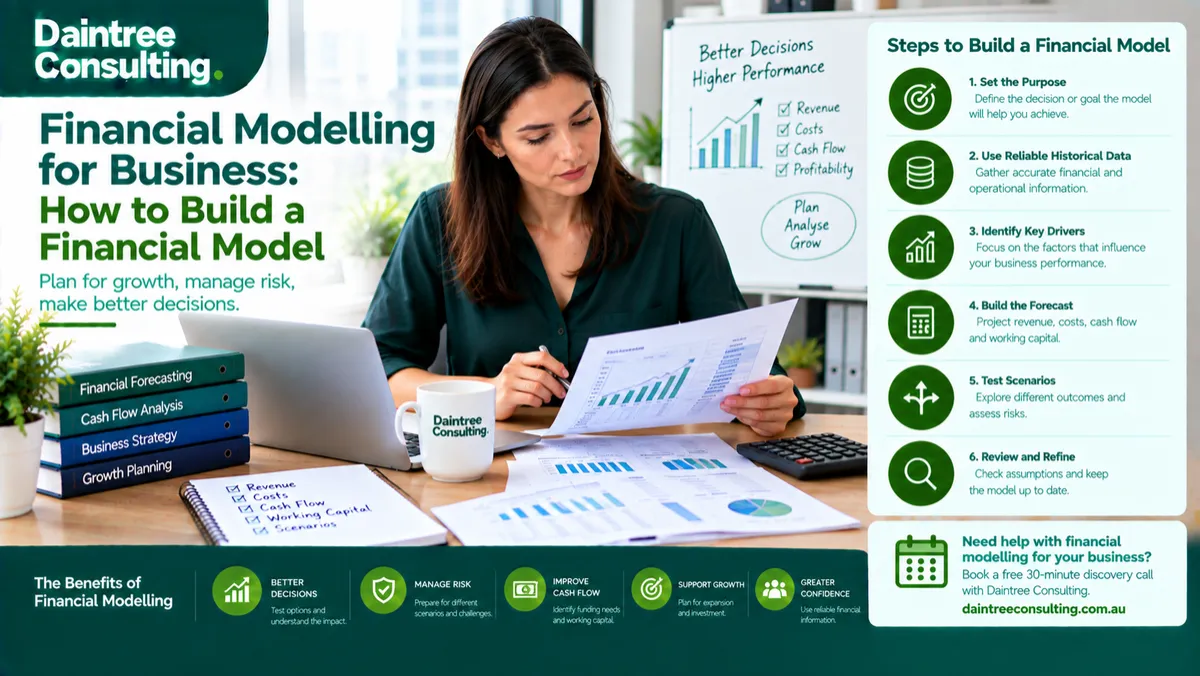
How to Build a Financial Model for Your Growing Business
Growth creates opportunities, but it also creates financial questions.
How much cash will the business need next year? Can the current team support another 20% in revenue? What happens if costs increase? Can the business afford new equipment, additional staff or another location? What would happen if a major customer paid more slowly than expected?
Want expert help? Daintree Consulting's outsourced CFO services can take this off your plate. Book a free consultation.
These questions are difficult to answer using historical financial reports alone.
This is where financial modelling for business can help.
A financial model brings together your business's revenue, costs, cash flow, working capital, funding requirements and other financial drivers to show how different assumptions could affect future results.
For a growing business, the value is not simply in producing a spreadsheet.
The value is in creating a structured way to understand how business decisions could affect financial performance.
Quick answer: What is financial modelling for business?
Financial modelling for business is the process of building a structured financial model that uses historical information, business assumptions and projected activity to estimate future financial outcomes.
A business financial model may include:
revenue forecasts
cost assumptions
gross margins
operating expenses
staffing costs
capital expenditure
working capital
cash flow
debt and funding
profit and loss projections
balance sheet projections
key performance indicators
scenario analysis.
The model can then be used to test different situations.
For example:
What happens if revenue grows by 15%?
What if supplier costs increase by 8%?
What if the business hires five additional employees?
What if customers take longer to pay?
How much funding might be required to support the planned expansion?
A well-structured model helps management explore these questions before making major decisions.
Why Does a Growing Business Need a Financial Model?
A small business can sometimes make decisions based largely on experience, current cash balance and recent financial results.
As the business grows, that becomes harder.
There are more moving parts.
You may have:
more employees
more customers
larger supplier commitments
longer payment cycles
multiple revenue streams
additional locations
greater inventory requirements
larger financing commitments
more significant capital expenditure.
A decision that appears profitable on paper can still create cash-flow pressure.
For example, winning a large new contract may increase revenue significantly. But if the business needs to hire employees, purchase inventory and provide services before receiving payment, the additional revenue may create a substantial short-term funding requirement.
A financial model can help identify that requirement before the decision is made.
What Does a Business Financial Model Actually Do?
At its simplest, a financial model connects assumptions to financial outcomes.
Consider a business that expects to grow its sales.
The model might start with assumptions about:
number of customers
average transaction value
sales volume
pricing
customer growth
retention
sales conversion.
Those assumptions can feed into projected revenue.
Revenue then affects other parts of the model, including:
cost of goods sold
gross profit
staffing requirements
operating expenses
accounts receivable
GST and tax-related cash requirements
cash flow.
This creates a connected picture of the business rather than treating each financial number separately.
That connection is one of the main reasons financial modelling becomes more valuable as a business becomes more complex.
Step 1: Define the Purpose of the Financial Model
Before building anything, decide what the model is supposed to help you understand.
A financial model designed for business expansion will look different from one designed for funding or restructuring.
Common purposes include:
planning business growth
evaluating an expansion
assessing a new location
determining staffing requirements
preparing for investment
assessing funding needs
analysing profitability
evaluating a new product or service
understanding cash requirements
preparing for a major acquisition
comparing strategic options.
Start with the decision.
For example:
“Can the business afford to open another location within the next 12 months?”
That question gives the model a clear purpose.
Without a defined objective, financial models can become unnecessarily complicated.
Step 2: Gather Reliable Historical Financial Information
A financial model is only as useful as the information supporting its assumptions.
Start with reliable historical financial information, such as:
profit and loss statements
balance sheets
cash-flow reports
sales data
payroll information
accounts receivable
accounts payable
inventory records
capital expenditure
loan balances
relevant operating KPIs.
Historical information helps establish how the business actually operates.
For example, if the business has historically generated a gross margin of approximately 42%, a forecast using a 65% margin should have a clear commercial reason behind it.
Similarly, if customers typically take 45 days to pay, assuming every customer pays immediately could produce a misleading cash-flow forecast.
Historical data does not determine the future.
It provides a starting point for developing reasonable assumptions.
Step 3: Identify the Key Business Drivers
A good financial model does not need to model every number independently.
Instead, identify the factors that actually drive financial performance.
These are often called business drivers.
For a professional services firm, drivers might include:
number of clients
billable staff
utilisation
average hourly rate
average project value
client retention.
For a retail business:
number of transactions
average transaction value
product margins
inventory turnover
store locations.
For a subscription business:
customers
new customer acquisition
churn
average revenue per customer
recurring revenue.
For a construction or project-based business:
projects won
project value
project duration
labour requirements
material costs
project margins.
Identifying these drivers makes the model easier to understand and update.
Step 4: Build the Revenue Model
Revenue is usually one of the most important parts of a financial model.
Rather than simply increasing last year's revenue by a percentage, consider what actually creates sales.
For example:
Customers × average revenue per customer = projected revenue
Or:
Units sold × average selling price = projected revenue
Depending on the business, you may need to model:
new customers
existing customers
customer churn
pricing changes
sales volume
seasonal demand
different products or services
different locations
recurring versus one-off revenue.
The more important the revenue assumption is to the decision, the more carefully it should be considered.
Step 5: Model Direct Costs and Gross Margin
Revenue alone does not tell you whether growth is profitable.
The next step is to model the costs directly associated with generating revenue.
These might include:
materials
inventory
subcontractors
direct labour
freight
payment processing
commissions.
From there, you can calculate projected gross profit and gross margin.
This is important because a business can grow revenue while its margin deteriorates.
For example, imagine a business increases sales significantly but wins that additional work by offering heavy discounts.
The revenue forecast may look impressive.
The gross profit forecast may tell a different story.
A financial model can make this relationship visible.
Step 6: Model Operating Expenses
Next, consider the costs required to operate the business.
These could include:
salaries
rent
software
insurance
marketing
professional fees
vehicles
utilities
administration
technology
office costs.
Separate costs where useful.
Some expenses may increase directly with growth.
Others may remain relatively stable.
For example, adding a new salesperson could increase salary, superannuation, software and travel costs.
Opening a new location could introduce an entirely different group of fixed costs.
The model should reflect how costs are actually expected to behave.
Step 7: Include Staffing and Payroll Assumptions
Staffing can be one of the largest costs for a growing business.
It can also be one of the biggest drivers of growth capacity.
A financial model may therefore include:
existing employees
planned hires
salaries
superannuation
payroll-related costs
start dates
expected productivity
wage increases
contractor costs.
Timing matters.
Hiring an employee in January rather than July can produce a materially different annual financial outcome.
The model should therefore consider when costs and expected revenue actually occur, rather than only using annual totals.
Step 8: Build the Cash-Flow Model
This is one of the most important parts of financial modelling for business.
Profit and cash are not the same thing.
A business may report a profit while experiencing cash-flow pressure because customers have not yet paid, inventory has increased or capital expenditure has absorbed cash.
The cash-flow model should therefore consider items such as:
customer receipts
supplier payments
payroll
GST-related payments
tax-related payments
capital expenditure
loan repayments
financing
working capital.
This can reveal when additional funding may be required.
For a growing business, this can be critical.
Growth often requires cash before the associated revenue is fully collected.
Step 9: Model Working Capital
Working capital is often overlooked in basic financial projections.
But it can have a significant effect on cash requirements.
Key areas may include:
accounts receivable
accounts payable
inventory
work in progress
customer deposits
supplier payment terms.
Suppose sales increase by 30%.
If customers take longer to pay while the business needs to purchase more stock upfront, the additional sales could consume cash.
The financial model should show that relationship.
This allows management to consider whether payment terms, supplier arrangements, inventory levels or financing need to change as the business grows.
Step 10: Build the Profit and Loss Forecast
The projected profit and loss statement brings the revenue and cost assumptions together.
It may include:
revenue
cost of sales
gross profit
operating expenses
EBITDA or operating earnings, where relevant
depreciation
interest
tax
net profit.
The purpose is not simply to produce a future profit figure.
The model should help management understand what is driving that result.
For example:
If projected profit increases, is it because of:
higher sales?
better pricing?
improved margins?
lower overheads?
increased productivity?
Understanding the drivers makes the model more useful for decision-making.
Step 11: Link the Balance Sheet
For more sophisticated financial modelling, the balance sheet should also be considered.
Relevant areas may include:
cash
receivables
inventory
fixed assets
loans
payables
tax-related balances
equity.
This helps create a more complete view of the business.
For example, projected revenue growth may increase receivables.
New equipment may increase fixed assets and funding requirements.
Additional borrowing may increase cash initially but also create future repayment obligations.
A connected model allows these effects to be considered together.
Step 12: Add Scenarios and Sensitivity Analysis
One of the biggest advantages of a financial model is the ability to test different assumptions.
Rather than relying on one forecast, management can compare scenarios.
For example:
Base case
The business performs broadly in line with current expectations.
Growth case
Revenue grows faster, additional staff are hired and operating costs increase accordingly.
Downside case
Revenue growth is slower, margins decline and customers take longer to pay.
The purpose is not to predict exactly which scenario will happen.
It is to understand how sensitive the business is to changes in key assumptions.
You can also test individual variables.
For example:
What happens if:
revenue is 10% lower?
prices increase by 5%?
supplier costs increase by 7%?
wages increase faster than expected?
debtor days increase by 15 days?
a planned hire is delayed?
capital expenditure is brought forward?
This can help management identify which assumptions matter most.
Step 13: Identify the Business's Key Financial Metrics
A financial model should connect to the metrics management actually uses.
Depending on the business, these might include:
revenue growth
gross margin
net profit margin
EBITDA
cash balance
operating cash flow
debtor days
creditor days
inventory turnover
customer acquisition cost
recurring revenue
utilisation
revenue per employee.
The purpose is to create a model that management can use alongside regular financial reporting.
If an important KPI changes significantly from the assumption used in the model, that may be a reason to update the forecast.
Step 14: Review the Model for Reasonableness
Before relying on the model, review the assumptions and outputs.
Ask:
Are the assumptions based on reliable information?
Are revenue assumptions commercially realistic?
Are cost increases reflected?
Does staffing match expected growth?
Are payment terms reflected in cash flow?
Has working capital been considered?
Are capital expenditure requirements included?
Are financing requirements realistic?
Are downside scenarios included?
Do the outputs make sense when compared with historical performance?
A financial model should be challenged rather than simply accepted because the spreadsheet calculates correctly.
A technically correct formula can still produce an unrealistic result if the underlying assumption is inappropriate.
What Should a Financial Model Look Like?
There is no single correct format.
A relatively simple business model might contain:
Assumptions
Revenue
Direct costs
Operating expenses
Profit and loss
Cash flow
Working capital
Capital expenditure
Funding
Scenarios
Key financial metrics.
A more complex model may include separate schedules for different revenue streams, employees, assets, debt, inventory, tax and other areas.
The important principle is that the model should be clear, connected and maintainable.
Complexity does not automatically make a model better.
Common Financial Modelling Mistakes
Building the model around revenue alone
Revenue growth does not automatically mean profitable or cash-generative growth.
Using unrealistic assumptions
A model can produce impressive numbers if the assumptions are overly optimistic.
Ignoring timing
Annual totals can hide significant cash-flow pressure during individual months.
Forgetting working capital
Growing sales can require additional cash before customers pay.
Separating the model from actual financial reporting
If the model is never compared with actual results, management loses an opportunity to learn from forecasting differences.
Making the model too complicated
A model that nobody understands or updates will quickly lose its value.
Treating the forecast as a guarantee
A financial model represents assumptions and scenarios. Actual results can differ because business conditions change.
How Often Should You Update a Financial Model?
The appropriate frequency depends on the purpose of the model and how quickly the business changes.
A rapidly growing business may need regular updates.
A more stable business may update its model less frequently but still review assumptions when significant circumstances change.
Triggers for updating a model could include:
significant revenue changes
major new contracts
loss of a major customer
changes in pricing
significant cost increases
new employees
major capital expenditure
new borrowing
changes in payment terms
expansion into a new market
changes in business strategy.
A useful practice is to compare actual performance with the model regularly.
This can show where assumptions were accurate and where they need to be changed.
Financial Model vs Financial Forecast
Financial modelling and financial forecasting are closely related, but they are not necessarily the same thing.
A financial forecast generally estimates future financial performance based on current information and assumptions.
A financial model provides the underlying structure that connects those assumptions and allows management to test different scenarios.
Think of it this way:
The forecast is an expected outcome.
The model is the framework that helps you explore how different assumptions produce different outcomes.
This distinction makes financial modelling particularly useful when a business is considering a decision rather than simply asking what is likely to happen.
When Should a Business Build a Financial Model?
A financial model can be useful whenever a decision has meaningful financial consequences.
Examples include:
Expanding the business
You may need to understand the additional revenue, costs, staffing and cash required.
Opening another location
The model can help estimate setup costs, ongoing expenses, expected revenue and funding requirements.
Hiring a larger team
You can model additional salaries and other employment costs against expected revenue and productivity.
Seeking funding
A lender or investor may require financial information and projections to understand the business's expected performance and funding requirements.
Launching a new product or service
The model can help test pricing, demand, costs, margins and cash requirements.
Acquiring another business
A model can help management consider the potential financial effects of the acquisition and different assumptions.
Managing financial pressure
If cash flow or profitability is under pressure, scenario modelling can help management examine potential responses.
How Financial Modelling Supports Better Business Decisions
The biggest benefit of financial modelling is not the spreadsheet itself.
It is the ability to ask better questions.
Instead of asking:
“Can we afford this?”
you can ask:
“What happens to cash flow if we make this investment?”
Instead of:
“Can we afford to hire more staff?”
you can ask:
“How much additional revenue would we need to generate to support these hires while maintaining our target margin?”
Instead of:
“Should we expand?”
you can ask:
“What level of sales, staffing and cash reserves would the expansion require under different scenarios?”
That creates a more structured basis for decision-making.
How Daintree Consulting Can Help With Financial Modelling
For a growing business, financial modelling can become a valuable part of broader financial planning and decision-making.
Daintree Consulting provides outsourced CFO and business advisory services to Australian businesses that need stronger financial oversight, forecasting, reporting and commercial support.
Depending on your circumstances, financial modelling support may help with:
business growth planning
cash-flow modelling
financial forecasting
scenario analysis
budgeting
management reporting
KPI development
working-capital analysis
funding preparation
investment and expansion decisions.
The right model depends on the business.
A growing professional services firm will have different financial drivers from a retailer, construction business or technology company.
The aim is therefore to build a model around the decisions and financial drivers that actually matter to your business.
Book a free 30-minute discovery call with Daintree Consulting to discuss your financial modelling, forecasting or broader CFO requirements.
Frequently Asked Questions About Financial Modelling for Business
What is financial modelling for business?
Financial modelling for business is the process of building a structured model that connects business assumptions with projected revenue, costs, profit, cash flow, working capital and other financial outcomes.
Why is financial modelling important for growing businesses?
Growth can increase both revenue and financial complexity. A financial model can help businesses understand cash requirements, profitability, funding needs and the potential financial effects of different growth decisions.
What should a business financial model include?
Depending on the purpose, a model may include revenue, direct costs, operating expenses, staffing, profit and loss, cash flow, working capital, capital expenditure, funding, balance sheet information, KPIs and scenarios.
Is financial modelling the same as forecasting?
Not exactly. Forecasting estimates future results, while financial modelling provides a connected framework for testing how different assumptions could affect those results.
Can a small business use financial modelling?
Yes. A small business does not necessarily need a highly complex model. A relatively simple model can still help with cash flow, hiring, pricing, growth and other important decisions.
How often should a financial model be updated?
It depends on the business and purpose of the model. A rapidly changing business may need more frequent updates, while a stable business may review it periodically and whenever significant assumptions change.
Can an accountant or CFO build a financial model?
Yes. An accountant or outsourced CFO can help develop financial models using accounting information, operational assumptions and management objectives. The appropriate level of modelling depends on the business and the decision being assessed.
Final Takeaway
Financial modelling for business is about more than forecasting a future profit number.
A well-structured model connects the key drivers of your business so you can understand how changes in revenue, costs, staffing, working capital, investment and funding could affect the financial position of the business.
For a growing business, that can provide useful visibility before major decisions are made.
The most effective models are not necessarily the most complicated.
They are the ones that:
use reliable financial information
identify the business's key drivers
make assumptions visible
connect profit and cash flow
account for working capital
test different scenarios
are regularly compared with actual results
support real management decisions.
As your business becomes more complex, having a structured financial model can give you a clearer way to evaluate opportunities, understand financial requirements and plan for different outcomes.
Important Publishing Note: Financial models, forecasts, budgets and projections are based on assumptions and professional judgement and are not guarantees of future results. Actual outcomes may differ materially as business conditions, costs, customer behaviour and other factors change. Financial modelling should be tailored to the business's circumstances and intended use. This article provides general information only and is not personal financial, investment, tax or legal advice.
Talk to Daintree about your finance function
Our ex-Big 4 team gives clear, senior-reviewed advice so you can act with confidence.
Book a free consultation →
Or explore our outsourced CFO services.
