What Financial Information Should a Business Have Before Seeking Investment?
Seeking investment is a significant step for any business.
Whether you are preparing for expansion, launching a new product, entering another market or funding a major growth opportunity, investors will want to understand more than how much revenue your business generates.
Want expert help? Daintree Consulting's business advisory services can take this off your plate. Book a free consultation.
They will want to know how the business makes money, how profitable it is, how it uses cash, what its financial position looks like and whether the numbers support the growth opportunity you are presenting.
Having the right financial information for investors can make those conversations much more productive.
It can also expose weaknesses in your business before an investor finds them.
If your financial records are incomplete, reporting is inconsistent or your forecasts are based on unclear assumptions, you may find it harder to explain the business and defend your valuation or funding requirements.
This guide explains the key financial information a business should consider preparing before seeking investment.
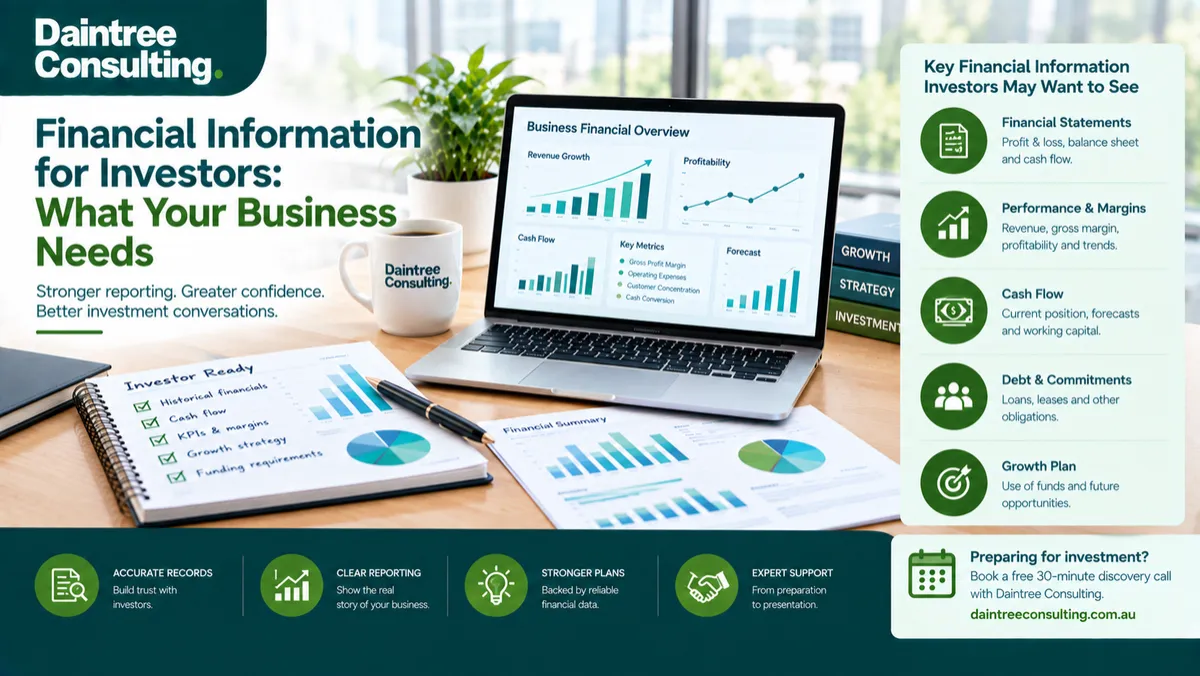
Quick Answer: What Financial Information Do Investors Need?
Before approaching investors, a business should generally have a clear and organised view of:
Historical profit and loss results
Balance sheet information
Cash-flow position
Revenue and gross margin trends
Operating expenses
Key financial ratios and KPIs
Accounts receivable and payable
Debt and other financial commitments
Customer or revenue concentration
Historical growth
Current financial performance
Business budgets and forecasts
Cash-flow forecasts
Funding requirements
Planned use of investment
Key assumptions behind future projections
The exact information required will depend on the business, investor and transaction.
The important point is that investors should be able to understand where the business has been, where it is now and where management expects it to go.
Why Financial Information Matters to Investors
Investors are taking a financial risk.
They need enough information to assess whether that risk makes sense.
Strong sales figures can be encouraging, but revenue alone does not tell an investor whether the business is financially sustainable.
Two businesses with identical revenue can have very different investment prospects if one has stronger margins, better cash conversion, lower debt and more predictable earnings.
Financial information helps investors assess questions such as:
Is the business growing?
Is growth profitable?
Are margins stable?
How much cash does the business generate?
How much funding does it require?
What will the investment be used for?
How dependent is the business on particular customers?
What are the major financial risks?
Are management's forecasts realistic?
What could prevent the business from achieving its targets?
The quality of your financial information can therefore influence how confidently an investor can assess the opportunity.
1. Prepare Your Historical Profit and Loss Information
Your profit and loss statement is one of the most important starting points.
Investors generally want to understand how revenue and expenses have changed over time rather than seeing only the current year's result.
Depending on the business and transaction, it may be useful to prepare historical financial information covering several reporting periods.
The analysis should make it easy to understand:
Revenue
Cost of sales or direct costs
Gross profit
Gross profit margin
Operating expenses
Earnings or operating profit
Significant one-off expenses
Other material income or expenses
The exact presentation will depend on the business.
What matters is consistency and clarity.
If revenue has grown significantly, be prepared to explain what drove that growth.
If profit has not increased at the same rate, investors may want to understand why.
Likewise, if margins have changed, management should be able to explain the underlying reasons.
2. Have an Up-to-Date Balance Sheet
Revenue and profit tell only part of the story.
The balance sheet provides insight into the business's financial position.
It can help show:
Cash held by the business
Accounts receivable
Inventory
Property and equipment
Other assets
Accounts payable
Loans and borrowings
Other liabilities
Equity
An investor may want to understand how much capital is tied up in the business and whether there are financial obligations that could affect future growth.
For example, a business may be profitable but have substantial debt or significant working capital requirements.
Those factors can materially affect an investment decision.
Before seeking investment, make sure balance-sheet accounts are appropriately reconciled and supported by reliable records.
3. Show How Revenue Has Developed
Investors will usually want to understand more than your current revenue figure.
They may want to see the trend.
Depending on the business, useful analysis may include:
Revenue by month or quarter
Year-on-year growth
Revenue by product or service
Recurring versus non-recurring revenue
Revenue by customer segment
Revenue concentration
Average transaction value
New versus existing customers
The objective is to demonstrate what is driving the business.
For example, $5 million of revenue generated from a diversified customer base may present a different risk profile from $5 million that depends heavily on one customer.
Being able to explain the composition of your revenue gives investors more useful information than a single headline number.
4. Understand Your Gross Profit and Margins
Revenue growth can look impressive until an investor examines the costs required to generate it.
That makes gross profit and margin analysis particularly important.
Consider preparing information showing:
Gross profit
Gross profit margin
Margin trends
Margin by product or service where relevant
Major changes in direct costs
Pricing changes
Supplier cost changes
If margins are improving, explain what is driving the improvement.
If margins are declining, be prepared to explain the reason and what management intends to do about it.
Investors do not necessarily expect every financial metric to be perfect.
They do expect management to understand the numbers.
5. Prepare Cash-Flow Information
Cash flow can become particularly important when a business is seeking investment to fund growth.
A company may report strong revenue and accounting profit while still requiring significant additional cash to support expansion.
Consider preparing:
Historical cash-flow information
Current cash position
Operating cash flow
Major cash outflows
Working-capital requirements
Existing financing commitments
Expected future cash requirements
Cash-flow forecasts
Investors may want to understand how much funding the business needs and how long that funding is expected to support its plans.
If you are seeking investment because the business needs additional working capital, explain the relationship between the funding requirement and the growth plan.
6. Know Your Working Capital Position
Working capital can become increasingly important as a business grows.
For example, taking on larger customers may increase receivables.
Expanding inventory may require more cash upfront.
Longer payment terms may delay collections.
At the same time, suppliers and employees still need to be paid.
Before approaching investors, understand:
Accounts receivable
Accounts payable
Inventory
Payment terms
Collection patterns
Working-capital requirements
Cash conversion
This can help explain why additional funding is required even if the business is already profitable.
7. Have a Clear View of Debt and Financial Commitments
Investors will want to understand the obligations that already exist.
Prepare a clear summary of relevant:
Business loans
Equipment finance
Credit facilities
Lease commitments
Director or shareholder loans
Other significant financial obligations
Do not wait until due diligence to discover that important commitments are difficult to explain.
A clear debt position helps investors understand the business's existing financial structure and how new capital may interact with it.
8. Identify Your Key Financial KPIs
Financial statements provide the foundation, but investors may also want to understand the operational metrics driving those results.
The appropriate KPIs depend heavily on the business model.
Potential measures include:
Revenue growth
Gross margin
Net margin
Customer acquisition cost
Customer retention
Average transaction value
Revenue per employee
Recurring revenue
Debtor days
Inventory turnover
Utilisation
Customer concentration
Cash conversion
Do not include dozens of KPIs simply to make an investor pack look impressive.
Focus on the measures that actually explain how your business performs.
9. Prepare a Business Budget
Historical financial information tells investors what has happened.
A budget helps explain what management expects to happen.
A useful business budget can provide a structured view of expected:
Revenue
Direct costs
Operating expenses
Profit
Capital expenditure
Cash requirements
Your budget should be connected to realistic business assumptions.
For example, if revenue is expected to increase substantially, the forecast should consider whether the business will need additional employees, equipment, premises, marketing or working capital to achieve that growth.
A forecast becomes more useful when the assumptions behind it can be explained.
10. Build a Cash-Flow Forecast
A profit forecast and cash-flow forecast are not the same thing.
A business can forecast higher profits while still experiencing periods of cash pressure.
A cash-flow forecast can help show:
Expected cash inflows
Expected operating expenses
Tax and other obligations
Capital expenditure
Debt repayments
Working-capital movements
Funding requirements
Expected cash balance
This can be particularly important if investment will be used to fund a period of rapid expansion.
The forecast should be based on reasonable assumptions and should be reviewed as circumstances change.
11. Explain Exactly How the Investment Will Be Used
Investors will want to know what their capital is intended to achieve.
Instead of simply stating that you need $1 million for growth, be more specific about the proposed use of funds.
For example, funding might support:
Additional staff
New equipment
Product development
Technology
Marketing
Inventory
Geographic expansion
Acquisitions
Working capital
The purpose should connect directly to your business plan.
A strong funding proposal answers:
How much capital do we need, why do we need it and what is it expected to help the business accomplish?
12. Prepare Financial Forecasts With Clear Assumptions
Financial forecasts can be useful to investors, but they need to be credible.
Avoid presenting projections as guaranteed outcomes.
Instead, document the assumptions supporting them.
For example:
Expected customer growth
Pricing assumptions
Gross margin assumptions
Hiring plans
Operating expense increases
Capital expenditure
Market expansion
Expected conversion rates
Working-capital requirements
Where uncertainty is significant, scenario analysis can be useful.
For example:
Base case: Expected performance based on current assumptions.
Upside case: Stronger growth or better-than-expected margins.
Downside case: Slower growth, higher costs or other adverse conditions.
This can demonstrate that management has considered more than one possible outcome.
13. Clean Up Your Financial Records Before Seeking Investment
One of the most practical steps a business can take is making sure its underlying accounting records are reliable.
If financial reports contain unexplained balances, unreconciled accounts or inconsistent classifications, those issues can create unnecessary questions during an investor review.
Before seeking investment, consider checking:
Bank reconciliations
Accounts receivable
Accounts payable
Payroll liabilities
GST and other tax-related accounts
Fixed assets
Loans
Inventory
Director or shareholder accounts
Intercompany balances
Retained earnings and equity accounts
The purpose is not to make the business look artificially better.
It is to make sure the information presented accurately reflects the business.
14. Be Ready to Explain Unusual Numbers
Financial statements rarely tell the whole story.
There may be legitimate reasons behind unusual results.
For example:
A one-off legal expense
An unusual equipment purchase
A temporary increase in marketing
A major customer contract
A restructuring cost
A significant supplier price change
A temporary staffing increase
If something materially affected the financial results, document it.
Investors are likely to ask questions about significant movements.
Being able to explain them clearly demonstrates that management understands the business rather than simply presenting numbers prepared by someone else.
15. Consider Normalising Certain Financial Results
Some businesses have financial results affected by unusual or non-recurring items.
Depending on the investment process, management may need to distinguish between normal operating performance and unusual items.
For example, a business might have incurred a one-off restructuring cost that will not recur.
However, any adjustments should be transparent and supportable.
Do not remove costs simply because they make the business look less profitable.
If an investor is assessing the business, credibility matters.
Any normalisation or adjustment should have a clear rationale and appropriate supporting information.
16. Understand Your Business Valuation Drivers
Financial information can also help you understand what may influence the value investors place on your business.
Depending on the business model, relevant factors can include:
Revenue growth
Profitability
Margins
Recurring revenue
Customer concentration
Cash generation
Growth opportunities
Market position
Debt
Working-capital requirements
Dependence on key individuals
Financial risk
Valuation is not determined by one accounting number.
Different investors and transactions use different approaches.
The important point is that your financial information should help you clearly explain the economic characteristics of the business.
What Should an Investor Financial Pack Contain?
There is no universal format for every investment transaction, but a useful financial information pack may include:
Historical performance
Profit and loss statements
Balance sheets
Cash-flow information
Revenue trends
Gross margin trends
Key financial KPIs
Current position
Latest management accounts
Current cash position
Receivables and payables
Debt
Working capital
Significant commitments
Future outlook
Business budget
Financial forecasts
Cash-flow forecast
Scenario analysis
Key assumptions
Funding proposal
Amount of investment sought
Proposed use of funds
Expected funding requirements
Growth plan
Key financial milestones
The exact level of detail should reflect the size and complexity of the transaction.
Common Financial Problems to Fix Before Approaching Investors
Some issues are particularly likely to make financial discussions more difficult.
Outdated accounts
If the latest financial reports are months out of date, investors may struggle to understand the current position.
Unreconciled accounts
Unreconciled balances can undermine confidence in the financial information.
Unclear profitability
If management cannot explain where profit comes from, an investor may have difficulty assessing the business model.
Weak cash-flow visibility
A business seeking funding should understand how much cash it needs and why.
Unsupported forecasts
Large growth projections without clear assumptions can raise questions rather than confidence.
Customer concentration
Heavy dependence on one or a small number of customers can create additional risk.
Poor documentation
Missing financial records or inconsistent reporting can slow down investor review.
Fixing these issues before seeking investment can make the process more efficient.
Financial Information for Investors Should Tell a Clear Story
Good financial information is not simply a collection of spreadsheets.
It should help tell the story of the business.
For example:
Where were we?
Historical financial results show the business's development.
Where are we now?
Current management accounts and KPIs show the present position.
Where are we going?
Budgets, forecasts and strategic plans explain the expected direction.
Why do we need investment?
The funding proposal explains what capital is required and how it will be used.
What could affect the plan?
Risks, assumptions and scenarios provide context around the forecast.
When these pieces connect, investors can develop a clearer understanding of the opportunity.
How Daintree Consulting Can Help
Preparing for investment often requires more than simply producing financial statements.
Daintree Consulting can help Australian businesses improve the quality and usefulness of their financial information before important funding or growth discussions.
Depending on your needs, support can include:
Management accounts
Financial reporting
Profitability analysis
Cash-flow reporting
Budgeting
Financial forecasting
KPI and dashboard development
Working-capital analysis
Business performance analysis
Funding and due-diligence support
Strategic business advisory
Outsourced CFO support
The goal is to give business owners clearer financial information so they can make better decisions and communicate their position with greater confidence.
Final Thoughts
Seeking investment is not simply about showing an investor that your revenue is growing.
You need to demonstrate that you understand the financial drivers behind the business.
That means having reliable historical accounts, a clear current financial position, useful KPIs, visibility over cash flow and realistic forecasts supported by understandable assumptions.
Most importantly, your numbers should tell a consistent story.
If your business is preparing for investment, start reviewing your financial information before the investor asks for it.
Fix gaps.
Reconcile the accounts.
Understand your margins.
Review cash flow.
Build realistic forecasts.
Document your assumptions.
And make sure you can explain the numbers behind your growth strategy.
Good financial information for investors does not guarantee investment. But it can help create a clearer, more credible picture of the business and make important financial conversations more productive.
Preparing Your Business for Investment?
Daintree Consulting can help you review your financial reporting, cash flow, forecasts and performance information before you approach investors.
Book a free 30-minute discovery call to discuss what your business needs and where your financial reporting could be strengthened.
Frequently Asked Questions
What financial information do investors usually want to see?
Investors may want to review historical financial statements, current management accounts, revenue and margin information, cash flow, debt, KPIs, budgets, forecasts and the proposed use of investment. The exact requirements depend on the investor and transaction.
How many years of financial statements should I provide to investors?
There is no universal period that applies to every investment transaction. The appropriate history can depend on the size, structure, age and circumstances of the business and what the investor is assessing.
Do investors look at cash flow or profit?
Both can matter. Profit provides information about financial performance, while cash flow shows how cash moves through the business and whether the business can fund its obligations and growth requirements.
Should I prepare a financial forecast before seeking investment?
A financial forecast can help explain your expected future performance and funding requirements. It should be based on reasonable assumptions and should not be presented as a guarantee of future results.
What should I do if my accounting records are not up to date?
Consider bringing your records up to date and resolving significant reconciliation or classification issues before presenting financial information to investors. Reliable underlying records make financial reporting more useful.
Why do investors care about gross profit margin?
Gross profit margin can help investors understand how efficiently a business converts revenue into gross profit before operating expenses. Changes in margin can also reveal pricing, supplier cost or product-mix issues.
Can an accountant help prepare financial information for investors?
Yes. Depending on the scope required, an accountant or adviser can assist with management reporting, financial analysis, budgeting, forecasting and preparation of information used in funding or investment discussions.
Can an outsourced CFO help with investor preparation?
An outsourced CFO can provide higher-level financial leadership around forecasting, financial modelling, management reporting, funding preparation and due-diligence support, depending on the business's needs and engagement scope.
Talk to Daintree about your next business decision
Our ex-Big 4 team gives clear, senior-reviewed advice so you can act with confidence.
Book a free consultation →
Or explore our business advisory services.
