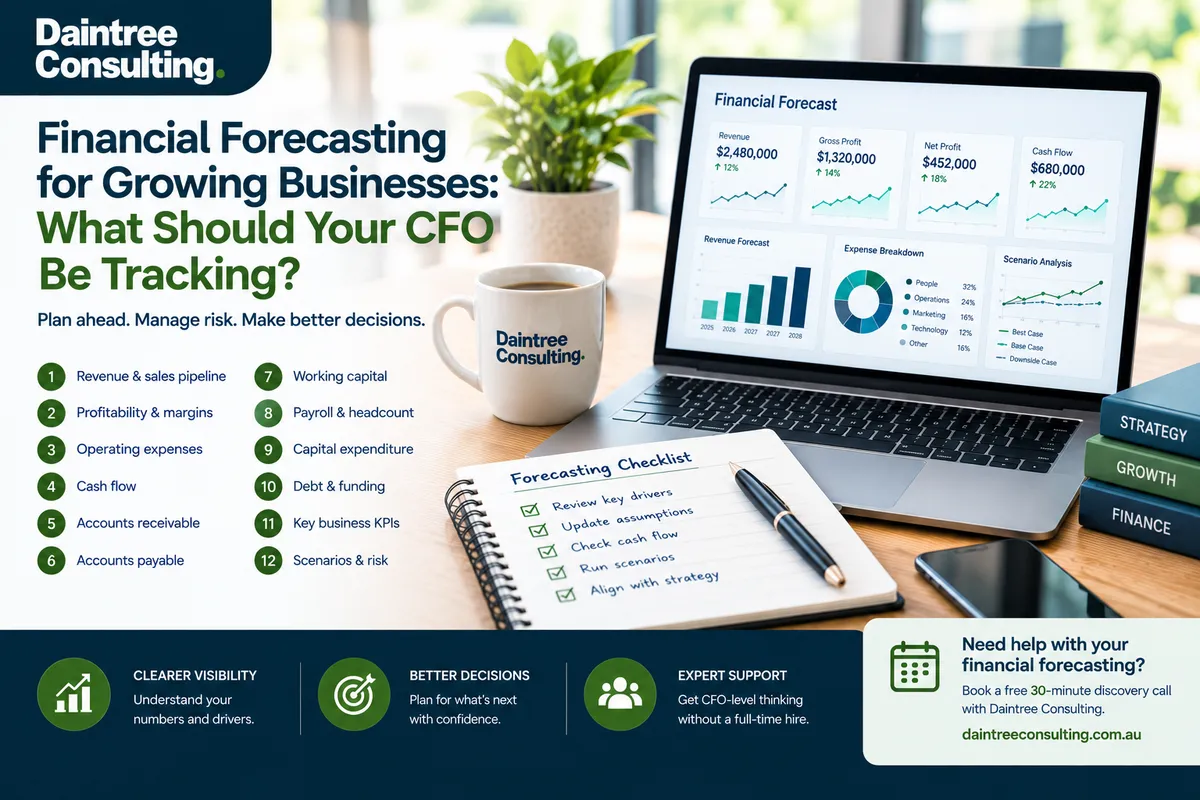
Financial Forecasting for Growing Businesses: What Should Your CFO Track?
Growth creates opportunities—but it also creates financial complexity.
A business can be winning new customers, increasing revenue and expanding its team while becoming harder to manage financially.
Want expert help? Daintree Consulting's outsourced CFO services can take this off your plate. Book a free consultation.
Cash requirements increase. Costs change. Hiring decisions become more important. Customers may take longer to pay. Inventory or project commitments can absorb cash before revenue is collected. And decisions that were once easy to make by instinct may now carry much greater financial consequences.
This is where financial forecasting for business becomes particularly valuable.
A good forecast is more than a spreadsheet showing what revenue might look like next year. For a growing business, it should help leadership understand where cash is heading, what assumptions are driving performance, what could go wrong and what decisions need to be made before problems become urgent.
For businesses with a CFO—or an outsourced CFO—the question should not simply be "Do we have a forecast?"
It should be:
"Are we tracking the right things, updating the forecast regularly and using it to make better decisions?"
Quick Answer: What Should a CFO Track in a Financial Forecast?
A CFO should typically monitor:
Revenue and sales pipeline
Gross profit and margins
Operating expenses
Cash inflows and outflows
Accounts receivable and payment timing
Accounts payable and upcoming commitments
Working capital
Payroll and headcount costs
Capital expenditure
Debt and funding requirements
Key business KPIs
Best-case, base-case and downside scenarios
The exact forecast will depend on the business model, industry, stage of growth and decision-making needs.
The goal is not to forecast every number perfectly.
The goal is to create a useful forward-looking view of the business that helps management act earlier and with greater confidence.
What Is Financial Forecasting for Business?
Financial forecasting is the process of estimating a business's future financial performance using current information, historical results, known commitments, assumptions and expected changes.
A forecast may consider:
Future revenue
Expenses
Profitability
Cash flow
Working capital
Staffing
Capital expenditure
Debt
Funding requirements
For a growing business, forecasting is particularly important because historical financial results may no longer be enough to explain what comes next.
A company that generated $2 million in revenue last year may be planning to reach $3 million this year.
But what happens to:
Payroll?
Marketing?
Inventory?
Supplier payments?
Customer receivables?
Technology costs?
Office or warehouse costs?
Working capital?
Cash reserves?
Revenue growth does not automatically translate into available cash.
A useful forecast helps leadership see these relationships before making the next major decision.
Why Growing Businesses Need Better Forecasting
Small businesses can sometimes operate successfully with relatively simple financial information.
As the business grows, however, decisions become interconnected.
Hiring five people affects payroll.
Higher payroll affects cash flow.
Expanding capacity may require equipment.
Equipment may require financing.
Financing creates additional repayments.
More sales may increase accounts receivable.
More accounts receivable may increase the amount of cash tied up in the business.
This is why growth can actually make financial forecasting more important, not less.
A growing business needs to understand not only:
"How much will we make?"
but also:
"How much cash will we need to support that growth?"
12 Things Your CFO Should Be Tracking
1. Revenue and Sales Pipeline
Revenue is usually one of the first areas to appear in a financial forecast.
But a CFO should not simply take last year's revenue and add a growth percentage.
The forecast should be connected to the actual drivers of revenue.
Depending on the business, these might include:
Number of customers
Average transaction value
Units sold
Billable hours
Project pipeline
Conversion rates
Recurring revenue
Customer retention
New contracts
Pricing changes
For example, a professional services business might forecast revenue based on:
Available capacity × utilisation × average billing rate
A subscription business may focus on:
Existing recurring revenue + new customers − churn
The more closely the forecast reflects how revenue is actually generated, the more useful it becomes.
2. Gross Profit and Margins
Revenue growth can look impressive while margins deteriorate.
That is why a CFO should track gross profit and gross margin alongside revenue.
Ask:
Are prices increasing?
Are supplier costs increasing?
Are labour costs increasing?
Are discounts reducing margins?
Are certain products or services becoming less profitable?
Is the sales mix changing?
Suppose revenue increases by 20%, but gross margin falls substantially.
The business may be growing, but not necessarily creating proportionate economic value.
A forecast should therefore show not just expected sales, but the profitability associated with those sales.
3. Operating Expenses
Growing businesses often experience rising overheads.
Additional expenses might include:
Salaries
Recruitment
Marketing
Software
Rent
Insurance
Professional fees
Vehicles
Technology
Administration
A CFO should distinguish between committed costs and discretionary costs.
Committed costs are expenses the business is likely to incur regardless of short-term revenue performance.
Discretionary expenses may be easier to adjust if circumstances change.
This distinction becomes particularly valuable when running downside scenarios.
4. Cash Inflows and Outflows
Profit does not tell you exactly when cash will enter or leave the bank account.
That's why cash-flow forecasting deserves its own attention.
A CFO should understand:
Where is cash coming from?
and
Where is cash going?
Cash inflows might include:
Customer receipts
Loans
Capital injections
Asset sales
Other operating receipts
Cash outflows might include:
Payroll
Supplier payments
Tax obligations
Loan repayments
Capital expenditure
Rent
Operating expenses
The objective is to identify potential cash shortages early enough to do something about them.
Daintree's outsourced CFO service includes cash and working-capital oversight as part of broader senior financial leadership.
5. Accounts Receivable and Customer Payment Timing
A sale does not necessarily mean cash has been collected.
If customers have 30-, 60- or longer payment terms, revenue can increase while cash remains tied up in receivables.
Your CFO should therefore track:
Outstanding invoices
Debtor ageing
Average collection time
Customer payment behaviour
Expected receipt dates
Concentration of major debtors
A forecast that assumes every invoice is collected exactly on time may provide a misleading picture.
For businesses experiencing rapid growth, this can become a major issue.
More sales can mean more money waiting to be collected.
6. Accounts Payable and Upcoming Commitments
Cash forecasting also needs to consider when money must leave the business.
Your CFO should understand upcoming:
Supplier payments
Payroll
Superannuation obligations
Tax-related payments
Rent
Loan repayments
Equipment purchases
Contractual commitments
The timing matters.
A business may appear financially comfortable based on its current bank balance, but that balance can change quickly when significant payments are due.
Forecasting helps management look beyond today's bank balance.
7. Working Capital
Working capital can become increasingly important as a business grows.
The basic issue is simple:
Growth often requires cash before the business receives all of the cash generated by that growth.
Working capital may be affected by:
Customer payment terms
Supplier payment terms
Inventory levels
Work in progress
Prepayments
Deposits
Contract structures
A CFO should understand how growth changes these requirements.
For example, doubling revenue may require significantly more cash tied up in inventory or receivables.
That is something management should ideally understand before pursuing the growth strategy.
8. Payroll and Headcount
People are often one of the largest costs in a growing business.
But headcount decisions are not simply about salary.
A CFO should consider the broader employment cost and timing of recruitment.
That can include:
Salaries
Superannuation
Recruitment costs
Training
Benefits
Equipment
Office requirements
Management capacity
The forecast should also consider when employees actually start contributing to revenue or productivity.
Hiring ahead of demand may be strategically appropriate—but it creates a period where costs rise before the expected return arrives.
That timing belongs in the forecast.
9. Capital Expenditure
Growth may require investment.
You might need:
New equipment
Vehicles
Technology
Premises
Production capacity
Software systems
Fit-outs
Capital expenditure can have a significant impact on cash flow even though it may not appear as an ordinary operating expense in the same way.
A CFO should therefore integrate planned capital expenditure into the financial forecast.
The key question is:
Can the business fund the investment while maintaining an appropriate level of financial resilience?
10. Debt and Funding Requirements
If your business uses debt or expects to seek funding, the forecast should incorporate:
Existing borrowings
Repayment schedules
Interest costs
Potential new funding
Funding requirements
Debt servicing capacity
Forecasting can help management identify funding needs before cash becomes critically tight.
That creates more options.
Instead of seeking finance because the business urgently needs money, management may be able to approach funding decisions with a clearer understanding of how much capital is required and why.
11. Business KPIs
Financial forecasts should not operate in isolation from operational performance.
A CFO should understand which operational indicators drive the financial results.
Depending on the business, these might include:
Customer acquisition
Customer retention
Average order value
Utilisation
Sales conversion
Recurring revenue
Gross margin
Revenue per employee
Project profitability
Debtor days
Inventory turnover
The most useful KPIs are those that help explain why financial performance is changing.
If revenue is below forecast, the CFO should be able to investigate the underlying driver rather than simply reporting that revenue is down.
12. Scenario Planning
This is where financial forecasting can become particularly powerful.
A single forecast represents one set of assumptions.
But the future is uncertain.
Instead of asking:
"What will happen?"
leadership should also ask:
"What happens if our assumptions change?"
A CFO can model scenarios such as:
Base Case
The business performs broadly in line with current expectations.
Upside Case
Sales are stronger, margins improve or growth occurs faster than expected.
Downside Case
Sales slow, customers pay later, costs increase or an expansion takes longer to generate returns.
Scenario planning can help identify:
Potential cash requirements
Break-even points
Funding needs
Cost reductions
Hiring decisions
Investment timing
Financial risks
The purpose isn't to predict the future perfectly.
It is to understand the business's range of possible outcomes.
How Often Should a Growing Business Update Its Forecast?
There is no universal frequency that works for every business.
A growing business may benefit from reviewing its forecast regularly, particularly when conditions are changing quickly.
Monthly forecasting is often useful when:
Revenue is changing rapidly
Cash flow is tight
The business is expanding
Major investments are underway
Funding is involved
Margins are changing
The business is experiencing uncertainty
The important thing is not simply how often the forecast is produced.
It is whether the forecast is actively used.
A forecast that is prepared once and forgotten is unlikely to help management make better decisions.
Forecast vs Budget: What's the Difference?
Budgets and forecasts are related, but they serve different purposes.
A budget generally establishes what the business plans or expects to achieve over a defined period.
A forecast is updated as new information becomes available to provide a current view of what may happen.
For example, the annual budget might have been prepared in July.
By November, the business may know much more about:
Sales
Costs
Staffing
Customer behaviour
Cash flow
Market conditions
The forecast should incorporate this newer information.
This makes forecasting a living management tool rather than a static annual exercise.
What Makes a Financial Forecast Useful?
A forecast does not need to be unnecessarily complicated.
In fact, excessive complexity can make forecasting less useful.
A strong forecasting process should be:
Clear
Leadership should understand what the numbers mean.
Driver-based
The forecast should connect financial results to operational drivers.
Forward-looking
It should help identify what may happen next.
Regularly updated
New information should influence expectations.
Scenario-based
Important assumptions should be tested.
Actionable
The forecast should lead to decisions.
This last point is critical.
If the forecast shows a potential cash-flow problem three months from now, the purpose is not simply to report it.
The purpose is to ask:
What can we do today?
Common Financial Forecasting Mistakes
Growing businesses can fall into several forecasting traps.
Relying Too Heavily on Historical Results
Last year's performance does not automatically predict next year's performance.
Growth changes the underlying economics of the business.
Using Revenue Growth as the Main Assumption
A forecast based on "we'll grow by 20%" is not enough.
Where will the 20% come from?
New customers? Higher prices? Existing customers? New products?
Ignoring Cash Flow
A profitable forecast can still hide a cash shortage.
Failing to Update Assumptions
If circumstances change, the forecast needs to change too.
Making the Model Too Complicated
A forecast nobody understands will not improve decision-making.
Treating Forecasts as Guarantees
Forecasts are based on assumptions.
Actual results can differ.
The value is in using the forecast to improve preparedness—not pretending that uncertainty does not exist.
How an Outsourced CFO Can Help
Not every growing business needs a full-time CFO.
But that does not mean senior financial leadership is unnecessary.
An outsourced CFO can provide access to CFO-level financial thinking without requiring a permanent full-time CFO position.
Depending on the engagement, support can include:
Financial forecasting
Scenario modelling
Management reporting
Cash-flow oversight
Working-capital management
KPI design
Business performance analysis
Funding preparation
Due diligence support
Finance-team leadership
Daintree Consulting's current Outsourced CFO service is designed around senior financial leadership for businesses that need stronger forecasting, reporting, cash management and decision support without necessarily employing a full-time CFO.
The benefit is not simply having another person look at the accounts.
It is having someone help connect the numbers to what management needs to decide next.
What Should Your CFO Ask Every Month?
A useful forecasting meeting should go beyond reviewing whether the business hit last month's budget.
Consider questions such as:
What changed?
Why did it change?
Is the change temporary or structural?
What does it mean for the next three to six months?
Are our revenue assumptions still realistic?
Are margins moving?
Are customers paying as expected?
Are costs increasing faster than planned?
Do we have enough working capital for the growth we're pursuing?
What decisions need to be made now?
That final question is often the most valuable.
Financial forecasting should help leadership determine what requires attention before it becomes urgent.
When Should a Growing Business Consider CFO Support?
You may want to consider CFO-level support when:
The business has become financially more complex
Revenue is growing rapidly
Cash flow is difficult to predict
You are planning significant investment
Funding is being considered
Management reporting is inadequate
You need scenario modelling
The owner is making major decisions without enough financial insight
Your existing accounting function is focused mainly on compliance
You need someone to challenge financial assumptions
The trigger is not necessarily business size.
It is financial complexity and decision-making needs.
A growing business can benefit from CFO-level thinking before it is large enough to justify a full-time CFO.
Final Thoughts: Financial Forecasting Should Help You See What's Coming
Growth is one of the best things that can happen to a business.
But unmanaged growth can create pressure just as quickly as it creates opportunity.
That is why financial forecasting for business should be more than an annual spreadsheet exercise.
Your CFO should be helping leadership understand:
Where revenue is coming from
Whether margins are sustainable
How costs are changing
When cash will come in
When cash needs to go out
How much working capital growth requires
Whether planned investments are affordable
When funding may be required
Which KPIs are driving performance
What happens if assumptions change
The most valuable forecast is not necessarily the one with the most detailed formulas.
It is the one that helps you answer:
"What do we need to know today to make a better decision about tomorrow?"
If your business is growing and your financial reporting is becoming harder to translate into practical decisions, it may be time to strengthen your forecasting and CFO support.
Need Better Financial Visibility as Your Business Grows?
Daintree Consulting provides Outsourced CFO Services for Australian businesses that need senior financial leadership without necessarily employing a full-time CFO.
Support can include forecasting and scenario planning, management reporting, cash and working-capital oversight, KPI design, funding and due diligence support, and finance-team leadership.
Explore Daintree Consulting's Outsourced CFO Services
If you're unsure what level of financial support your business needs, you can start with a free 30-minute discovery call to discuss your current situation and priorities.
Book a Free 30-Minute Discovery Call
Frequently Asked Questions
What is financial forecasting for business?
Financial forecasting is the process of estimating future financial performance using historical results, current information, business assumptions and expected changes. It can cover revenue, expenses, profit, cash flow, working capital, capital expenditure and funding requirements.
Why is financial forecasting important for growing businesses?
Growth can increase revenue while also increasing expenses, working-capital requirements and cash commitments. Financial forecasting helps management understand the potential financial consequences of growth and identify issues or funding requirements earlier.
What should a CFO include in a financial forecast?
A CFO may track revenue, margins, operating costs, cash flow, accounts receivable, accounts payable, working capital, payroll, capital expenditure, debt, funding requirements and operational KPIs. Scenario analysis can also be useful.
How often should a business update its financial forecast?
The appropriate frequency depends on the business. Growing or financially complex businesses may benefit from regular updates, particularly when revenue, costs, cash flow or investment requirements are changing quickly.
Is a financial forecast the same as a budget?
No. A budget generally represents planned financial performance for a defined period. A forecast can be updated as new information becomes available to provide a current view of expected future performance.
Can an outsourced CFO prepare financial forecasts?
Yes. Financial forecasting and scenario planning can form part of an outsourced CFO engagement. The appropriate scope depends on the business's needs, financial complexity and decision-making requirements.
Can financial forecasting predict exactly how much profit a business will make?
No. Forecasts are based on assumptions and are not guarantees of future performance. Their value comes from helping management understand potential outcomes, test assumptions and make better-informed decisions.
What is scenario planning in financial forecasting?
Scenario planning involves modelling different potential outcomes, such as a base case, stronger-than-expected performance and a downside scenario. It can help management understand how changes in revenue, costs, margins or cash collection could affect the business.
Talk to Daintree about your finance function
Our ex-Big 4 team gives clear, senior-reviewed advice so you can act with confidence.
Book a free consultation →
Or explore our outsourced CFO services.
