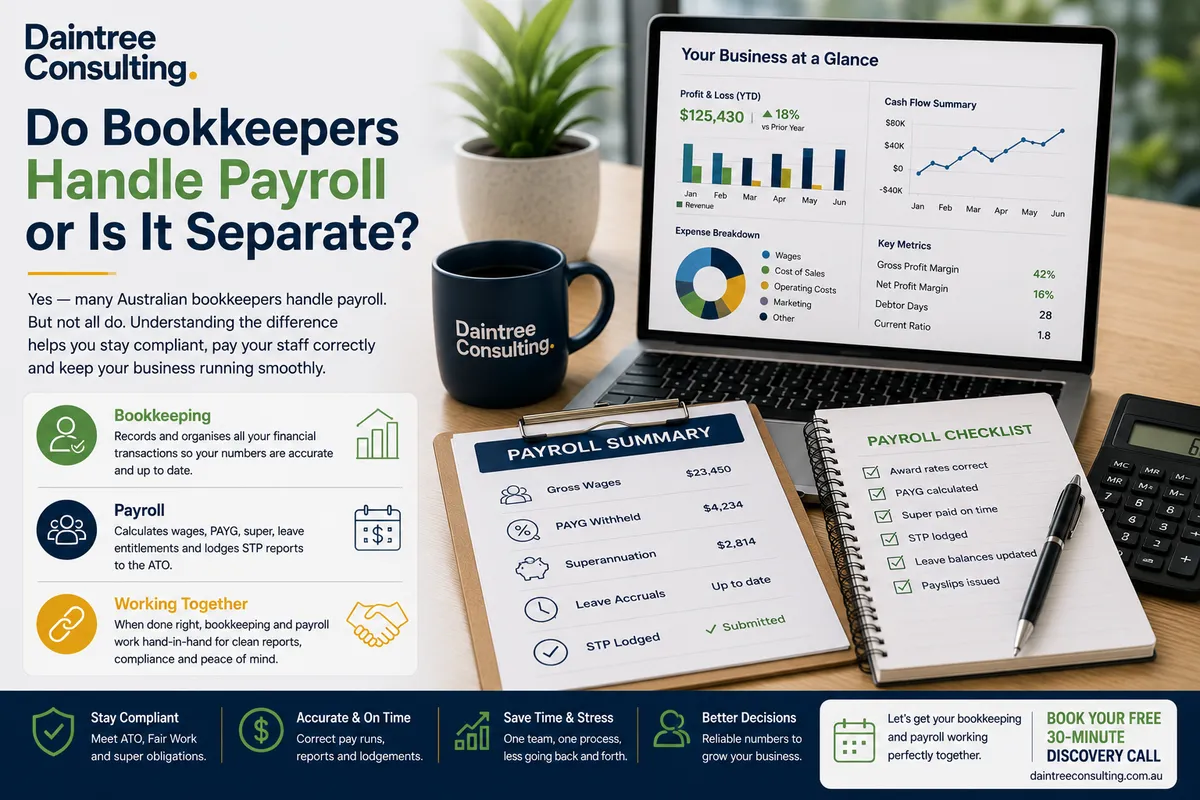
Do Bookkeepers Handle Payroll or Is It Separate?
Yes — many Australian bookkeepers handle payroll. But it is not automatic, and treating the two as identical can create real compliance risk.
Payroll is a specialised subset of financial administration. Bookkeeping is the broader process of recording and organising all business transactions. When a bookkeeper also runs payroll, they must understand awards, Superannuation Guarantee, Single Touch Payroll (STP), leave accruals, and PAYG withholding. Not every bookkeeper offers this, and not every business should combine the two.
Want expert help? Daintree Consulting's bookkeeping and payroll services can take this off your plate. Book a free consultation.
This guide explains exactly where the lines sit in Australia in 2026, when it makes sense to keep payroll inside bookkeeping, and when separation (or specialist support) is the smarter move.
Quick Answer
Can a bookkeeper process payroll?
Yes. Many Australian bookkeepers offer payroll processing as part of their services. However, payroll is not automatically included in every bookkeeping package.
Is payroll automatically included in bookkeeping?
No. Payroll is often offered as a separate service or add-on, depending on the provider, number of employees and complexity of the payroll.
What is required to handle payroll properly?
A provider handling payroll should understand relevant awards, Single Touch Payroll (STP), superannuation, PAYG withholding, leave entitlements and payroll reporting requirements.
What is the best approach for most SMEs?
For many small and medium-sized businesses, using one experienced provider for both bookkeeping and payroll can reduce handovers, improve consistency and simplify financial administration.
The key point: bookkeeping and payroll are closely connected, but they are not the same service. Make sure your provider has the specific payroll expertise your business requires.
What Bookkeeping Actually Covers
Bookkeeping is the day-to-day recording and organisation of your financial transactions. Typical tasks include:
Recording sales, purchases, expenses and receipts
Bank and credit card reconciliations
Accounts payable and receivable management
Coding GST correctly
Preparing management reports (profit & loss, balance sheet)
Preparing data for BAS and year-end tax
A registered BAS Agent can also prepare and lodge your Business Activity Statements. That registration is separate from payroll capability.
What Payroll Specifically Involves
Payroll is narrower and more compliance-heavy. It includes:
Calculating gross pay (including overtime, loadings, allowances)
Applying the correct award or enterprise agreement rates
Calculating and withholding PAYG tax
Calculating Superannuation Guarantee (currently 12%)
Tracking and accruing leave entitlements
Generating payslips
Lodging Single Touch Payroll (STP) reports to the ATO after every pay run
Paying super to the correct funds on time (Payday Super rules apply)
Handling terminations, final pays and payment summaries
Errors here attract Fair Work underpayment claims, ATO penalties, and Super Guarantee Charge liabilities. That is why some bookkeepers deliberately stay away from payroll.
Can a Bookkeeper Legally Handle Payroll in Australia?
Yes. There is no separate “payroll licence” required in the same way BAS Agent registration is required for paid BAS work. However:
The bookkeeper must understand current employment law and awards
They must lodge STP correctly
Super must be paid on time under the new Payday Super rules
Records must be kept accurately for Fair Work and ATO purposes
Many professional bookkeepers (especially those who are members of the Institute of Certified Bookkeepers or Australian Bookkeepers Network) routinely offer payroll as part of their service. Others focus only on general ledger work and refer payroll out.
When It Makes Sense to Combine Bookkeeping and Payroll
For most small and medium businesses, combining the two is more efficient and lower risk:
Payroll figures flow straight into the general ledger
One person (or team) owns the numbers end-to-end
Super, PAYG and leave balances stay consistent with the books
You deal with one provider instead of two
Month-end reporting is cleaner and faster
This integrated model works especially well when your payroll is relatively straightforward (standard awards, limited allowances, fewer than 20–30 staff).
When Separation Can Be Better
Consider keeping payroll separate (or using a specialist payroll bureau) if:
You have complex awards, multiple enterprise agreements, or rostering complications
You operate across multiple states with different long-service leave rules
You have high staff turnover or frequent casual conversions
Your current bookkeeper is strong on general ledger work but admits limited payroll depth
You want an independent check on payroll calculations
In these cases, a specialist payroll provider can feed clean data into your bookkeeper’s system.
Common Risks of Getting It Wrong
Businesses that treat payroll as “just another bookkeeping task” without checking capability often face:
Incorrect award interpretation leading to underpayments
Missed or late super contributions
STP lodgement errors that trigger ATO attention
Leave balances that do not match actual entitlements
Year-end adjustments that delay tax returns
The cost of fixing these issues almost always exceeds the modest extra fee of using a properly equipped provider from the start.
How Daintree Handles Bookkeeping and Payroll
At Daintree Consulting we treat bookkeeping and payroll as connected but distinct capabilities. Our team includes registered BAS Agents and experienced payroll processors who work inside the same integrated finance function.
Clients typically receive:
Accurate day-to-day bookkeeping
Compliant payroll processing (including STP and super)
Clean monthly reporting
A clear path to management reporting or outsourced CFO support as the business grows
We are Brisbane-based, CPA and CA led, and support businesses Australia-wide. The goal is simple: reliable numbers and compliant payroll without the owner having to become the expert.
Ready to Clarify Your Current Setup?
If you are unsure whether your current bookkeeper is properly equipped for payroll, or whether your payroll is creating hidden risk in the books, the fastest way to find out is a short conversation.
Book a free 30-minute discovery call. We will look at how your bookkeeping and payroll currently work and identify any gaps — with no pressure and no obligation.
Frequently Asked Questions
Do all bookkeepers handle payroll?
No. Many do, especially those who specialise in small business support, but it is not automatic. Always ask specifically about payroll experience, awards knowledge, and STP processes.
Is payroll included in a standard bookkeeping package?
Often it is listed as an add-on or included only up to a certain number of employees. Clarify the scope before engaging.
Can a bookkeeper lodge Single Touch Payroll?
Yes, provided they have the correct software access and understand the reporting requirements. Most professional bookkeepers who offer payroll do this as standard.
What is the difference between a bookkeeper and a payroll specialist?
A bookkeeper manages the full set of financial records. A payroll specialist focuses only on employee payments, entitlements and related compliance. Some people do both; others specialise in one.
Should I use the same provider for bookkeeping and payroll?
For most SMEs the answer is yes — it reduces handovers, improves accuracy, and usually costs less overall. Separation only becomes preferable with high complexity or specialised needs.
Does Daintree offer both bookkeeping and payroll?
Yes. We provide integrated bookkeeping and payroll support as part of our outsourced finance services for Australian businesses.
Talk to Daintree about your bookkeeping and payroll
Our ex-Big 4 team gives clear, senior-reviewed advice so you can act with confidence.
Book a free consultation →
Or explore our bookkeeping and payroll services.
