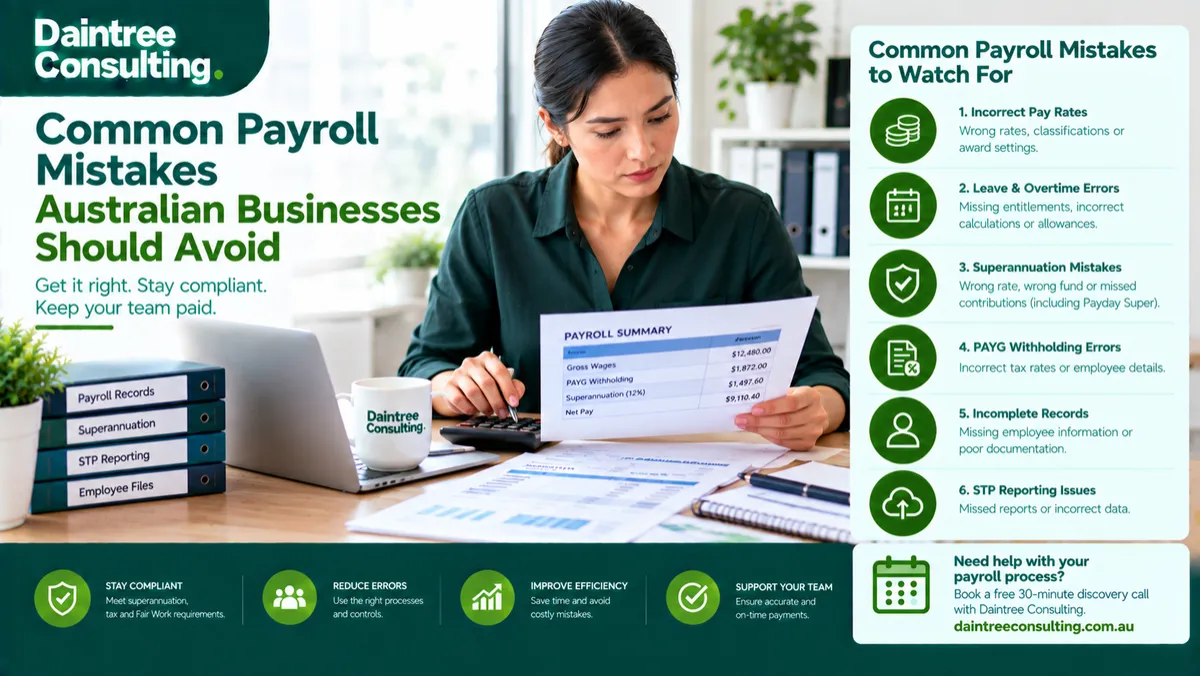
Common Payroll Mistakes Australian Businesses Should Avoid
Payroll is one of those business processes where small mistakes can become expensive problems.
An incorrect pay rate, missed allowance, wrong super contribution or poorly maintained employee record can affect employees, tax reporting, cash flow and compliance.
Want expert help? Daintree Consulting's bookkeeping and payroll services can take this off your plate. Book a free consultation.
For Australian businesses, payroll has become even more important to manage carefully following the introduction of Payday Super from 1 July 2026. Employers now need to pay superannuation contributions on payday, with contributions generally required to reach employees' super funds within 7 business days, subject to applicable exceptions.
That means payroll is no longer simply a matter of calculating wages and transferring money to employees.
It involves coordinating:
Employee information
Hours worked
Pay rates
Awards and entitlements
Leave
PAYG withholding
Superannuation
Pay slips
Single Touch Payroll reporting
Record keeping
Payroll accounting
Super payment processes
End-of-year reporting
The good news is that many payroll mistakes are preventable.
A consistent payroll process, appropriate software and regular review can help businesses reduce errors and keep their payroll records organised.
Quick answer: What are common payroll mistakes?
Some of the most common payroll mistakes Australian businesses should watch for include:
Using the wrong employee pay rate.
Applying the wrong award or classification.
Missing overtime, penalty rates or allowances.
Incorrectly calculating leave.
Paying superannuation incorrectly.
Sending super to the wrong fund.
Failing to adapt payroll processes for Payday Super.
Making errors in PAYG withholding.
Providing incorrect or incomplete pay slips.
Missing or inaccurate Single Touch Payroll reporting.
Failing to keep required employee records.
Misclassifying employees or contractors.
Making unauthorised deductions.
Failing to reconcile payroll to the accounting system.
Not reviewing payroll reports before payments are finalised.
The exact requirements depend on the business, employees, awards, agreements and other circumstances.
1. Using the wrong employee pay rate
One of the most basic payroll mistakes is paying an employee at the wrong rate.
This can happen when:
An employee receives a pay increase
An employee changes classification
An employee moves from casual to permanent employment
An award rate changes
An employment agreement changes
A new employee is entered incorrectly into payroll software
A payroll system can calculate the numbers correctly while still producing the wrong result if the underlying employee information is incorrect.
That is why payroll reviews should not focus only on whether the software processed the pay run successfully.
The business also needs to confirm that the inputs are correct.
2. Applying the wrong award or classification
Australian workplace awards can contain detailed requirements covering minimum rates, ordinary hours, overtime, penalty rates, allowances and other entitlements.
A common payroll problem occurs when an employee is assigned the wrong award or classification.
For example, two employees performing similar roles may have different classifications because of their responsibilities, experience or applicable industrial instrument.
If the classification is wrong, other payroll calculations may also be affected.
Businesses should therefore review the applicable award or agreement rather than assuming that a generic hourly rate is sufficient.
3. Missing overtime and penalty rates
Employees may be entitled to additional payments depending on when and how they work.
This can include:
Overtime
Weekend penalty rates
Public holiday rates
Shift penalties
Other award-based payments
Payroll mistakes can occur when timesheets or rosters are not properly connected to the payroll process.
For example, an employee may work additional hours that were recorded by a manager but never transferred into the payroll system.
A good process should make it clear:
Hours worked → approved timesheet → payroll calculation → payroll review → payment
The more manual steps involved, the more important the review process becomes.
4. Missing allowances
Allowances are another area where payroll errors can occur.
Depending on the employee's circumstances and applicable award or agreement, an employee may receive allowances related to things such as:
Travel
Meals
Tools
Uniforms
Working conditions
Other employment-related expenses
Not every allowance applies to every employee.
The important point is that businesses should understand which allowances apply and make sure payroll processes capture them correctly.
5. Incorrect leave calculations
Leave can create payroll complexity because different types of leave can have different rules.
Businesses may need to account for:
Annual leave
Personal/carer's leave
Compassionate leave
Long service leave
Parental leave
Family and domestic violence leave
Other applicable leave arrangements
Errors can occur when:
Leave balances are not updated
Leave is entered under the wrong category
Employees are paid incorrectly while on leave
Historical leave balances are imported incorrectly
Payroll software settings are not reviewed after an employee changes employment conditions
Leave records should be reconciled regularly rather than relying entirely on the payroll system to identify discrepancies.
6. Getting superannuation wrong
Superannuation is one of the most important areas of payroll compliance.
The super guarantee rate increased to 12% from 1 July 2025.
But calculating the correct percentage is only part of the process.
Businesses also need to consider:
Which workers are eligible
What earnings are subject to super
Which fund should receive the contribution
Whether employee fund details are correct
Whether contributions have been successfully processed
Whether contributions reach the fund within the required timeframe
The ATO recommends checking worker eligibility, fund details, contribution amounts and payment timing as part of a basic super compliance process.
7. Not adapting to Payday Super
This is particularly important for Australian businesses now.
From 1 July 2026, Payday Super changed the timing of superannuation payments.
Instead of generally paying super quarterly, employers must pay super each payday, with contributions generally required to be received by the employee's super fund within 7 business days after payday.
This means businesses need payroll processes that can handle more frequent super payments.
A payroll process designed around quarterly super payments may no longer be appropriate.
Businesses should review:
Payroll software configuration
Super payment processes
Employee fund details
Super contribution calculations
Payment timing
Error handling
STP reporting
Reconciliation procedures
The ATO also advises employers to use a SuperStream-compliant method and ensure their systems are ready to process the new requirements.
8. Paying super to the wrong fund
Even if the contribution amount is correct, the payment can still create a problem if it goes to the wrong fund.
Employee fund details need to be maintained accurately.
Potential problems include:
Incorrect fund details
Incorrect member numbers
Outdated employee information
Rejected contributions
Contributions being returned
Incorrect employee matching
The ATO's Payday Super guidance specifically highlights the importance of addressing rejected contributions and correcting employee or fund information quickly.
This is another reason businesses should not treat the super payment process as something that can simply run in the background without review.
9. Getting PAYG withholding wrong
Payroll also involves withholding tax from employee payments.
Errors can occur when:
Employee tax file number information is incorrect
Tax declaration information is entered incorrectly
Payroll settings are wrong
Bonuses are processed incorrectly
Termination payments are entered incorrectly
Payroll software is not configured properly
PAYG withholding information also feeds into the business's broader reporting obligations.
A payroll process should therefore include checks that compare payroll calculations with the business's accounting and reporting records.
10. Providing incorrect pay slips
Pay slips are not simply an administrative courtesy.
Australian employers generally need to provide employees with a pay slip within one working day of payday. Pay slips need to contain prescribed information about the employee's pay, deductions and superannuation where relevant.
Common problems can include:
Missing employee details
Incorrect pay period
Incorrect gross or net pay
Missing hours or rates
Missing allowances
Incorrect deductions
Incorrect super information
Businesses should have a process for checking pay slip information when payroll settings or employee details change.
11. Not keeping proper employee records
Payroll records need to be accurate and accessible.
The Fair Work Ombudsman states that employers must keep time and wages records for 7 years. Records need to be clear, accessible and accurate.
Records can include information about:
Employee details
Pay
Hours worked
Overtime
Leave
Superannuation
Termination
Other relevant employment matters
Poor record keeping can make it much harder to investigate a payroll discrepancy.
It can also make responding to employee queries or regulatory requests more difficult.
12. Treating payroll software as a substitute for payroll controls
Modern payroll systems can automate a significant amount of payroll processing.
But automation does not eliminate the need for review.
Payroll software can process incorrect information perfectly.
For example, if an employee is entered with:
The wrong pay rate
The wrong classification
The wrong super fund
Incorrect hours
Incorrect leave settings
the system may calculate the payroll accurately based on those incorrect inputs.
A strong payroll process therefore combines automation with appropriate controls.
13. Failing to reconcile payroll to the accounting records
Payroll should not exist separately from the accounting system.
The payroll records should be reconciled to the business's financial accounts.
This can include checking:
Gross wages
PAYG withholding
Superannuation
Leave liabilities
Payroll-related expenses
Net wages
Payroll clearing accounts
A reconciliation can identify differences between what the payroll system says was processed and what has been recorded in the general ledger.
For example, if payroll reports show $85,000 in gross wages but the accounting system records $81,500, the difference needs to be understood.
It could be caused by:
Timing
A journal entry
Incorrect coding
Duplicate processing
An omitted payroll transaction
The important thing is not to leave the difference unexplained.
14. Not reviewing payroll before finalising it
A payroll run should have an appropriate review process.
Before approving payroll, a business may review:
Total payroll
Employee count
Gross wages
Net wages
PAYG withholding
Super liability
Overtime
Allowances
Leave payments
Large changes from the previous pay period
New employees
Departing employees
Bank payment amounts
A simple variance review can be particularly useful.
If payroll was normally $120,000 per fortnight and suddenly becomes $165,000, someone should investigate why.
There may be a legitimate reason.
But the difference should be explainable before payment is finalised.
15. Not reviewing new employees carefully
New employees can introduce several payroll risks at once.
Before the first pay run, businesses should ensure the payroll record contains the appropriate information.
This can include:
Correct name
Employment type
Start date
Pay rate
Award or agreement information
Tax information
Super fund details
Bank details
Leave settings
Relevant payroll categories
An error made during employee setup can continue affecting every subsequent pay run until someone identifies it.
A new-starter checklist can therefore prevent repeated payroll errors.
16. Not updating employee changes
Payroll information needs to change when an employee's circumstances change.
Examples include:
Pay increase
Promotion
Classification change
Change in hours
Change from casual to permanent
Change in bank details
Change in super fund
Extended leave
Termination
A business may have a correct employment agreement but still pay the wrong amount if the payroll system was never updated.
A simple process should connect HR or management changes with payroll updates.
17. Making incorrect deductions
Employers cannot simply deduct any amount they want from an employee's wages.
Fair Work guidance explains that deductions generally need to meet specific requirements, such as being authorised by law, a court or commission order, an applicable award/agreement, or being genuinely agreed to in writing in circumstances permitted by the rules.
This means businesses should be particularly careful with deductions for:
Equipment
Loans
Overpayments
Salary sacrifice
Other employee-related arrangements
A payroll deduction should have an appropriate basis and supporting documentation.
18. Misclassifying employees and contractors
The distinction between an employee and an independent contractor can affect payroll and superannuation obligations.
A business should not assume that a worker is a contractor simply because:
They have an ABN
They submit invoices
They work remotely
Their contract calls them a contractor
The actual working arrangement matters.
The ATO also notes that certain contractors paid mainly for their labour can have superannuation obligations.
This means worker classification should be reviewed carefully rather than treated as a payroll administration decision alone.
19. Missing Single Touch Payroll reporting issues
Single Touch Payroll (STP) allows employers to report payroll information to the ATO through payroll software.
STP reporting covers information including salaries and wages, PAYG withholding and superannuation information.
Payroll problems can arise when:
A report is missed
Employee details are incorrect
Payroll categories are mapped incorrectly
Duplicate employee records exist
Corrections are not properly processed
Year-to-date figures do not reconcile
Businesses should therefore include STP checks within their broader payroll review process.
20. Not updating payroll processes after regulatory changes
Payroll requirements can change.
The introduction of Payday Super is a major recent example.
A business that continues using an old payroll process without reviewing its settings can create unnecessary risks.
When requirements change, businesses should consider whether they need to update:
Payroll software
Employee records
Payment processes
Super processes
Reporting settings
Internal checklists
Reconciliation procedures
Staff responsibilities
The ATO has specifically advised businesses to ensure payroll systems and processes are prepared for Payday Super and the related STP reporting changes.
21. Forgetting to reconcile super payments
Under Payday Super, superannuation transactions occur more frequently.
That makes reconciliation increasingly important.
Businesses should be able to determine:
How much super was calculated
How much was paid
Which employees the payments relate to
Which funds received the contributions
Whether any payments were rejected
Whether any payments remain outstanding
If a contribution fails, the problem should be identified and corrected promptly.
The ATO's first-year Payday Super guidance specifically encourages employers to fix mistakes quickly and keep records of what happened and how the error was corrected.
22. Relying on manual spreadsheets without controls
Spreadsheets can be useful for payroll analysis and checking.
However, payroll becomes increasingly difficult to control when critical calculations are spread across multiple disconnected spreadsheets.
Risks can include:
Incorrect formulas
Outdated employee information
Duplicate versions
Manual data entry
Missing changes
Unclear responsibility
Poor audit trails
If spreadsheets are part of the payroll process, businesses should make sure there are appropriate controls over who can edit them and how changes are reviewed.
What does a good payroll process look like?
A reliable payroll process does not have to be complicated.
A basic workflow could look like:
1. Maintain employee information
Keep employment, pay and super information current.
2. Capture hours and leave
Use approved timesheets, rosters or other appropriate records.
3. Process payroll
Calculate wages, withholding, super and other applicable amounts.
4. Review payroll
Check totals, unusual changes and employee-specific issues.
5. Pay employees
Make sure payment information is correct.
6. Provide pay slips
Issue pay slips within the required timeframe.
7. Process super
Ensure contributions are calculated, paid and received within the applicable timeframe.
8. Complete STP reporting
Check that payroll information is reported correctly.
9. Reconcile
Compare payroll records with the accounting system and payment records.
10. Retain records
Keep appropriate payroll and employment records securely.
This structure creates multiple opportunities to identify errors before they become larger problems.
How can Australian businesses reduce payroll mistakes?
The best payroll process is usually one that is consistent.
Businesses can reduce payroll mistakes by:
Use a payroll checklist
A checklist can make sure key steps are completed every pay cycle.
Restrict payroll access
Only authorised staff should be able to change sensitive employee or payroll information.
Review employee changes
Pay increases, new employees and terminations should receive additional attention.
Reconcile regularly
Do not wait until year-end to identify payroll discrepancies.
Review unusual movements
Compare payroll to previous periods and investigate significant unexplained changes.
Keep supporting records
Retain timesheets, leave approvals and other payroll documentation.
Monitor super payments
Payday Super means businesses need to monitor super payment processes more frequently.
Keep software current
Make sure payroll software supports current reporting and payment requirements.
Have someone review payroll
Where practical, separate payroll preparation from final approval.
Payroll mistakes can affect more than payroll
A payroll error does not necessarily stop with an employee's pay.
Payroll information flows into other areas of the business.
Errors can affect:
Financial statements
Cash flow
PAYG withholding
Superannuation
Leave liabilities
Management reporting
BAS-related information
STP reporting
Year-end accounting
Employee records
This is why payroll should be treated as part of the broader accounting process.
Accurate payroll records help create more reliable financial information across the business.
When should a business consider outsourcing payroll?
Payroll outsourcing may make sense when:
Payroll takes too much internal time
The business has a growing number of employees
Payroll errors are becoming more frequent
Internal staff lack payroll experience
Award interpretation is becoming difficult
Super processes are becoming more complex
Payroll is dependent on one employee
Management wants stronger payroll controls
The business needs better payroll-to-accounting reconciliation
Internal payroll responsibilities are distracting staff from other work
Outsourcing does not remove the employer's responsibilities.
However, it can provide access to payroll processes, systems and specialist support without requiring the business to manage every payroll task internally.
How Daintree can help with payroll
Payroll is closely connected to bookkeeping, accounting and financial reporting.
Daintree Consulting can support Australian businesses with bookkeeping and payroll processes designed to keep financial records organised and payroll information properly integrated with the broader accounting function.
Support can include:
Payroll processing
Superannuation processing
Payroll reconciliations
Employee record support
Accounts payable and receivable
Bank reconciliations
Month-end close
BAS-ready bookkeeping
Coordination with accounting and tax work
Payroll reporting and financial records
The exact support depends on the business's payroll structure, systems and requirements.
Need help reducing payroll mistakes?
If payroll is taking too much time, errors are becoming difficult to manage, or your business needs a more reliable payroll process, Daintree Consulting can help.
Book a free 30-minute discovery call to discuss your bookkeeping and payroll requirements.
Frequently Asked Questions
What are the most common payroll mistakes?
Common payroll mistakes include incorrect pay rates, missed overtime or allowances, incorrect leave calculations, superannuation errors, PAYG withholding errors, incorrect pay slips, poor record keeping, STP reporting issues and payroll-to-accounting reconciliation problems.
How can businesses prevent payroll mistakes?
A consistent payroll process, accurate employee records, appropriate software, regular reconciliations and an independent review of payroll before payment can help reduce mistakes.
How often should payroll be checked?
Payroll should generally be reviewed during every pay cycle, with additional periodic reconciliations to the accounting records and other supporting information.
What payroll records do Australian businesses need to keep?
Employers need to keep appropriate employment records, including information about pay, hours worked, leave and other prescribed matters. Fair Work states that time and wages records generally need to be kept for 7 years.
When do employers need to provide pay slips?
Pay slips generally need to be provided within one working day of payday.
What is Payday Super?
Payday Super is the superannuation payment reform that started on 1 July 2026. Employers generally need to pay super each payday, with contributions generally required to reach the employee's super fund within 7 business days, subject to applicable exceptions.
What is the current super guarantee rate?
The super guarantee rate is 12% from 1 July 2025, subject to the applicable rules about eligibility and earnings.
Does payroll need to be reconciled with accounting records?
Yes. Reconciling payroll with the accounting records can help identify differences in wages, PAYG withholding, superannuation, leave liabilities and other payroll-related balances.
Can payroll be outsourced?
Yes. Businesses can outsource some or all payroll functions depending on their requirements. However, the employer remains responsible for meeting its applicable obligations.
What should I do if I discover a payroll mistake?
Investigate the error promptly, determine who was affected and correct the payroll records and payments as appropriate. Keep a record of what happened and how the error was corrected. For regulatory or employee entitlement issues, consider obtaining appropriate professional advice.
Talk to Daintree about your bookkeeping and payroll
Our ex-Big 4 team gives clear, senior-reviewed advice so you can act with confidence.
Book a free consultation →
Or explore our bookkeeping and payroll services.
