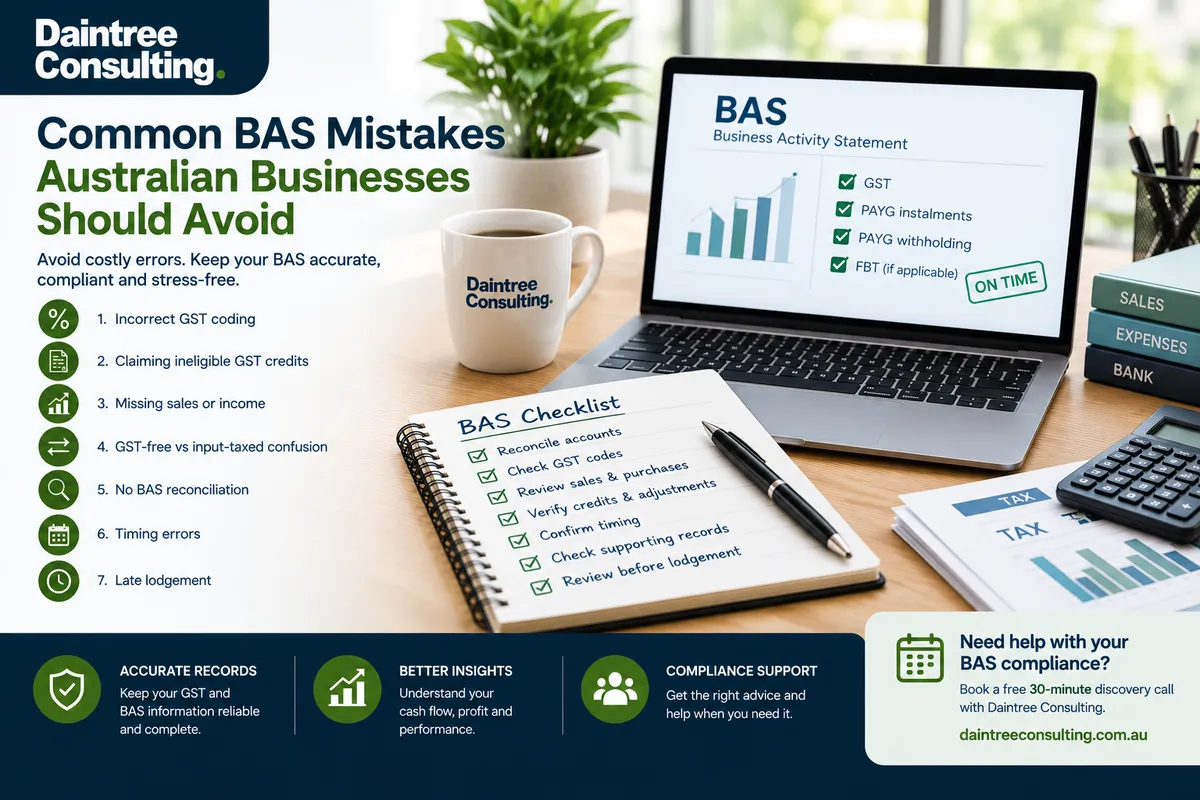
Common BAS Mistakes Australian Businesses Should Avoid
A Business Activity Statement (BAS) is one of those business responsibilities that can feel routine—until something goes wrong.
You reconcile the accounts, review the numbers, lodge the BAS and move on.
Want expert help? Daintree Consulting's tax and BAS services can take this off your plate. Book a free consultation.
But small errors in the underlying bookkeeping can flow through to your BAS. A transaction can be coded incorrectly, GST can be claimed where it should not be, sales can be omitted, an adjustment can be handled incorrectly, or the BAS can simply be lodged late.
The problem is that BAS mistakes are not always obvious when they happen.
The Australian Taxation Office has identified risks including incorrectly classified transactions, incomplete GST data, manual processing errors, transactions missing from source reports and late BAS lodgement. The ATO has also highlighted incorrect reporting of GST-free supplies, input-taxed supplies, related-party transactions and exports as areas where errors can occur.
For Australian businesses, the answer is not simply to "be more careful".
A better approach is to have a consistent process for recording, reconciling, reviewing and lodging your BAS.
This guide explains the most common BAS mistakes businesses should watch for—and what you can do to reduce the risk of repeating them.
Quick Answer: What Are the Most Common BAS Mistakes?
Common BAS mistakes Australian businesses should avoid include:
Using incorrect GST codes
Claiming GST credits on purchases that are not eligible
Failing to record all sales or income correctly
Confusing GST-free and input-taxed transactions
Not reconciling the BAS to the accounting records
Getting the timing of transactions or adjustments wrong
Lodging the BAS late
Failing to keep adequate supporting records
Relying on accounting software without reviewing the data
Not correcting errors when they are discovered
Not every error has the same consequences, and the correct way to fix a BAS error depends on the circumstances.
The ATO distinguishes between a mistake—where an amount was incorrect when it was originally reported—and an adjustment, where the original reporting was correct but something subsequently changed.
That distinction is important when deciding how an issue should be corrected.
1. Using the Wrong GST Code
One of the most common sources of BAS problems starts well before the BAS itself is prepared.
It starts when transactions are entered into the accounting system.
If a transaction is assigned the wrong GST treatment, the resulting BAS figures may also be wrong.
For example, a business may incorrectly treat a transaction as:
GST-inclusive when it is not
GST-free when GST actually applies
subject to GST when it should not be
eligible for a GST credit when it is not
outside the scope of GST when it should be reported
This is why BAS accuracy depends heavily on the quality of the underlying bookkeeping.
Don't assume every transaction gets the same GST treatment
Businesses can have different types of transactions, and the GST treatment can depend on what is being supplied or purchased and the circumstances involved.
This becomes particularly important for businesses with:
mixed products or services
exports
property transactions
related-party transactions
employee-related expenses
private-use components
financial supplies
GST-free activities
The ATO has specifically identified incorrect classification of supplies and acquisitions as a GST risk.
How to reduce the risk
Use consistent GST coding in your accounting system and review unusual or significant transactions rather than assuming the software has automatically selected the correct treatment.
2. Claiming GST Credits on Ineligible Purchases
Another common BAS mistake is assuming:
"We paid GST, so we can claim it back."
That's not always the case.
Whether a business can claim a GST credit depends on the circumstances and the nature of the purchase.
For example, you may need to consider:
whether the purchase relates to making taxable supplies
whether GST was actually included
whether the business has appropriate supporting documentation
whether there is a private or non-business component
whether special rules apply to the transaction
The risk increases when bookkeeping is done quickly without reviewing unusual expenses.
A simple example
Imagine a business owner sees an expense for $1,100 and assumes it includes $100 GST.
If the transaction does not actually qualify for the expected GST treatment, that assumption could result in an incorrect BAS claim.
The lesson is simple:
Don't calculate GST based solely on the amount paid.
The underlying transaction needs to be considered.
3. Failing to Record All Sales Correctly
BAS preparation depends on having a complete picture of business activity.
If sales are missing from the accounting records, the BAS may also be understated.
This can happen when a business:
relies on multiple sales systems
receives payments through different platforms
has manual invoices
operates a POS system separately from its accounting software
records transactions in spreadsheets
forgets to enter certain invoices
incorrectly handles refunds or credits
The ATO has identified situations where source reports do not include all relevant GST transactions as a BAS compilation risk.
The danger of disconnected systems
Suppose a business uses:
one system for invoicing
another for online payments
another for bookkeeping
a separate bank account
If those systems aren't reconciled properly, transactions can be missed or duplicated.
That creates a BAS problem even though each individual system appears to be working.
4. Confusing GST-Free and Input-Taxed Transactions
This is an area where businesses can easily make assumptions.
GST-free and input-taxed are not simply two different ways of saying "no GST".
They have different GST consequences.
For GST-free supplies, GST is generally not charged to the customer, but eligible related purchases may still allow GST credits.
For input-taxed supplies, GST is generally not charged, and GST credits relating to making those supplies are generally restricted.
The exact treatment depends on the transaction and circumstances.
The ATO has specifically identified incorrect reporting of input-taxed supplies and GST-free items among the types of BAS errors it encounters.
Why this matters
If your business operates in an industry with GST-free or input-taxed transactions, incorrect coding can affect both sides of the GST calculation.
This is why businesses should not rely on a generic "GST-free" code without understanding why the transaction is GST-free and whether the correct accounting treatment has been applied.
5. Not Reconciling Your BAS to the Accounting Records
This is one of the biggest process mistakes.
A business should not simply look at the BAS figures and ask:
"Do these numbers look about right?"
A better question is:
"Can we reconcile these figures back to our underlying accounting records?"
A BAS review should ideally involve checking whether:
sales agree with the accounting records
GST collected makes sense
GST credits claimed are supported
relevant accounts have been reconciled
unusual movements have been investigated
previous-period issues have been addressed
the BAS period is correct
The ATO has identified discrepancies between BAS reporting and other financial information as an area of concern in its compliance work.
Why reconciliation matters
Suppose your BAS reports significantly more sales than your income tax records later show.
That discrepancy may trigger questions.
It does not automatically mean something is wrong—different reporting requirements and accounting treatments can produce differences—but significant unexplained discrepancies should be investigated.
A proper reconciliation helps identify those issues earlier.
6. Getting Transaction Timing Wrong
GST reporting depends partly on when transactions are attributed.
This means a transaction can sometimes appear in a different reporting period depending on the accounting method and circumstances.
Timing can become particularly important around:
invoices
payments
credit notes
refunds
deposits
asset purchases
adjustments
end-of-period transactions
If transactions are entered late or assigned to the wrong period, the BAS may not accurately reflect the activity for that reporting period.
Why this happens
Common causes include:
delayed bookkeeping
invoices entered after period end
bank feeds not reconciled
manual journals
incorrect accounting dates
backdated transactions
misunderstanding cash versus accrual accounting
The ATO identifies transactions processed after BAS source reports have been run as a potential BAS compilation risk because those transactions may not be included in the reported figures.
This is one reason why a proper BAS cut-off process matters.
7. Treating Accounting Software as a Substitute for Review
Cloud accounting software can make bookkeeping and BAS preparation much easier.
But software doesn't automatically understand every business transaction.
It works from:
the settings you establish
the GST codes you select
the transactions entered
the rules and integrations configured
the information provided to it
If the underlying data is wrong, the software can produce a very polished-looking wrong answer.
Automation is useful—but review still matters
A good system can:
import bank transactions
apply recurring rules
generate reports
calculate GST information
reduce manual data entry
improve collaboration
create audit trails
But someone still needs to review the results.
The ATO's BAS risk guidance specifically identifies manual manipulation, incorrect source reports and classification errors as risks in BAS preparation.
The goal should be automation plus oversight, not automation instead of oversight.
8. Missing the BAS Lodgement or Payment Deadline
This one sounds obvious.
But it happens.
Businesses get busy.
The bookkeeper is waiting for information.
The owner is travelling.
The accounts aren't reconciled.
An employee leaves.
A BAS is sitting in an inbox.
Then the deadline passes.
Late lodgement can create unnecessary compliance problems and may result in penalties or other consequences depending on the circumstances.
The ATO identifies late BAS lodgement as one of the risks associated with ineffective BAS processes.
Don't rely on memory
A better process includes:
knowing the business's reporting obligations
keeping deadlines visible
having a responsible person assigned
starting preparation early
allowing time to resolve questions
reviewing the BAS before authorisation
confirming lodgement and payment
Daintree's current BAS service focuses on completing BAS and tax work to an agreed timetable, with visibility of upcoming obligations and clean supporting records.
9. Lodging the BAS Without Reviewing Unusual Numbers
A BAS can technically be completed while still containing a number that deserves further investigation.
For example:
sales suddenly double
GST credits fall dramatically
GST payable changes significantly
a major expense appears for the first time
a particular account has an unexpected balance
a previous GST code has been changed
one reporting period looks very different from the others
These aren't necessarily errors.
Businesses naturally have unusual months.
The issue is failing to ask why.
A simple BAS review question
Before lodging, ask:
"What changed this period?"
Then investigate significant movements.
The ATO's GST compliance material emphasises the importance of governance and controls that detect and remediate errors regularly because transaction-level GST errors can compound over time.
10. Not Keeping Supporting Records
Your BAS should not exist as a standalone document.
The figures reported should be supported by appropriate accounting records.
Depending on the transaction and circumstances, supporting records can include:
Tax invoices
Purchase invoices
Sales invoices
Receipts
Bank statements
Credit notes
Contracts
Import/export documentation
Accounting system records
Other relevant evidence
If the ATO asks how a particular figure was calculated, you should be able to trace it back through your accounting records.
Good records make BAS preparation easier
Good record keeping is not just about surviving an audit.
It can also make routine BAS preparation faster because the information is already organised.
Daintree's taxation and BAS service specifically emphasises clean supporting records and reconciliations as part of its compliance process.
11. Forgetting About One-Off Transactions
Businesses often have strong processes for their normal transactions.
The problems sometimes arise from transactions that happen only once.
For example:
buying or selling a major asset
acquiring a business
selling business equipment
restructuring
entering a property transaction
dealing with an unusual supplier
making a related-party transaction
receiving an unusual payment
exporting goods or services
Because these transactions don't happen regularly, the business may not have a standard process for handling them.
The ATO has observed errors involving one-off transactions outside taxpayers' core business activities.
The lesson
If a transaction is unusual or significant, don't automatically code it like the transactions you process every week.
Stop and check the GST treatment.
12. Making BAS Corrections Without Understanding the Difference Between a Mistake and an Adjustment
Discovering a BAS problem doesn't necessarily mean you simply change the next BAS.
The correct treatment depends on what happened.
The ATO distinguishes between:
A mistake:
An amount was incorrect when it was originally reported.
An adjustment:
The original sale or purchase was correctly reported at the time, but something happened later that changed the GST amount.
The way the issue is corrected can depend on the nature of the error, the reporting period, the amount involved and other circumstances.
Don't guess
If you discover an error in a previous BAS, review the ATO's current correction guidance or speak with your registered tax or BAS professional.
The worst response is to ignore the problem because you're unsure how to fix it.
Why Do BAS Mistakes Keep Happening?
Most BAS mistakes aren't caused by one dramatic failure.
They usually come from small process weaknesses.
For example:
The bookkeeping is completed late.
↓
Bank accounts aren't fully reconciled.
↓
Some transactions are coded incorrectly.
↓
The BAS is prepared from incomplete information.
↓
There isn't enough time for review.
↓
The BAS is lodged with an error.
The lesson is important:
BAS accuracy is a process issue, not just a BAS issue.
If the underlying accounting system is unreliable, preparing a better BAS becomes much harder.
How to Reduce BAS Mistakes
A strong BAS process doesn't have to be complicated.
It should be consistent.
Step 1: Keep bookkeeping current
Don't allow months of transactions to accumulate before reviewing the accounts.
Step 2: Reconcile bank accounts regularly
Make sure recorded transactions align with actual bank activity.
Step 3: Use appropriate GST codes
Review GST treatment rather than blindly accepting automated classifications.
Step 4: Review unusual transactions
Large, unusual or one-off transactions deserve additional attention.
Step 5: Reconcile BAS figures
Check the BAS against the underlying accounting records.
Step 6: Investigate significant movements
Ask why GST, sales or purchases have changed materially.
Step 7: Keep supporting documentation
Make sure reported figures can be substantiated.
Step 8: Start early
Give yourself time to resolve questions before the relevant deadline.
Step 9: Have a review process
Where appropriate, someone other than the person preparing the BAS can review the information before lodgement.
Step 10: Correct errors promptly
If something is wrong, determine the appropriate correction rather than leaving it unresolved.
A Simple BAS Review Checklist
Before your BAS is lodged, consider checking:
Sales
Have all relevant sales been recorded?
Do sales in the accounting system make sense compared with previous periods?
Are GST-free and other special categories correctly treated?
Purchases
Are major purchases recorded?
Are GST credits supported?
Have private or non-business components been considered?
Bank accounts
Are relevant bank accounts reconciled?
Are there unexplained transactions?
Are credit cards and other relevant accounts up to date?
GST
Are GST codes being used consistently?
Are unusual transactions reviewed?
Does the GST position look reasonable compared with previous periods?
BAS
Is the correct reporting period being used?
Do the BAS figures reconcile to the accounting records?
Has the BAS been reviewed before authorisation?
Is there enough time to address questions before lodgement?
Records
Are invoices and supporting documents available?
Can significant transactions be explained?
Are records stored in a way that makes them easy to retrieve?
This doesn't replace professional advice.
It simply creates a practical final review process.
What If Your Business Has Already Made a BAS Mistake?
Don't ignore it.
The first step is to identify exactly what happened.
Ask:
Which BAS was affected?
What transaction caused the issue?
Was the original amount incorrect when reported?
Did something happen later that changed the GST position?
Does the issue affect other reporting periods?
What supporting records are available?
Does the ATO's current correction guidance specify a particular process?
The ATO provides guidance on fixing BAS mistakes and making adjustments, including distinguishing between an error in a previously lodged BAS and a later adjustment.
If you're unsure, obtain professional advice rather than guessing.
BAS Mistakes Are Often a Symptom of a Bigger Accounting Problem
This is something business owners should pay attention to.
If BAS errors keep recurring, the problem may not be the BAS itself.
It may be:
inconsistent bookkeeping
poor GST coding
insufficient reconciliations
disconnected systems
unclear responsibilities
inadequate review procedures
late bookkeeping
poor record keeping
lack of management oversight
In other words, repeated BAS mistakes can be a signal that the business needs a stronger accounting and compliance process.
That is particularly important as a business grows.
The larger the transaction volume, the harder it becomes to fix everything manually at the end of the reporting period.
How Daintree Consulting Can Help With BAS Compliance
Daintree Consulting provides taxation and BAS compliance support for Australian businesses, including BAS preparation and lodgement support for GST, PAYG and FBT, alongside tax returns, tax planning and ATO correspondence support within the agreed engagement.
Its approach is built around connecting the records, obligations and reporting process.
That can include:
confirming entities and registrations
reviewing reporting obligations
collecting required information
reconciling supporting records
preparing BAS work
resolving material questions
reviewing and authorising the work
lodging through the appropriate process
Daintree can also coordinate BAS work with bookkeeping and accounting services, helping businesses avoid treating each financial task as a disconnected process.
For businesses experiencing recurring BAS problems, that connected approach can be more useful than simply fixing one incorrect BAS and moving on.
Final Thoughts: Good BAS Compliance Starts Before the BAS
The easiest BAS to prepare is usually the one supported by accurate, organised and reconciled accounting records.
The biggest mistake is to think of BAS preparation as a once-a-quarter form-filling exercise.
It isn't.
It's the end result of everything that happened beforehand:
Transactions → Bookkeeping → GST coding → Reconciliation → Review → BAS → Lodgement
If something goes wrong early in that chain, it can eventually appear in your BAS.
That is why businesses should focus on building a reliable process rather than simply trying to avoid individual mistakes.
If your BAS process regularly involves last-minute corrections, unexplained figures, missing records or stressful deadline pressure, it may be time to review the system behind the BAS.
Accurate records. Clear responsibilities. Timely review. Fewer surprises.
That's a much stronger foundation for Australian business compliance.
Frequently Asked Questions
What are the most common BAS mistakes?
Common BAS mistakes include incorrect GST coding, claiming GST credits incorrectly, missing sales, incorrectly treating GST-free or input-taxed transactions, failing to reconcile BAS figures, timing errors, inadequate records and late lodgement.
The ATO has identified incorrect classification, incomplete source data, manual processing and late lodgement among BAS-related risks.
What happens if I make a mistake on my BAS?
The appropriate correction depends on the type of error and the circumstances.
The ATO distinguishes between mistakes that existed when the BAS was originally lodged and adjustments arising from events that occurred after the original reporting was correct.
If you're unsure, check the ATO's current guidance or speak with a registered tax or BAS professional.
Can I correct a BAS mistake on my next BAS?
Sometimes, but not automatically.
Whether a correction can be made on a later BAS depends on factors including the nature and amount of the error and the applicable ATO rules. Don't assume every previous-period error can simply be added to the next BAS.
Why is my BAS different from my profit and loss report?
A BAS and profit and loss report serve different purposes and can contain different information.
Differences can arise because GST reporting and accounting reports use different treatments and timing, among other reasons.
However, significant unexplained discrepancies should be investigated rather than ignored. The ATO has identified discrepancies between BAS and income tax reporting as an area of compliance concern.
Does accounting software prevent BAS mistakes?
No.
Accounting software can reduce manual work and improve consistency, but it depends on correct transaction entry, GST coding, configuration and review.
Automation should support a good process rather than replace professional judgement and checking.
How often should I reconcile my accounts for BAS?
The appropriate frequency depends on the size, transaction volume and complexity of the business.
For many businesses, regular reconciliation throughout the reporting period is preferable to trying to reconcile everything immediately before the BAS is due.
What records should I keep for BAS?
Businesses should retain appropriate records supporting their transactions and GST reporting, such as invoices, receipts, bank records and other relevant documentation. The exact records and retention requirements depend on the business and the transaction.
Can a BAS agent help fix previous BAS mistakes?
A registered BAS or tax professional can help assess the issue and determine the appropriate correction process within their scope of registration and engagement.
If you discover a problem, dealing with it promptly is generally better than leaving an identified error unresolved.
Need Help With BAS Compliance?
If BAS preparation has become a recurring source of stress—or you're concerned that your current bookkeeping and GST process may be creating errors—Daintree Consulting can help review the situation and identify a practical next step.
Daintree provides BAS preparation and lodgement support, GST and PAYG compliance support, bookkeeping coordination and broader accounting services for Australian businesses.
Book a free 30-minute discovery call to discuss your current BAS process, reporting obligations and financial systems.
Daintree Consulting — Taxation & BAS Compliance
Talk to Daintree about your tax and BAS
Our ex-Big 4 team gives clear, senior-reviewed advice so you can act with confidence.
Book a free consultation →
Or explore our tax and BAS services.
