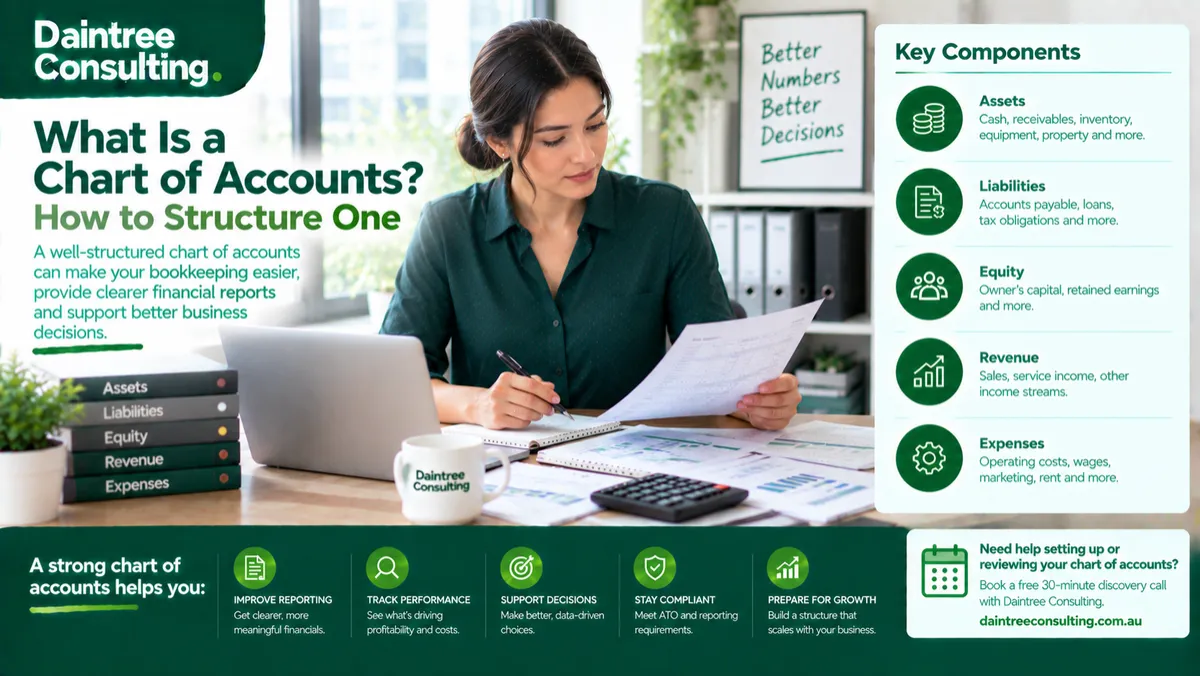
What Is a Chart of Accounts and How Should a Business Structure It?
A chart of accounts is one of the basic building blocks of a business accounting system. It provides the structure used to classify transactions so your bookkeeping and financial reports remain organised and useful.
While the concept sounds technical, the purpose is straightforward: every transaction needs somewhere appropriate to go.
Want expert help? Daintree Consulting's accounting services can take this off your plate. Book a free consultation.
If your chart of accounts is too simple, your financial reports may not give you enough information to understand how the business is performing. If it is too complicated, bookkeeping can become unnecessarily difficult and reports can become cluttered.
For Australian businesses, a well-structured chart of accounts can help create more consistent accounting records, support financial reporting and make it easier to analyse revenue, expenses, assets, liabilities and equity.
In this guide, we explain what a chart of accounts is, what it normally contains, how to structure one and what to consider as your business grows.
Quick Answer: What Is a Chart of Accounts?
A chart of accounts is an index of the accounts a business uses to classify its financial transactions. It provides a framework for recording income, expenses, assets, liabilities and equity.
business.gov.au defines a chart of accounts as an index of the accounts a business uses to classify transactions.
For example, instead of recording every business expense simply as "expenses", a business might have separate accounts for:
Office expenses
Software subscriptions
Advertising and marketing
Motor vehicle expenses
Professional fees
Insurance
Rent
Wages and salaries
Bank fees
The exact structure should reflect how the business operates and the level of financial detail management actually needs.
Why Does a Chart of Accounts Matter?
Your chart of accounts affects much more than where individual transactions are recorded.
It influences the way financial information is organised and ultimately how you interpret your business performance.
A useful chart of accounts can help you:
Produce clearer financial reports
Separate different types of revenue and expenses
Track business costs more consistently
Compare actual results against budgets
Identify unusual changes in spending
Prepare information for tax and reporting purposes
Analyse profitability
Monitor financial trends
Make management reporting more useful
Give your accountant or finance team cleaner records
The Australian Taxation Office also refers to a chart of accounts as part of the accounting systems and records a company may maintain.
This is important because your accounting system should not simply record transactions. It should organise financial information in a way that supports the reporting and decisions your business needs to make.
What Are the Main Categories in a Chart of Accounts?
Most charts of accounts are organised around five broad categories:
Assets
Liabilities
Equity
Revenue
Expenses
These categories broadly correspond with the information you would expect to see in financial statements.
The individual accounts underneath them provide more detail.
1. Assets
Assets are resources owned or controlled by the business that have economic value.
Examples can include:
Business bank accounts
Cash
Accounts receivable
Inventory
Vehicles
Equipment
Computers
Property
Other business assets
For example, a business might have separate accounts for its operating bank account, savings account and accounts receivable.
Depending on the business, fixed assets may also be separated into categories such as motor vehicles, office equipment or plant and equipment.
2. Liabilities
Liabilities represent amounts the business owes.
Examples include:
Accounts payable
Business loans
Credit cards
Employee-related liabilities
GST or other tax-related accounts
Lease liabilities
Other amounts payable
The level of detail required will depend on the business and its reporting needs.
For example, a business with several types of financing may need more detailed liability accounts than a small service business with no external debt.
3. Equity
Equity generally represents the owner's or owners' interest in the business after liabilities are taken into account.
Depending on the business structure, equity accounts may include:
Owner's capital
Owner's drawings
Share capital
Retained earnings
Current-year earnings
Other equity accounts
The appropriate accounts depend on whether the business operates as a sole trader, partnership, company or trust and how its accounting system is configured.
Business structure can affect tax, legal and reporting obligations, so accounting structures should be considered in the context of the actual entity.
4. Revenue
Revenue accounts record income generated from business activities.
A simple business might only need one main sales account.
A larger business may benefit from separating revenue by:
Product
Service
Business division
Location
Revenue stream
Customer category
For example, a professional services business might separately track accounting services, advisory services and other consulting revenue.
However, more accounts are not automatically better.
If management never uses the additional detail, separating revenue into dozens of categories can create unnecessary bookkeeping work.
5. Expenses
Expense accounts record the costs associated with operating the business.
Common examples include:
Advertising and marketing
Accounting and professional fees
Insurance
Rent
Telecommunications
Software
Office supplies
Travel
Motor vehicle expenses
Wages and salaries
Training
Repairs and maintenance
Bank charges
The right level of detail depends on what you need to understand about the business.
How Should You Structure a Chart of Accounts?
There is no single chart of accounts that is appropriate for every Australian business.
The best structure reflects the business model, reporting requirements, transaction volume and decisions management needs to make.
A practical approach is to work through the following steps.
Step 1: Start With Your Financial Reporting Needs
Before creating individual accounts, consider what you want your financial reports to tell you.
Ask questions such as:
What revenue do we need to track?
Which expenses matter most to management?
Do we need to monitor different departments?
Do we operate multiple locations?
Do we sell different products or services?
Do we need to monitor project profitability?
What information do we review every month?
What information does our accountant need?
What information supports budgeting and forecasting?
This prevents the chart of accounts from becoming a list of accounts created simply because they seem useful.
The goal is to create financial information that supports the way the business actually operates.
Step 2: Establish the Major Account Groups
Start with the major categories:
Assets
Liabilities
Equity
Revenue
Expenses
Then build the individual accounts underneath them.
This gives your accounting system a logical hierarchy.
For example, instead of having dozens of unrelated expense accounts, you can group similar costs together and then determine where additional detail is useful.
Step 3: Keep Similar Transactions Consistent
Consistency is one of the most important principles of a useful chart of accounts.
If software subscriptions are recorded under "Software", avoid recording similar subscriptions under several different accounts simply because different staff members process the transactions.
Likewise, if professional fees have their own account, establish a consistent rule for what belongs there.
Without consistency, financial reports become harder to compare from month to month.
Step 4: Avoid Creating Too Many Accounts
One common mistake is assuming that more detail automatically means better accounting.
It does not.
A business could create separate accounts for every supplier, every small expense category and every minor type of purchase. But this can make the bookkeeping process unnecessarily complicated.
Instead, ask:
Will this additional account help us make a better decision or produce a more useful report?
If the answer is no, it may not need to be separated.
Step 5: Avoid Making the Chart Too Broad
The opposite problem can also occur.
If everything is grouped into a handful of broad categories, important information can disappear.
For example, putting advertising, software, insurance, travel and professional fees into one general "Operating Expenses" account may make the accounts easier to maintain, but it provides little insight into where money is actually being spent.
The right balance is enough detail to support meaningful reporting without creating unnecessary administration.
Should You Use Account Numbers?
Many accounting systems use numerical codes to organise the chart of accounts.
For example, a business might establish a numbering structure where:
1000–1999 = Assets
2000–2999 = Liabilities
3000–3999 = Equity
4000–4999 = Revenue
5000 onwards = Expenses
The exact numbering system is not important as long as it is logical and consistent.
Account numbers can make it easier to sort accounts, locate them within accounting software and maintain a consistent structure as the business grows.
You may also want to leave gaps between account numbers.
This provides room to add accounts later without completely redesigning the numbering system.
Should Every Business Have the Same Chart of Accounts?
No.
A construction business, professional services firm, retailer and property business can have very different accounting requirements.
For example, a professional services business may focus heavily on:
Service revenue
Contractor costs
Employee costs
Professional fees
Software
Marketing
Office expenses
A retailer may need more detailed accounts for:
Sales
Cost of goods sold
Inventory
Freight
Merchant fees
Discounts
Returns
A business with multiple locations may also need a structure that makes it easier to analyse performance across locations.
The chart should therefore follow the business rather than forcing every business into the same template.
Chart of Accounts vs General Ledger: What's the Difference?
These terms are related but they are not the same thing.
The chart of accounts is the organised list of accounts available for classifying transactions.
The general ledger contains the transactions recorded against those accounts.
Think of the chart of accounts as the structure or filing system, while the general ledger contains the financial activity recorded within that structure.
A well-designed chart of accounts helps keep the general ledger organised and makes financial reporting more meaningful.
How a Chart of Accounts Supports Financial Reporting
Your chart of accounts ultimately influences the information that flows into your financial reports.
For example, a profit and loss report may show:
Revenue
Cost of sales
Gross profit
Operating expenses
Net profit
The detail underneath those categories comes from the accounts used to classify transactions.
A poorly structured chart can therefore make a financial report difficult to interpret.
A well-designed structure can make it easier to identify:
Revenue trends
Rising costs
Changes in gross margin
Overheads
Unusual expenditure
Areas where spending is increasing
Differences between budget and actual results
This is particularly useful when financial reports are reviewed regularly rather than only at tax time.
Should You Structure Your Chart of Accounts Around Tax Categories?
Not necessarily.
Tax reporting is one consideration, but your accounting system should also provide information that helps you run the business.
For example, two expenses may receive similar tax treatment but have very different management significance.
If management needs to understand advertising expenditure separately from software costs, combining them simply because they are treated similarly for tax purposes may reduce the usefulness of internal reporting.
Your accountant can help determine how tax requirements and management reporting should work together.
The ATO's record-keeping guidance also recognises that businesses may maintain accounting systems and records beyond the information required for a particular tax return.
When Should You Review Your Chart of Accounts?
Your chart of accounts should not necessarily remain unchanged forever.
It may need review when:
The business launches new products or services
Revenue streams change
The business expands into new locations
New departments are created
The business acquires another business
Transaction volumes increase
Management reporting requirements change
Your accounting system changes
Existing reports no longer provide useful information
Too many accounts have accumulated over time
Growth is a particularly common reason for reviewing accounting processes.
A chart that worked for a small business with a handful of monthly transactions may become less effective when the business has multiple revenue streams, employees, locations or financing arrangements.
Signs Your Chart of Accounts Needs Attention
You may need to review your structure if:
Your reports are too vague
If your profit and loss statement contains broad categories that don't tell you where money is going, you may need more useful detail.
You have too many accounts
If staff regularly struggle to determine which account to use, the structure may be unnecessarily complicated.
Similar expenses are classified differently
Inconsistent coding can make financial reports less reliable.
You frequently use miscellaneous accounts
A large miscellaneous category can hide information that management actually needs to understand.
Your reports don't match how the business operates
If your business has changed but your accounts still reflect an old operating model, your reports may no longer provide the right information.
Budgeting is difficult
A well-structured chart can make it easier to compare actual results with budget categories.
If your accounting structure does not align with the way your budget is prepared, monthly performance analysis can become unnecessarily difficult.
Common Chart of Accounts Mistakes
1. Copying another business's chart without reviewing it
A chart designed for another company may not reflect your revenue streams, costs or reporting requirements.
2. Creating accounts whenever a new transaction appears
This can cause the chart to grow unnecessarily.
A new transaction does not always require a new account.
3. Using inconsistent account names
Clear naming conventions help everyone classify transactions consistently.
4. Mixing fundamentally different costs
Combining unrelated costs can make management reporting less useful.
5. Ignoring future reporting requirements
If the business is growing, the structure should be capable of supporting reasonable future reporting needs without being unnecessarily complex today.
6. Never reviewing the structure
A chart of accounts can become cluttered over time as new accounts are added and old accounts become redundant.
A periodic review can help keep the accounting system practical.
How Should a Growing Business Approach Its Chart of Accounts?
For a growing business, the goal should be to create a structure that can evolve without becoming unnecessarily complicated.
Start with the information management genuinely needs.
Then consider whether the business may eventually require additional reporting by:
Department
Location
Product
Service
Project
Business unit
Revenue stream
However, not every business needs all of these dimensions.
Some accounting software can also use tracking categories, classes, projects or other reporting features instead of creating a separate general ledger account for every possible distinction.
This can be useful because it allows the chart of accounts to remain relatively clean while still providing additional reporting detail.
The appropriate approach depends on the accounting software, business structure and reporting requirements.
How a Clean Chart of Accounts Helps With Month-End Reporting
A well-organised chart of accounts can also support a more efficient month-end process.
When transactions are consistently classified, your finance team can more easily:
Reconcile bank and other balance sheet accounts.
Review revenue and expenses.
Investigate unusual movements.
Compare actual results with budget.
Review outstanding receivables and payables.
Prepare management reports.
Identify issues requiring follow-up.
This connects the chart of accounts to the broader accounting process.
It is not simply a setup task to complete once and forget.
It forms part of the underlying structure used to produce financial information throughout the year.
What Should You Do If Your Existing Chart of Accounts Is Messy?
You don't necessarily need to start again.
A review can identify:
Duplicate accounts
Unused accounts
Inconsistent naming
Overly broad categories
Excessive detail
Incorrect classifications
Accounts that no longer reflect the business
Reporting categories that management actually needs
The next step may be to consolidate, rename, archive or reorganise accounts.
Before making significant changes, consider how the changes could affect historical reporting and comparative financial information.
Your accountant or finance professional can help assess the implications before changes are implemented.
How Daintree Consulting Can Help With Accounting Processes
A chart of accounts is only one part of a reliable accounting system.
Daintree Consulting helps Australian businesses improve the connection between their accounting records, management reporting and financial decision-making.
Its Accounting Services support can include management accounts, balance-sheet and control-account reconciliations, budget-to-actual reporting, cash-flow reporting and financial oversight.
The aim is not simply to produce accounting records. It is to create financial information that is organised, timely and useful for running the business.
If your existing accounting structure has become difficult to manage, your reports are no longer giving you enough visibility, or you're preparing for a period of growth, reviewing your chart of accounts can be a practical place to start.
Frequently Asked Questions
What is a chart of accounts in simple terms?
A chart of accounts is a list of the accounts a business uses to organise and classify financial transactions. It normally includes categories for assets, liabilities, equity, revenue and expenses.
What are the five main categories in a chart of accounts?
The five broad categories are assets, liabilities, equity, revenue and expenses. Individual accounts are then created underneath these categories based on the business's activities and reporting needs.
How many accounts should a small business have?
There is no universal number. A small business should have enough accounts to produce useful financial reports without creating unnecessary bookkeeping complexity.
Can a chart of accounts be changed?
Yes. A business can review and modify its chart of accounts when its reporting needs or operations change. Significant changes should be planned carefully so historical reporting remains understandable.
Should expenses be separated into different accounts?
Usually, expenses should be separated where the distinction provides useful financial or management information. However, creating an account for every minor expense can make bookkeeping unnecessarily complicated.
Is a chart of accounts required for Australian businesses?
A chart of accounts forms part of many accounting systems, and the ATO specifically refers to charts of accounts among accounting systems and records maintained by businesses. The exact record-keeping and reporting requirements depend on the business and its circumstances.
What is the difference between a chart of accounts and a general ledger?
The chart of accounts is the list and structure of accounts used to classify transactions. The general ledger contains the transactions recorded against those accounts.
Final Takeaway
A chart of accounts provides the structure behind your business accounting records.
When it is designed well, it can make financial reporting easier to understand, improve consistency in bookkeeping and provide better information for analysing business performance.
The key is balance.
Your chart should contain enough detail to answer important financial questions without creating unnecessary administrative work.
As your business grows, reviewing the structure can help ensure your accounting system continues to support the way the business operates and the information your leadership team needs.
If your current accounts are difficult to understand, your management reports aren't giving you enough detail, or your accounting processes have become harder to control, it may be time to review the underlying structure.
Need help improving your business accounting and financial reporting? Book a free 30-minute discovery call with Daintree Consulting.
Important Publishing Note
Accounting, tax, record-keeping and reporting requirements can vary depending on the business structure, activities and circumstances. This article provides general information only and should not be treated as accounting, tax, legal or financial advice. Current Australian requirements should be checked before making decisions about accounting systems or reporting structures.
Talk to Daintree about your accounting
Our ex-Big 4 team gives clear, senior-reviewed advice so you can act with confidence.
Book a free consultation →
Or explore our accounting services.
