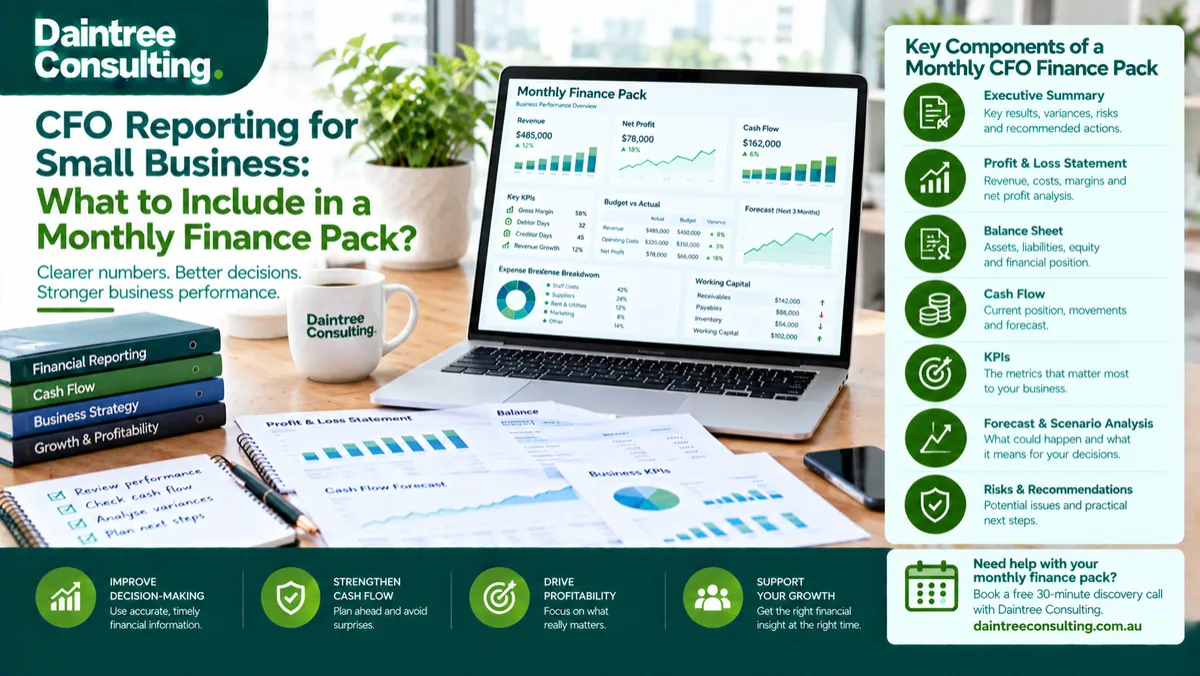
CFO Reporting for Small Business: What Should Be Included in a Monthly Finance Pack?
Small businesses often have plenty of financial information.
The problem is that having information is not the same as having useful financial reporting.
Want expert help? Daintree Consulting's outsourced CFO services can take this off your plate. Book a free consultation.
You might have accounting software showing your profit and loss, a bank account showing your cash balance and a spreadsheet tracking sales. But if those numbers do not come together in a clear monthly view, it can still be difficult to answer the questions that matter:
Are we actually making enough profit?
Is cash flow going to be tight next month?
Which areas of the business are performing well?
Where are costs increasing?
Are we on track against the budget?
Can we afford to hire?
Should we invest in new equipment?
Is growth putting pressure on working capital?
What should management focus on next?
This is where CFO reporting can add value.
A good monthly finance pack should not simply reproduce accounting reports. It should turn financial data into information that helps the owner or leadership team understand what happened, why it happened and what may happen next.
For a small business, the right finance pack does not necessarily need to be enormous.
It needs to be relevant, timely and decision-focused.
Quick answer: What should a monthly CFO finance pack include?
A practical monthly CFO reporting pack may include:
Executive financial summary
Profit and loss statement
Balance sheet
Cash-flow position and forecast
Budget vs actual analysis
Key business KPIs
Revenue and gross-margin analysis
Accounts receivable and payable
Working-capital analysis
Forecast and forward-looking outlook
Major financial risks and issues
Recommended management actions
The exact contents should be tailored to the business.
A professional services firm may need different information from a construction company, retailer, manufacturer or rapidly growing technology business.
The objective is not to create more reports.
The objective is to make better decisions with the numbers you already have.
What is CFO reporting?
CFO reporting is the process of turning financial and operational information into reporting that supports business leadership and decision-making.
Traditional accounting reporting often focuses on recording and presenting what has already happened.
CFO reporting goes further.
It can help management understand:
What happened?
Why did it happen?
What does it mean?
What is likely to happen next?
What should we do about it?
That forward-looking component is particularly important for growing businesses.
A small business owner does not necessarily need a full-time CFO sitting in the office five days a week.
However, the business may still benefit from the financial leadership, analysis and reporting discipline that a CFO can provide.
This is one reason businesses consider an outsourced CFO arrangement.
Why does a small business need a monthly finance pack?
A monthly finance pack creates a regular financial review cycle.
Instead of looking at the bank balance whenever there is a problem, the business has a structured process for reviewing performance.
This can help management identify:
Declining margins
Unexpected cost increases
Cash-flow pressure
Slow-paying customers
Working-capital issues
Underperforming products or services
Budget variances
Rising debt
Changes in sales trends
Staffing and productivity pressures
Upcoming funding requirements
More importantly, a monthly finance pack creates a common set of numbers for management discussions.
Everyone can work from the same information.
1. Start with an executive financial summary
The first page should answer the question:
“What do I need to know about the business this month?”
This should not be a page full of accounting terminology.
It should highlight the most important movements and issues.
For example:
Revenue
How much did the business generate?
How does that compare with the budget and previous periods?
Profitability
Did gross profit and net profit improve or decline?
Cash
How much cash is available, and what does the short-term outlook look like?
Working capital
Are receivables, inventory or other working-capital requirements putting pressure on cash?
Major variances
What changed significantly from budget or forecast?
Key risks
Are there any issues management needs to address?
Recommended actions
What decisions or actions should management consider?
This summary is particularly valuable for owners who do not have time to work through every line of the accounts.
2. Include the profit and loss statement
The profit and loss statement remains one of the core components of CFO reporting.
However, simply presenting the report is not enough.
The finance pack should help management interpret it.
At a minimum, consider reviewing:
Revenue
Cost of sales
Gross profit
Gross margin
Operating expenses
EBITDA or another relevant operating measure where appropriate
Net profit
Significant income or expense movements
Where possible, compare the results against:
Budget
Previous month
Previous year
Current forecast
This allows management to see both performance and trends.
Don't just report the variance
Suppose revenue is $50,000 below budget.
That number is useful.
But the next question is:
Why?
Perhaps:
One major customer delayed an order
A project moved into the following month
Sales conversion declined
Pricing changed
A product was unavailable
Seasonal factors affected demand
The CFO reporting process should help explain the variance rather than simply highlight it.
3. Show gross margin clearly
Revenue growth can look impressive while profitability deteriorates.
That is why gross margin deserves specific attention.
A monthly finance pack can track:
Gross profit
Gross-margin percentage
Margin by product or service
Margin by customer where practical
Changes in direct costs
Pricing movements
If revenue is growing but gross margin is falling, management needs to understand why.
Potential causes could include:
Supplier price increases
Discounting
Labour costs
Product mix
Project overruns
Pricing that has not kept pace with costs
Increased delivery costs
A CFO-style report should make these issues visible.
4. Include the balance sheet
Small businesses sometimes focus heavily on the profit and loss statement and overlook the balance sheet.
That can be a mistake.
The balance sheet can reveal important information about the financial health of the business.
Depending on the business, management may want to monitor:
Cash
Accounts receivable
Inventory
Work in progress
Fixed assets
Accounts payable
Loans
Other liabilities
Equity
The balance sheet becomes particularly useful when reviewing working capital.
For example, a business can be profitable while experiencing increasing pressure from unpaid invoices or inventory.
The balance sheet helps show where resources are tied up.
5. Make cash flow a central part of the pack
For many small businesses, cash is one of the most important financial measures.
A monthly CFO finance pack should therefore provide a clear view of:
Opening cash
Cash received
Cash paid
Closing cash
Expected receipts
Upcoming payments
Tax and statutory commitments
Loan repayments
Capital expenditure
Short-term funding requirements
The business should also have some visibility beyond the current month.
A cash-flow forecast can help answer:
“What could our cash position look like over the next few months?”
That can be far more useful than simply knowing how much is currently sitting in the bank.
6. Include budget vs actual reporting
A budget becomes much more useful when actual performance is compared against it.
The monthly finance pack should highlight meaningful variances rather than forcing management to compare every number manually.
For example:
Revenue: below budget
Gross margin: below budget
Payroll: above budget
Marketing: above budget
Cash: below forecast
The next step is to investigate the reasons.
Some variances may be temporary or expected.
Others may indicate that the original assumptions are no longer realistic.
A CFO can help management distinguish between the two.
7. Track the KPIs that actually matter
Not every business needs twenty or thirty KPIs.
A better approach is to identify the small number of measures that genuinely influence business performance.
Depending on the business, these could include:
Revenue
Gross margin
Net profit margin
Average transaction value
Customer acquisition cost
Customer retention
Sales conversion rate
Revenue per employee
Billable utilisation
Debtor days
Inventory turnover
Working capital
Recurring revenue
Project profitability
The right KPIs depend on the business model.
For example, a professional services firm may focus heavily on utilisation, billable revenue and debtor days.
A retail business may pay more attention to gross margin, stock turnover and average transaction value.
A CFO finance pack should reflect how the business actually makes money.
8. Report accounts receivable
Revenue is not the same as cash received.
If customers are taking longer to pay, the business may experience cash-flow pressure even when sales are healthy.
Monthly CFO reporting should therefore consider:
Total accounts receivable
Current invoices
Overdue invoices
Ageing of receivables
Largest outstanding balances
Debtor days
Significant collection issues
The report should help management identify whether the issue is temporary or becoming a trend.
For example, if debtor days have increased consistently over several months, management may need to review:
Payment terms
Invoicing processes
Follow-up procedures
Customer credit policies
Disputed invoices
9. Review accounts payable
The other side of working capital is what the business owes suppliers and other creditors.
A finance pack can provide visibility over:
Supplier balances
Upcoming payments
Overdue accounts
Payment terms
Large one-off commitments
Changes in supplier costs
This can help management understand upcoming cash requirements and avoid unexpected payment pressure.
Supplier relationships can also become an important part of cash-flow planning.
10. Include working-capital analysis
Working capital is often where profitable businesses experience unexpected financial pressure.
Cash can be tied up in:
Unpaid invoices
Inventory
Work in progress
Deposits
Other operating assets
A CFO reporting pack should help management understand how efficiently working capital is being used.
The objective is not necessarily to minimise working capital.
The objective is to maintain an appropriate level while supporting operations and growth.
11. Add a rolling forecast
Historical reporting tells you what has happened.
A forecast helps you think about what could happen next.
A monthly CFO pack should ideally include a rolling forecast covering an appropriate period for the business.
This may include forecasts for:
Revenue
Gross profit
Operating expenses
Cash flow
Working capital
Staffing costs
Capital expenditure
Funding requirements
The forecast should be updated as new information becomes available.
If actual sales are lower than expected, the forecast should reflect that.
If a major customer signs a new contract, the forecast may need to change.
The purpose is not to predict the future perfectly.
It is to give management an updated view of possible outcomes.
12. Include scenarios when decisions are significant
Sometimes a single forecast is not enough.
If the business is considering a major decision, scenario analysis can provide additional insight.
For example:
Base case
What happens if current assumptions continue?
Growth case
What happens if sales increase significantly?
Downside case
What happens if sales fall or costs increase?
Scenario analysis can be useful when considering:
Hiring
Opening a new location
Purchasing equipment
Taking on debt
Expanding into a new market
Acquiring another business
Major marketing investment
Large customer contracts
The purpose is to understand the financial consequences before committing to the decision.
13. Highlight financial risks
A good CFO report should not only show positive numbers.
It should identify potential risks.
Examples might include:
Declining gross margin
Customer concentration
High debtor balances
Cash-flow gaps
Increasing debt
Rising supplier costs
Large upcoming tax obligations
Unprofitable projects
Excess inventory
Over-reliance on one revenue stream
Forecast assumptions that are becoming unrealistic
This creates a more balanced view of the business.
14. Finish with actions and recommendations
This is one of the biggest differences between basic reporting and CFO reporting.
The report should not finish with:
“Here are the numbers.”
It should help answer:
“What should we do next?”
For example:
Issue: Gross margin declined for the third consecutive month.
Potential cause: Supplier costs increased while pricing remained unchanged.
Recommended action: Review pricing and supplier arrangements before the next reporting period.
Or:
Issue: Accounts receivable has increased significantly.
Potential cause: Several large customers are paying outside agreed terms.
Recommended action: Review outstanding invoices and strengthen collection follow-up.
This converts financial reporting into management action.
What a monthly CFO finance pack might look like
A practical small-business pack could follow this structure:
Section 1: Executive summary
Key financial results
Major changes
Key risks
Recommended actions
Section 2: Profitability
Revenue
Gross profit
Gross margin
Operating expenses
Net profit
Budget vs actual
Section 3: Financial position
Cash
Receivables
Payables
Inventory
Debt
Working capital
Section 4: Cash flow
Current cash position
Recent cash movements
Short-term forecast
Upcoming major commitments
Section 5: KPIs
Business-specific performance indicators
Trend analysis
Target vs actual
Section 6: Forecast
Updated revenue forecast
Profit forecast
Cash-flow forecast
Key assumptions
Scenario analysis where relevant
Section 7: Management actions
Issues requiring attention
Recommended actions
Decisions required
Items to monitor next month
This is enough to give many small businesses a meaningful management view without creating a report that nobody reads.
How often should CFO reporting be produced?
For many small businesses, monthly reporting provides a practical balance between detail and workload.
Monthly reporting creates enough frequency to identify trends while giving the business sufficient time to generate meaningful financial information.
However, some businesses may need more frequent monitoring.
For example, weekly or fortnightly cash-flow reporting may be appropriate when:
Cash reserves are tight
Revenue fluctuates significantly
The business is growing quickly
Large payments are due regularly
Working capital is under pressure
The business is managing significant debt
The reporting frequency should reflect the decisions the business needs to make.
What makes CFO reporting different from bookkeeping?
Bookkeeping and CFO reporting perform different functions.
Bookkeeping focuses on accurately recording financial transactions and maintaining financial records.
CFO reporting uses financial and operational information to help management understand performance and make decisions.
You can think of the process as:
Bookkeeping → Accurate data
Accounting → Financial reporting
CFO reporting → Analysis, interpretation, forecasting and decision support
These functions work together.
If the underlying bookkeeping is inaccurate or incomplete, CFO reporting will be less reliable.
This is why a strong finance function needs good processes from the transaction level through to management reporting.
What makes CFO reporting different from standard management accounts?
There is some overlap.
Management accounts may provide reports such as:
Profit and loss
Balance sheet
Cash flow
Budget comparisons
KPIs
CFO reporting typically adds a stronger focus on:
Financial interpretation
Forward-looking forecasts
Scenario planning
Business drivers
Risk identification
Working capital
Strategic decisions
Recommended actions
The distinction is not necessarily the format of the report.
It is the level of insight and decision support behind it.
Common mistakes businesses make with monthly finance packs
Making the pack too long
More information does not automatically mean better reporting.
If management receives 50 pages of numbers every month, the important information can get lost.
Focus on what matters.
Reporting without explaining
A variance without context is only part of the story.
Explain what changed and why.
Looking only backwards
Historical results matter, but management also needs to understand what is coming next.
Include forecasts and relevant assumptions.
Ignoring cash
Profit does not pay suppliers — cash does.
Make cash-flow visibility a core part of the reporting process.
Tracking too many KPIs
Too many metrics can create noise.
Choose measures that influence decisions.
Producing reports too late
A beautifully prepared report that arrives several months after the relevant period has limited management value.
Timeliness matters.
How to get more value from your monthly finance pack
A finance pack becomes more useful when it becomes part of the management routine.
A simple monthly process could be:
Step 1: Close the books
Make sure the relevant bookkeeping and reconciliations are complete.
Step 2: Prepare the reports
Produce the agreed monthly financial information.
Step 3: Analyse the results
Identify material movements and trends.
Step 4: Compare against expectations
Review budget, prior period and forecast.
Step 5: Update the forecast
Adjust assumptions based on new information.
Step 6: Discuss the findings
Focus management attention on the most important issues.
Step 7: Agree actions
Turn the analysis into specific decisions and responsibilities.
Step 8: Monitor the next month
Check whether the actions improved the result.
This creates a continuous financial management cycle rather than a once-a-year tax exercise.
When should a small business consider CFO reporting support?
You may benefit from stronger CFO reporting if:
You are growing quickly
Revenue is increasing but cash remains tight
You are unsure where profit is being generated
Your financial reports arrive too late
You do not have reliable forecasts
Budget variances are not being investigated
Working capital is becoming difficult to manage
You are considering expansion
You are preparing for investment or funding
You are making major decisions without clear financial analysis
You have an accountant but need more ongoing commercial financial support
This does not necessarily mean you need to hire a full-time CFO.
An outsourced CFO can provide senior financial leadership and reporting support without requiring the cost and commitment of a permanent executive appointment.
Final thoughts
A good monthly finance pack should do more than tell a small business owner what happened last month.
It should provide a clear view of:
Performance.
Profitability.
Cash flow.
Financial position.
Key business drivers.
Future outlook.
Risks.
Actions.
That is the real value of CFO reporting.
The right reports give business owners greater visibility over what is happening financially and help turn that information into better decisions.
For a growing business, this can be particularly valuable. Decisions about hiring, pricing, investment, funding and expansion all have financial consequences.
The sooner those consequences can be understood, the better positioned management is to make informed choices.
Need better financial reporting for your small business?
Daintree Consulting provides accounting, business advisory and outsourced CFO support for Australian businesses that need clearer financial information and stronger decision-making.
Our outsourced CFO services can help with management reporting, cash-flow planning, forecasting, KPI reporting, financial analysis, funding preparation and ongoing financial leadership.
Book a free 30-minute discovery call with Daintree Consulting to discuss what your monthly finance pack should include and how stronger CFO reporting could support your business.
Frequently Asked Questions
What is CFO reporting?
CFO reporting is financial and operational reporting designed to help business owners and leadership teams understand performance, financial risks, cash flow, forecasts and business drivers so they can make better decisions.
What should a monthly CFO report include?
A monthly CFO report can include an executive summary, profit and loss, balance sheet, cash flow, budget vs actual analysis, KPIs, working-capital information, accounts receivable and payable, forecasts, risks and recommended management actions.
The exact content should be tailored to the business.
Does a small business really need CFO reporting?
Not every small business needs a formal CFO reporting function.
However, businesses experiencing growth, cash-flow pressure, complex financial decisions or limited management visibility may benefit from more structured financial reporting and CFO-level analysis.
What is the difference between CFO reporting and bookkeeping?
Bookkeeping records financial transactions and maintains accounting records.
CFO reporting uses financial and operational information to analyse performance, identify risks, forecast future outcomes and support business decisions.
How often should CFO reports be prepared?
Monthly reporting is often a practical starting point for small businesses.
Businesses with more volatile cash flow or significant financial commitments may benefit from more frequent monitoring of specific metrics, particularly cash flow and working capital.
Should a CFO finance pack include cash flow?
Yes.
Cash-flow visibility is particularly important because a profitable business can still experience cash shortages. A useful finance pack should show the current cash position as well as expected future cash movements where appropriate.
Should CFO reporting include forecasts?
Yes, where forecasting is relevant to the business.
A forward-looking forecast can help management understand potential revenue, profitability, cash-flow and funding requirements and adjust decisions as circumstances change.
What KPIs should a small business track?
The right KPIs depend on the business model.
Potential measures include revenue, gross margin, net profit margin, debtor days, utilisation, revenue per employee, customer retention, recurring revenue, inventory turnover and working capital.
The goal should be to track metrics that influence business decisions rather than simply collecting more data.
Can an outsourced CFO prepare monthly finance packs?
Yes. An outsourced CFO can help design, prepare and interpret monthly financial reporting and connect the results with forecasting, cash-flow management, KPIs and business decisions.
The scope should be agreed according to the business's needs.
Is CFO reporting the same as management accounts?
There can be significant overlap.
Management accounts provide internal financial reporting, while CFO reporting generally places greater emphasis on interpretation, forecasting, strategic analysis, risks and recommended actions.
Talk to Daintree about your finance function
Our ex-Big 4 team gives clear, senior-reviewed advice so you can act with confidence.
Book a free consultation →
Or explore our outsourced CFO services.
