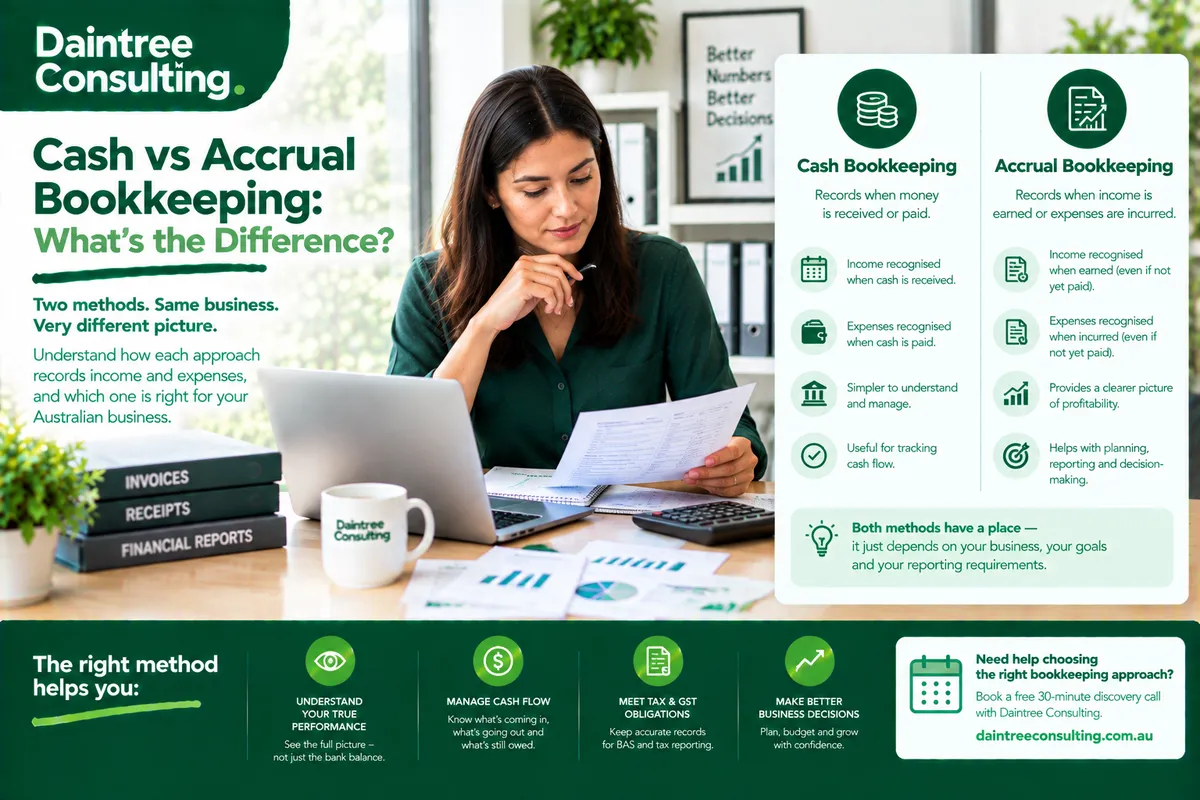
Cash vs Accrual Bookkeeping: What’s the Difference?
One of the first bookkeeping decisions a business needs to understand is how its income and expenses are recorded.
Two common approaches are cash bookkeeping and accrual bookkeeping.
Want expert help? Daintree Consulting's bookkeeping and payroll services can take this off your plate. Book a free consultation.
The difference can sound simple:
Cash basis: record transactions when money is received or paid.
Accrual basis: recognise income and expenses when they are earned or incurred, rather than waiting for the cash to move.
But the practical difference can be much more important than that short explanation suggests.
The accounting method a business uses can affect how it understands revenue, expenses, outstanding invoices, unpaid bills, profitability and financial performance.
It can also become important when preparing tax information and Business Activity Statements, because the ATO distinguishes between accounting methods for income and the separate accounting methods used for GST.
The ATO specifically warns not to confuse the accounting methods for business income with the two GST accounting methods.
For Australian businesses, understanding cash vs accrual bookkeeping can help owners choose an appropriate bookkeeping approach and, just as importantly, understand what their financial reports are actually showing.
What is cash bookkeeping?
Cash bookkeeping records income and expenses based on when money is actually received or paid.
For example, imagine a business completes a $5,000 project in June but does not receive payment from the customer until July.
Under a cash basis for income, the $5,000 would generally be recognised when the payment is received rather than when the work was completed.
The ATO explains that, where assessable income is accounted for on a cash basis, payments received during the financial year are included even if the work was performed in a different financial year. Amounts relating to work completed but not yet paid are generally not included on that cash basis.
The same basic concept applies to expenses: the timing of the cash payment is important.
Simple example
A business receives:
$20,000 from customers in June
and pays:
$8,000 of business expenses in June.
A cash-based report focuses on the $20,000 received and $8,000 paid during that period.
This can make cash movement relatively easy to understand.
But it may not always show the complete economic activity of the business during that period.
What is accrual bookkeeping?
Accrual bookkeeping recognises transactions based on when income is earned and expenses are incurred, rather than simply when the associated cash is received or paid.
For example, suppose a business completes work for a customer in June and issues a $10,000 invoice.
The customer pays in July.
Under an accrual approach, the revenue may be recognised in June because that is when the income was earned, subject to the applicable accounting and reporting requirements.
The July payment then settles the outstanding receivable.
This means an accrual-based set of accounts can show:
June revenue: $10,000
June accounts receivable: $10,000
July cash receipt: $10,000
The business therefore has a clearer record of both the income earned and the amount still owed by the customer.
Cash vs accrual bookkeeping: the key difference
The easiest way to understand the difference is to focus on timing.
Cash bookkeeping
The transaction is generally recognised when money changes hands.
Accrual bookkeeping
The transaction is generally recognised when the income is earned or the expense is incurred, subject to the applicable accounting requirements.
This can create significant differences in monthly financial reports.
A business could have:
Strong sales but little cash
Significant cash receipts from previous sales
Large unpaid customer invoices
Supplier bills that have not yet been paid
Expenses relating to future periods
Revenue earned but not yet collected
Cash and accrual bookkeeping can therefore produce different pictures of performance at a particular point in time.
Example: A customer invoice
Consider a consulting business that completes a $12,000 project on 25 June.
The business invoices the customer immediately.
The customer pays on 15 July.
Under cash bookkeeping
The $12,000 is generally recognised when the payment is received.
So the cash-based records show the receipt in July.
Under accrual bookkeeping
The $12,000 is generally recognised when the revenue is earned, subject to the applicable accounting requirements.
The June accounts may therefore show:
Revenue: $12,000
Accounts receivable: $12,000
Then in July:
Cash increases by $12,000
Accounts receivable decreases by $12,000
The underlying transaction has not changed.
What changes is the timing of recognition.
Example: An unpaid supplier invoice
The same principle can apply to expenses.
Suppose a business receives a $4,000 supplier invoice in June for services provided during June.
The business does not pay the invoice until July.
Under an accrual approach, the expense is generally recognised in the period to which it relates, with a payable recorded until the invoice is paid.
This can provide a more complete picture of the costs associated with the period.
Under a cash approach, the payment would generally affect the records when the business actually pays the supplier.
Why accrual bookkeeping can provide a clearer picture of performance
One of the major advantages of accrual accounting is that it can help businesses understand performance based on the activity that actually occurred during a period.
Imagine a business has:
$100,000 of revenue earned in June
$60,000 of expenses relating to June
$40,000 of outstanding customer invoices
$20,000 of unpaid supplier invoices
A cash-only view could look very different depending on when customers and suppliers actually make or receive payments.
An accrual-based view can help management see the revenue and expenses associated with the period, while separately showing amounts owed by customers and amounts owed to suppliers.
This can make financial reports more useful for management decision-making.
Why cash bookkeeping can still be useful
Cash bookkeeping is not automatically "bad" bookkeeping.
For some businesses and circumstances, a cash-based approach can provide a straightforward view of money coming in and going out.
It can help answer questions such as:
How much cash came into the business?
How much cash was paid out?
What is the current bank position?
How much cash is available?
When were customers actually paying?
When are suppliers actually being paid?
This information is valuable.
In fact, even businesses that use accrual accounting still need to understand cash flow.
The important point is that profit and cash are not the same thing.
Cash flow and accrual profit are different
This is one of the most important concepts for business owners.
A business can report a profit while having limited cash available.
For example, a business may invoice customers for $100,000 during a month but collect only $30,000 before the end of the month.
At the same time, it may have paid $40,000 of expenses.
The business could therefore have recognised significant revenue while experiencing a cash-flow squeeze.
The reverse can also happen.
A business might receive a large cash payment relating to work completed in a previous period.
The bank balance increases, but that does not necessarily mean the current month's revenue has increased by the same amount.
This is why management reporting should generally consider both:
Profitability
and
Cash flow.
What is the difference between cash basis and accrual basis for GST?
This is where Australian businesses need to be particularly careful.
The ATO has separate GST accounting methods:
Cash basis
Non-cash basis, sometimes referred to as accruals
These are not necessarily the same thing as the accounting method used for business income.
The ATO explicitly states that the two accounting methods for business income should not be confused with the two GST accounting methods.
Under the GST rules, the accounting basis selected can affect when amounts are reported on the BAS.
For example, the ATO explains that businesses accounting for GST on a cash basis generally account for relevant GST amounts in the reporting period when payment or part payment is received or made.
Under the non-cash basis, GST is generally accounted for in the earlier reporting period in which payment is received or made or an invoice is issued or received, subject to the applicable rules and exceptions.
This is an important distinction.
Your bookkeeping basis and your GST accounting method should not automatically be assumed to be the same thing.
Cash vs accrual bookkeeping for accounts receivable
Accounts receivable is one of the clearest examples of the difference.
Accounts receivable represents amounts owed to the business by customers.
Under accrual bookkeeping, unpaid customer invoices can appear as receivables even though the business has not yet received the cash.
This can help management answer:
How much have we invoiced?
How much do customers owe us?
How old are the outstanding invoices?
Which customers are overdue?
How much cash might be collected?
Are receivables increasing too quickly?
This is particularly useful for businesses that offer credit terms.
A business could be profitable on paper but still experience cash-flow problems if customers take too long to pay.
Cash vs accrual bookkeeping for accounts payable
Accounts payable provides the opposite perspective.
It represents amounts the business owes to suppliers and other creditors.
Under accrual bookkeeping, expenses can be recorded when incurred even when payment has not yet been made.
This can help management understand:
What bills are outstanding?
How much is owed to suppliers?
What expenses relate to the current month?
What payments are coming due?
How much working capital is required?
This information can be important for cash-flow planning.
Which method is better for a small business?
There is no universal answer.
The appropriate method depends on factors such as:
Business structure
Nature of the business
Size of the business
Transaction volume
Customer payment terms
Supplier payment terms
Reporting requirements
Tax circumstances
Management reporting needs
Accounting systems
Applicable accounting framework
A very small business with straightforward transactions may have different bookkeeping needs from a growing business with multiple employees, significant receivables, supplier accounts and inventory.
The key question is not simply:
"Which method is easier?"
It is:
"Which approach gives the business the information it needs and complies with the requirements that apply to it?"
When might accrual bookkeeping become more useful?
Accrual bookkeeping can become particularly useful as a business becomes more complex.
This can happen when a business:
Has significant accounts receivable
Offers customers payment terms
Has substantial supplier accounts
Uses inventory
Has recurring expenses
Enters into longer-term contracts
Has multiple revenue streams
Needs monthly management reporting
Is preparing for investment or finance
Is experiencing rapid growth
Needs clearer profitability reporting
As the business grows, simply looking at bank transactions can become an increasingly incomplete way to understand performance.
What about businesses that want better management reporting?
Management reporting is one area where accrual information can be particularly valuable.
Business owners may want to know:
How much revenue did we actually generate this month?
What did it cost us to generate that revenue?
Are margins improving?
How much do customers owe us?
How much do we owe suppliers?
Are expenses increasing?
Is the business genuinely profitable?
Why does profit differ from cash in the bank?
A well-structured accrual-based reporting process can help answer these questions.
It can also support reports such as:
Profit and loss statements
Balance sheets
Aged receivables
Aged payables
Budget-to-actual reports
Cash-flow forecasts
Management accounts
Financial dashboards
Cash bookkeeping does not replace cash-flow management
It is tempting to think:
"If I use cash bookkeeping, I already know my cash flow."
Not necessarily.
Cash bookkeeping records transactions based on the relevant cash movement.
Cash-flow management goes further.
It involves understanding:
Expected customer receipts
Supplier payments
Payroll
Tax obligations
Loan repayments
Capital expenditure
Seasonal fluctuations
Future cash requirements
A business can therefore use cash-based records and still need a separate cash-flow forecast.
Similarly, a business using accrual accounting should still monitor actual cash and future cash requirements.
What happens at the end of the financial year?
The distinction between cash and accrual accounting can become particularly important around year-end.
A business may have:
Invoices issued before 30 June but paid after 30 June
Supplier invoices received before year-end but paid later
Expenses incurred but not yet invoiced
Prepaid expenses
Revenue relating to future periods
Accrued income
Unreconciled bank transactions
Under an accrual approach, these items may need to be considered when preparing the financial statements.
The correct treatment depends on the circumstances and applicable accounting and tax requirements.
This is one reason year-end bookkeeping should not simply be a matter of checking the bank balance.
Cash vs accrual bookkeeping and financial statements
For businesses preparing financial statements, the accounting basis and applicable reporting framework matter.
ASIC states that companies must keep up-to-date financial records that correctly track and explain their transactions and financial position and performance and enable accurate financial statements to be prepared and audited.
For entities subject to Australian financial reporting requirements, financial reports need to comply with the applicable Australian Accounting Standards.
This means businesses with formal financial reporting obligations need to consider the applicable reporting framework rather than choosing a bookkeeping approach solely because it is simpler.
Not every Australian business has the same financial reporting obligations.
Some companies are required to prepare and lodge financial reports with ASIC, while others are not.
Common mistakes when using cash vs accrual bookkeeping
Mistake 1: Confusing cash flow with profit
A bank balance does not tell you everything about profitability.
Mistake 2: Assuming an unpaid invoice does not matter
Under an accrual approach, unpaid customer invoices can still represent revenue and accounts receivable.
Mistake 3: Ignoring unpaid expenses
Expenses incurred but not yet paid may need to be recognised in accrual-based reporting.
Mistake 4: Mixing cash and accrual methods without understanding the consequences
The ATO states that when accounting for business income, you need to account for transactions within a financial year using the same method.
Mistake 5: Assuming GST and income-tax accounting methods are identical
The ATO specifically distinguishes accounting methods for business income from GST accounting methods.
Mistake 6: Using bookkeeping reports without understanding what they measure
A report is only useful if the business owner understands whether it is showing cash movements, accrued revenue and expenses, outstanding balances or another measure.
How to choose the right bookkeeping approach
Before choosing or changing a bookkeeping method, consider the following questions.
How does your business get paid?
Do customers pay immediately or on 7-, 14- or 30-day terms?
How do you pay suppliers?
Do you pay immediately or receive invoices with payment terms?
Do you hold inventory?
Inventory can add complexity to financial reporting and management accounts.
Do you need monthly profitability reporting?
If management needs a clear view of monthly performance, accrual information may be particularly useful.
How complex are your transactions?
A growing business may need a more structured bookkeeping process.
What are your tax and GST requirements?
Your GST accounting method and income-tax treatment need to be considered separately.
What does your accountant recommend?
Your accountant can assess the business's circumstances and explain the accounting and tax implications of different approaches.
How to improve bookkeeping regardless of the method
Choosing cash or accrual bookkeeping is only one part of maintaining reliable financial records.
Businesses should also focus on the underlying process.
Reconcile bank accounts regularly
Make sure recorded transactions agree with bank activity.
Keep accounts receivable up to date
Know what customers owe and how long invoices have been outstanding.
Monitor accounts payable
Know what bills are coming due and what obligations need to be funded.
Keep supporting documentation
Invoices, receipts, contracts and other financial records should be organised and accessible.
Review unusual transactions
Large or unusual transactions should be investigated rather than simply left unreconciled.
Close the books regularly
A consistent month-end process can make financial reporting more reliable.
Review financial reports
Do not wait until the end of the financial year to discover that the numbers do not make sense.
ASIC expects companies to maintain financial records that correctly record and explain transactions and financial position and performance.
Cash vs accrual bookkeeping: a practical example
Imagine a business has the following activity in June:
$50,000 of work completed
$30,000 collected from customers
$20,000 still outstanding
$25,000 of expenses incurred
$15,000 of those expenses paid
$10,000 still owing to suppliers
A cash-based view may focus on:
$30,000 received - $15,000 paid = $15,000 net cash movement
An accrual-based view may focus on:
$50,000 revenue - $25,000 expenses = $25,000 accounting result
The two figures are not necessarily contradictory.
They answer different questions.
The cash figure helps explain what happened to the bank balance.
The accrual figure helps explain the revenue and expenses associated with the period.
This is why business owners often need to look at both profitability and cash flow.
Why the difference matters as your business grows
For a small business, the distinction between cash and accrual bookkeeping may initially seem like an accounting technicality.
As the business grows, it can become much more important.
Consider a business that has:
100 customers
30-day payment terms
20 regular suppliers
Monthly payroll
Recurring software subscriptions
Equipment finance
Significant inventory
Multiple locations
The bank account alone cannot explain everything happening in the business.
Management needs to understand what has been earned, what has been spent, what is still owed and what cash is likely to be available in the future.
That is where a structured bookkeeping and reporting process becomes valuable.
How Daintree Consulting can help with bookkeeping and accounting
Choosing between cash and accrual bookkeeping is only one part of building reliable financial records.
Daintree Consulting can help Australian businesses establish and maintain bookkeeping processes that provide clearer information for day-to-day management and financial reporting.
Support can include:
Bookkeeping
Bank and account reconciliations
Accounts payable
Accounts receivable
Payroll
Month-end close
Management reporting
BAS-ready records
Financial reporting
Coordination with accountants
Review of bookkeeping processes
The objective is not simply to record transactions.
It is to help business owners understand what the numbers are actually telling them.
If your bookkeeping reports do not clearly explain your profitability, cash position, outstanding invoices and upcoming obligations, it may be worth reviewing the way your financial information is being maintained.
Need help with your business bookkeeping?
Daintree Consulting provides Bookkeeping & Payroll support for Australian businesses that need organised records, reliable reconciliations and clearer financial information.
Book a free 30-minute discovery call with Daintree Consulting to discuss your bookkeeping and accounting requirements.
Frequently Asked Questions
What is the difference between cash and accrual bookkeeping?
Cash bookkeeping generally records income and expenses when money is received or paid. Accrual bookkeeping generally recognises income when earned and expenses when incurred, subject to the applicable accounting and reporting requirements.
Is cash or accrual bookkeeping better?
Neither method is automatically better for every business. The appropriate approach depends on the business structure, transaction complexity, reporting requirements, tax circumstances and management information needed.
Does cash bookkeeping show profit?
Cash-based records can provide useful information about money received and paid, but cash movement is not the same thing as accounting profit.
Why do businesses use accrual bookkeeping?
Accrual bookkeeping can provide a clearer view of revenue and expenses relating to a particular period, including amounts that have been earned or incurred but have not yet been paid.
What are accounts receivable?
Accounts receivable represents amounts owed to a business by its customers. Under accrual bookkeeping, customer invoices can generally remain as receivables until they are collected.
What are accounts payable?
Accounts payable represents amounts a business owes to suppliers and other creditors. Accrual-based records can recognise expenses while the related supplier amounts remain unpaid.
Is GST cash accounting the same as cash bookkeeping?
No. The ATO distinguishes accounting methods for business income from the separate methods used for GST. A business's GST accounting basis can affect when GST-related amounts are reported on the BAS.
Can a business use cash accounting for income and a different method for GST?
The accounting method for business income and the GST accounting method are separate concepts. The appropriate treatment depends on the business's circumstances and applicable requirements.
Does every Australian business have to use accrual accounting?
Not necessarily. Requirements depend on the entity, financial reporting framework and circumstances. Some businesses have formal financial reporting obligations that require compliance with Australian Accounting Standards.
How can I tell whether my bookkeeping method is working?
Your bookkeeping should provide reliable information about transactions, profitability, cash flow, amounts owed by customers, amounts owed to suppliers and other information relevant to managing the business.
Talk to Daintree about your bookkeeping and payroll
Our ex-Big 4 team gives clear, senior-reviewed advice so you can act with confidence.
Book a free consultation →
Or explore our bookkeeping and payroll services.
