
Can you claim accounting fees as a tax deduction?
Yes, you can claim accounting fees as a tax deduction in Australia when they relate to managing your tax affairs or running an income-producing business. For your 2026 tax return, separate deductible tax and business work from private or capital work, and claim only the portion you are entitled to deduct.
TL;DR
Want expert help? Daintree Consulting's tax and BAS services can take this off your plate. Book a free consultation.
Can you claim accounting fees as a tax deduction? Yes—eligible Australian tax agent fees and business accounting costs qualify.
Tax return preparation and business bookkeeping can qualify under different deduction rules.
Private work, capital advice and GST credits require separate treatment.
Keep an itemised invoice and claim the expense in the correct income year.
Can you claim accounting fees as a tax deduction?
Accounting fees are deductible according to the work performed, not simply because an accountant issued the invoice. Tax return preparation, business bookkeeping and advice about meeting tax obligations have different purposes, so assess each service separately.
Daintree Consulting provides accounting, tax and advisory services for Australian businesses. Its accounting and advisory services cover both compliance and business decision-making; the tax treatment still depends on the particular work.
Accounting work | Best for | Deduction treatment | Main limitation |
|---|---|---|---|
Tax return preparation | Meeting tax reporting obligations | Generally deductible as a cost of managing tax affairs | Claim in the income year the expense is incurred |
Business bookkeeping | Maintaining business financial records | Generally deductible as an ongoing business expense | Exclude private work and amounts requiring capital treatment |
Payroll and BAS preparation | Managing business compliance | Generally deductible where connected with business operations | Account for any GST credit entitlement |
Tax advice | Understanding Australian tax obligations | Generally deductible when the tax-affairs rules are satisfied | Recognised tax adviser requirements apply |
Business acquisition advice | Assessing a proposed purchase | Requires separate assessment | Do not assume an immediate deduction |
Private financial work | Managing personal spending or private borrowing | Not deductible merely because an accountant performs it | A specific deduction rule must apply |
The Australian Taxation Office distinguishes costs of managing tax affairs from ordinary business expenses. The relevant legislative starting points are section 25-5 of the Income Tax Assessment Act 1997 for tax-affairs costs and section 8-1 for general business deductions.
Why this matters
A bundled accounting invoice can contain several different types of work. Claiming everything as one expense risks including private advice or capital expenditure; claiming nothing risks missing a legitimate deduction.
For your 2026 return, focus on three questions: what was the work for, who incurred the expense, and when did the obligation to pay arise? Those answers matter more than the invoice heading.
A deduction reduces taxable income. It does not mean the Australian Taxation Office reimburses the accounting fee, and it does not remove the need to pay the invoice.
Tax return preparation: generally deductible
Fees for preparing and lodging your Australian income tax return are generally deductible as costs of managing your tax affairs. This applies to eligible individual tax return fees as well as relevant business tax compliance work.
Best for: taxpayers who need help preparing an accurate return or resolving tax reporting questions. The benefit is assistance with compliance; the limitation is that unrelated private financial advice does not become deductible just because it appears on the same invoice.
Where the expense is for tax advice, the recognised tax adviser requirements matter. A registered tax agent is a recognised tax adviser; the legislation also includes certain legal practitioners.
An invoice can relate to a return for an earlier income year without belonging in that earlier year's deduction claim. The timing generally follows when the expense is incurred, not the year printed on the tax return being prepared.
Bookkeeping and payroll: generally business deductions
Ongoing bookkeeping, payroll processing and accounting work generally qualify as business deductions when they support your income-producing business. These expenses are ordinarily assessed as operating costs rather than treated as personal tax return preparation fees.
Best for: business owners who need accurate transaction records, employee payroll and usable financial reports. The benefit is clearer ongoing records; the limitation is that private work and capital-related services still need separate treatment.
A sole trader should distinguish business accounting from personal spending. A company should identify expenses it incurred rather than automatically claiming every accounting invoice associated with a director.
Management reporting and forecasting also require attention to purpose. Routine support for an existing business differs from work undertaken to acquire a new business or establish a new structure.
Business purchase and setup advice: assess separately
Accounting advice connected with buying a business, acquiring an asset or establishing a business structure needs a separate tax assessment. A connection with your business does not automatically make an expense immediately deductible.
Best for: owners evaluating a purchase, restructure or new venture. The benefit is informed decision-making; the limitation is that the fee can be capital in nature, with treatment determined by the applicable rules.
Some expenditure is included in an asset's cost base or dealt with under a specific deduction provision. Other expenditure is not deductible. Ask the accountant to identify the treatment of the particular service rather than relying on a general description such as business advice.
Do this before finalising the return. An itemised invoice is especially useful when a project includes both ordinary tax compliance and transaction advice.
Why accounting fee deductions vary
The amount you can claim depends on the expense itself. These factors explain why two accounting invoices can receive different treatment:
Purpose of the work: tax compliance, ongoing business operations and private financial matters follow different rules.
Capital connection: work related to acquiring a business, an asset or a new structure needs separate assessment.
Who incurred it: identify the individual, company, trust or other taxpayer legally responsible for the expense.
Timing: determine when the liability was incurred rather than assuming payment date always controls.
GST entitlement: exclude GST from the income tax deduction to the extent you can claim a GST credit.
Mixed services: allocate bundled fees between deductible and non-deductible work on a reasonable basis.
An accountant's professional status alone does not settle these questions. The invoice description, engagement terms and actual services provide the supporting evidence.
Which income year should you claim accounting fees in?
You generally claim an eligible accounting expense in the income year you incur it. An expense is ordinarily incurred when you have a presently existing liability to pay, even if payment happens later; prepayments and other special rules can change the outcome.
For the income year ending 30 June 2026, assess whether the liability arose by that date. Work first engaged and invoiced after 1 July 2026 generally belongs to the following income year, subject to the actual terms and circumstances.
Do not automatically move a later accounting fee into the return it helped prepare. Equally, do not assume that an unpaid invoice is excluded merely because cash has not left your bank account.
If an engagement spans year-end, ask for clarification of the services completed and your obligation to pay. The invoice date is evidence, but it is not a substitute for understanding when the expense was incurred.
Can you claim the whole invoice if it includes private advice?
You can claim only the deductible portion of a mixed accounting invoice. Private budgeting, personal borrowing advice and other non-deductible work need to be separated from qualifying tax or business services.
Ask for itemisation by service, taxpayer and purpose. A reasonable allocation supported by the work performed is stronger than an unsupported estimate made when lodging your return.
Do not deduct the same expense twice. An eligible fee should not appear both as a business operating expense and again as a separate cost of managing tax affairs.
How does GST affect the accounting fee deduction?
Your income tax deduction generally excludes GST to the extent you are entitled to claim a GST credit. If you are not entitled to a GST credit, the GST component can form part of an otherwise deductible expense.
GST registration alone does not establish entitlement to every credit. The service must satisfy the GST rules, and a business cannot automatically claim GST credits for an owner's private accounting work.
Check the tax invoice, identify the recipient and separate business from private services. Income tax deductions and GST credits are related calculations, but they are not the same claim.
How to prepare your accounting fee claim
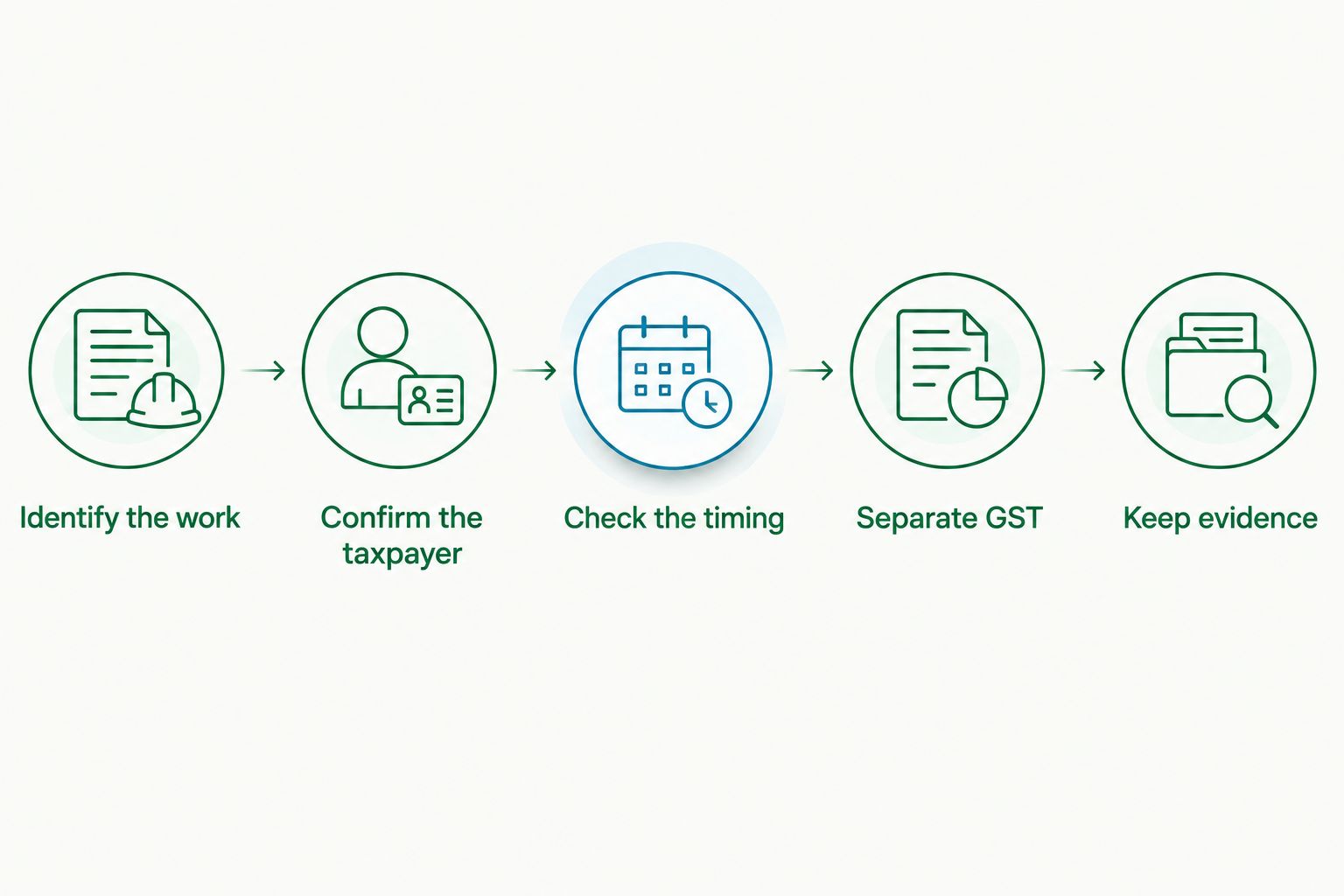
Use this sequence before approving your 2026 return. It creates a clear record of the claim without turning every invoice into a separate tax project.
01. Identify the work
Read the service description and engagement terms. Separate tax return preparation, bookkeeping, payroll, business reporting and transaction advice where they have different purposes.
02. Confirm the taxpayer
Check who engaged the accountant and incurred the liability. If an invoice covers you personally and your company, request a clear allocation rather than claiming the total in whichever return is easiest.
03. Check the timing
Confirm when the expense was incurred and whether any prepayment rules apply. Keep the invoice and relevant engagement correspondence where the timing crosses an income-year boundary.
04. Separate GST
Record any GST credit entitlement before calculating the income tax deduction. This prevents the recoverable GST component from also being included in the deduction.
05. Keep evidence
Retain the itemised invoice, payment record and explanation of any allocation. For individual tax deduction records, the general retention period is 5 years from the date you lodge the return; longer periods apply in some circumstances.
Keep this explanation with the records, not just in your memory. It is particularly useful when a different person prepares the next return or reviews an earlier claim.
When should you ask for a closer review?
Request specific advice where the invoice covers a business purchase, restructure, several entities or both private and business work. These are classification questions, not simply receipt-keeping questions.
Daintree Consulting's accounting and advisory services are best for Australian businesses that need compliance support alongside financial decision-making. The firm provides bookkeeping, payroll, tax, audit and outsourced CFO services; whether any particular fee is deductible depends on the engagement, not the provider's service range.
Bring the underlying documents rather than asking only whether an accountant's fee is deductible. That allows the discussion to focus on the correct taxpayer, deduction category and income year.
Clarify your accounting and tax needs
Review accounting, tax compliance and advisory support for your Australian business.
FAQ
Can I claim my personal tax agent fee as a deduction?
Yes, eligible fees for preparing and lodging your Australian personal income tax return are generally deductible as costs of managing tax affairs. Claim the expense in the income year it is incurred, subject to the applicable rules.
Can a sole trader deduct bookkeeping and accounting fees?
Yes, a sole trader can generally deduct bookkeeping and accounting fees connected with running an income-producing business. Separate private services and assess capital-related work before claiming the invoice.
Can I claim accounting fees if I do not receive a tax refund?
Yes, an eligible accounting fee deduction does not depend on receiving a tax refund. A deduction reduces taxable income; it is not a reimbursement of the fee.
Do I claim accounting fees when I pay them?
You generally claim accounting fees when the expense is incurred, which is not always the payment date. Check when a presently existing liability arose and whether prepayment or other special rules apply.
Can I claim GST and an income tax deduction on the same accounting bill?
Yes, where you satisfy both sets of rules, but the income tax deduction generally excludes the GST you are entitled to recover as a credit. You cannot also deduct that recoverable GST component.
Can I deduct accounting advice about buying a business?
Do not assume accounting advice about buying a business is immediately deductible. Acquisition-related fees require separate assessment because capital expenditure follows different rules from ordinary operating expenses.
What records should I keep for accounting fees claimed in 2026?
Keep the invoice, supporting service details, payment evidence and any allocation used for your 2026 claim. Individual tax deduction records generally need to be kept for 5 years from lodgement, with longer periods required in some circumstances.
One last thing
The description on the invoice can be more useful than the total. Before lodging your 2026 return, ask for enough detail to distinguish tax compliance, ongoing business accounting, private advice and capital work.
That small administrative step gives you a clearer claim and a better explanation if questions arise. General information cannot determine the treatment of your particular engagement; confirm the position against your circumstances before lodging.
Related guides
Talk to Daintree about your tax and BAS
Our ex-Big 4 team gives clear, senior-reviewed advice so you can act with confidence.
Book a free consultation →
Or explore our tax and BAS services.
