
Can you backdate a missed BAS lodgement?
You cannot backdate a missed BAS lodgement to make it appear lodged on time; you lodge the overdue statement for its original reporting period, with the actual lodgement date recorded. Late-lodgement penalties and interest on unpaid amounts are separate issues, so submitting the BAS does not automatically resolve the debt or remove charges.
TL;DR
Want expert help? Daintree Consulting's tax and BAS services can take this off your plate. Book a free consultation.
Can you backdate a missed BAS lodgement? No. The ATO records when you actually lodge.
Lodge an overdue BAS for its original reporting period; do not shift transactions into the current statement.
Daintree Consulting provides BAS compliance support for Australian businesses needing help with overdue reporting.
Check unpaid tax, interest and penalties separately from the outstanding lodgement.
Can you backdate a missed BAS lodgement?
No. You can lodge a BAS late for an earlier period, but you cannot change the actual submission date. The reporting period identifies the business activity being reported; the lodgement date records when the Australian Taxation Office receives the statement.
For Australian businesses reviewing overdue BAS in 2026, the distinction matters. An old reporting period belongs on the correct outstanding statement, not on a newly dated invoice or an inflated current-period return.
Daintree Consulting provides accounting, bookkeeping and tax and BAS compliance services to Australian businesses. Professional support is particularly relevant when overdue periods overlap with incomplete bookkeeping or earlier reporting errors.
Situation | Correct approach | Main benefit | Limitation |
|---|---|---|---|
BAS was never lodged | Lodge the outstanding statement for its original period | Brings that reporting obligation up to date | Does not erase late lodgement or unpaid debt |
BAS was lodged with an error | Assess whether to revise it or correct an eligible error later | Addresses the reporting mistake | Later-period corrections have conditions |
BAS was lodged but remains unpaid | Address the account balance and payment arrangements | Deals with the outstanding debt | Does not replace any other missing lodgements |
GST registration date is wrong | Review registration separately with the ATO or an adviser | Addresses the registration issue | Does not change when a BAS was submitted |
Why this matters
Treating an overdue BAS as a backdating exercise creates the wrong objective. You need accurate reporting for the correct period, followed by a clear plan for any amount payable.
A quarterly BAS covers 3 months of activity. Moving transactions from that quarter into a later statement can distort both periods and leave the original lodgement outstanding.
In 2026, keep the reporting problem and the payment problem separate. Lodge an accurate statement even when you cannot pay the full balance immediately, then address payment with the ATO rather than leaving the reporting obligation unresolved.
How to lodge a missed BAS correctly
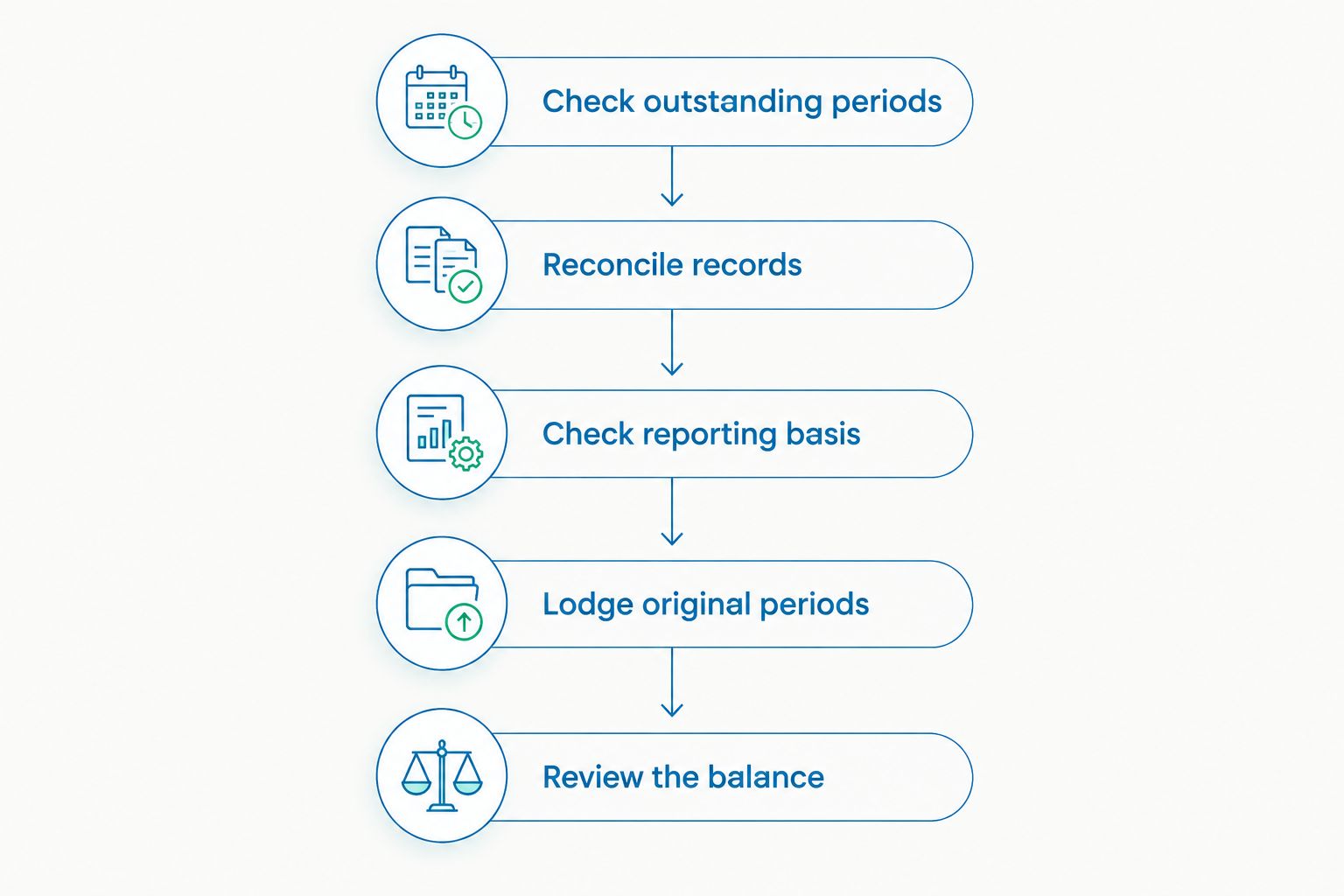
Use the following sequence to establish what is overdue, prepare reliable figures and check the outcome. Do not start by guessing what you owe.
1. Check outstanding periods
Review your ATO account or ask your registered tax or BAS agent to identify outstanding activity statements. Confirm the reporting period, statement type and due date for each missing lodgement.
Distinguish an unlodged statement from a lodged statement with an unpaid balance. They require different action, and an account debt alone does not establish which lodgements are missing.
2. Reconcile records
Bring the bookkeeping for each overdue period up to date. Reconcile bank transactions, check sales and expenses, and review payroll information where PAYG withholding applies.
Use source documents rather than bank descriptions alone to establish the GST treatment. A payment appearing in your bank account does not, by itself, establish whether it includes GST or whether you can claim a GST credit.
3. Check reporting basis
Confirm whether the business accounts for GST on a cash or non-cash basis. That basis affects which period includes a sale or purchase, so assigning everything by invoice date can produce the wrong result.
Also check whether transactions were already included in a later BAS. Finding those overlaps before lodgement helps prevent duplicate reporting and identifies statements that need further review.
4. Lodge original periods
Submit each missing BAS against its actual reporting period. If several statements are overdue, working through the oldest records first helps you trace opening balances and identify duplicated transactions.
Keep the lodgement receipt and a copy of the figures submitted. The receipt establishes that the statement was received; it does not prove that every underlying transaction was treated correctly.
5. Review the balance
After lodgement, check the ATO account for the resulting liability, existing payments, interest and any penalties. Confirm how payments have been allocated rather than assuming a transfer cleared a particular statement.
If payment in full is not possible, discuss an arrangement with the ATO. A payment plan addresses collection of the debt; it is not a substitute for lodging outstanding statements.
Why the consequences of a missed BAS vary
An overdue BAS does not produce the same outcome for every business. The ATO's failure-to-lodge rules, the amount unpaid and the circumstances behind the delay all matter.
Length of delay: A longer delay can affect the failure-to-lodge penalty calculation and the period over which unpaid amounts attract interest.
Business size: The ATO's failure-to-lodge penalty framework applies different treatment according to entity size.
Outstanding tax: Interest relates to unpaid liabilities. A statement with nothing payable presents a different debt position from one with unpaid GST or PAYG withholding.
Reporting accuracy: Missing invoices, incorrect GST codes and duplicate transactions change what needs to be corrected before the statement is reliable.
Reason for the delay: Circumstances outside your control can be relevant to a request for penalty remission, supported by evidence.
Existing arrangements: Check any approved deferral or payment arrangement against its actual terms. Do not assume it covers another period or obligation.
For a 2026 catch-up, ask for the actual account position before discussing the likely consequences. A generic penalty estimate is not a substitute for reviewing the notices and liabilities attached to your business.
Can you avoid penalties by lodging late voluntarily?
Lodging voluntarily addresses the outstanding reporting obligation, but it does not automatically cancel a penalty. The ATO can apply a failure-to-lodge penalty when a required statement is late.
If a penalty has been imposed, review whether there are grounds to request remission. Explain the circumstances, identify the affected periods and retain evidence supporting the explanation.
Do not confuse penalty remission with interest remission. They are separate decisions, and a request about one does not automatically resolve the other.
The practical priority is to stop the reporting gap from growing. Keep current BAS obligations under control while resolving the overdue statements, rather than allowing the catch-up work to create another missed deadline.
Can you correct an old BAS through your next statement?
You can correct some GST errors on a later BAS, but only when the ATO's eligibility conditions are met. That correction process does not replace lodging a statement that was never submitted.
The distinction is straightforward: an overdue BAS is missing reporting; an incorrect BAS is reporting that needs correction. Some businesses have both problems at once.
For GST errors, the available correction method can depend on the error type, applicable time and value limits, and whether compliance activity affects eligibility. PAYG withholding and other activity statement labels require their own treatment; do not apply GST correction rules to every figure on the form.
Before submitting a current BAS in 2026, check whether it contains transactions shifted from an earlier period. Review those transactions individually rather than moving a single balancing amount between statements.
What if your records are incomplete?
Start with the records you can verify: bank statements, sales records, supplier invoices, payroll reports and earlier lodged statements. Request missing documents from suppliers where necessary, then reconcile them against the bookkeeping.
Australian businesses generally need to keep most business records for 5 years, although some records must be retained longer. An overdue BAS is a reason to preserve supporting documents, not discard them because the transaction happened some time ago.
GST credit claims also have time limits. The ATO generally applies a 4-year limit to claiming GST credits, subject to the applicable rules and exceptions; that is not an extra period in which you can ignore BAS deadlines.
Ask an adviser to check older claims before including them. Do not assume that lodging an old statement makes every old purchase eligible for a GST credit.
Avoid inventing invoices, changing transaction dates or applying a blanket GST percentage to unexplained bank payments. Reconstructing reliable records is different from manufacturing evidence.
When should you get professional help?
Get support when you cannot establish the correct reporting periods, your records do not reconcile, or overdue BAS overlap with payroll and tax debts. These are connected problems, but they still need separate checks.
Daintree Consulting is suited to Australian businesses seeking BAS compliance support alongside bookkeeping and business advice. Its accounting and advisory services cover these areas, allowing the discussion to address the records as well as the outstanding statements.
Professional help does not remove your responsibility to provide complete information. It also does not guarantee penalty remission or change the date on which a late statement was lodged.
Prepare the following before asking for help:
The outstanding periods shown in your ATO account.
Copies of relevant ATO notices and correspondence.
Access to bookkeeping records and bank statements.
Details of transactions already reported in another period.
Any existing payment arrangements or approved deferrals.
Agree on what the engagement includes. Preparing overdue BAS, correcting earlier statements, responding to penalties and managing ongoing bookkeeping are distinct tasks.
Review your BAS support needs
Discuss overdue BAS, bookkeeping and the reporting support your business needs.
FAQ
Can you backdate a missed BAS lodgement in Australia?
No. You lodge the overdue BAS for its original reporting period, but the ATO records the actual submission date. Lodging for an earlier period does not make the statement on time.
Should I lodge an overdue BAS if I cannot pay it?
Yes. Lodge an accurate overdue BAS and address payment separately with the ATO. Leaving the statement unlodged does not resolve the debt and can create a separate failure-to-lodge issue.
Do I still need to lodge a BAS if there was no business activity?
Yes, if the ATO requires that statement, you must lodge it even when there is nothing to report. Confirm that it is genuinely a nil statement, including any relevant purchases or withholding obligations.
Will the ATO automatically waive a late BAS penalty?
No. Lodging an overdue BAS does not automatically remove a penalty. Review any penalty notice and request remission where the circumstances support it.
Can I put missed GST transactions into my next BAS?
Only where the applicable GST correction or attribution rules allow that treatment. A later BAS does not replace an outstanding statement, and transactions must not be reported twice.
How long should I keep records supporting an overdue BAS?
Most business records generally need to be kept for 5 years, with longer requirements applying to some records. Preserve the documents supporting overdue statements and check the rules relevant to those records.
Does cancelling my ABN remove overdue BAS obligations?
No. Cancelling an ABN does not erase outstanding reporting or tax obligations. Review outstanding statements and any final reporting requirements when closing the business.
One last thing
A BAS showing nothing payable is not the same as having nothing to lodge. That distinction is easy to miss when a business has paused trading or its owner assumes that no sales means no reporting obligation.
For your 2026 catch-up, finish with an obligation check, not just a payment check. Confirm which statements remain outstanding, retain submission receipts and record the next due dates.
Daintree Consulting can support BAS compliance and the bookkeeping behind it. The useful outcome is one clear picture of what has been lodged, what remains payable and what needs attention next.
Related guides
Talk to Daintree about your tax and BAS
Our ex-Big 4 team gives clear, senior-reviewed advice so you can act with confidence.
Book a free consultation →
Or explore our tax and BAS services.
