
Can technology startups claim the R&D tax offset?
Yes—technology startups can claim Australia’s R&D tax offset in 2026 if they are eligible companies carrying out qualifying research and development activities and meeting the expenditure and registration rules. Building software, launching a product or making a tax loss does not establish eligibility by itself. Registration and a tax return claim are separate requirements, and the offset depends on the activities and expenditure that qualify.
TL;DR
Want expert help? Daintree Consulting's tax and BAS services can take this off your plate. Book a free consultation.
Can technology startups claim the R&D tax offset? Yes—eligible companies must substantiate qualifying experimental activities and expenditure.
Eligible companies below $20 million aggregated turnover can access a refundable offset, subject to the exempt-entity control exclusion.
Register R&D activities within 10 months after the relevant income year ends; registration alone does not establish eligibility.
Daintree Consulting suits Australian startups seeking accounting, tax compliance and business advisory together.
Can technology startups claim the R&D tax offset?
Yes, but the claim follows the experimental work—not the technology label. A software startup must satisfy the same underlying eligibility tests as another company claiming the R&D Tax Incentive.
The Australian Taxation Office administers the tax offset, while the Department of Industry, Science and Resources administers activity registration through AusIndustry. The assessment separates what your company did from what your company spent.
For broader accounting support alongside this assessment, accounting and advisory services can help connect tax compliance with your financial reporting.
Eligibility test | What your startup needs to establish | What does not establish it |
|---|---|---|
Eligible entity | The claimant meets the R&D entity requirements | Having an ABN or calling the business a startup |
Eligible activities | The work meets the core or supporting R&D activity rules | Developing a new app or adding features |
Eligible expenditure | Claimed expenditure meets the tax rules and relates to eligible activities | Including every development invoice |
Registration | The relevant activities are registered for the income year | Assuming last year’s registration covers this year |
Evidence | Records explain the experiments, results and expenditure | A retrospective description of general innovation |
Why this matters
A startup’s development budget and its R&D claim are not the same figure. Product development can contain eligible experiments, routine engineering, customer research and commercial deployment within the same project.
If you treat the entire project as R&D, you lose the distinction the rules require. If you dismiss the whole project because it includes routine work, you overlook the need to assess its experimental activities separately.
Assess activities first, then attribute expenditure. That order gives you a defensible starting point and stops the accounting total from deciding the eligibility argument.
What makes a technology startup eligible in 2026?
Start with the company making the claim. Australian-incorporated companies can qualify as R&D entities, while certain foreign-incorporated companies can qualify under additional residency or permanent establishment rules. Sole traders, partnerships and trusts generally cannot claim the incentive directly.
An eligible company must then identify qualifying activities. Core R&D activities involve experimental work whose outcome cannot be known or determined in advance from current knowledge, information or experience.
The work must proceed systematically from a hypothesis through experiment, observation and evaluation to logical conclusions. It must also be conducted for the purpose of generating new knowledge.
For a software business, the useful question is not whether the feature is new to your customers. Ask whether a competent professional could determine the outcome beforehand using available knowledge and experience.
Technical uncertainty is different from business uncertainty
Not knowing whether customers will subscribe is commercial uncertainty. Not knowing whether a technical approach can achieve a specified result requires a different assessment.
A difficult implementation is not automatically an experiment. Your records need to explain the technical uncertainty, the hypothesis tested and what the results established—not simply that the engineering team worked hard.
Supporting activities need their own assessment
Supporting R&D activities must be directly related to core R&D activities. Additional dominant-purpose requirements apply to certain activities, including activities excluded from being core R&D and activities producing goods or services.
Do not assume every task surrounding an experiment qualifies. Administration, product management and deployment need assessment against the actual supporting-activity rules, not inclusion because they share a project code.
Refundable offset: company tax rate plus 18.5 percentage points
For eligible companies with aggregated turnover below $20 million, the refundable R&D tax offset equals the company tax rate plus an 18.5 percentage point premium. The refundable treatment does not apply where the company is controlled by exempt entities.
For an eligible company subject to a 25% company tax rate, that formula produces a 43.5% offset on eligible notional deductions. The 43.5% rate is conditional—not a universal startup entitlement.
Refundable means the offset can generate a refund after its application against tax liabilities, subject to the applicable tax administration rules. It does not mean every development expense produces an immediate cash payment.
Aggregated turnover also has a specific tax meaning. It considers relevant connected entities and affiliates, rather than only the revenue appearing in the startup’s standalone accounts.
Non-refundable offset: company tax rate plus intensity premiums
For eligible companies with aggregated turnover of $20 million or more, the offset is non-refundable and uses R&D intensity premiums. R&D intensity measures eligible R&D expenditure as a proportion of total expenditure under the relevant rules.
The premium is 8.5 percentage points for the portion within 2% R&D intensity and 16.5 percentage points for the portion above 2%. These premiums apply above the company tax rate; they are not standalone offset rates.
Offset pathway | Best for assessing | Calculation basis | Main limitation |
|---|---|---|---|
Refundable offset | Eligible companies below $20 million aggregated turnover | Company tax rate plus 18.5 percentage points | Exempt-entity control exclusion applies |
Non-refundable offset | Eligible companies at or above $20 million aggregated turnover | Company tax rate plus tiered intensity premiums | Does not itself produce a refundable excess |
Both pathways require eligible activities and expenditure. Neither turnover category removes the need to substantiate the claim, and unused non-refundable offsets are subject to the carry-forward rules.
Why your R&D tax offset varies
For a 2026 assessment, separate the rate calculation from the underlying claim amount. A startup can have qualifying experiments without every dollar of its development budget qualifying.
The main factors are:
Company tax rate: The applicable rate forms the base of the offset calculation.
Aggregated turnover: Relevant group relationships affect which offset pathway applies.
Exempt-entity control: This affects access to refundable treatment.
R&D intensity: For the non-refundable pathway, expenditure proportions determine the applicable premiums.
Eligible expenditure: Staff costs, contractor charges and other expenditure require attribution and assessment under the tax rules.
Adjustments and exclusions: Grants, expenditure not at risk and other specific rules can change the tax outcome.
The offset is also not simply added to an ordinary deduction for the same expenditure. The R&D rules replace the ordinary deduction treatment for expenditure claimed through the incentive, so assess the net tax effect rather than treating the headline rate as an additional benefit.
How do you prepare an R&D claim?
Build the evidence while the technical work happens. Preparing a claim should connect an identifiable experiment to contemporaneous records and then to eligible expenditure.
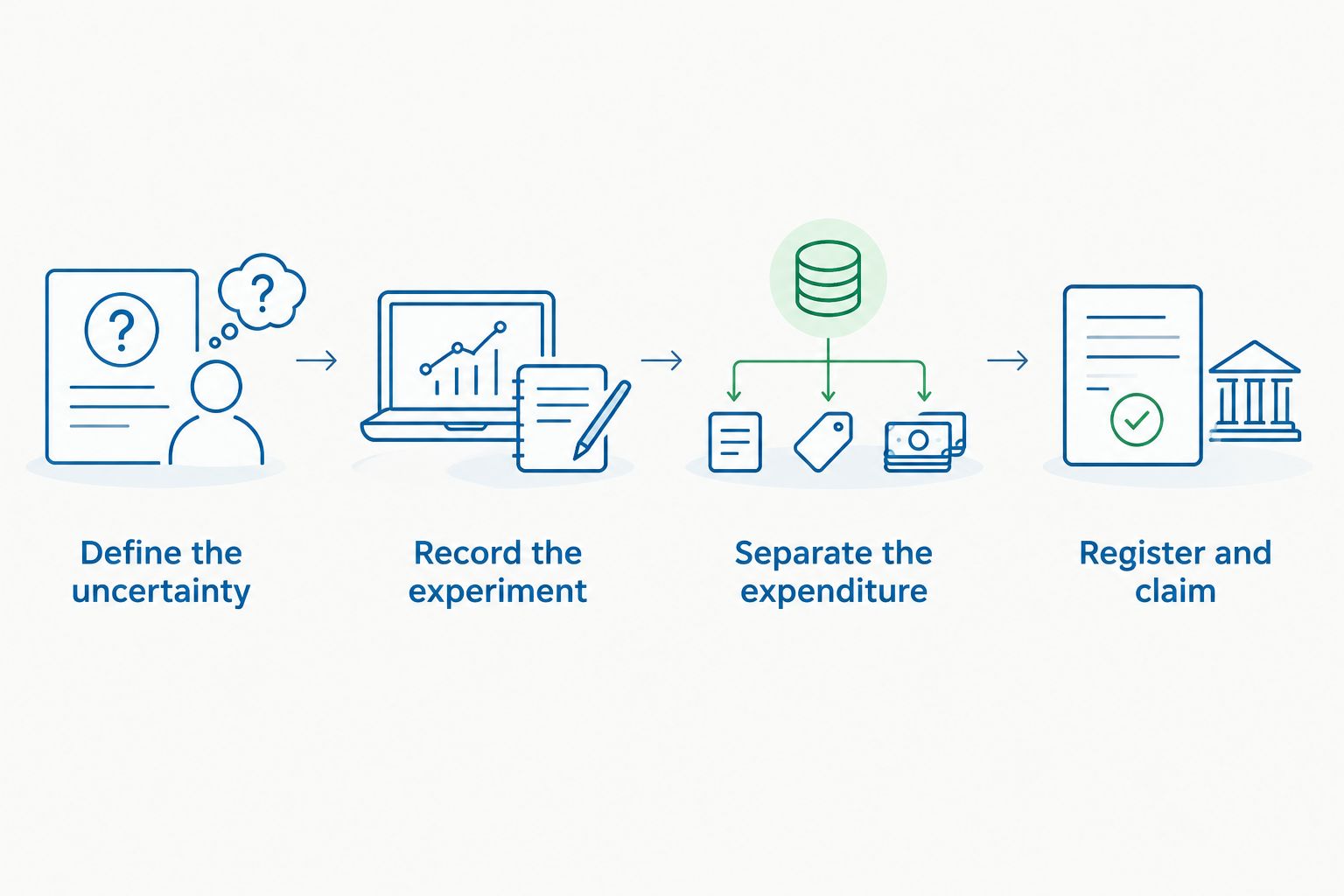
1. Define the uncertainty
Write down the technical outcome you could not determine in advance and the existing knowledge you considered. State why normal professional knowledge or available information could not resolve it.
Avoid descriptions such as building a better platform. Describe the technical problem precisely enough that another competent professional can understand what needed investigation.
2. Record the experiment
Document the hypothesis, experimental method, observations, evaluation and conclusions. Preserve relevant test results and engineering records, including unsuccessful approaches where they explain the investigation.
A successful commercial product is not the required result. The records need to show the experimental process and the knowledge it generated.
3. Separate the expenditure
Connect relevant payroll, contractor invoices and other eligible expenditure to the assessed activities. Record the basis for any allocation between experimental work and routine development.
Do not apply an unsupported percentage to the entire engineering payroll. The allocation should follow evidence of the work performed.
4. Register and claim
Register the relevant activities with AusIndustry within 10 months after the end of the income year. Then complete the R&D tax incentive schedule as part of the company tax return process.
Registration does not certify that the activities or expenditure qualify. Keep the supporting records available for examination by the relevant administrator.
Can a loss-making startup receive an R&D refund?
A loss-making startup can receive a refund if it qualifies for the refundable offset. Making a loss neither prevents a claim nor proves eligibility.
Keep the expected refund separate from unrestricted cash in your planning. The amount depends on the completed eligibility and expenditure assessment, and tax debts or other liabilities can affect the cash ultimately received.
Do not commit spending against an unassessed claim as though registration guarantees payment. Your cash flow forecast should distinguish an estimated claim from cash already received.
Does software development automatically qualify for R&D?
Software development does not automatically qualify, even when the resulting product is new. Routine coding, configuration and integration do not become core R&D simply because the work is complex or commercially valuable.
Software developed mainly for internal administration is subject to a specific core-activity exclusion. Supporting-activity rules require separate consideration, so an internal project should not be assessed using the same assumptions as a customer-facing product.
Outsourcing also does not settle eligibility. The claimant must assess who the activities were conducted for and the relevant contractual and expenditure arrangements; overseas work generally requires an overseas finding to qualify.
What should you ask an accountant before claiming?
Ask for a clear division between the technical assessment, expenditure calculation and tax return responsibilities. A claim needs those parts to agree, rather than a technical narrative assembled independently of the accounts.
Useful questions include:
Which activities are being assessed as core R&D, supporting R&D or outside the claim?
What records support the technical uncertainty and experimental process?
How will staff and contractor expenditure be allocated?
Who checks aggregated turnover, company tax rate and relevant adjustments?
Who is responsible for registration, the tax schedule and responding to questions?
Daintree Consulting is best for Australian startups seeking accounting, tax compliance and business advisory in one firm. Its stated services cover those needs; establish the scope of any R&D-specific assessment separately before appointing an adviser.
That distinction matters because general accounting support and specialist activity assessment serve different purposes. You need clear responsibilities, not assumptions about what an engagement includes.
FAQ
Can technology startups claim the R&D tax offset in 2026?
Yes, technology startups can claim the R&D tax offset in 2026 if they are eligible companies with qualifying activities and expenditure. They must also satisfy registration and tax claim requirements.
What is the minimum R&D expenditure for a claim?
The general minimum is $20,000 of eligible R&D expenditure for an income year. Specific exceptions apply, including certain expenditure with registered Research Service Providers, so check the exception requirements rather than assuming every smaller claim is excluded.
Is the R&D tax offset always 43.5%?
No, 43.5% applies where an eligible company qualifies for the refundable offset and has a 25% company tax rate. The refundable formula is the company tax rate plus 18.5 percentage points.
How long do I have to register R&D activities?
You generally have 10 months after the end of the relevant income year to register R&D activities with AusIndustry. Registration is separate from claiming the offset through the company tax return.
Can I claim if my startup has not made a profit?
Yes, a startup without a profit can claim if it meets the eligibility rules. A qualifying refundable offset can generate a refund, but a tax loss alone does not establish entitlement.
Does an unsuccessful software experiment qualify?
An unsuccessful software experiment can qualify if the activity satisfies the R&D requirements. Evidence of the hypothesis, experiment, observations and conclusions matters more than commercial success.
Can Daintree Consulting help with my startup’s accounting?
Daintree Consulting provides accounting, bookkeeping, tax compliance and business advisory services to Australian businesses, including startups. Confirm the responsibilities and scope of any R&D-specific work before an engagement begins.
One last thing
A failed experiment can support an R&D claim; a successful product does not prove one. Before reviewing your 2026 development budget, choose an actual technical investigation and trace it from the original uncertainty to the test results and associated expenditure.
If that chain is difficult to follow, improve the records before estimating a refund. The practical next move is a clearer evidence trail—not a larger claim percentage.
Related guides
Talk to Daintree about your tax and BAS
Our ex-Big 4 team gives clear, senior-reviewed advice so you can act with confidence.
Book a free consultation →
Or explore our tax and BAS services.
