
Can healthcare clinics outsource payroll and bookkeeping together?
Yes, Australian healthcare clinics can outsource payroll and bookkeeping together, with one provider handling agreed payroll processing, transaction records and reconciliations. The clinic still needs to approve payments, supply accurate employment information and check that its obligations are met. In 2026, the right arrangement combines clear responsibilities with controlled access to employee and patient information—not simply a shared software login.
TL;DR
Want expert help? Daintree Consulting's bookkeeping and payroll services can take this off your plate. Book a free consultation.
Can healthcare clinics outsource payroll and bookkeeping together? Yes, with clear approvals and an agreed service scope.
Daintree Consulting suits Australian businesses seeking bookkeeping, payroll and accounting support from one firm.
Combined support connects payroll expenses, bank reconciliations and financial reporting; clinic management still owns key approvals.
Keep patient clinical records separate from the financial information needed for bookkeeping and payroll.
Can healthcare clinics outsource payroll and bookkeeping together?
Yes. Payroll and bookkeeping can sit within one outsourced service, provided the agreement explains what the provider processes and what the clinic approves. The important distinction is between outsourcing the work and transferring responsibility. They are not the same thing.
You can explore bookkeeping and payroll services together, rather than treating payroll as an isolated administrative task. Before choosing an arrangement, compare the practical trade-offs.
Arrangement | Best for | Main benefit | Main limitation |
|---|---|---|---|
Combined outsourced support | Clinics wanting connected payroll and financial records | Payroll expenses and liabilities can be reconciled within the same workflow | Responsibilities and independent approvals still need explicit separation |
Separate payroll and bookkeeping providers | Clinics retaining a specialist provider for either function | Each provider can focus on its agreed area | Someone must coordinate payroll journals, corrections and reconciliations |
Internal processing | Clinics keeping day-to-day processing with their own team | Direct oversight of routine work | The clinic must maintain capability, cover absences and manage reviews |
None of these structures removes the need for accurate employee records. Choose the arrangement that gives your practice manager a clear picture of completed work, outstanding questions and upcoming obligations.
Why this matters for healthcare clinics
Payroll affects more than employee payments. It also creates wage expenses, leave balances, PAYG withholding and superannuation liabilities that need to agree with your accounts.
A clinic can pay employees correctly while its financial records remain incomplete. It can also have tidy accounts while incorrect employment settings flow through each pay run. Combining the services helps only when the provider checks the connection between them.
For a clinic reviewing its arrangements in 2026, the useful question is therefore not just whether both tasks can be outsourced. Ask how the provider will keep payroll, bank activity and reporting consistent—and how exceptions will reach you before approval.
What should a combined service include?
Start with a written scope. The terms payroll and bookkeeping describe broad functions, not a standard package with identical inclusions everywhere.
Payroll processing
An agreed payroll scope can cover employee setup, processing approved hours, maintaining payroll records, generating payslips and preparing required payroll reporting. It should also explain how leave, changes to pay and termination instructions reach the processor.
Your clinic should approve employment terms and changes before they enter payroll. A processor should not have to infer an employee's classification or entitlement from a timesheet description.
Ask who reviews unusual payments and who handles employee queries. A routine pay-run service does not automatically include employment law advice, award interpretation or resolving a disputed entitlement.
Bookkeeping and reconciliation
Bookkeeping can cover transaction coding, bank reconciliations, supplier records and the financial entries generated by payroll. For clinics, the scope should also address how patient receipts, payment processor settlements and relevant payer remittances are reconciled.
A settlement arriving in your bank account is not always the same as gross billings. Fees, adjustments and timing differences need an agreed treatment so that income and cash receipts remain distinguishable.
Ask whether the provider reconciles payroll liability accounts, rather than only posting a wage expense. Unexplained balances need an owner and a resolution process.
Compliance and reporting boundaries
Clarify whether the engagement includes BAS preparation, lodgement, superannuation payment administration and Single Touch Payroll reporting. These activities should not be assumed merely because bookkeeping appears in the proposal.
Australian tax and BAS services are subject to registration requirements and exemptions. Check the appropriate Tax Practitioners Board registration for the services being provided, rather than relying on a general accounting job title.
How do you keep control when both tasks are outsourced?
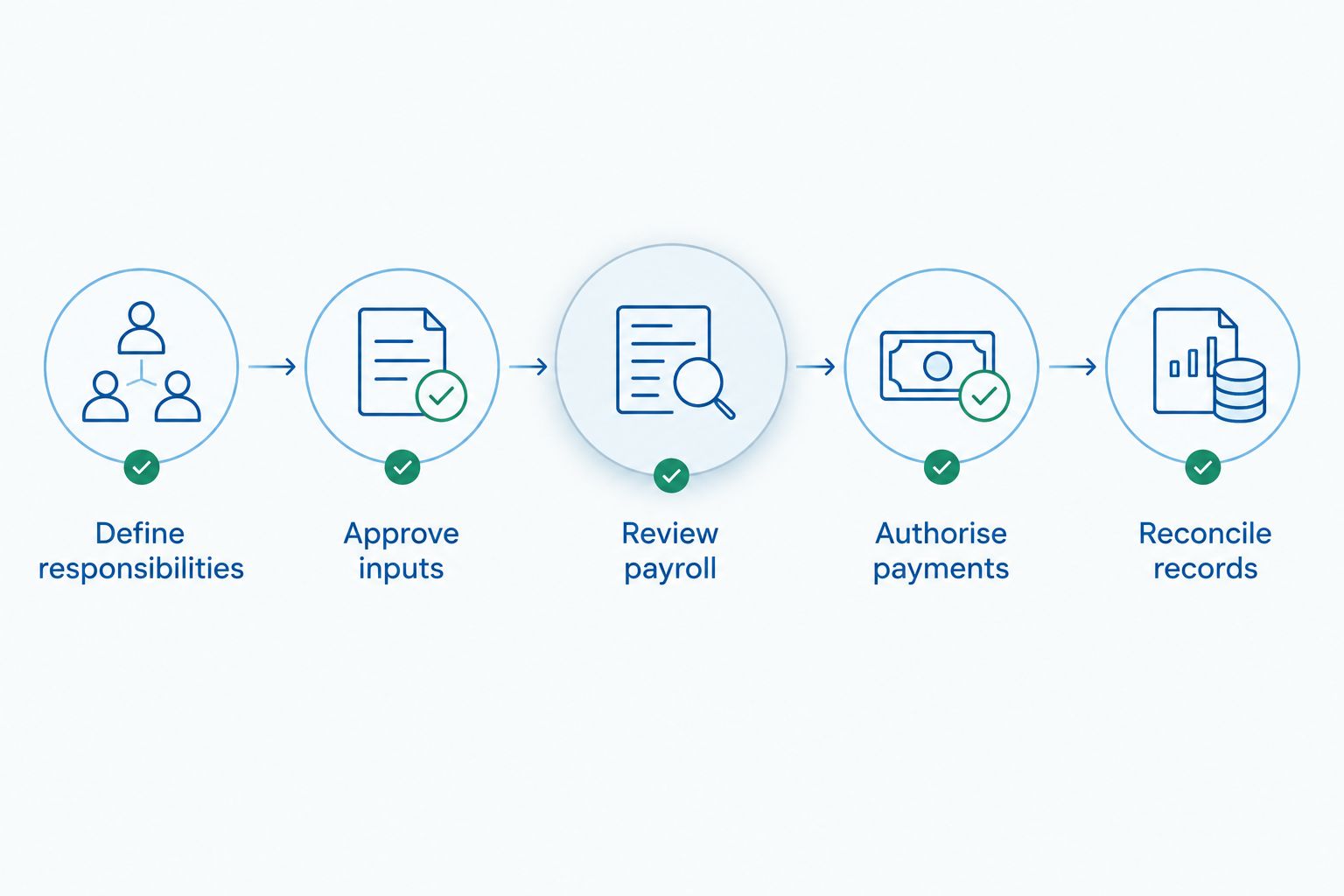
Keep approval authority inside the clinic, even when processing happens outside it. A useful control structure separates the person preparing a payment from the person authorising its release.
1. Define responsibilities
Write down who supplies payroll inputs, checks changes, reviews reports and authorises payment. Include responsibility for payroll reporting, superannuation administration and bookkeeping corrections.
Name a clinic contact and a provider contact. An inbox alone does not establish who must resolve a problem.
2. Approve inputs
Give the provider approved timesheets, leave requests and employment changes through a consistent process. Separate a request for a change from approval to implement it.
Record how late changes are handled. Otherwise, an urgent message can bypass the checks your normal process relies on.
3. Review payroll
Review the payroll summary before payment, concentrating on new employees, changed bank details, unusual hours, leave and final payments. Compare unexplained changes with the approved inputs.
Do not treat a total that looks familiar as evidence that every employee has been paid correctly. Errors can offset each other within the overall amount.
4. Authorise payments
Decide who prepares payment files and who releases funds through the bank. Keep access rights aligned with those duties.
Verify employee bank-detail changes through an established process before payment. An email requesting a change should not be the only evidence used to redirect wages.
5. Reconcile records
Check that payroll reports, bank payments and accounting entries agree. Review outstanding payroll liabilities and investigate balances that remain unexplained.
Include corrections in the review trail. A fix should show what changed, why it changed and who approved it.
Why the right outsourcing arrangement varies
Your clinic's operating detail should shape the engagement. Use these factors to explain the work accurately when requesting a proposal in 2026:
Employment arrangements: Different roles, employment types and applicable industrial instruments need correct setup and review. Do not assume every clinic employee falls under the same award.
Roster inputs: Variable hours, overtime, allowances and leave create different processing requirements from an unchanged salary run.
Practitioner arrangements: Employee payroll and payments to independent practitioners are not interchangeable. Contract labels alone do not settle every tax, superannuation or employment question.
Revenue reconciliation: Patient payments, payer remittances, refunds and settlement deductions need a clear route into the accounts.
Systems and access: Practice management software, payroll software and accounting records need a defined handoff, whether through an integration or a controlled transfer.
Reporting needs: A clinic seeking basic reconciliations requires a different scope from one seeking management reporting, cash-flow forecasting and advisory support.
These factors determine the work to specify, not a reason to accept an unclear proposal. Ask the provider to explain inclusions, exclusions and your team's required contribution in plain language.
How should clinics protect employee and patient information?
Give the provider the information needed for the agreed financial task, not unrestricted access to every clinic record. Bookkeeping generally needs transaction evidence; it does not require routine access to clinical notes.
Start by mapping what information moves between systems. Identify where employee details, bank information and patient identifiers appear, including in exported reports and emailed attachments.
Ask the provider to explain:
Which people can access your records, including subcontractors.
Where information is stored and how remote access is controlled.
Whether individual accounts and multi-factor authentication are used.
How access changes when staff leave or responsibilities change.
How security incidents, record retention and return of data are handled.
Australian privacy obligations require more than a confidentiality statement in a proposal. Check the arrangement against your clinic's obligations and obtain appropriate advice where sensitive information, overseas access or unusual data-sharing arrangements are involved.
How do you move both services without losing continuity?
Treat a change of provider as a controlled handover, not simply a transfer of passwords. Before the change, agree who handles outstanding work and who owns each reporting obligation during the transition.
Confirm the starting position
Have the incoming provider review opening payroll balances, employee details, leave records and outstanding liabilities. Identify unreconciled bank transactions and incomplete reporting before routine processing begins.
Keep a written list of unresolved items. An old balance should not become an accepted opening figure merely because it has been carried forward.
Test the information flow
Walk through how approved hours become payroll, how payroll becomes a payment and how that payment reaches the accounts. Confirm who receives exceptions at each stage.
Check the connection between practice management reports and bank receipts as well. Payroll can be orderly while the revenue side of the bookkeeping remains incomplete.
Review the handover
Before ending the previous arrangement, confirm access to historical reports, supporting records and required exports. Establish who will answer questions about work completed before the transition.
For a 2026 handover, check current reporting requirements and software settings rather than assuming the previous configuration remains appropriate. Keep the review focused on actual settings, records and responsibilities.
Does outsourcing remove the clinic's payroll responsibilities?
No. Outsourcing processing does not remove the clinic's responsibilities as an employer. You still need accurate employment arrangements, approved inputs and oversight of payments and obligations.
The provider's responsibilities should be enforceable through a clear engagement, but the contract is not a substitute for clinic-level review. Escalate uncertainty about classifications or entitlements before it becomes a repeated payroll setting.
Should practitioner payments go through employee payroll?
Practitioner payments should follow the actual working arrangement, not whichever payment method is easiest. Employees and independent practitioners require different treatment, and an ABN or invoice alone does not resolve every classification issue.
Ask for advice where the arrangement is unclear. Superannuation and state or territory payroll tax questions can require assessment beyond ordinary bookkeeping entries.
Is combined support right for your clinic?
Choose combined support when you want a single accountable workflow across payroll processing, reconciliations and financial reporting. Keep separate providers if specialist responsibilities are already working well and the handoff between them is clear.
Daintree Consulting provides bookkeeping and payroll alongside accounting, tax and advisory services for Australian businesses. That breadth suits a clinic seeking connected financial support; it does not replace checking the proposed team's experience with your employment arrangements, practice systems and reporting requirements.
Before appointing Daintree Consulting or another provider, request a written responsibility schedule and a walkthrough of the approval process. Choose demonstrated understanding of your workflow over a broad promise to handle everything.
Clarify your clinic's support needs
Discuss the responsibilities, approvals and reporting your bookkeeping and payroll arrangement needs.
FAQ
Can a small healthcare clinic outsource payroll and bookkeeping together?
Yes, a small healthcare clinic can outsource both functions under one engagement. Define the processing tasks, clinic approvals and reporting responsibilities before work starts.
Will outsourcing payroll make the provider responsible for all employment compliance?
No, outsourcing payroll does not transfer all employer responsibilities to the provider. The clinic still needs correct employment arrangements, accurate instructions and oversight of payments and obligations.
Does a bookkeeper need access to patient clinical notes?
Routine bookkeeping does not require access to patient clinical notes. Give the provider the financial records needed for reconciliation and limit unnecessary patient information.
Can the same provider handle payroll and BAS?
Yes, one provider can handle payroll and BAS where those services are included and the relevant registration requirements are met. Confirm preparation, review and lodgement responsibilities separately.
Should the outsourced provider approve employee bank-detail changes?
The clinic should retain a clear approval process for employee bank-detail changes. Verify the request through an established channel before the provider updates payroll or a payment is released.
Can independent practitioners be paid through the same process as employees?
Independent practitioner payments should not automatically be treated as employee payroll. Assess the actual arrangement and obtain advice on employment, tax and superannuation treatment where necessary.
What should a clinic check before changing payroll providers in 2026?
Before changing payroll providers in 2026, check employee records, opening balances, outstanding liabilities, reporting responsibilities and access to historical information. Agree who resolves unfinished work before the previous engagement ends.
One last thing
Ask the prospective provider to walk you through an employee changing bank details just before a pay run. Who verifies the request, who changes the record, who reviews the payment and who releases the funds?
That practical example reveals more about your control environment than a list of software features. For your 2026 review, use it alongside a reconciliation example: ask how the provider proves that wages paid through the bank agree with payroll and the accounts.
Related guides
Talk to Daintree about your bookkeeping and payroll
Our ex-Big 4 team gives clear, senior-reviewed advice so you can act with confidence.
Book a free consultation →
Or explore our bookkeeping and payroll services.
