
Can construction businesses claim GST on retention payments?
Yes—an Australian construction business can claim a GST credit on a retention payment when the underlying purchase is creditable and the amount is attributable to its BAS period. If you account for GST on a cash basis, you claim the retained component only when you pay it; non-cash accounting requires you to check the invoicing and attribution rules. If you are the contractor receiving the retention, you account for GST on sales rather than claim a purchase credit.
TL;DR
Want expert help? Daintree Consulting's tax and BAS services can take this off your plate. Book a free consultation.
Can construction businesses claim GST on retention payments? Yes, subject to GST registration, creditable acquisition requirements and BAS timing.
Cash-basis purchasers claim GST credits on retained amounts when paid, not merely when invoiced.
Non-cash purchasers must check invoice timing and any applicable particular attribution rules.
Australian Taxation Office guidance distinguishes GST credits on purchases from GST payable on construction sales.
Why this matters
Retention changes the payment arrangement; it does not automatically remove GST from the construction work. The practical question is which business is claiming a credit, on what acquisition, and in which reporting period.
Your accounting and BAS support should connect the contract, progress claim, tax invoice and payment record. A retention balance sitting in your accounts is not, by itself, evidence that you can claim another GST credit.
For your 2026 BAS review, separate the tax treatment from the commercial reason for withholding payment. A defects obligation explains why money remains unpaid, but your GST accounting method determines how payment affects attribution.
Can construction businesses claim GST on retention payments?
Yes, provided the construction business is entitled to a GST credit for the underlying acquisition. Generally, you must be registered for GST, acquire the work for a creditable business purpose, receive a taxable supply and hold the required supporting documentation.
Start by identifying your position in the transaction:
Your position | Best for identifying | GST treatment | Main limitation |
|---|---|---|---|
Builder withholding money from a subcontractor | GST credits on purchased work | Assess the credit and its attribution under your GST accounting method | An unpaid retention does not establish cash-basis entitlement |
Subcontractor waiting for retention money | GST payable on work supplied | Assess GST on the construction sale | Receipt of retention is not a purchase credit |
Business both withholding and awaiting retentions | Separate purchase and sales obligations | Review each contract side independently | Netting the balances obscures their different treatment |
The Australian Taxation Office’s guidance on claiming GST credits and cash versus non-cash accounting provides the general framework. Construction contracts also require attention to progressive supplies, invoice wording and any applicable particular attribution rules.
Do not claim GST twice: releasing retention is not a second acquisition of the same construction work.
Cash-basis GST: claim the retained component when paid
If you account for GST on a cash basis, your purchase credit generally follows the consideration you actually provide. When you pay only part of a taxable construction invoice, you claim the corresponding proportion of the available credit, subject to the usual entitlement requirements.
The withheld balance remains unpaid. You claim the credit associated with that balance in the period when you pay it, assuming you have not already claimed it and the documentation supports the purchase.
For an acquisition wholly subject to GST at 10%, the GST component is ordinarily 1/11 of the GST-inclusive consideration. Do not apply that fraction indiscriminately where an invoice contains amounts with different GST treatment.
Check these records together:
The supplier’s tax invoice and its GST treatment.
The amount actually paid during the BAS period.
The retention withheld under the contract.
Any earlier credits recorded against the same invoice.
For cash-basis reporting in 2026, an invoice marked as paid in your software is not enough if the retained amount has not actually been paid. Reconcile the accounting entry to the payment evidence.
Non-cash GST: check attribution before claiming
Non-cash accounting does not use the same payment-only test. Under the ordinary attribution rules, a purchase credit is generally attributed by reference to the earlier of providing consideration or receiving an invoice, with a tax invoice required before claiming where the tax invoice rules apply.
That general rule is the starting point—not permission to claim every retention balance immediately. Check the contract, the invoice’s scope and any particular attribution rules relevant to the arrangement.
An invoice for the full value of work, a progress claim showing a deduction for retention, and a later invoice specifically seeking retention release are not documents you should treat as interchangeable. Establish what each document does before deciding the BAS treatment.
Ask your accountant to record the reasoning, particularly where the contract has separate progress and retention obligations. A documented attribution decision gives the next person preparing the BAS a clear basis for continuing the treatment.
For a 2026 review, distinguish a genuine tax timing issue from a bookkeeping issue. An incorrectly coded retention account needs correction, but changing the account code does not itself change the legal entitlement to a GST credit.
Why GST treatment varies between retention arrangements
The label on the ledger is not decisive. These factors explain why two construction businesses can have different reporting outcomes:
Your role: purchasing construction work creates a different GST question from supplying it.
GST accounting method: cash accounting links purchase credits to payments; non-cash accounting uses different attribution rules.
Underlying supply: a GST credit requires an eligible acquisition, not merely a payment described as retention.
Contract and invoice terms: progress payments, retained consideration and release obligations need to be read together.
Previous reporting: an amount already included in a valid earlier credit cannot be claimed again on release.
Later changes: a genuine reduction in consideration can require adjustment treatment rather than ordinary payment allocation.
These are checks to make against your records, not alternative treatments to choose for a preferred BAS result. Apply the rules that fit the actual transaction.
How do you check a retention payment before lodging BAS?
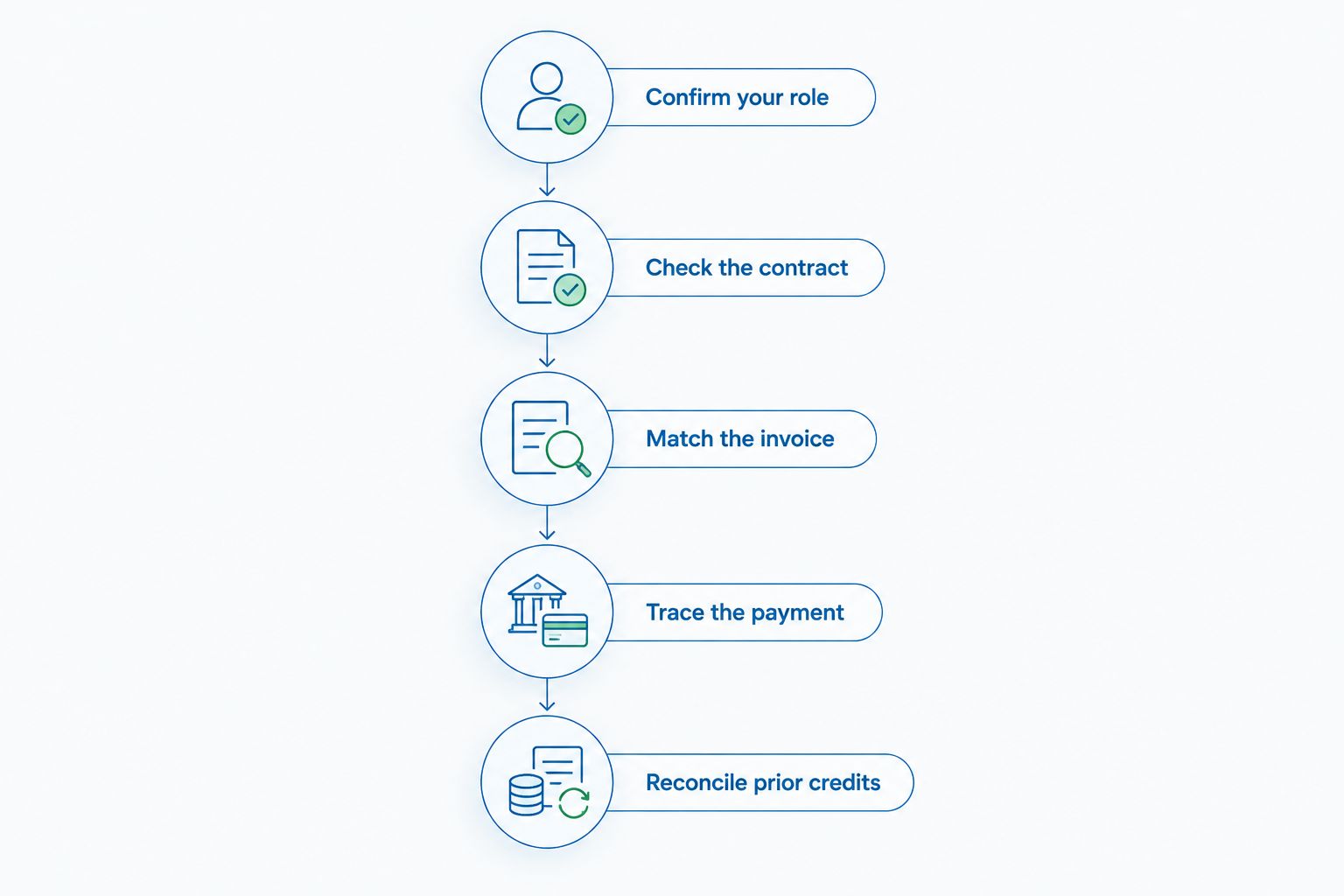
Use the following sequence for each material retention balance. Keep purchase retentions separate from amounts customers owe you, even when both relate to the same building project.
01. Confirm your role
Identify whether you owe the retention to a supplier or are waiting to receive it from a customer. This establishes whether you are reviewing a purchase credit or GST payable on a sale.
02. Check the contract
Read the retention clause alongside the payment provisions. Identify the work covered, the retained consideration and the conditions governing release, rather than relying on a description in the accounting software.
03. Match the invoice
Connect the tax invoice to the progress claim and retention schedule. Check whether the retained amount is included in the invoiced consideration and whether later paperwork repeats an amount already recorded.
04. Trace the payment
Match bank transactions to the supplier balance. A transfer between a trade creditor account and a retention liability account is not, by itself, payment to the supplier.
05. Reconcile prior credits
Compare the proposed claim with earlier BAS reporting. Leave a clear record of the credit claimed, the remaining balance and the reason for its treatment.
A useful 2026 retention schedule shows the supplier, contract reference, invoice reference, retained balance, payment status and GST already claimed. That is more useful for BAS preparation than a single unexplained total in the balance sheet.
What if the customer is withholding retention from your business?
GST on retention you receive is a sales reporting question, not a purchase credit. If you are the subcontractor, the customer’s decision to hold back payment does not turn your receivable into an expense.
For cash-basis GST accounting, GST on the retained consideration generally follows receipt. For non-cash accounting, check the applicable attribution rules rather than assuming you can wait until the customer pays.
Keep the retention receivable visible in your debtor reconciliation. Otherwise, a later receipt risks being recorded as a new sale instead of being allocated against the existing balance.
The same distinction applies when you buy subcontractor services and invoice a head contractor. Your supplier retention and customer retention are separate transactions, even where commercial cash flow connects them.
What happens if retention is reduced or never released?
An unpaid retention and a reduction in the agreed consideration are not the same event. A delayed payment leaves a collection or payment issue; an agreed change to the amount payable requires a separate GST assessment.
Do not automatically reverse GST because the defects period has ended without payment. Establish whether the amount remains owing, has been varied by agreement, is disputed or is affected by bad-debt rules.
For cash-basis purchases, an amount never paid generally has not generated a payment-based credit. Where a credit was already attributed under non-cash accounting, ask whether adjustment provisions apply to the subsequent events.
Keep settlement correspondence and any adjustment documentation with the original invoice. That creates a clear explanation for the difference between the original contract amount and the eventual accounting outcome.
When should you ask your accountant to review retention GST?
Ask for a review when the retention schedule does not reconcile, a supplier issues replacement paperwork, your GST accounting method changes, or earlier claims do not have a clear audit trail. Resolve the treatment before carrying it into another reporting period.
Daintree Consulting is best suited to Australian businesses seeking accounting, BAS compliance and advisory support together. Its stated service scope includes bookkeeping and accounting alongside broader business advice; a retention review still depends on the actual contract and transaction records.
You can discuss your retention records with Daintree Consulting. Bring the contract, relevant invoices, payment history and prior BAS treatment so the discussion addresses the transaction rather than the account label.
FAQ
Can I claim GST on retention before paying the subcontractor?
If you use cash-basis GST accounting, you generally cannot claim the credit for the unpaid retained component. Under non-cash accounting, check invoice timing, entitlement and any applicable particular attribution rules rather than applying the cash-basis test.
Do construction retention payments include GST?
Retention does not independently determine whether GST applies; the underlying supply does. Where the retained consideration relates to a taxable construction supply, withholding payment does not automatically make that consideration GST-free.
Is GST on retention always one-eleventh of the payment?
The GST component is ordinarily 1/11 of GST-inclusive consideration where the amount is wholly subject to GST at 10%. Check the invoice before applying that calculation to mixed or differently treated amounts.
Can I claim GST again when retention is released?
No, you cannot claim a second credit for an amount already validly claimed. Reconcile the release against the original invoice and previous BAS reporting before recording another GST credit.
Does moving retention into another account count as paying it?
A bookkeeping transfer between creditor and retention accounts does not, by itself, pay the supplier. Cash-basis credit attribution requires you to establish the consideration actually provided.
What documents should I keep for a retention GST claim?
Keep the contract, tax invoice, progress claim, retention schedule, payment evidence and records of GST already claimed. Retain relevant variation or settlement documents where the amount payable changes.
Can Daintree Consulting help review construction retention records?
Daintree Consulting provides accounting, bookkeeping and tax and BAS compliance services. A retention discussion should cover the contract, invoices, payment records and earlier reporting so the GST position can be assessed.
One last thing
Check the original claim before checking the release payment. The most useful question is often not whether GST applies, but whether the credit has already been accounted for.
GST credits generally have a 4-year time limit, measured from the due date of the BAS for the period in which you first became entitled to the credit. Do not assume that finding an old retention balance during your 2026 reconciliation restarts that period.
Related guides
Talk to Daintree about your tax and BAS
Our ex-Big 4 team gives clear, senior-reviewed advice so you can act with confidence.
Book a free consultation →
Or explore our tax and BAS services.
