
Can bookkeeping be done remotely for a small business?
Yes, bookkeeping can be done remotely for a small business when your bookkeeper can securely access accounting records, receive supporting documents and resolve questions with you. Physical tasks such as counting cash or checking stock still need someone on site, and you must agree who approves payments, manages payroll and handles BAS work.
TL;DR
Want expert help? Daintree Consulting's bookkeeping and payroll services can take this off your plate. Book a free consultation.
Can bookkeeping be done remotely for a small business? Yes, with secure access, complete records and clear responsibilities.
Remote bookkeeping handles digital records; physical cash counts and stock checks still need someone on site.
Daintree Consulting provides bookkeeping alongside accounting, tax and advisory services for Australian businesses.
Check Tax Practitioners Board registration when engaging a paid provider for BAS services.
Why this matters
Remote bookkeeping separates the location of the work from the quality of the work. For your 2026 setup, focus on accurate records, controlled access and timely answers rather than whether your bookkeeper sits in your office.
The scope matters just as much as the location. When reviewing accounting and bookkeeping services, distinguish routine transaction processing from payroll, BAS preparation, tax advice and financial reporting. A remote arrangement needs clear ownership of each task, not an assumption that bookkeeping includes everything.
Can bookkeeping be done remotely for a small business?
Yes. Most bookkeeping tasks can be completed remotely when the underlying records are available digitally. These tasks include recording transactions, matching payments to invoices, reconciling bank accounts and preparing reports from the accounting records.
A remote bookkeeper still needs information that a bank feed cannot supply. A payment description rarely explains the business purpose of an expense, whether an invoice includes GST or whether a purchase belongs to the business owner personally.
You can choose a fully remote arrangement or combine remote processing with local support. The right choice depends on how your business captures evidence and handles physical transactions.
Arrangement | Best for | Main advantage | Main limitation |
|---|---|---|---|
Remote bookkeeping | Businesses that capture invoices, receipts and approvals digitally | Records and questions can move between you and the bookkeeper without an office visit | Missing documents or unanswered questions interrupt processing |
Hybrid bookkeeping | Businesses with digital accounts and recurring physical paperwork or cash handling | Remote processing works alongside local document collection or checks | Responsibilities can overlap unless you define the handover |
On-site bookkeeping | Businesses that need regular hands-on access to physical records and staff | The bookkeeper can resolve document questions in person | Physical attendance does not replace access controls or approval procedures |
None of these arrangements removes your responsibility to provide accurate information. Choose the working model that keeps records complete and decisions visible.
What can a remote bookkeeper actually do?
Transaction recording and reconciliation
A remote bookkeeper can categorise income and expenses, match customer payments and reconcile bank and credit card accounts. Reconciliation checks that the accounting records agree with the relevant statements; it is not simply accepting every transaction suggested by the software.
Ask how unexplained transactions will be handled. A useful process keeps unresolved items visible and sends you specific questions rather than burying them in a general expense category.
Customer invoices and supplier bills
Your bookkeeper can record supplier bills, track unpaid customer invoices and prepare information about amounts owed. Invoice creation, payment reminders and payment preparation can also form part of the agreed scope.
Preparing a payment and approving a payment are separate responsibilities. Remote access should not automatically give a bookkeeper unrestricted authority to move money. Keep approval with the person authorised to make the spending decision.
Payroll and BAS support
Payroll can be administered remotely when employee records, approved hours, leave details and pay changes reach the person processing it. Payroll is a distinct responsibility, so confirm whether it is included rather than assuming it comes with bookkeeping.
BAS work also needs a scope check. In Australia, a provider charging for BAS services generally needs Tax Practitioners Board registration unless an exemption applies; registered tax agents can also provide BAS services. Check the registration relevant to the work you are engaging them to perform.
Reporting
A remote bookkeeper can prepare reports from maintained accounts, including profit and loss reports and information about customer debts or supplier balances. Those reports are useful only when transactions, adjustments and reconciliations are up to date.
Ask what each report covers and which questions remain unresolved. A polished report with incomplete records does not give you a clear picture of the business.
What still needs someone inside the business?
Remote bookkeeping cannot replace physical verification or management judgement. Someone in your business must confirm what actually happened and authorise what happens next.
Typical local responsibilities include:
Cash handling: Count physical cash, document takings and explain differences between records and deposits.
Stock checks: Confirm goods held on site and report discrepancies or damaged stock.
Document capture: Photograph or scan paper receipts and invoices before they disappear.
Business explanations: Identify private spending, owner contributions and unusual transactions.
Approvals: Authorise purchases, employee changes and payments under your agreed controls.
These responsibilities do not make remote bookkeeping unsuitable. They define the handover between your business and the bookkeeper. A cash-handling business can use remote bookkeeping, but somebody local must produce reliable cash records.
How do you set up remote bookkeeping properly?
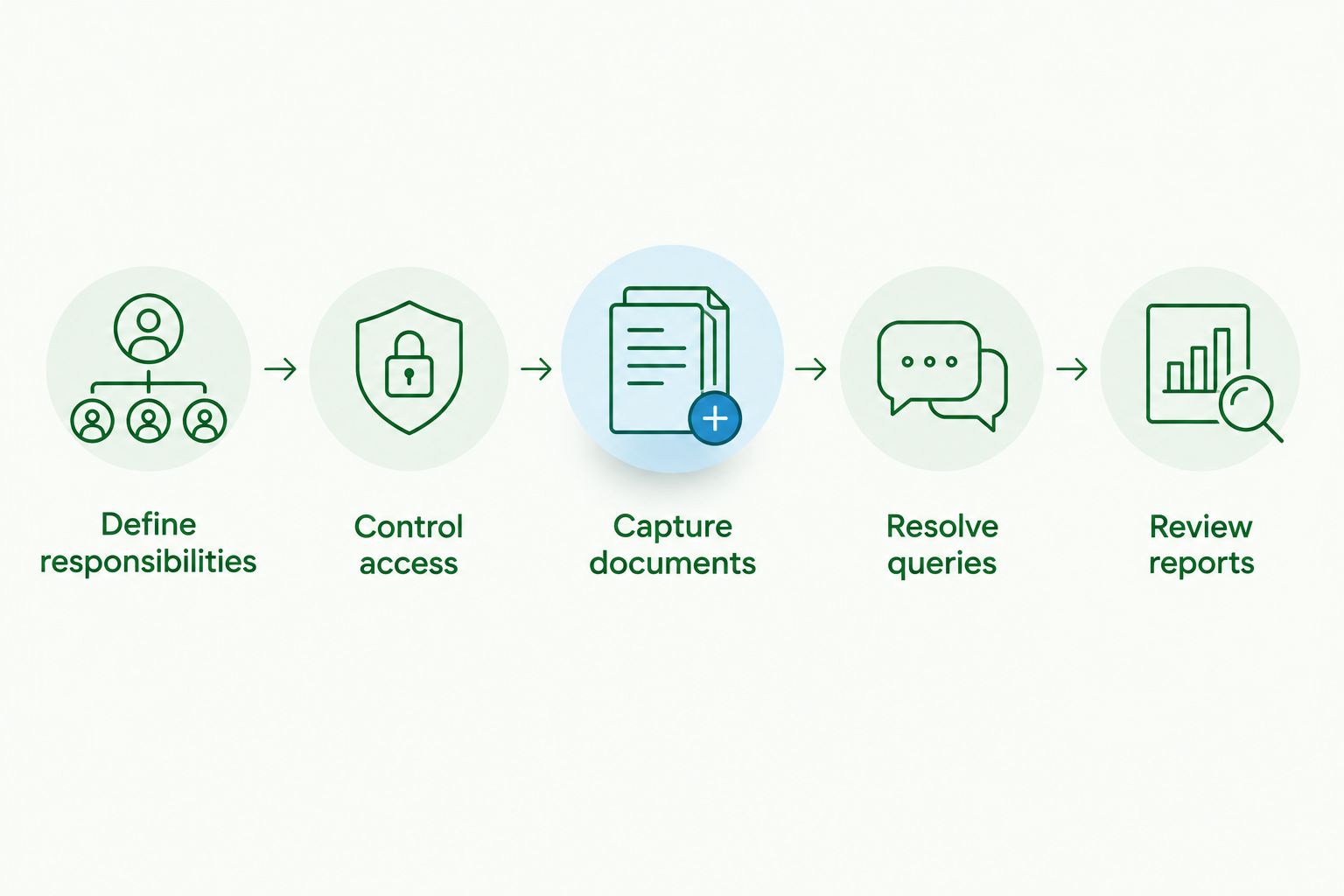
Use this sequence when establishing or reviewing your 2026 arrangement. Agree the process before handing over access, particularly if an existing backlog needs attention.
1. Define responsibilities
Write down who records transactions, collects documents, answers queries, approves payroll and authorises payments. Include BAS responsibilities and the reports you expect to receive.
Separate historical clean-up from ongoing work. Otherwise, both parties can believe the other is fixing old transactions while current records continue to accumulate.
2. Control access
Give the bookkeeper an individual user account with permissions suited to the agreed tasks. Use multi-factor authentication where available, and avoid sharing the owner's login.
Discuss bank access separately from accounting access. Viewing transactions, preparing payments and releasing payments are different permissions; do not treat them as a single requirement.
3. Capture documents
Choose an agreed channel for invoices, receipts and payroll information. Tell staff where records belong and who checks that submissions are complete.
Australian Taxation Office guidance generally requires businesses to retain most business records for 5 years, although some records have longer retention requirements. Electronic records must remain readable and accessible; a bank feed alone does not provide every supporting document.
4. Resolve queries
Nominate a person who can answer bookkeeping questions and agree when they will respond. Unresolved queries should have a clear owner rather than circulating through several inboxes.
Explain changes early, including new finance arrangements, staff changes and unfamiliar income streams. Your bookkeeper cannot reliably classify a transaction from an amount and a short description alone.
5. Review reports
Agree when reconciliations and reports will be ready, then review them together with outstanding questions. Check bank balances, unpaid invoices, supplier liabilities and any accounts used to hold unresolved transactions.
For your 2026 review, ask whether the process produces usable information before you make decisions. Completing records eventually is not the same as keeping you informed.
Why remote bookkeeping arrangements vary
The same remote setup will not suit every small business. Assess these factors against your actual records rather than choosing on location alone:
Document quality: Clear invoices and receipts support accurate processing; missing evidence creates follow-up work.
Transaction complexity: Loans, owner transactions and unusual purchases need more explanation than straightforward sales and expenses.
Physical activity: Cash handling and stock movements require reliable local records, even when the bookkeeping happens elsewhere.
Payroll responsibilities: Approved hours, leave and employee changes need a dependable handover before payroll is processed.
Compliance scope: Routine bookkeeping, BAS services and tax advice have different responsibilities and registration considerations.
Owner availability: Someone with authority must answer questions and approve decisions; remote access cannot replace that involvement.
In 2026, these are practical selection criteria for a remote arrangement. Ask a prospective provider to explain how each issue will be handled in your business, not simply whether their software supports online access.
Is remote bookkeeping secure for a small business?
Remote bookkeeping needs controlled access, secure document sharing and clear payment authority. Working remotely is not evidence of security, just as working in your office is not evidence of good controls.
Ask how user accounts are created and removed, who else can access your records and how a suspected security incident is reported. Confirm whether subcontractors or other staff will handle the work, rather than assuming only your main contact has access.
Payment-detail changes deserve a separate check. Verify a supplier's changed bank details through a trusted contact method before authorising payment; an email request alone is not sufficient confirmation.
Keep control of the accounting account and know how to retrieve your records. A provider relationship should not leave your business unable to access its own financial information.
Do you need a local bookkeeper if you handle cash or stock?
You need reliable local checks, not necessarily a bookkeeper who attends the premises. Someone on site must count cash, confirm stock information and supply records that the remote bookkeeper can reconcile.
A hybrid arrangement is appropriate when physical paperwork or operational questions repeatedly interrupt remote processing. Be specific about which local tasks solve the problem; paying for attendance does not help if nobody owns the document handover.
For example, separate the physical cash count from the accounting reconciliation. The first confirms what is present, while the second checks how the recorded takings, deposits and differences fit together.
When should you combine bookkeeping with accounting advice?
Combine the services when you need the records to support tax compliance, cash flow decisions or business planning, rather than transaction processing alone. Ask where bookkeeping ends and where accounting or advisory work begins.
Daintree Consulting suits Australian businesses seeking bookkeeping alongside tax and business advisory support. The firm also provides payroll, accounting and outsourced CFO services, allowing you to consider the scope of support as your business becomes more complex.
The decision still needs a clear brief. Ask Daintree Consulting how bookkeeping responsibilities, reporting and communication would be organised for your business; do not assume a particular remote workflow, software package or response time.
FAQ
Can bookkeeping be done remotely for a small business in Australia?
Yes, bookkeeping can be done remotely for a small business when records are available digitally and responsibilities are clear. Someone inside the business still needs to provide documents, explain transactions and approve decisions.
Do I need to give a remote bookkeeper my bank password?
No, you should not share your personal bank password with a remote bookkeeper. Use authorised access arrangements suited to the work, and distinguish transaction visibility from permission to release payments.
Can a remote bookkeeper run payroll?
Yes, payroll can be administered remotely when it is included in the agreed service and accurate employee information is supplied. Confirm who approves hours, pay changes and the final payroll before processing.
Can a remote bookkeeper lodge my BAS?
A remote provider can lodge your BAS when the service is agreed and the provider meets the applicable registration requirements. Check the Tax Practitioners Board register and confirm who prepares, reviews and lodges the BAS.
How long should I keep records for remote bookkeeping?
Most business records generally need to be retained for 5 years under Australian Taxation Office guidance, with longer requirements for some records. Remote bookkeeping does not change your obligation to keep records readable and accessible.
Can I use remote bookkeeping if my business is not registered for GST?
Yes, remote bookkeeping does not depend on GST registration. For 2026, the general compulsory GST registration threshold is $75,000 in GST turnover for businesses and $150,000 for non-profit organisations, with special rules applying to some activities; these are turnover thresholds, not service fees.
How do I change remote bookkeepers without losing my records?
Keep business-controlled access to your accounting records and agree a documented handover. Confirm the reconciliation position, outstanding queries, upcoming obligations and document access before removing the outgoing provider's permissions.
One last thing
A reconciled bank account can still contain incorrectly classified transactions. Matching the bank balance proves that the recorded movements agree with the statement; it does not prove that every expense has the correct tax treatment or supporting evidence.
Before accepting your next reporting pack, ask which transactions remain unexplained and which supporting documents are outstanding. That question tells you more about the condition of the books than whether the bookkeeper works nearby.
Related guides
Talk to Daintree about your bookkeeping and payroll
Our ex-Big 4 team gives clear, senior-reviewed advice so you can act with confidence.
Book a free consultation →
Or explore our bookkeeping and payroll services.
