
Can a startup afford an outsourced CFO?
Yes—a startup can afford an outsourced CFO when the agreed scope fits its cash budget and addresses a financial decision the business needs to make. Affordability depends on the work required, not simply the startup’s size. Allow for the internal effort needed to prepare reliable accounts, explain assumptions and act on the advice.
TL;DR
Want expert help? Daintree Consulting's outsourced CFO services can take this off your plate. Book a free consultation.
Can a startup afford an outsourced CFO? Yes, when a defined scope fits its cash budget and decision needs.
Bookkeeping keeps records current; outsourced CFO support connects cash flow, forecasting and business decisions.
Daintree Consulting suits Australian startups seeking accounting and outsourced CFO support together.
Fix unreliable financial records before commissioning forecasts built on them.
Can a startup afford an outsourced CFO?
A startup can afford an outsourced CFO if it can fund a clearly defined engagement without compromising essential payments. That engagement should address a specific need: understanding cash runway, assessing a hiring decision or planning the funding required for growth.
Daintree Consulting provides accounting and outsourced CFO support for Australian businesses, including startups. The right starting point is deciding whether your business needs better financial records, better interpretation or both.
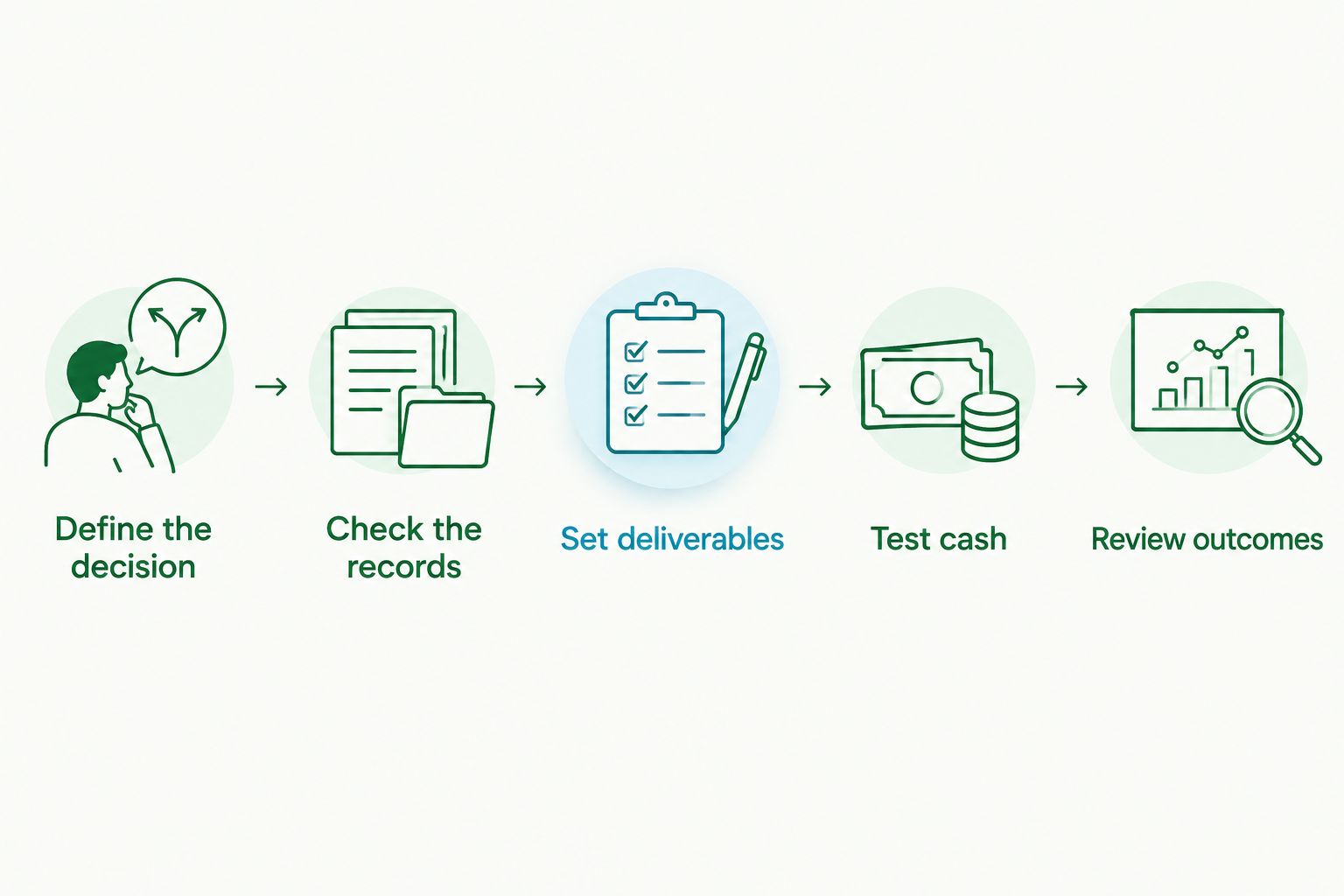
Use this sequence before requesting a proposal:
Name the decision. Identify what you need to decide and when: hiring, expansion, funding or operating changes.
Check the foundation. Confirm that bank reconciliations, payroll and outstanding invoices reflect the business accurately.
Define the output. Specify the forecast, reporting or decision analysis you need, rather than asking for general financial help.
Test the commitment. Put the proposed engagement into your cash forecast alongside wages, suppliers and statutory obligations.
This is the affordability test for 2026: can the business fund the work, and will the agreed output support a decision that matters? A proposal that answers only the first question is incomplete.
Why this matters
A startup can show revenue growth while struggling to meet payments. Sales, profit and cash measure different things, and the timing between them affects what you can safely commit to.
An outsourced CFO helps connect those measures to decisions. That does not replace bookkeeping or tax compliance, and it does not make an uncertain forecast certain.
Buy support for the financial question you need answered, not for the CFO title. If your immediate problem is unreconciled accounts, start there. If the accounts are reliable but you cannot judge what the next hire means for cash, financial planning becomes the relevant work.
Which level of financial support does your startup need?
Bookkeeping, accounting and CFO support overlap, but they are not interchangeable. Compare the work you need before comparing proposals.
Support | Best for | Main contribution | Limit to recognise |
|---|---|---|---|
Bookkeeping | Startups needing reliable transaction records | Recording activity, reconciliations and keeping accounts current | Accurate records alone do not provide a forward-looking operating plan |
Accounting and tax | Startups needing financial reporting and compliance support | Preparing accounts, addressing tax obligations and interpreting results | Confirm whether ongoing forecasting and decision support are included |
Outsourced CFO | Startups facing cash, funding or growth decisions | Connecting forecasts, reporting and financial analysis to management decisions | Depends on reliable inputs and management acting on the findings |
These are descriptions of the work, not fixed boundaries between providers. An accountant can also provide advisory services; a CFO engagement can include coordination with the people handling bookkeeping and compliance.
Ask each provider to distinguish recurring tasks from advisory work. You need to know who maintains the records, who reviews the forecast and who explains what needs to change.
For your 2026 planning, write those responsibilities beside the actual deliverables. A service label is not enough to establish what you are buying.
Start with the decision, then set the scope
A useful engagement starts with a question narrow enough to answer. Replace “we need financial advice” with “can we hire without creating a cash shortfall?” or “what funding does this expansion require?”
Cash flow
Best for: a startup that needs to understand upcoming receipts and payments.
A proposed starting point is a 13-week cash forecast, updated as actual receipts and payments become known. Thirteen weeks is a planning horizon for this exercise, not a promise that every uncertainty will be resolved.
The benefit is visibility over timing. The limitation is that customer payment assumptions and unexpected expenses still need management attention.
Growth planning
Best for: a startup considering hiring, additional capacity or expansion.
Ask for a forecast that connects the proposed change to revenue assumptions, operating expenses and cash requirements. Separate costs you must commit to from costs you can defer.
The benefit is seeing the financial consequences before committing. The limitation is that a model cannot prove customer demand or guarantee that growth will arrive as planned.
Management reporting
Best for: a startup with usable accounts but no clear picture of performance.
Ask for reporting that explains movements in revenue, margin, operating expenses and cash. Each report should end with the decisions or follow-up work it requires.
The benefit is a consistent basis for discussion. The limitation is that reporting becomes another administrative task if nobody owns the actions it identifies.
Why outsourced CFO scope varies
The work changes as the business becomes more complex. These factors explain why a proposal should be tailored to your startup rather than copied from another business:
Record quality: unreconciled accounts and unclear balances need attention before financial analysis can be trusted.
Cash flow timing: payroll, customer receipts, supplier payments and tax obligations need to appear in the same cash picture.
Reporting needs: a founder’s operating review and reporting for an established organisation serve different audiences.
Growth decisions: hiring and expansion require assumptions about the extra commitments the business will take on.
Service boundaries: bookkeeping, payroll, tax and advisory responsibilities need clear ownership when several people are involved.
A wider scope is not automatically a better scope. Ask which activities support your immediate decision and which belong in a later stage.
For a 2026 engagement, distinguish the initial setup from the continuing work. Otherwise, you cannot tell whether a proposal addresses a temporary reporting gap or an ongoing management need.
How do you test affordability before signing?
Treat the proposed engagement as a business commitment, not an exception to your normal spending discipline. Work through the following sequence using your own figures.
Define the decision
Write down the question, the decision date and the information you currently lack. A deadline attached to an actual hiring or funding decision gives the work a purpose.
Avoid a list that contains every financial concern in the business. Start with the decision that needs attention first.
Check the records
Confirm that the accounts reconcile and that receivables, payables, payroll and tax balances are understood. Flag disputed invoices and uncertain receipts rather than treating them as dependable cash.
If the records need repair, separate that work from the CFO deliverables. Otherwise, you risk paying for analysis before the underlying information is ready.
Set deliverables
Specify what you will receive and what you must supply. That can include a cash forecast, an explanation of assumptions, a management report and a discussion of the available choices.
Make the boundary explicit: preparing information is different from reviewing it, and making a recommendation is different from implementing it.
Test cash
Enter the proposed commitment into your forecast. Check whether wages, suppliers and statutory obligations remain funded under the assumptions you are using.
Also identify the founder or team time required. Advice creates work when someone needs to gather information, challenge assumptions and follow through.
Review outcomes
Set a review point after the first 30 days to assess whether the information is usable. Consider a further review after 3 months to decide whether the scope should continue, change or stop.
These are suggested review intervals, not promised delivery times. Judge the engagement by clearer decisions and completed actions, not simply by the volume of reports.
How do you compare proposals without buying the wrong scope?
Ask providers to respond to the same decision brief. When the underlying request changes between conversations, comparing the resulting proposals tells you little about which service fits.
Request a written explanation of the deliverables, responsibilities, exclusions and review process. Clarify who will discuss the findings with you and how changes in scope will be agreed.
Daintree Consulting is a fit for Australian startups seeking outsourced CFO and accounting support together. That alignment is relevant when your financial records, compliance work and forward planning need coordination; it does not remove the need to agree exactly what your engagement covers.
Jurisdiction also matters. A comparison of fractional CFO services for UAE SMEs addresses a different business market; Australian founders still need a proposal that identifies responsibility for Australian tax, BAS and payroll obligations.
For your 2026 shortlist, compare what happens after a report is delivered. Does the engagement include explaining the implications and discussing the decision, or does it end with the document? Neither arrangement should be left implicit.
When should a startup wait?
Wait when the proposed CFO work has no clear decision, usable inputs or affordable scope. Waiting is not the same as ignoring the finances; it means fixing the more immediate problem first.
If your records are unreliable, prioritise bookkeeping and reconciliation. If a tax or BAS obligation needs attention, address compliance rather than assuming a broader advisory engagement includes it.
Also wait if you cannot identify who will act on the advice. A forecast that recommends changes to collections, spending or hiring needs someone with authority to make those changes.
An outsourced CFO is not a substitute for demand, operating discipline or management judgement. The service supports decisions; the founder remains responsible for the business commitments that follow.
Is outsourced CFO support only for funded startups?
No. Funding status alone does not determine whether a startup needs outsourced CFO support; the relevant questions are financial complexity, decision needs and affordability.
A business using customer receipts to fund growth still needs to understand cash commitments. A funded business still needs to define what it expects the engagement to deliver.
Can my accountant handle the work instead?
Yes, if your accountant offers the forecasting, reporting and advisory work you need. Ask for a defined scope rather than assuming that ongoing CFO support forms part of tax compliance.
Keeping the work together can simplify coordination, but only when responsibilities are clear. You still need to know who prepares the information, who interprets it and who discusses the decisions with you.
What should you prepare before the first conversation?
Bring current financial reports, information about outstanding customer and supplier balances, payroll commitments and known tax obligations. Add the decision you need to make and the assumptions causing uncertainty.
For a 2026 planning discussion, explain what has changed since the latest reports. A new hire, delayed receipt or proposed expansion can make historical results an incomplete starting point.
FAQ
Can a startup afford an outsourced CFO before it is profitable?
Yes, if the startup can fund a defined engagement without compromising essential payments. Profitability alone does not establish affordability; test the commitment against available cash and expected receipts.
What is the difference between a bookkeeper and an outsourced CFO?
A bookkeeper maintains financial records, while an outsourced CFO connects financial information to forward-looking decisions. Reliable bookkeeping provides the foundation for useful forecasting and analysis.
Do I need an outsourced CFO if I already have an accountant?
You need additional support only if your existing arrangement does not cover the financial planning and decision work required. Ask your accountant whether forecasting, management reporting and ongoing advisory discussions are included.
What should an outsourced CFO do first for a startup?
An outsourced CFO should clarify the decision the startup needs to make and check whether the financial information supports it. The initial deliverables should follow that assessment rather than a generic reporting package.
Can an outsourced CFO guarantee that my startup will grow?
No, an outsourced CFO cannot guarantee growth. Forecasts and analysis help you assess choices, but customer demand, execution and changing circumstances still affect results.
Does Daintree Consulting work with startups?
Yes, Daintree Consulting serves Australian startups as well as growing SMEs and established organisations. Its services include accounting, bookkeeping, tax compliance, business advisory and outsourced CFO support.
One last thing
Before commissioning a forecast, write down what you would change if it showed a cash shortfall. Would you delay hiring, change a commitment or follow up customer payments sooner?
If no result would change your decision, reconsider the scope. The value lies in the action the financial picture supports—not in having another spreadsheet.
Related guides
Talk to Daintree about your finance function
Our ex-Big 4 team gives clear, senior-reviewed advice so you can act with confidence.
Book a free consultation →
Or explore our outsourced CFO services.
