
Can a small business run payroll without software?
Yes, a small business can calculate wages manually and pay staff without buying its own payroll software, but most Australian employers still need a software-enabled way to report through Single Touch Payroll (STP). In 2026, a spreadsheet alone does not satisfy that reporting obligation. You can use a payroll provider or registered agent with a suitable reporting solution, or operate outside STP only where an applicable exemption applies.
TL;DR
Want expert help? Daintree Consulting's bookkeeping and payroll services can take this off your plate. Book a free consultation.
Can a small business run payroll without software? Manual calculations are possible, but STP generally requires a software-enabled reporting solution.
Australian employers must still manage PAYG withholding, superannuation, payslips and employee records.
Daintree Consulting provides bookkeeping and payroll support for Australian businesses seeking help with these obligations.
Choose your reporting method before deciding whether spreadsheets are sufficient for wage calculations.
Why this matters
Calculating wages, paying employees and reporting payroll are separate tasks. A spreadsheet can support the calculations, and a bank transfer can move the money, but neither automatically reports payroll to the Australian Taxation Office (ATO).
That distinction matters when you assess whether manual payroll is practical in 2026. Your decision needs to cover the full process, not just how you arrive at an employee's take-home pay. Daintree Consulting provides accounting, bookkeeping and payroll services for Australian businesses that want support across these responsibilities.
Can a small business run payroll without software?
You can run payroll without operating your own software, but that is different from running payroll without software anywhere in the process. Under the ATO's STP requirements, most employers report employees' payroll information through an STP-enabled solution each payday, unless a different reporting arrangement applies.
Employing just 1 person does not automatically remove the reporting requirement. A business using manual calculations therefore still needs to resolve how its payroll information reaches the ATO.
Approach | Best for | What it handles | Main limitation |
|---|---|---|---|
Manual calculations with separate STP reporting | Employers with straightforward calculations and a confirmed reporting method | Wage calculations and records, with reporting handled separately | Requires reconciliation between the calculations and the submitted report |
Employer-operated payroll software | Employers wanting to process payroll internally | Calculations, records and reporting where supported by the chosen system | Requires correct setup, accurate inputs and ongoing review |
Outsourced payroll | Employers wanting someone else to operate the payroll process | Agreed processing and reporting tasks through the provider's systems | The employer still needs to supply information, approve payments and oversee compliance |
The ATO's STP guidance for employers is the relevant starting point for reporting requirements in 2026. Fair Work Ombudsman guidance separately explains employee record and payslip obligations; meeting one set of requirements does not replace the other.
What does manual payroll actually involve?
Manual payroll means you calculate the amounts rather than relying on a payroll system to calculate them. You still need to establish gross earnings, allowances, deductions, PAYG withholding, superannuation and net pay.
You also need to update leave records, produce payslips, maintain employee records and complete the required reporting. A worksheet that calculates net pay is only part of that job.
Manual calculations with separate STP reporting
This approach keeps the wage calculation outside a payroll platform while using a separate solution or authorised provider for reporting. It suits straightforward payroll only when you have a clear reporting arrangement and a reliable checking process.
Its advantage is control over the calculations and supporting records. Its drawback is duplication: information calculated in one place must reach another place accurately, and corrections must remain consistent across both.
For example, changing an employee's gross pay after preparing the reporting information creates a reconciliation task. Before payment, check that gross earnings, withholding, superannuation and net pay agree with the final payroll records and the information being reported.
Do not assume an accountant will report payroll simply because they prepare your tax return. Agree on who processes each pay run, who submits the STP report and who corrects mistakes.
Employer-operated payroll software
Employer-operated software suits a business that wants to retain payroll processing internally and connect calculations with reporting. The benefit is a more connected workflow; the limitation is that the system still depends on your decisions and inputs.
Software does not decide whether you have classified an employee correctly. You must establish the relevant award or agreement, employment type, hours, allowances and other entitlements before relying on the result.
Check what a proposed system actually supports. STP reporting, leave handling, superannuation processing and record exports are separate capabilities, and the presence of one does not establish the others.
Before adopting a system in 2026, confirm how you will review a pay run, correct an error and retrieve records if you later change providers. A simpler interface is useful only if the underlying process meets your obligations.
Outsourced payroll
Outsourced payroll suits employers who want a provider to operate the agreed processing and reporting tasks rather than maintain an internal payroll workflow. You do not have to operate the software yourself, although the provider still uses systems to deliver the service.
The benefit is a defined person or team responsible for the agreed work. The limitation is that outsourcing does not remove your responsibilities as the employer or fix incomplete information about hours, employment conditions and staff changes.
Daintree Consulting's bookkeeping and payroll services suit Australian businesses seeking support with payroll and compliance. Before appointing any provider, confirm the scope, information deadlines, approval process and responsibility for corrections.
A useful engagement separates preparing payroll from approving it. You should understand what is being paid and reported, even when someone else performs the calculations.
Why the practicality of manual payroll varies
The question is not simply whether you can use a spreadsheet. It is whether you can maintain accurate calculations, records and reporting without leaving gaps between them.
Employment conditions: Awards and enterprise agreements can affect minimum rates, allowances, overtime and penalty rates. Identify the applicable rules before calculating wages.
Working patterns: Changing hours, overtime and different shifts require more checking than a consistently structured pay run.
Leave and adjustments: Leave taken, leave balances, back pay and corrections need to remain consistent across payroll records.
Reporting arrangements: Manual calculations need a separate STP reporting method unless an applicable exemption removes that requirement.
Review and continuity: Payroll needs an approval process and a workable handover when the person who normally handles it is absent.
Headcount alone is not a reliable measure of complexity. A small team with changing shifts and allowances can require substantial payroll checking.
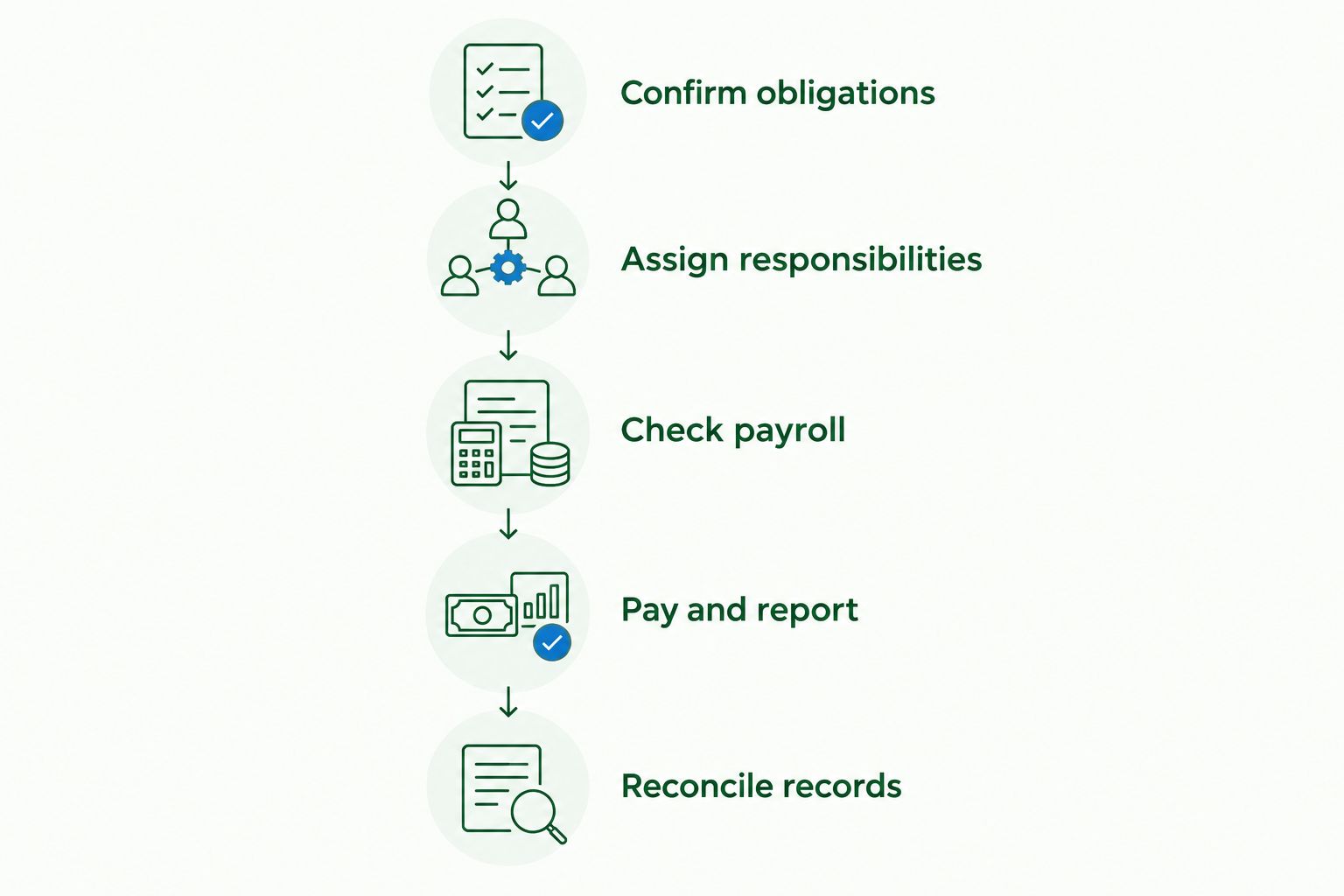
How do you set up payroll without operating your own software?
Use this sequence to establish the process before the first payment. The reporting method should be a starting decision, not something you investigate after paying staff.
01. Confirm obligations
Identify the employees you will pay, their employment arrangements and the applicable award or agreement. Establish what information you need to calculate wages, withholding, superannuation and leave correctly.
Check your STP position with the ATO or an appropriately registered adviser. Do not treat a small payroll, limited computer access or a spreadsheet preference as an exemption.
02. Assign responsibilities
Write down who collects hours, checks changes, calculates payroll, approves payments and submits reporting. If a provider is involved, confirm exactly which tasks sit within the engagement.
Decide who monitors superannuation payments and responds to rejected or incorrect submissions. A task without a named owner is not a completed payroll arrangement.
03. Check payroll
Review employee details, hours, rates, leave, allowances and deductions before approving the pay run. Use the relevant ATO withholding schedules or calculator rather than applying an assumed tax percentage.
Check superannuation against ordinary time earnings and the applicable rules. In 2026, the standard super guarantee rate is 12%, but deciding which earnings attract super still requires care.
04. Pay and report
Approve the final payroll, make the payments and complete STP reporting within the applicable requirements. Confirm submission results rather than treating a file upload as proof of acceptance.
Provide compliant payslips within 1 working day of payday. The Fair Work Ombudsman's payslip guidance applies to electronic and paper payslips; paying by bank transfer does not replace them.
05. Reconcile records
Check that payroll records, bank payments and reported information agree. Record corrections clearly so another person can understand what changed and why.
Fair Work rules require employee records to be retained for 7 years. Keep records accessible and protect employee information, including when changing accountants, payroll providers or systems.
Which obligations remain when you calculate payroll manually?
Manual payroll changes the method, not the employer's obligations. Your 2026 payroll checklist still needs to cover correct pay, withholding, superannuation, records, payslips and reporting.
The ATO's published super guarantee rate for 2026 is 12%. Apply it to the correct earnings base, check employee eligibility and follow the payment deadlines that apply to the relevant period; showing super on a payslip does not establish that it has been paid.
Fair Work Ombudsman guidance requires payslips within 1 working day of payday and employee records retained for 7 years. These requirements apply independently of whether your calculations sit in a workbook or a payroll platform.
Also check that deductions are lawful and properly recorded. An employee's request, an employment contract or a software setting should not be treated as a substitute for checking the applicable deduction rules.
Can I use a spreadsheet for just one employee?
Yes, you can calculate payroll for 1 employee in a spreadsheet, but that does not create an STP exemption. You still need a compliant reporting arrangement and accurate records of pay, withholding, superannuation and leave.
Can my accountant lodge payroll reports for me?
A registered tax or BAS agent can provide payroll reporting services within the scope of their registration and engagement. Confirm that payroll reporting is included, how information will be authorised and who checks that submissions have been accepted.
Does outsourcing payroll remove my legal responsibility?
No, outsourcing payroll does not remove your responsibilities as the employer. You still need to provide correct employment information, approve the payroll and check that the agreed payments and reporting occur.
FAQ
Can a small business run payroll without software in Australia?
A small business can calculate payroll manually, but most Australian employers still need a software-enabled STP reporting method. Using a provider lets you avoid operating the software yourself; it does not mean software is absent from the process.
Do I need STP if I only employ one person?
Employing 1 person does not automatically exempt your business from STP. Check whether an applicable exemption or reporting arrangement applies rather than relying on employee numbers.
Can I pay wages straight from my business bank account?
Yes, you can pay wages by bank transfer, but the transfer does not calculate entitlements, issue a payslip or complete STP reporting. Those tasks need their own process.
How quickly do I need to give employees their payslips?
You must provide payslips within 1 working day of payday under Fair Work requirements. Payslips must contain the required information, whether supplied electronically or on paper.
How long do I need to keep payroll records?
Fair Work rules require employee records to be kept for 7 years. Keep them accessible and maintain a clear record of any corrections.
What super rate should I use for payroll in 2026?
The standard super guarantee rate in 2026 is 12% of ordinary time earnings for eligible employees. Check the earnings base, eligibility and payment requirements rather than applying the percentage to every payroll amount automatically.
Can Daintree Consulting help if I do not want to process payroll myself?
Daintree Consulting provides bookkeeping and payroll services for Australian businesses. Confirm the proposed engagement covers the processing, reporting and record-keeping tasks you want handled.
One last thing
Ask how you will retrieve your payroll records before choosing how to run payroll. A system or provider can change; your record-keeping obligation continues.
Confirm that you can obtain payslips, payroll summaries, leave records and reporting information in a usable form. That final check helps you choose a process you can explain, review and hand over—not just one that produces the next wage payment.
Talk to Daintree about your bookkeeping and payroll
Our ex-Big 4 team gives clear, senior-reviewed advice so you can act with confidence.
Book a free consultation →
Or explore our bookkeeping and payroll services.
