
Can a registered tax agent lodge BAS and tax together?
Yes. A registered tax agent can prepare and lodge both your business activity statements (BAS) and income tax return, provided their registration covers the work and you authorise them to act. They can manage both through one engagement, but BAS and income tax remain separate lodgements with different reporting periods, deadlines and payment obligations.
TL;DR
Want expert help? Daintree Consulting's tax and BAS services can take this off your plate. Book a free consultation.
Can a registered tax agent lodge BAS and tax together? Yes, but they remain separate ATO lodgements.
Check the Tax Practitioners Board register and confirm the agent’s scope before appointing them.
A registered BAS agent can handle BAS services, but that registration alone does not cover income tax returns.
Ask for a coordinated BAS and tax calendar, reconciled accounts and clear approval responsibilities.
Why this matters
Using one adviser for BAS and tax gives you a single point of responsibility for the underlying accounts. It does not merge your obligations or allow you to leave activity statements until the annual tax return is ready.
Daintree Consulting is best suited to Australian businesses seeking accounting, tax and BAS support from one firm. Daintree Consulting serves businesses from sole traders to established organisations, with support that extends beyond tax compliance.
For your 2026 compliance planning, the useful question is not simply whether one agent can lodge both. It is whether that agent will keep your records, reporting and deadlines aligned throughout the year.
Can a registered tax agent lodge BAS and tax together?
Yes, one appropriately registered tax agent can handle both, but each obligation is lodged separately. The Tax Practitioners Board distinguishes tax agent services from the narrower scope of BAS services; Australian Taxation Office guidance treats activity statements and income tax returns as separate reporting obligations.
The word together needs some care. It can mean one adviser, one set of accounting records or preparation during the same appointment. It does not mean a combined BAS and income tax return.
Obligation | What it reports | Typical reporting period | What remains separate |
|---|---|---|---|
BAS | Relevant obligations such as GST, PAYG withholding and PAYG instalments | Monthly, quarterly or annually, depending on the obligation and reporting arrangements | Activity statement, due date and resulting account balance |
Income tax return | Assessable income, allowable deductions and other tax information for the relevant taxpayer | Usually a 12-month income year | Tax return, lodgement deadline and income tax assessment |
A quarterly BAS generally covers 3 months. An income tax return usually covers 12 months, so the two documents do not describe the same slice of business activity.
Your agent should reconcile the records behind both documents. That means explaining differences rather than forcing the BAS totals and tax return figures to match.
Registered tax agent: best for combined BAS and income tax work
A registered tax agent can provide BAS services as well as income tax services, subject to any conditions on their registration. For a business owner seeking coordinated compliance support, this is the relevant registration to check.
The advantage is continuity: the adviser preparing your annual return can also understand the transactions and adjustments recorded during the year. The limitation is that registration alone does not tell you what the engagement includes, who maintains your accounts or how promptly work will be completed.
Before appointing an agent in 2026, check the Tax Practitioners Board register. Confirm the registered person or entity responsible for your work, their current status and any conditions that affect the services you need.
Registered BAS agent: best for BAS-focused support
A registered BAS agent can provide services within the BAS service scope, subject to their registration conditions. That includes relevant GST and payroll-related reporting work, but BAS registration alone does not authorise the preparation and lodgement of income tax returns for a fee.
BAS-focused support works well when transaction processing and activity statement compliance are your immediate needs. Its limitation is the handover: if a separate tax agent prepares the annual return, both advisers need access to consistent records and a clear division of responsibility.
Adviser option | Best for | Main advantage | Main limitation |
|---|---|---|---|
Registered tax agent | Businesses wanting BAS and income tax managed by one adviser | Can cover both service areas within their registration scope | You still need to confirm bookkeeping, reconciliation and advice are included |
Registered BAS agent | Businesses needing BAS-focused support | Provides specialist support within the BAS service scope | BAS registration alone does not cover income tax returns |
Separate BAS and tax agents | Businesses keeping transaction support separate from annual tax work | Each adviser has a defined role | Records, adjustments and deadlines need a managed handover |
Choose the registration and service scope that fit the work, not the job title on a business card. An accountant, bookkeeper or business adviser is not automatically authorised to provide every tax service.
Why the right arrangement varies
The legal distinction is consistent, but the practical workload depends on your business. These factors determine whether one adviser can manage everything efficiently or whether a shared arrangement needs tighter coordination:
Reporting frequency. Monthly activity statements require a different workflow from quarterly reporting and an annual tax return.
Record quality. Unreconciled bank accounts, missing invoices and uncertain transaction coding need attention before reliable reporting.
Payroll obligations. Employee payments and withholding introduce records that must agree with the accounts and relevant reporting.
Business structure. A sole trader's tax return differs from the returns and associated work required for companies, trusts or partnerships.
GST treatment. GST-free, input-taxed and taxable transactions need the correct treatment rather than one blanket coding rule.
Service boundaries. One engagement might cover lodgement only; another might also cover bookkeeping, reconciliations and ongoing advice.
A business reviewing its arrangements in 2026 should start with these responsibilities. Having one firm involved helps only when someone owns the work between lodgement dates.
How do you arrange BAS and tax with one agent?
Use a clear sequence rather than sending a folder of records just before a deadline. The aim is one reliable set of accounts supporting separate, accurate submissions.
01. Check registration
Confirm the agent's registration and any conditions through the Tax Practitioners Board. Ask which registered entity will provide the services and who will be responsible for your account.
02. Agree the scope
List the work you expect: bookkeeping, bank reconciliations, payroll support, BAS preparation, income tax returns and advice. Put responsibilities in the engagement rather than assuming that the word accounting includes everything.
03. Authorise access
Complete the authority and ATO appointment steps relevant to your circumstances. Some business clients must complete the ATO's client-to-agent linking process before a new agent can act; ask your adviser which steps apply to you.
04. Reconcile records
Provide complete records and resolve unexplained balances before approving lodgement. Ask how year-end adjustments will flow back into the accounting file, especially if another bookkeeper maintains it.
05. Approve lodgements
Review the documents and provide the required declarations or authorisations. Keep copies of the lodged forms, payment instructions and any explanation of adjustments so your records remain usable after submission.
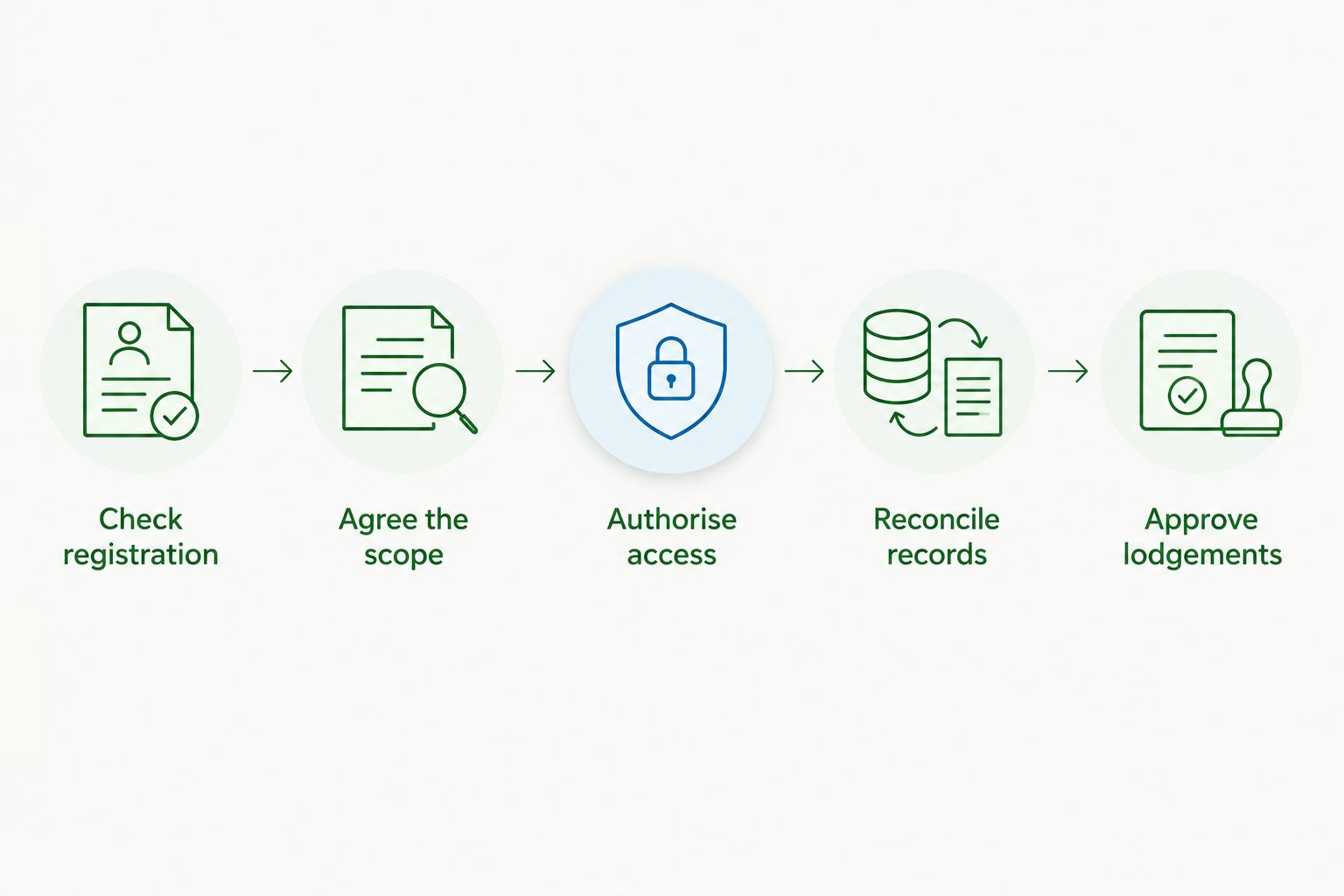
The process should leave you knowing who supplies information, who checks it and who approves submission. That clarity matters more than whether every task sits with the same individual.
Do BAS and income tax figures have to match?
No. BAS figures and income tax return figures serve different purposes, so matching every total is not the test of accuracy. The important test is whether the differences are supported and reconciled.
For example, GST treatment affects activity statement reporting, while income tax calculations apply their own rules to income and deductions. Reporting periods and accounting methods can also create differences that need explanation.
Your agent should identify whether a difference reflects timing, GST treatment, an adjustment or an error. Do not approve a return simply because its totals resemble the BAS totals. Ask for an explanation you can follow from the accounting records.
Where separate advisers are involved, agree who updates the ledger after adjustments. Otherwise, the tax return can be correct while the everyday accounts still contain unresolved balances.
Can you wait until tax time to lodge your BAS?
No. A quarterly BAS generally covers 3 months and has its own deadline; preparing an annual tax return does not postpone it. The ATO generally requires monthly activity statements by the 21st day of the following month, subject to applicable concessions and specific arrangements.
For your 2026 calendar, confirm the due date for each obligation rather than copying the tax return deadline across everything. Agent lodgement concessions depend on the relevant programme and eligibility; appointing an agent does not automatically extend every deadline.
Also separate lodgement from payment. Ask for both dates in writing and confirm how any existing payment arrangement interacts with new liabilities. Do not assume that an extension to lodge changes the payment deadline.
What should you ask before moving both services?
A short scoping conversation should establish whether the arrangement will simplify your work or just change who receives the paperwork. Ask these questions before transferring responsibility:
Who reconciles the bank accounts and checks GST coding?
Who follows up missing records before each BAS?
Does the engagement include annual accounts as well as the income tax return?
Who reviews PAYG instalments and explains their treatment?
How are prior-period errors and year-end adjustments handled?
Who tells you what to approve, lodge and pay, and when?
Daintree Consulting's accounting and advisory services include accounting, bookkeeping and payroll, tax and BAS compliance. The useful starting point is to agree which of those responsibilities your business needs covered.
Clarify your BAS and tax responsibilities
Review the accounting, bookkeeping and tax support your business needs in one coordinated scope.
FAQ
Can a registered tax agent lodge BAS and tax together in 2026?
Yes, a registered tax agent can handle both BAS and income tax work within their registration scope, but they remain separate lodgements. Agree the engagement, authorise the agent and confirm each deadline.
Can my bookkeeper lodge my business tax return?
Your bookkeeper needs the appropriate tax agent registration to provide income tax return services for a fee. BAS agent registration alone does not authorise that work; check the responsible person or entity on the Tax Practitioners Board register.
Do I need the same agent for BAS and my tax return?
No, you can use separate advisers for BAS and income tax. Give both access to consistent records and agree who handles reconciliations, corrections and year-end adjustments.
Does lodging BAS mean I have paid my annual income tax?
No, BAS lodgement does not settle your annual income tax position. PAYG instalments reported through activity statements are payments towards income tax, while GST and PAYG withholding are different obligations.
Will appointing a tax agent automatically extend my BAS deadline?
No, appointing a tax agent does not automatically extend every BAS deadline. Ask the agent to confirm the applicable due date and any concession before relying on extra time.
Can Daintree Consulting help with both BAS and income tax?
Daintree Consulting provides tax and BAS compliance alongside accounting, bookkeeping and payroll services. Agree the services, responsibilities and reporting calendar required for your business before the engagement starts.
Do I still need to approve returns if my agent prepares them?
Yes, review the information and provide the required declarations or authorisations before your agent lodges. Using an agent does not remove your responsibility to provide accurate, complete records.
One last thing
The best check is not whether the BAS and tax return were submitted on the same day. It is whether the adjustments made for the tax return also reached the records you use to run the business.
For your 2026 review, ask for the reconciled accounts, an explanation of material adjustments and a calendar of the next obligations. That gives you one clear picture without confusing separate lodgements.
Related guides
Talk to Daintree about your tax and BAS
Our ex-Big 4 team gives clear, senior-reviewed advice so you can act with confidence.
Book a free consultation →
Or explore our tax and BAS services.
