Can a manufacturing business claim R&D tax incentives?
Yes, a manufacturing business can claim R&D tax incentives in Australia in 2026 if it is an eligible company conducting qualifying experimental activities and incurring eligible expenditure. Manufacturing alone does not establish eligibility: you must separate experimental work from routine production, register the activities and retain evidence supporting the claim.
TL;DR
Want expert help? Daintree Consulting's tax and BAS services can take this off your plate. Book a free consultation.
Can a manufacturing business claim R&D tax incentives? Yes—Australia’s R&D Tax Incentive covers eligible companies conducting qualifying experimental activities.
Routine manufacturing, equipment purchases and product improvements do not qualify automatically.
Keep evidence of technical uncertainty, hypotheses, experiments, results and expenditure as the work happens.
Register activities within 10 months after the relevant income year ends; registration does not establish expenditure eligibility.
Can a manufacturing business claim R&D tax incentives?
Yes—but eligibility attaches to specific activities, not your manufacturing business as a whole. A factory can undertake eligible experiments alongside ordinary production, with different tax treatment applying to each.
Australian Government R&D Tax Incentive guidance distinguishes experimental activities from ordinary commercial work. The following examples illustrate that distinction; none establishes eligibility without examining the underlying facts.
Manufacturing activity | Potential qualifying element | Limitation |
|---|---|---|
Developing a production process | Experiments addressing an outcome that a competent professional cannot determine in advance | Installing an established process is not enough |
Testing a material formulation | Systematic experiments to generate new knowledge about material behaviour | Trying alternatives without a documented hypothesis is insufficient evidence |
Running a production-line trial | An identifiable experiment with observations and evaluated results | Ordinary production does not become R&D because a trial occurs nearby |
Checking finished products | Testing performed as part of a qualifying experiment | Routine quality control does not qualify merely because it involves testing |
Why this matters
A manufacturing project can contain design, procurement, experimentation, commissioning and commercial production. Treating that entire project as R&D obscures the activities that actually meet the legislation.
For your 2026 planning, the useful starting point is an activity map—not a percentage of factory costs. Daintree Consulting provides business accounting and advisory support; establish separately who will assess the technical activities and prepare any specialist R&D advice.
What makes a manufacturing experiment eligible?
Core R&D activities must meet the statutory experimental test. A commercially useful result is not enough, and an unsuccessful result does not automatically disqualify the work.
An outcome that cannot be determined in advance
The relevant uncertainty concerns the experimental outcome. It must not be determinable in advance from current knowledge, information or experience by a competent professional in the field.
Not knowing how to configure equipment within your own team is different from a genuine technical uncertainty. Before claiming, document the existing knowledge you considered and why it did not resolve the question.
A systematic experimental process
Qualifying core activities involve a systematic progression from a hypothesis through experiment, observation and evaluation to logical conclusions. Your records should connect these stages rather than simply describe a project as innovative.
For example, a manufacturer investigating material behaviour should explain the proposed technical relationship, how it will test that relationship and what the results show. A production diary recording that a batch failed does not, by itself, explain the experiment.
A purpose of generating new knowledge
The activity must be conducted for the purpose of generating new knowledge. That includes knowledge used to create new or improved materials, products, devices, processes or services.
A new product is not automatically R&D, and a failed experiment is not automatically ineligible. The test concerns the activity, its purpose and the experimental process—not whether the product sells.
Core R&D activities: the experimental work
Core activities are the experiments that satisfy the legislative requirements. Describe them narrowly enough that someone outside your business can understand what you investigated.
For a manufacturing project, separate the technical question from the commercial objective. Increasing output is a business objective; investigating an unresolved relationship between process conditions and material performance describes a potential experimental question.
Record the hypothesis, variables, method, observations and conclusions. If you change the experiment after an unexpected result, explain why the change follows from the evidence.
The benefit of this approach is a clear connection between the work and the eligibility test. Its limitation is equally important: a well-written description cannot turn routine engineering into eligible R&D.
Supporting R&D activities: directly related work
Supporting activities must be directly related to core R&D activities. Certain supporting activities also need to satisfy a dominant-purpose test, including activities that produce goods or services or are directly related to their production.
Preparing experimental samples or configuring a trial can form part of the supporting work, depending on the facts. Being necessary to the wider project is not the same as being directly related to eligible core activities.
This distinction matters on an operating production line. A trial can involve experimental work, supporting work and ordinary commercial output; record those boundaries rather than treating the entire shift as eligible.
Who can claim, and what thresholds matter?
The R&D Tax Incentive is available to eligible companies. A sole trader, partnership or trust cannot claim the incentive in its own right, even where its manufacturing work is technically experimental.
For eligible companies, the treatment depends on factors including aggregated turnover and tax-exempt ownership. Under the Australian rules relevant to 2026:
$20,000 in eligible notional deductions: this is generally the minimum expenditure threshold for claiming. Exceptions apply, including qualifying expenditure with a registered research service provider.
$20 million in aggregated turnover: this is the turnover dividing line between the refundable and non-refundable offset frameworks, subject to the other eligibility conditions.
10 months after income-year end: this is the standard deadline for applying to register the relevant R&D activities.
Aggregated turnover is not necessarily the sales figure for the factory or company making the claim. It can include turnover of connected entities and affiliates under the relevant rules.
These thresholds answer different questions. Meeting the expenditure threshold does not establish that an activity qualifies, and being below the turnover threshold does not remove the need to substantiate the claim.
Why manufacturing R&D claims vary
The same production project can produce different claim outcomes depending on its activities, ownership structure and expenditure. These are the main drivers to review:
Technical uncertainty: identify what a competent professional could not determine before the experiment began.
Activity boundaries: separate eligible experiments and directly related support from routine production, installation and maintenance.
Company eligibility: confirm that the claiming entity meets the company requirements rather than assuming the operating structure qualifies.
Expenditure treatment: wages, materials, contractor costs and assets require the appropriate tax treatment; accounting expense totals are not a claim calculation.
Production and sales: materials used or transformed during experiments can trigger feedstock adjustment considerations when resulting goods are supplied or used.
Funding and ownership: grants, recoupments, arrangements with other entities and who benefits from the work require separate examination.
Build the claim from eligible activities outward, not from the general ledger inward. Cost records support a claim only after you establish what the costs relate to.
How should you prepare a manufacturing R&D claim?
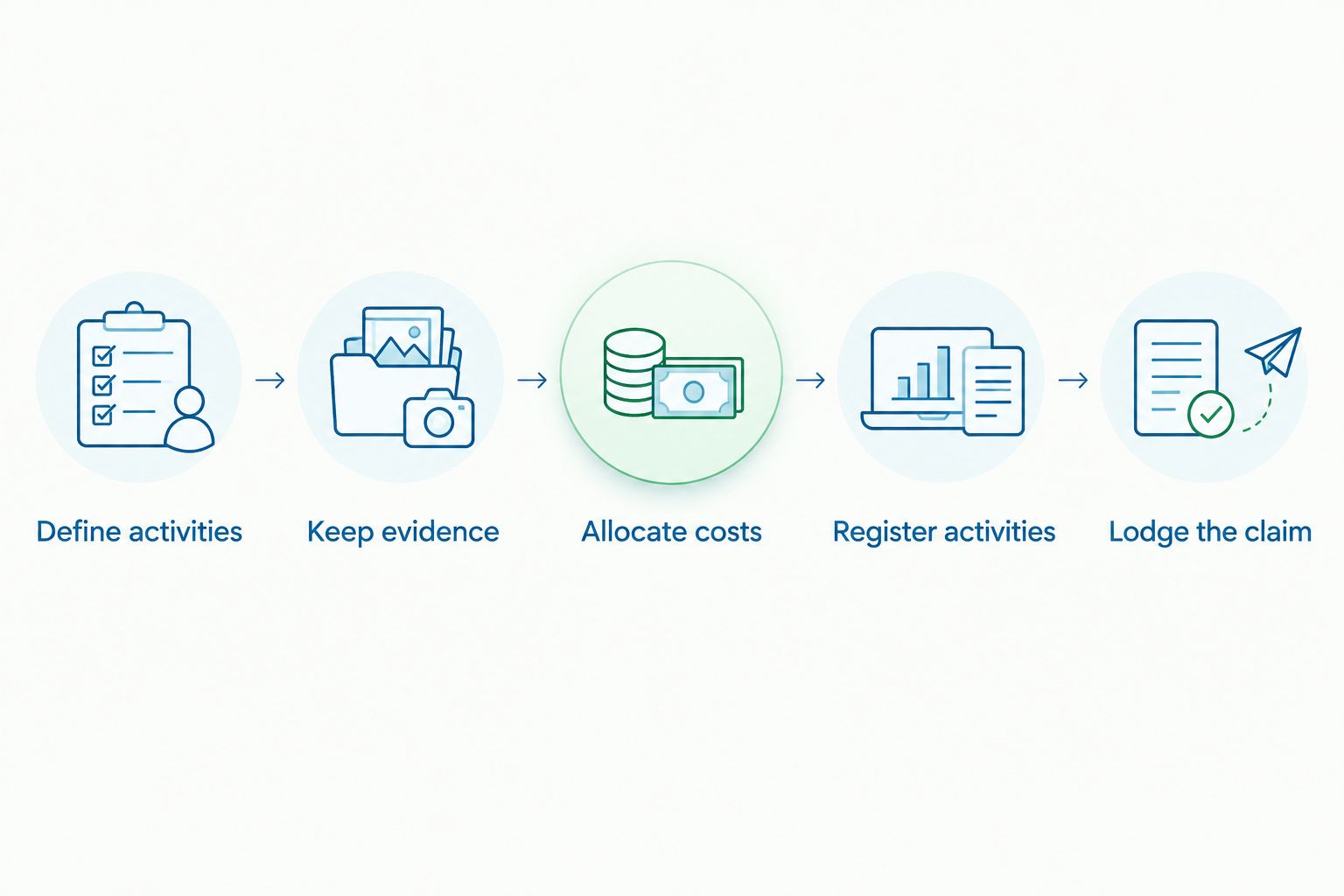
Use this sequence to connect technical work, financial records and lodgement responsibilities. It also gives your production team and accountant a shared view of what belongs in the claim.
Define activities. Identify the experiments, their technical uncertainties and any directly related supporting work. Mark where ordinary production begins and ends.
Keep evidence. Record hypotheses, methods, observations and conclusions while the work happens. Preserve unsuccessful results as well as successful ones.
Allocate costs. Connect employee time, materials, external work and relevant asset use to identified activities using a supportable method.
Register activities. Apply through the Australian Government’s R&D registration process for the relevant income year within the applicable deadline.
Lodge the claim. Reconcile the eligible expenditure calculation with the company tax return and retain the supporting schedules.
Registration and the tax claim are separate parts of the process. The Department of Industry, Science and Resources administers activity registration and eligibility, while the Australian Taxation Office administers the tax offset and expenditure rules.
Registration is not confirmation that every registered activity or claimed cost satisfies the law. Keep the technical explanation and expenditure calculation consistent throughout.
What records should you keep during 2026?
Keep records that explain both the experiment and the spending. A project name, invoice description or year-end summary does not establish the connection on its own.
Useful technical evidence includes:
The technical question and existing knowledge considered before testing.
Hypotheses, trial plans and reasons for selecting the experimental method.
Process settings, material specifications, test observations and measured results.
Conclusions, unsuccessful outcomes and reasons for changing the next experiment.
Useful financial evidence includes payroll records, activity-based time records, supplier invoices and material usage records. Where you allocate shared costs, retain the calculation and explain why the allocation reflects the underlying work.
Avoid reconstructing the technical story solely from invoices after the project finishes. An invoice can establish a purchase without showing whether that purchase supported an eligible activity.
Can you claim if the experiment fails?
Yes—failure does not prevent eligibility. An unsuccessful manufacturing experiment can still satisfy the core R&D requirements when the uncertainty, purpose and systematic experimental process meet the law.
Keep the failed results and explain the conclusions. Repeating an unsuccessful run without investigating or evaluating it is not, by itself, evidence of a qualifying experiment.
Can you claim for equipment used in R&D?
Equipment use does not make the full purchase amount eligible. Asset expenditure requires separate tax treatment, including consideration of eligible decline-in-value amounts and the extent of R&D use.
Distinguish the asset purchase from the experimental activity it supports. Keep usage records where equipment serves both experiments and ordinary production.
When should you get accounting and specialist advice?
Get advice before committing to a claim when the experimental boundary, company eligibility or expenditure treatment is unclear. Raise the question while your technical team can still document the work accurately.
Daintree Consulting is best for Australian business owners seeking accounting and advisory support alongside tax compliance. For an R&D claim, agree explicitly who is responsible for technical eligibility, expenditure analysis, registration and the company tax return.
For your 2026 review, bring the project description, experimental records, entity structure and expenditure schedules together. That gives the advisers a defined set of activities to assess rather than a request to classify an entire factory upgrade.
Discuss your manufacturing tax position
Clarify your accounting needs and the advice required before preparing an R&D claim.
FAQ
Can a small manufacturing company claim R&D tax incentives?
Yes, an eligible small manufacturing company can claim for qualifying R&D activities and eligible expenditure. Business size does not replace the activity, entity, registration or record-keeping requirements.
Can a sole trader claim the Australian R&D Tax Incentive?
No, a sole trader cannot claim the Australian R&D Tax Incentive in their own right. The incentive is available to eligible companies, subject to the statutory requirements.
Does improving an existing manufacturing process count as R&D?
Improving an existing process can qualify when the activities satisfy the experimental requirements. Routine optimisation or applying an established solution does not qualify automatically.
What is the minimum expenditure for an R&D tax claim?
Eligible notional deductions generally need to total at least $20,000 for the income year. Exceptions apply, including qualifying expenditure with a registered research service provider.
How long do manufacturers have to register R&D activities?
Manufacturers generally have 10 months after the relevant income year ends to apply to register their R&D activities. Track registration separately from the company tax return deadline.
Does R&D registration mean the government has approved every cost?
No, activity registration does not establish that every claimed cost is eligible. The company must separately substantiate its expenditure and apply the relevant tax rules.
Can ordinary production costs be included in an R&D claim?
Ordinary production costs are not eligible merely because experimental work happens in the same factory. Identify the qualifying activities, apply the supporting-activity rules where relevant and substantiate the expenditure allocation.
One last thing
Before your next manufacturing trial in 2026, write down the technical question, hypothesis, planned method and evidence you will collect. Then ask the production team to record what happened and what the results mean.
The strongest starting point is an identifiable experiment—not an expensive project. This guide provides general information; obtain advice on your company’s circumstances before lodging a claim.
Related guides
Talk to Daintree about your tax and BAS
Our ex-Big 4 team gives clear, senior-reviewed advice so you can act with confidence.
Book a free consultation →
Or explore our tax and BAS services.
