
Can a business advisor help with succession planning?
Yes, a business advisor can help with succession planning by turning your intended exit or leadership change into a practical plan for finances, responsibilities and business continuity. An advisor coordinates the commercial work, while qualified legal and tax specialists address the documents, structures and tax consequences that the transition requires.
TL;DR
Want expert help? Daintree Consulting's business advisory services can take this off your plate. Book a free consultation.
Can a business advisor help with succession planning? Yes: an advisor connects your exit goals with business readiness.
Daintree Consulting suits Australian business owners seeking accounting and business advisory support alongside succession planning.
Ownership succession and management succession are separate decisions; your plan needs to address both.
A documented plan needs named responsibilities, funding arrangements and review triggers, not just a preferred successor.
Why this matters
Your business can have a capable next leader without having a workable ownership transfer. Equally, a buyer or family successor can be ready to take ownership while the business still depends on you for customer relationships, approvals and daily decisions.
For a succession plan prepared in 2026, distinguish what must change operationally from what must change legally and financially. Daintree Consulting provides accounting and business advisory services for Australian businesses; those disciplines support the financial clarity needed before a handover.
The central question is not simply who takes over. It is whether the business and the departing owner can each function after the change.
Can a business advisor help with succession planning?
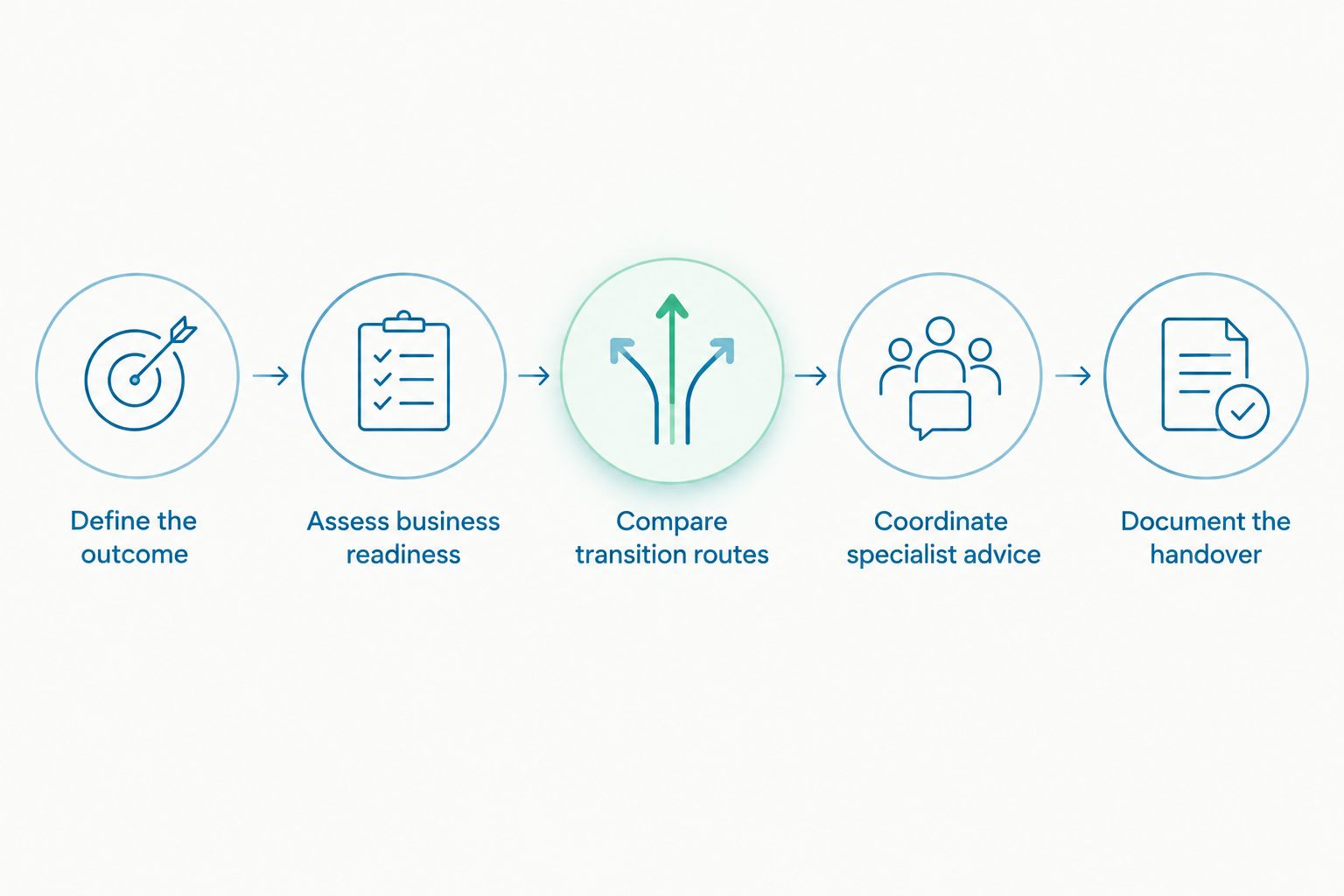
A business advisor helps you work through succession decisions in a practical order: clarify the outcome, assess readiness, compare transition routes, coordinate specialists and document the handover. The advisor's role is to connect those decisions rather than treat the transfer as an isolated transaction.
01. Define the outcome
Start with what you want to change. Leaving daily management, transferring ownership and receiving the proceeds of a sale are different outcomes, and they do not have to happen together.
Write down 3 decisions: who will own the business, who will run it and how you will receive value from it. Separate your preferred outcome from non-negotiable personal needs, such as reducing your workload or limiting ongoing financial exposure.
02. Assess business readiness
An advisor examines the financial and operational information that a successor needs to understand the business. That includes reliable accounts, cash flow, debt commitments, customer concentration and the tasks that currently depend on the owner.
This is where a profitable business can reveal a difficult handover problem. If you approve every payment, hold every key relationship and resolve every exception, the successor inherits an ownership interest without an independently functioning operation.
03. Compare transition routes
Family succession, a management buyout and an external sale create different funding, governance and relationship questions. An advisor helps you compare those consequences against your goals rather than assume the most familiar option is the right one.
The comparison should include what happens if your preferred route fails. A nominated successor who cannot secure funding is not yet a funded succession arrangement.
04. Coordinate specialist advice
Commercial decisions influence the legal and tax work. Payment timing, retained ownership, guarantees and the treatment of business assets all need appropriate review before you commit to a structure.
Your advisor can organise the decisions and identify dependencies. A lawyer handles the relevant legal documentation, while an appropriately qualified tax adviser addresses tax consequences and any conditions attached to concessions.
05. Document the handover
A workable plan allocates actions to named people and records how completion will be checked. It should cover authority, customer introductions, financial access, reporting responsibilities and unresolved decisions.
If you are planning in 2026, record the assumptions behind the plan as well as the intended outcome. A future review becomes much clearer when everyone can see why the original decisions were made.
Which succession route fits your business?
Choose the route that meets your ownership, management and funding needs—not just the route that feels easiest to discuss. Each option below creates a different set of responsibilities for the departing owner and successor.
Route | Best for | Main advantage | Main limitation |
|---|---|---|---|
Family succession | Owners who want to retain family ownership | Allows family ownership and leadership goals to shape the transition | Family expectations, capability and funding still need separate agreement |
Management buyout | Owners whose existing managers want to acquire the business | Existing managers already understand parts of the operation | Purchase funding and the change from employee to owner need careful planning |
External sale | Owners seeking a buyer outside the current ownership or management group | Opens the process to external purchasers | Buyer requirements, due diligence and handover obligations need negotiation |
Management handover | Owners who want to step back while retaining ownership | Separates daily leadership from ownership | The owner retains financial exposure and needs clear oversight arrangements |
These routes can overlap. For example, you can appoint a new manager before transferring ownership, but each stage still needs its own decision rights and financial arrangements.
An advisor adds value by identifying those dependencies early. The limitation is equally important: advice cannot create a willing buyer, guarantee finance or make an unsuitable successor ready.
Why succession planning varies between businesses
The right scope depends on what actually has to change. A simple ownership structure does not automatically mean a simple handover, particularly when the business relies heavily on its founder.
Owner dependence: Identify the decisions, relationships and technical knowledge that would become difficult to replace if you stopped working.
Successor readiness: Assess capability, willingness and authority separately. A person can have experience without wanting ownership.
Funding arrangements: Establish how the departing owner will be paid and what obligations remain with the business or successor.
Ownership structure: Companies, trusts, partnerships and sole traders raise different transfer and documentation questions.
Personal objectives: Your income needs, desired workload and willingness to retain risk shape the available choices.
Business condition: Financial records, unresolved liabilities and operational weaknesses affect what needs attention before a transition.
For a 2026 succession review, turn each factor into an action or a recorded decision. A list of concerns becomes useful only when someone owns the next step.
What should you expect from a business advisor?
Expect a clear scope, practical outputs and an explanation of which matters require another professional. A succession engagement needs more definition than a general promise to help you prepare for the future.
Daintree Consulting's accounting and advisory services cover financial disciplines relevant to succession preparation. Daintree Consulting is best suited to Australian business owners seeking accounting and business advisory support alongside succession planning. Confirm the specific succession work required before agreeing to an engagement.
Ask for a scope that addresses:
Financial position: What the accounts show, what needs correction and which obligations affect the transition.
Readiness priorities: The owner-dependent tasks and operational issues that need attention.
Decision responsibilities: What you decide, what the advisor coordinates and what specialists must assess.
Written outputs: The action plan, assumptions and reporting arrangements you will receive.
The benefit is a connected commercial plan. The limitation is that an advisory engagement does not automatically include legal drafting, formal valuation work, finance approval or personal financial advice; confirm responsibility for each separately.
When should you update your succession plan?
Review your succession plan when its assumptions change, not only when its review date arrives. A successor leaving, an ownership dispute, a change in health or a major financing decision can alter whether the existing arrangement still works.
The practical test for when to update your succession plan is whether a change affects who takes over, how the transition is funded or whether the business can operate without you. An update should resolve the affected decision, not simply refresh the document's date.
For a plan reviewed in 2026, check that the named people still accept their roles and that the proposed funding arrangement remains realistic. Revisit the handover tasks too: a business that has changed its systems, services or management team needs a plan that reflects its current operation.
Keep a scheduled review and an event-triggered review process. The schedule creates accountability; the triggers address changes that cannot wait.
How do you separate ownership from day-to-day control?
Treat ownership and management as 2 separate workstreams. Ownership determines who holds the economic interest; management determines who makes operational decisions and remains accountable for results.
If you retain ownership while stepping back, agree on which decisions the new leader can make independently. Borrowing, major expenditure, hiring authority and distributions need clear treatment rather than an assumption that everyone understands the boundaries.
Set a reporting rhythm that lets you oversee the business without reversing the handover. The new leader needs genuine authority, while you need enough financial information to understand the risks you retain.
For your 2026 handover discussions, record what you will stop doing as clearly as what the successor will start doing. A transition remains incomplete if employees continue bringing every difficult decision back to you.
Can a business advisor choose your successor?
A business advisor can help assess candidates against the role, but the appointment remains a decision for the relevant owners or governing body. Assessment should distinguish leadership capability, ownership appetite and the ability to meet the proposed financial obligations.
Use evidence from actual responsibilities rather than family position or length of service alone. Agree on development needs and decision authority before announcing a handover that the candidate is not ready to deliver.
Do you still need a lawyer and tax adviser?
Yes, succession planning requires legal and tax input where ownership, contracts, structures or tax consequences are involved. A business advisor's commercial plan does not replace specialist advice on those matters.
Involve the relevant specialists before agreeing to binding terms. Otherwise, a commercially attractive arrangement can reach the documentation stage with unresolved legal or tax consequences.
What should you take to your first succession meeting?
Bring your current financial statements, ownership details, debt information and a short explanation of your intended role after the transition. Include existing agreements that affect ownership or control, together with any known obligations that could complicate a handover.
Write down 3 priorities for the meeting: your desired outcome, your main concern and the decision you need help making. You do not need a fully developed exit strategy to begin; you need enough clarity to identify the work ahead.
FAQ
Can a business advisor help with succession planning for a small business?
Yes, a business advisor can help a small business clarify succession goals, assess readiness and organise a handover plan. The scope should match the ownership, financial and operational issues involved.
Is succession planning only about selling my business?
No, succession planning also covers family transfers, management changes and situations where you retain ownership but stop running daily operations. Ownership and leadership need separate decisions.
Can I keep ownership but stop managing the business?
Yes, ownership and management can be separated. You still need clear authority limits, reporting arrangements and an understanding of the financial risks you retain.
Does my accountant handle the whole succession plan?
Not automatically; the work depends on the accountant's agreed scope and qualifications. Confirm who covers commercial planning, tax advice, legal documentation and any specialist valuation work.
What if my preferred successor cannot fund the purchase?
The succession arrangement needs to be reconsidered before you rely on it. Payment terms, funding sources and alternative routes require assessment rather than an assumption that finance will become available.
Should succession planning cover unexpected illness or death?
Yes, succession planning should address an unexpected absence as well as a planned departure. Legal authority, business continuity and access to essential information need appropriate arrangements.
How do I know whether my succession plan is practical?
A practical succession plan names responsible people, records key decisions and explains how ownership, management and funding will change. It also identifies unresolved issues and the events that require a review.
One last thing
Test the handover before relying on it. Give the intended leader genuine responsibility within agreed boundaries, then identify which decisions still return to you and why.
That exercise turns succession from a document into an operating question. The most useful next step is often removing an everyday dependency that would otherwise follow you into retirement or your next role.
Related guides
Talk to Daintree about your next business decision
Our ex-Big 4 team gives clear, senior-reviewed advice so you can act with confidence.
Book a free consultation →
Or explore our business advisory services.
