
Can a business advisor help with cash flow problems?
Yes, a business advisor can help with cash flow problems by identifying why cash is running short, forecasting upcoming commitments and turning the findings into practical decisions. Advice does not create cash by itself: you still need to collect payments, control outgoings and address any underlying trading losses.
TL;DR
Want expert help? Daintree Consulting's outsourced CFO services can take this off your plate. Book a free consultation.
Can a business advisor help with cash flow problems? Yes: forecasting and practical decisions work together.
Daintree Consulting provides business advisory alongside accounting, bookkeeping and outsourced CFO services.
Separate payment-timing problems from ongoing losses before choosing a solution.
If your business cannot pay debts when due, seek insolvency advice promptly.
Why this matters
A profitable business can still run short of cash when customers pay after wages, suppliers and tax fall due. A business making losses has a different problem: improving payment timing alone will not repair its underlying economics.
For your 2026 planning, the first task is to establish which problem you have. The Daintree Consulting service offering includes accounting and business advisory, allowing financial records and forward-looking decisions to be considered together.
The useful outcome is not another report. It is a clear sequence of decisions, with someone responsible for each action.
Can a business advisor help with cash flow problems?
Yes. A business advisor helps you move from a bank balance that describes today to a forecast that shows what happens next. The work should connect your accounting records with customer receipts, supplier commitments, payroll, tax and the decisions you control.
A practical engagement follows this sequence.
1. Establish the cash position
Start with available bank funds, outstanding customer invoices and payments already committed. Include payroll, supplier invoices, loan repayments and tax obligations rather than relying only on expenses visible in your profit and loss report.
Your advisor should distinguish confirmed amounts from estimates. A customer invoice is not the same as a confirmed receipt, and an unused borrowing facility is not operating income.
The immediate output is a list of obligations and expected receipts arranged by payment date. This reveals the timing gaps that a headline bank balance conceals.
2. Build a rolling forecast
Ask for a 13-week cash flow forecast as a practical starting point, with receipts and payments shown weekly. Treat that horizon as a planning choice, not a rule: extend it when your commitments or trading cycle require a longer view.
Build the forecast around expected payment dates rather than invoice dates. Separate reliable receipts from amounts that depend on winning work, resolving disputes or persuading a customer to pay sooner.
In 2026, the forecast should remain a working document, not a file prepared once and forgotten. Update it as actual receipts, payments and commitments change.
3. Test the cause
A cash shortfall can arise from timing, insufficient margin, excessive commitments or growth that requires spending before customers pay. Those causes need different responses.
Your advisor should connect the forecast back to the accounts and operating decisions. If sales rise but cash falls, examine when customers pay, what you spend to deliver the work and whether the work leaves enough margin.
Borrowing can bridge a timing gap; it does not make an unprofitable activity profitable.
4. Assign actions
Turn each finding into an action with an owner and a deadline. Examples include following up overdue invoices, resolving billing disputes, reviewing purchasing commitments or discussing payment arrangements with creditors.
Do not assume a proposed arrangement exists until the other party agrees. Your forecast should reflect the current obligation until a revised arrangement is confirmed.
A useful action list also states what decision comes next if the first action fails. That prevents a missed customer payment from becoming another week of waiting without a plan.
5. Review and adjust
For a business under cash pressure, a review every 7 days is a practical starting recommendation. Compare actual cash movements with the forecast, explain material differences and update the next decisions.
Keep the discussion focused on exceptions. An invoice arriving late, an unexpected purchase or a changed payroll commitment matters because it alters the cash position—not because the spreadsheet needs to look complete.
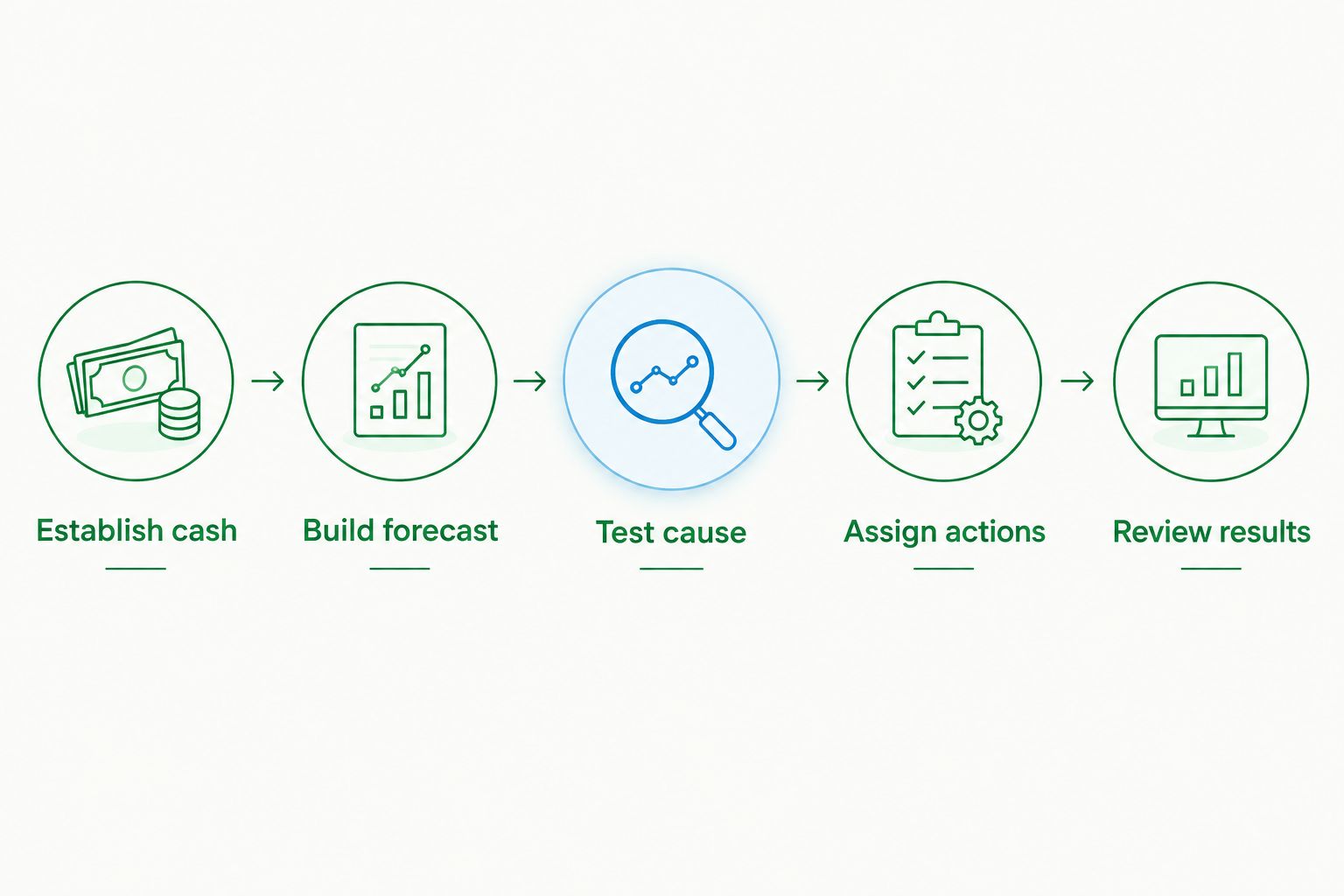
The sequence above moves from establishing cash to building a forecast, testing the cause, assigning actions and reviewing results. You need all of those elements: a forecast without decisions simply describes the shortfall more clearly.
What kind of help does your cash position need?
Choose support according to the work that needs doing, not the job title alone. Bookkeeping, accounting, business advisory and outsourced CFO support can overlap, so confirm the actual scope before appointing anyone.
Support | Best for | Main contribution | Limitation to clarify |
|---|---|---|---|
Bookkeeping | Businesses needing reliable transaction records | Reconciliations, receivables, payables and agreed payroll support | Forecasting and commercial decisions may sit outside the engagement |
Accounting | Businesses needing financial reporting and tax obligations considered together | Financial statements, tax compliance and interpretation of results | Historical reporting alone does not provide a cash action plan |
Business advisory | Owners needing decisions about cash, margins and commitments | Forecasting, scenario analysis and practical action planning | Results depend on reliable information and implementation |
Outsourced CFO support | Businesses needing ongoing financial oversight | Recurring forecasting, reporting and financial decision support | Responsibilities must fit the existing team and decision process |
These are not mutually exclusive choices. Your business might need accurate bookkeeping first, then advisory support to interpret the numbers and decide what to change.
For a 2026 engagement, ask who maintains the underlying records and who owns the forecast. If those responsibilities are unclear, the advice can become disconnected from what is happening in the bank account.
Why cash flow problems vary between businesses
The right response depends on the cause, the quality of your records and the decisions available to you. Review these factors before choosing the scope of support:
Cash reporting: Reconciled records make it easier to distinguish an actual shortfall from incomplete information. Out-of-date records weaken the starting position.
Forecasting: A forecast exposes the relationship between expected receipts and committed payments. Assumptions need to be visible so you can challenge them.
Payroll commitments: Payroll creates scheduled cash obligations. Include the full employment-related commitments relevant to your business, not only take-home wages.
Tax and BAS obligations: Keep these visible in the cash plan. Money in the bank is not automatically money available for discretionary spending.
Business complexity: More entities, activities or reporting requirements require clearer coordination. A simple cash summary can hide obligations elsewhere in the business.
Growth decisions: Hiring, purchasing and expansion change when cash leaves the business. Test the cash effect before making a commitment, rather than after signing it.
An advisor should explain which factors drive your position, not apply the same response to every business. Better reporting helps you see the problem; a decision about the underlying cause is what addresses it.
What should you do before meeting a business advisor?
Prepare the information needed to discuss actual commitments rather than working from memory. You do not need a polished presentation; you need records that show what is owed, when it falls due and what is expected to arrive.
Bring:
Current bank balances and recent bank statements.
Aged customer and supplier invoice reports.
Payroll commitments and relevant payment dates.
Tax and BAS amounts due, including existing arrangements.
Loan repayment schedules and other committed payments.
Recent financial reports and any existing budget or forecast.
Known changes, such as a customer dispute or planned purchase.
Flag information you cannot confirm. An honest gap is more useful than an assumption presented as a fact, particularly when the forecast depends on a large customer payment.
Also explain what you need to decide. Whether to hire, accept a contract, defer a purchase or negotiate a payment arrangement is a more useful starting question than simply asking for better cash flow.
How do you turn advice into a workable cash plan?
Ask your advisor to separate immediate decisions from changes that take longer to implement. Chasing an overdue invoice and changing how future work is billed belong in the same plan, but they affect different periods.
Use a 30-day action plan as a recommended starting format for near-term tasks. Give each task an owner, an agreed completion date and an expected effect on the forecast; do not treat hoped-for receipts as confirmed cash.
For the rest of 2026, keep the action plan connected to your operating decisions. A revised forecast should change what you do when it shows a problem, rather than merely documenting why the bank balance fell.
A useful review asks:
Which expected receipts did not arrive?
Which payments changed or were missing?
Which actions have been completed?
What decision is now required?
Avoid judging progress only by today's balance. A higher balance can reflect an unpaid bill rather than an improvement in the business.
How do you choose the right business advisor?
Ask how the advisor will turn your information into decisions. You should understand the proposed deliverables, who prepares them, who explains them and what remains your responsibility.
Useful questions include:
Will the forecast show payment timing as well as totals?
How will assumptions and uncertain receipts be recorded?
Who will follow up actions between meetings?
How will tax, payroll and supplier commitments be included?
When will the advisor recommend specialist help outside the engagement?
Daintree Consulting is best suited to Australian business owners seeking accounting and cash flow advisory together. Its stated services include bookkeeping and payroll, tax and BAS compliance, business advisory and outsourced CFO support.
That combination is relevant when record-keeping and decision support need to work together. Confirm the engagement scope: appointing a firm does not automatically mean every service, weekly forecast update or creditor discussion is included.
Can a business advisor help if my business is profitable?
Yes, a business advisor can help a profitable business identify why accounting profit is not turning into available cash. Customer payment timing, inventory purchases, capital expenditure and loan principal repayments can create differences between profit and cash movements.
Ask the advisor to explain that difference in plain language. You should be able to see where the cash went and which changes would affect future balances.
Can a business advisor help me avoid taking out a loan?
A business advisor can assess whether collections, spending changes or revised commitments address the shortfall before you seek finance. There is no guarantee those actions will remove the need for borrowing.
If finance is being considered, include repayments in the forecast and test the assumptions supporting them. A loan decision needs a credible repayment path, not just an immediate need for funds.
When is a cash flow problem more than an advisory issue?
A cash flow problem needs specialist insolvency attention when your business cannot pay its debts as they fall due. Do not wait for the next reporting meeting if that is your position.
Seek advice promptly from an appropriately qualified insolvency practitioner or legal adviser. A business advisor can support financial analysis, but a cash forecast is not a substitute for advice about insolvency obligations.
FAQ
Can a business advisor fix my cash flow problems?
A business advisor can diagnose cash flow problems and develop an action plan, but cannot guarantee a fix. Results depend on the cause, available options and whether agreed actions are implemented.
Should I speak to my accountant or a business advisor first?
Start with the professional who can assess both your current records and upcoming cash commitments. Ask whether cash forecasting and action planning are included, rather than relying on the title alone.
What information does a business advisor need for cash flow advice?
A business advisor needs bank balances, customer and supplier balances, payroll commitments, tax obligations and other scheduled payments. Explain uncertain receipts and upcoming changes separately.
How often should I review a cash flow forecast?
A review every 7 days is a practical starting recommendation when cash is under pressure. Review sooner when a significant receipt, payment or commitment changes.
Does increasing sales always improve cash flow?
Increasing sales does not always improve cash flow. If you pay to deliver work before customers pay you, growth can increase the cash you need.
Can Daintree Consulting help with cash flow planning?
Daintree Consulting provides business advisory and outsourced CFO services alongside accounting and bookkeeping. Discuss whether forecasting, reporting and action reviews should form part of your engagement.
What should I do if I cannot pay business debts when they are due?
Seek specialist insolvency or legal advice promptly if your business cannot pay debts when they fall due. Do not assume a future sale or proposed payment arrangement resolves the position.
One last thing
A cash flow forecast can show a healthier closing balance simply because a supplier payment has been pushed beyond the forecast period. That is a timing change, not necessarily an improvement.
Before accepting a reassuring forecast in 2026, ask what remains unpaid at its end. Review the closing bank balance alongside outstanding obligations. That gives you a clearer basis for deciding whether the business is recovering or just postponing the pressure.
Related guides
Talk to Daintree about your finance function
Our ex-Big 4 team gives clear, senior-reviewed advice so you can act with confidence.
Book a free consultation →
Or explore our outsourced CFO services.
