
Can a bookkeeper lodge a tax return?
A bookkeeper can lodge your income tax return as a paid service only if the person or business providing that service has the required tax agent registration, or the work is performed under a registered tax agent’s supervision and control. Being a bookkeeper or a registered BAS agent does not, by itself, authorise someone to provide paid income tax return services. The distinction in 2026 is between preparing your accounting records and taking responsibility for your tax return.
TL;DR
Want expert help? Daintree Consulting's tax and BAS services can take this off your plate. Book a free consultation.
Can a bookkeeper lodge a tax return? Bookkeeping qualifications alone do not authorise paid income tax return services.
A registered BAS agent can provide BAS services, but that registration does not cover income tax returns.
Daintree Consulting provides bookkeeping and tax services; confirm who takes responsibility for each part of your engagement.
Check the Tax Practitioners Board register before appointing someone to provide paid tax return services.
Why this matters
Your bookkeeper can know your business well without being authorised to advise on your income tax position. Accurate records support a return, but they do not settle questions about deductions, capital expenditure or the treatment of business income.
Daintree Consulting is best suited to Australian businesses seeking bookkeeping, tax and advisory services from one firm. When discussing support with Daintree Consulting, separate the bookkeeping responsibilities from the tax return responsibilities so neither becomes an assumption.
Can a bookkeeper lodge a tax return?
Yes, if the appropriate tax agent registration or supervised arrangement covers the service; no, not on bookkeeping or BAS registration alone. For a 2026 engagement, the practical check is the provider’s registration and responsibility for the work, not the job title on an email signature.
The Tax Practitioners Board’s registration framework distinguishes tax agent services from BAS services. Preparing or lodging an income tax return for a client for a fee generally requires tax agent registration. Employees and other people working under a registered tax agent’s supervision and control do not necessarily need their own registration.
Provider or arrangement | Best for | What it covers | Main limitation |
|---|---|---|---|
Bookkeeper without tax or BAS agent registration | Maintaining business records | Recording transactions, reconciliations and administrative preparation | Bookkeeping alone does not authorise paid tax agent or BAS services |
Registered BAS agent | BAS-related obligations | BAS services within the agent’s registration and competence | BAS registration does not authorise income tax return services |
Registered tax agent | Income tax returns and tax advice | Tax agent services within the agent’s registration and competence | Registration does not define what your particular engagement includes |
Staff working under a registered tax agent | Coordinated preparation and lodgement | Work performed under the registered agent’s supervision and control | You still need to know which registered provider is responsible |
Registration establishes the permitted scope. Your engagement agreement establishes which services the provider has agreed to deliver.
A bookkeeper: records prepared for review
A bookkeeper’s core contribution is to keep the underlying accounts organised. That includes recording transactions, reconciling bank accounts and identifying missing invoices or unexplained entries.
Those tasks give your tax agent a clearer starting point. They also help you see whether the accounts reflect what actually happened in the business, rather than leaving unexplained balances until the return is due.
Best for: maintaining reliable records throughout the year. The limitation is that a balanced ledger does not establish the correct income tax treatment of every transaction.
For example, recording equipment expenditure is different from deciding how that expenditure should be treated in your tax return. Your bookkeeper can assemble the invoice and payment records; the tax treatment belongs with someone authorised to provide that advice.
A registered BAS agent: BAS services, not income tax returns
A registered BAS agent can provide BAS services within the scope of their registration and competence. This can include relevant GST and PAYG withholding work, rather than simply entering figures supplied by someone else.
Best for: managing BAS-related compliance alongside business records. The limitation is clear: BAS registration alone does not extend to preparing or lodging your income tax return as a paid service.
A person can hold both BAS agent and tax agent registration. If your bookkeeper says they also handle tax returns, check the relevant tax agent registration rather than assuming the BAS registration covers everything.
That distinction still applies in 2026 when bookkeeping software connects directly to reporting and lodgement systems. Access to a function does not establish authority to provide the underlying professional service.
A registered tax agent: income tax advice and lodgement
A registered tax agent can provide income tax return services within their registration and competence. Depending on your engagement, that work can include reviewing the accounts, making tax adjustments, preparing the return and lodging it with the Australian Taxation Office.
Best for: determining and reporting your income tax position. The limitation is that tax agent registration does not automatically include ongoing bookkeeping, forecasting or business advice in your agreed scope.
Ask what the tax agent will review before lodgement. A return prepared from reconciled accounts is a different assignment from one that also requires missing records, unresolved balances and prior-period errors to be addressed.
You should also understand who answers questions after lodgement. A clear engagement identifies the responsible provider and explains how follow-up work is handled.
Why the answer varies between providers
Two businesses can both advertise bookkeeping and offer different levels of support. The difference comes from registration, supervision and the services included in the engagement—not the label alone.
Registration: A bookkeeper might hold tax agent registration, BAS agent registration, both or neither.
Supervision: A team member can prepare work under a registered tax agent’s supervision and control without holding individual registration.
Service scope: Maintaining accounts, preparing a BAS and preparing an income tax return are distinct responsibilities.
Business structure: A sole trader’s individual return differs from a company, partnership or trust return.
Record quality: Missing documents and unreconciled balances affect the preparation needed before the tax position can be finalised.
For your 2026 appointment, ask about these points before agreeing to the work. A clear answer should identify the responsible registered provider and explain what happens between the bookkeeping handover and lodgement.
How do I check whether my bookkeeper can lodge my return?
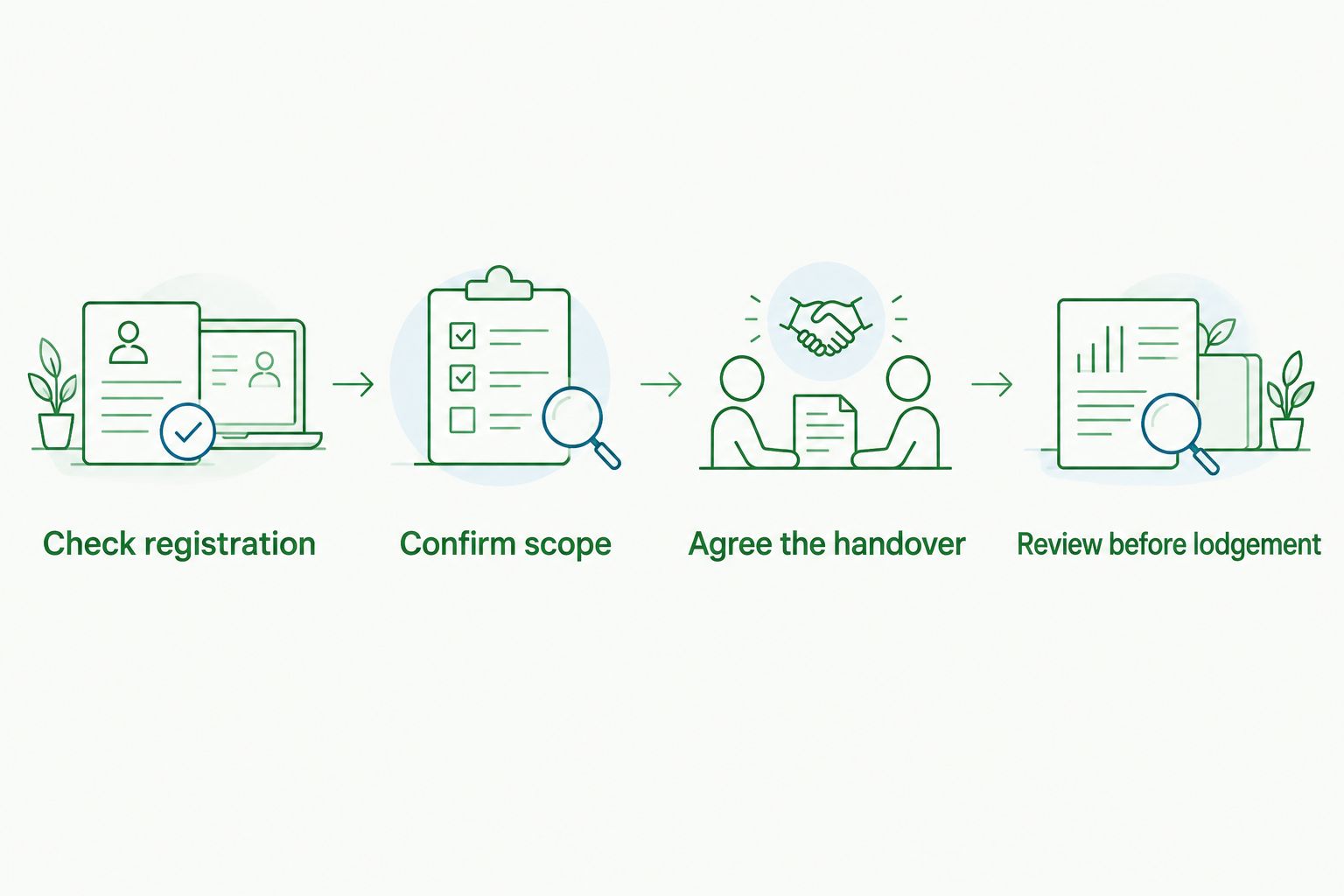
Use 4 steps to establish who is authorised, what they will deliver and what you need to approve. You do not need to understand every tax rule to ask for a clear allocation of responsibility.
1. Check registration
Search the Tax Practitioners Board register using the provider’s name or registration number. Confirm that the relevant registration is for a tax agent, not only a BAS agent.
If the business uses a team, ask which registered person or entity provides the tax return service. The employee who communicates with you is not necessarily the registered provider.
2. Confirm scope
Ask whether the engagement includes bookkeeping, BAS preparation, income tax preparation, lodgement and tax advice. Have the provider distinguish between those tasks in writing.
Also identify the taxpayer covered by the engagement. Your personal return and a separate company’s return are not interchangeable simply because you own the business.
3. Agree the handover
Confirm who provides the reconciled accounts, supporting documents and explanations for unusual transactions. Identify who resolves discrepancies before the return is prepared.
A shared accounting file helps people access records, but it does not replace an agreed handover. Someone still needs to confirm that the records are ready for tax review.
4. Review before lodgement
Review the completed return and ask about entries you do not understand before authorising lodgement. Confirm how you will receive the lodged return and subsequent correspondence.
Using an agent does not remove your responsibility to provide complete, accurate information. Keep copies of what you supply and approve.
What should the bookkeeping and tax engagement include?
Treat the engagement as an allocation of work, not a list of job titles. You need to know who maintains the records, who reviews the tax treatment and who lodges the return.
When comparing the cost of bookkeeping services, compare the work included rather than treating bookkeeping and income tax preparation as the same service. A bookkeeping engagement can leave tax preparation outside its scope, even when the records are ready for review.
Ask for a written distinction between routine work and additional work. Correcting old balances, investigating missing transactions and preparing a separate entity’s return should not be left to assumptions about what a general service description means.
Daintree Consulting provides bookkeeping, tax and advisory services. If you want these services coordinated, ask how the engagement connects the records, compliance work and financial reporting you need; having several services available does not mean every service is included automatically.
What records should I give my tax agent?
Give your tax agent reconciled accounts and the documents needed to explain the figures. Depending on your business, that includes income records, expense invoices, bank statements, asset purchases, loan details and payroll information.
Flag unusual transactions instead of leaving the tax agent to infer their purpose. A payment description alone does not establish whether an expense relates to the business or how it should be treated.
The Australian Taxation Office’s general business record-keeping guidance requires most business records to be kept for 5 years, although some records need to be retained longer. The starting point for that period depends on the record and circumstances, so do not delete documents solely because they are old.
For a 2026 return, ask which documents remain outstanding before approving the final version. Retaining evidence and resolving questions are separate tasks; you need both.
Can my bookkeeper prepare the figures for my accountant?
Yes, your bookkeeper can prepare the accounting records your tax agent uses. This commonly includes reconciliations, ledger reports and supporting schedules, provided the work stays within the bookkeeper’s authorised scope.
The distinction is between preparing records and independently providing tax advice. Ask your bookkeeper to flag uncertain tax treatments for the tax agent rather than silently making assumptions.
Can a BAS agent also be my tax agent?
Yes, a provider can hold both registrations. Check the tax agent registration specifically before engaging that provider for your income tax return.
One contact can coordinate the work, but your engagement should still distinguish BAS responsibilities from annual income tax responsibilities. Convenience does not remove the need for clear scope.
Can I lodge my own business tax return?
You can generally lodge your own return, using the method applicable to your business structure. Having a bookkeeper maintain the accounts does not require you to appoint that bookkeeper to lodge it.
Self-lodgement also means taking responsibility for the tax treatment, not just copying the profit figure from your accounting software. If you need paid assistance with that judgement, check the provider’s tax agent registration.
FAQ
Can a bookkeeper lodge a tax return in Australia in 2026?
A bookkeeper can provide paid income tax return services when the required tax agent registration or a suitable supervised arrangement covers the work. Bookkeeping qualifications or BAS agent registration alone do not provide that authority.
Is a registered BAS agent the same as a registered tax agent?
No, BAS agent registration and tax agent registration cover different scopes of service. BAS registration alone does not authorise paid income tax return preparation or lodgement.
Does every employee at an accounting firm need tax agent registration?
No, employees can perform work under a registered tax agent’s supervision and control without necessarily holding individual registration. Confirm which registered provider is responsible for your service.
Can my bookkeeper tell me what deductions to claim?
Bookkeeping status alone does not authorise paid income tax advice about your deductions. A bookkeeper who also has the appropriate tax agent registration, or works under a registered tax agent’s supervision and control, can perform work within that arrangement.
How do I check whether someone is a registered tax agent?
Search the Tax Practitioners Board register using the provider’s name or registration number. Check the relevant registration type and status rather than relying on a bookkeeping or accounting job title.
Do I still need to check my return if an agent prepares it?
Yes, review your return and provide complete, accurate information before authorising lodgement. Ask the agent to explain anything you do not understand and keep a copy of the completed return.
How long should I keep business tax records?
Most business records generally need to be kept for 5 years under Australian Taxation Office guidance, but some records require longer retention. Confirm the applicable starting point and exceptions before disposing of records.
One last thing
The strongest check is not whether your bookkeeper can press the lodge button; it is who takes professional responsibility for the return. Before your next lodgement, ask for the registered provider’s details and a written description of the work.
That gives you one clear picture: who keeps the records, who makes the tax judgements and who answers your questions after lodgement.
Related guides
Talk to Daintree about your tax and BAS
Our ex-Big 4 team gives clear, senior-reviewed advice so you can act with confidence.
Book a free consultation →
Or explore our tax and BAS services.
