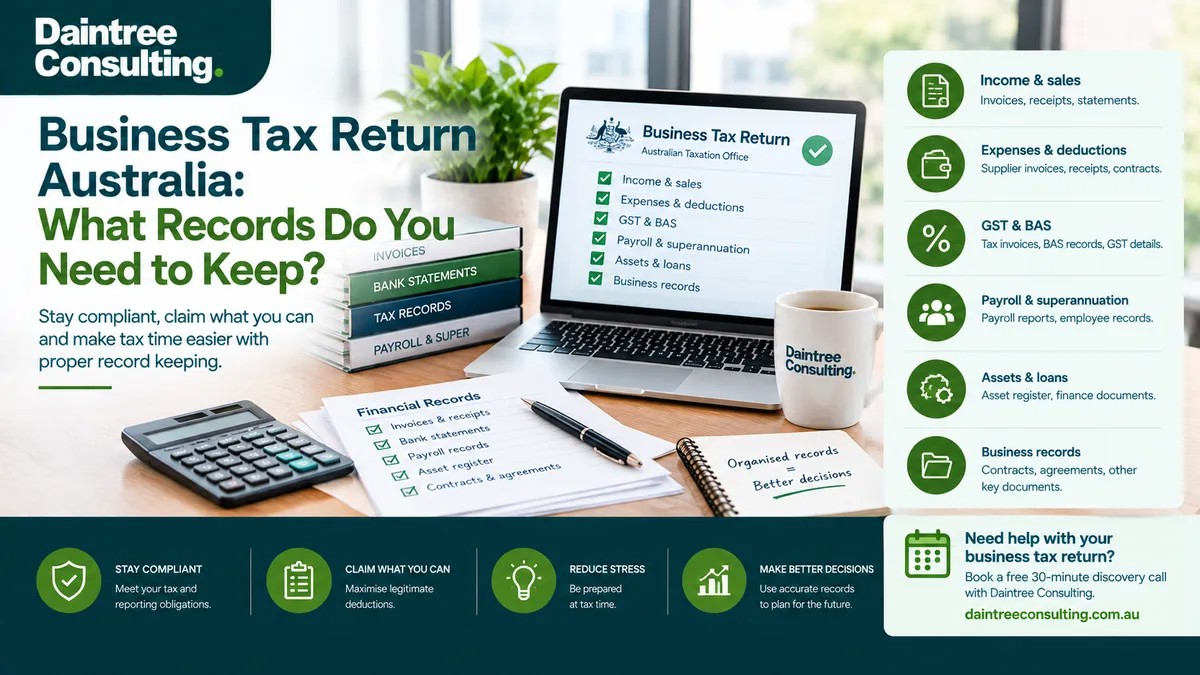
Business Tax Returns in Australia: What Records Do You Need to Keep?
Preparing a business tax return is much easier when your records are complete, organised and supported by clear evidence.
For many Australian business owners, the problem is not necessarily earning income or claiming legitimate deductions. It is finding the right documents months later and working out whether the numbers in the accounting system can actually be supported.
Want expert help? Daintree Consulting's tax and BAS services can take this off your plate. Book a free consultation.
Good record keeping helps your accountant prepare a more accurate business tax return in Australia, identify missing information, reconcile business activity and expenses, and deal with questions from the ATO if they arise.
The Australian Taxation Office generally requires businesses to keep most tax records for five years, although some records need to be kept longer depending on the transaction or obligation.
So, what exactly should you keep?
This guide explains the key records Australian businesses should have ready for their tax return, how long records generally need to be retained, and how to make the year-end process easier.
Quick Answer: What Records Do You Need for a Business Tax Return in Australia?
For most businesses, you should keep records that support:
Business income and sales
Business expenses and deductions
Bank and credit-card transactions
GST and BAS information
Payroll and employee costs
Superannuation records
Business assets and depreciation
Loans and finance arrangements
Motor vehicle and travel expenses
Stock or inventory, where applicable
Contractor and professional-service costs
Tax payments and previous tax records
Documents supporting significant business transactions
Records of elections, choices or other tax positions made by the business
The ATO says business records generally need to contain enough information to explain transactions and calculate the business's tax and other obligations.
The important point is this:
Your accounting software report is not always the evidence by itself.
You may also need the invoices, receipts, statements, contracts, agreements or other documents behind the numbers.
Why Record Keeping Matters for Your Business Tax Return
A tax return is ultimately based on the financial information reported by the business.
If that information is incomplete, incorrectly classified or unsupported, your accountant may need to spend additional time investigating transactions before the return can be finalised.
Poor records can also create other problems.
For example, imagine a business reports $800,000 of revenue and $650,000 of expenses in its accounting system.
At first glance, the numbers look complete.
But during year-end review, the accountant discovers:
Several bank accounts have not been reconciled.
Some supplier invoices are missing.
Vehicle expenses have no supporting records.
Asset purchases have been coded as ordinary expenses.
A business loan balance does not agree to the lender statement.
Some GST transactions have been treated incorrectly.
Payroll figures do not agree to the payroll system.
Several large transactions have no clear explanation.
The problem is no longer simply "preparing the tax return".
The business first needs to establish whether the underlying financial information is reliable.
That is why good record keeping should happen throughout the year rather than being treated as a task for June or July.
1. Keep Records of All Business Income
The first category is relatively straightforward: you need evidence of the income your business earns.
Depending on how your business operates, this may include:
Sales invoices
Tax invoices
Customer receipts
Point-of-sale reports
Online sales reports
E-commerce platform statements
Merchant facility statements
Commission income
Interest received
Rental or other business income
Contract income
Other amounts received in connection with the business
Your records should allow the income reported in the tax return to be traced back to the underlying transactions.
Don't rely only on your bank statement
A bank statement can show that money entered the business account, but it may not explain exactly what the payment relates to.
For example, a $20,000 deposit could represent:
A customer payment
A loan
An owner's contribution
A refund
The sale of an asset
A transfer between accounts
These transactions can have very different tax treatments.
Clear descriptions and supporting documents make it easier to distinguish them.
2. Keep Evidence for Business Expenses
Business expenses are another major part of the tax return.
You should retain documents supporting expenses such as:
Rent
Utilities
Insurance
Advertising
Software subscriptions
Professional fees
Accounting fees
Legal fees
Office expenses
Telephone and internet
Repairs and maintenance
Travel
Motor vehicle costs
Training
Equipment
Business supplies
Contractor costs
Interest and finance costs
The important question is not simply:
"Did the business pay this?"
It is:
"Can the business demonstrate what the payment was for and why it relates to the business?"
For many expenses, an invoice or receipt provides that evidence.
The ATO specifically includes documents relating to business income and expenses among the records businesses need to keep.
3. Keep Your Bank and Credit-Card Records
Bank accounts are central to most business tax returns.
Keep statements and supporting information for:
Business bank accounts
Savings accounts
Business credit cards
Merchant accounts
Payment platforms
Other accounts used for business transactions
Your bookkeeping should also reconcile these accounts regularly.
A year-end bank reconciliation can identify problems such as:
Missing transactions
Duplicate transactions
Incorrect payments
Unpresented items
Personal transactions recorded as business expenses
Transfers incorrectly classified as income or expenses
A clean reconciliation gives your accountant greater confidence that the accounting records represent what actually happened.
4. Keep BAS and GST Records
If your business is registered for GST, your BAS information forms an important part of the year-end tax process.
Keep records supporting:
GST collected
GST paid
Taxable sales
GST-free transactions
Input-taxed transactions
BAS lodgements
GST adjustments
Relevant purchase invoices
Relevant sales invoices
Your BAS and accounting records should also make sense together.
For example, if the GST figures reported throughout the year do not align with the accounting records, your accountant may need to investigate the differences before completing the tax return.
Daintree's Taxation & BAS Compliance service specifically includes BAS preparation and lodgement support, GST and related compliance support, and coordination with bookkeeping and accounting records.
5. Keep Payroll and Superannuation Records
If you employ staff, payroll records become another important part of the tax and accounting process.
Depending on your circumstances, records may include:
Payroll reports
Employee payment records
PAYG withholding information
Superannuation records
Payment summaries or relevant reporting information
Leave information
Payroll tax records where applicable
Employment-related expenses
Contractor payment information where relevant
Payroll should be reconciled against the accounting records rather than simply assumed to be correct.
There can also be record-keeping obligations under workplace laws in addition to tax requirements, so businesses should consider all applicable retention requirements rather than relying on the ATO minimum alone.
6. Keep Records for Business Assets
Large purchases often need more attention than ordinary operating expenses.
Examples include:
Vehicles
Machinery
Computers
Furniture
Equipment
Commercial property
Fit-outs
Other significant business assets
Keep documents such as:
Purchase invoices
Contracts
Settlement documents
Finance agreements
Payment records
Disposal or sale documents
Asset registers
Depreciation information
Why does this matter?
Because purchasing a $30,000 piece of equipment is not necessarily treated the same way as purchasing $300 of office supplies.
The tax treatment may involve depreciation, capital allowances, capital gains tax or other rules depending on the asset and the circumstances.
Your accountant needs enough information to determine the appropriate treatment.
7. Keep Loan and Finance Documents
Business loans can easily become confusing if supporting documents are missing.
Keep:
Loan agreements
Lender statements
Interest statements
Repayment records
Refinancing documents
Finance contracts
Records of loan establishment costs
Evidence of how borrowed funds were used
This becomes particularly important when a loan has been used for multiple purposes.
For example, a facility may have been used partly for business purposes and partly for another purpose. Your accountant may need to understand the underlying transactions before determining the appropriate treatment.
8. Keep Motor Vehicle and Travel Records
Vehicle and travel expenses are areas where businesses should be particularly careful about documentation.
Depending on the claim and circumstances, you may need records such as:
Vehicle logbook information
Fuel receipts
Registration costs
Insurance
Repairs
Lease or finance documents
Parking receipts
Tolls
Travel invoices
Accommodation receipts
Business travel itineraries
Evidence explaining the business purpose of travel
Don't assume that every cost incurred while travelling or driving is automatically a business deduction.
The supporting records should establish what the expense was and how it relates to the business.
9. Keep Records for Contractors and Professional Services
Many Australian businesses use contractors, consultants, freelancers and specialist service providers.
Keep:
Contractor invoices
Agreements
Payment records
Statements
Relevant tax information
Records supporting the business purpose of the service
This can be particularly important when a business has a large contractor workforce.
Your accountant may need to understand the nature of the relationship and payments rather than simply relying on the expense account in the general ledger.
10. Keep Records for Stock and Inventory
If your business sells physical products, inventory records can affect your financial statements and tax position.
Depending on the business, useful records may include:
Stocktake records
Inventory reports
Supplier invoices
Purchase records
Sales records
Freight costs
Inventory adjustments
Damaged or obsolete stock records
The objective is to make sure the accounting records properly reflect what the business actually holds and sells.
This becomes increasingly important as the volume and value of inventory increases.
11. Keep Records for Business Transactions That Are Out of the Ordinary
One of the easiest things to overlook is an unusual transaction.
For example:
Buying or selling a business
Buying or selling a major asset
Restructuring the business
Taking on a significant loan
Bringing in a new business owner
Paying a shareholder or director
Receiving government funding
Entering into a major commercial agreement
Disposing of an asset
Acquiring another business
Don't simply assume the accounting software classification explains everything.
Keep the underlying contracts, agreements, correspondence and settlement documents.
These documents can be especially valuable when the transaction has tax consequences beyond a normal operating expense.
How Long Do You Need to Keep Business Tax Records in Australia?
The commonly quoted rule is five years, but businesses should be careful about treating that as an absolute rule for every document.
The ATO says you generally need to keep most business records for five years. The retention period can depend on when the record was prepared or obtained, or when the relevant transaction or act was completed.
Some records need to be retained for longer.
For example, the ATO specifically identifies categories of records where the normal five-year period may not be sufficient.
There may also be separate record-keeping requirements under other laws.
The practical rule
Don't delete records simply because five years have passed without first checking whether another requirement applies.
This is particularly important for:
Long-term assets
Capital gains tax records
Property transactions
Company records
Employment records
Superannuation records
Ongoing legal or commercial arrangements
When in doubt, ask your accountant which records should be retained and for how long.
Digital Records Are Fine — But They Need to Be Accessible
Business records do not necessarily need to exist as paper documents.
Digital record keeping can make it much easier to:
Search invoices
Store receipts
Reconcile transactions
Share records with your accountant
Retrieve historical information
Maintain an organised audit trail
But simply having a cloud accounting subscription does not guarantee that your records are complete.
You still need a reliable process for capturing and storing supporting documentation.
A good system might look like:
Transaction → Invoice/receipt → Accounting entry → Reconciliation → Review → Tax return
The stronger the connection between these stages, the easier it becomes to explain the numbers.
What Should You Give Your Accountant at Tax Time?
Instead of sending your accountant a random collection of files, create a year-end checklist.
Depending on your business, this may include:
Financial records
Profit and loss report
Balance sheet
General ledger
Bank reconciliations
Credit-card reconciliations
Accounts receivable
Accounts payable
Income records
Sales reports
Revenue reconciliations
Other income
Investment or interest income
Expense records
Major invoices
Professional fees
Insurance
Rent
Vehicle expenses
Travel
Software
Contractor expenses
Tax and compliance records
BAS records
GST information
PAYG information
Previous tax returns
ATO correspondence
Tax payment records
Asset and finance records
Asset register
New asset purchases
Asset disposals
Loan statements
Interest statements
Finance agreements
Payroll records
Payroll reports
Superannuation information
Employee-related expenses
Relevant payroll reconciliations
The exact information required will depend on the business structure, industry and transactions during the year.
Common Record-Keeping Mistakes Businesses Make
Even businesses with accounting software can have gaps.
Here are some of the most common.
1. Keeping the accounting file but not the evidence
Your ledger may say "Office Expense — $2,500", but where is the supporting documentation?
2. Mixing personal and business expenses
This can make reconciliation and tax preparation unnecessarily difficult.
3. Waiting until tax time to reconcile
Problems discovered once a year are harder to fix than problems identified monthly.
4. Treating every purchase as an ordinary expense
Significant assets may require different accounting and tax treatment.
5. Losing documents when staff change
If only one person knows where the records are stored, the business has a process risk.
6. Keeping records without a consistent structure
A folder containing thousands of files called receipt123.pdf is technically storage, but it is not necessarily good record management.
7. Forgetting unusual transactions
Large loans, asset sales, restructures and owner transactions should be documented properly.
How to Make Your Business Tax Return Easier Next Year
You don't need to wait until tax time to improve your records.
A better approach is to build a simple monthly process.
Step 1: Reconcile accounts regularly
Make sure bank and credit-card accounts are up to date.
Step 2: Capture supporting documents
Attach or store invoices and receipts against the relevant transactions.
Step 3: Review unusual transactions
Don't let large or unusual amounts sit in generic accounts without explanation.
Step 4: Keep tax obligations visible
Track BAS, PAYG, superannuation and other relevant obligations.
Step 5: Review the financial reports
Your profit and loss and balance sheet should be reviewed regularly, not only when the tax return is due.
Step 6: Prepare a year-end checklist
Give your accountant a structured information pack rather than a last-minute collection of documents.
This can make the tax-return process more efficient and give you better visibility over the business before the return is lodged.
What If Your Records Are Behind?
It is common for business owners to fall behind with bookkeeping or record keeping.
That does not necessarily mean the situation cannot be fixed.
The first step is to establish what is missing.
A practical clean-up may involve:
Reconciling bank and credit-card accounts.
Identifying missing transactions.
Collecting invoices and receipts.
Reviewing unpaid customer and supplier balances.
Checking GST and BAS records.
Reconciling payroll.
Reviewing asset purchases.
Investigating unusual transactions.
Preparing a clean year-end financial position.
Giving your tax adviser the information needed to prepare the return.
Daintree's approach is built around bringing records, obligations and responsibilities into a clearer view before determining the appropriate next step.
When Should You Get Help With Your Business Tax Return?
You may benefit from professional support if:
Your bookkeeping is consistently behind.
You are unsure which expenses are business-related.
Your BAS and accounting records do not agree.
Your business has multiple bank accounts.
You have employees or contractors.
You have purchased or sold significant assets.
Your business has loans or complex finance arrangements.
You have overdue tax returns or BAS lodgements.
Your business structure has changed.
You are spending too much time preparing records yourself.
You want clearer visibility before the end of the financial year.
The goal isn't simply to get a tax return lodged.
It is to have financial records that make sense, can be supported and give you confidence in the numbers being reported.
Frequently Asked Questions
What records do I need for a business tax return in Australia?
You generally need records supporting business income, expenses, assets, liabilities, GST and other relevant tax information. Depending on your business, this can include invoices, receipts, bank statements, payroll records, asset registers, loan documents and BAS information.
How long do I need to keep business tax records?
Most business records generally need to be kept for five years, although some records need to be retained longer depending on the transaction or other legal requirements.
Can I keep my business tax records electronically?
Yes. Digital record keeping can be an effective way to organise and retrieve business records, provided the records remain accessible and meet applicable requirements.
Do bank statements count as business records?
Bank statements are important records, but they may not be sufficient by themselves to explain every transaction. Supporting invoices, receipts, contracts and other evidence may also be required.
What happens if I don't have all my receipts?
Speak with your accountant before finalising the return. Depending on the expense and circumstances, alternative evidence may be available, but you should not assume an expense is deductible simply because it appears in the bank account.
Do I need to keep records after lodging my tax return?
Yes. Lodging the return does not mean you can immediately dispose of the supporting records. The applicable retention period generally continues after lodgement.
Can an accountant help organise my records before preparing the tax return?
Yes. Depending on the engagement, an accountant or accounting team can help identify missing information, reconcile accounts, review records and prepare the information required for tax compliance.
Final Checklist: Are Your Business Tax Records Ready?
Before your next business tax return in Australia, ask:
Is all business income recorded?
Are bank accounts reconciled?
Are credit cards reconciled?
Are major expenses supported?
Are BAS and GST records complete?
Are payroll figures reconciled?
Are superannuation records available?
Are major asset purchases documented?
Are loan balances and interest supported?
Are vehicle and travel records organised?
Are unusual transactions explained?
Are important contracts and agreements retained?
Are records stored securely and accessible?
Have you checked whether any records need to be kept longer than five years?
If several answers are "no", it may be worth addressing the record-keeping gap before the tax return deadline arrives.
Need Help Preparing Your Business Tax Records?
A business tax return is only as reliable as the information behind it.
At Daintree Consulting, tax and BAS support is connected with bookkeeping and accounting so businesses can work from cleaner records, clearer responsibilities and a more practical compliance process. Services include business tax return support, BAS preparation and lodgement support, GST and PAYG compliance, tax planning discussions and coordination with bookkeeping and accounting.
If your records are behind, fragmented or simply taking too much time to manage, a free 30-minute discovery call can help identify what needs attention and what support makes sense.
Daintree Consulting – Taxation & BAS Compliance
Talk to Daintree about your tax and BAS
Our ex-Big 4 team gives clear, senior-reviewed advice so you can act with confidence.
Book a free consultation →
Or explore our tax and BAS services.
