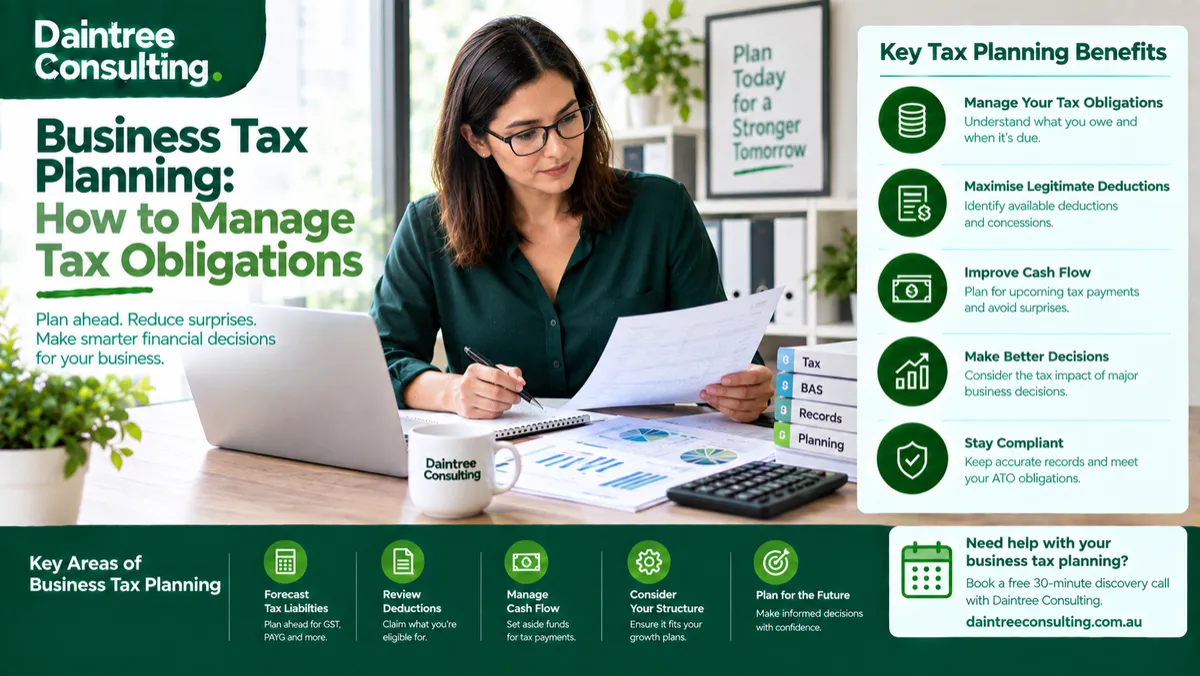
How Tax Planning Can Help Businesses Manage Their Tax Obligations
Tax is part of running a business, but it does not have to become a last-minute problem every financial year.
For many Australian businesses, tax planning is most useful when it happens throughout the year rather than just when the tax return is being prepared.
Want expert help? Daintree Consulting's tax and BAS services can take this off your plate. Book a free consultation.
Business tax planning involves looking ahead at your expected income, expenses, tax obligations, cash flow and business activities so you can make informed decisions and avoid unnecessary surprises.
It is not about avoiding tax or claiming expenses that are not legitimate. It is about understanding your obligations, keeping accurate records, identifying available deductions and concessions where eligible, planning for upcoming payments and making business decisions with the tax consequences in mind.
The taxes that may apply to a business depend on factors such as its structure, activities, employees and turnover. These can include income tax, GST, PAYG withholding, PAYG instalments, FBT and, in some circumstances, other federal or state taxes.
For business owners, effective tax planning can therefore form part of broader financial management.
Quick Answer: What Is Business Tax Planning?
Business tax planning is the process of reviewing your business's financial position and upcoming activities to manage tax obligations proactively and make informed financial decisions.
This can involve reviewing:
Current and projected income
Business expenses
Potential tax deductions
GST and BAS obligations
PAYG instalments
Payroll-related obligations
Capital purchases
Depreciating assets
Business structure
Cash flow
Tax payment timing
Record keeping
Potential tax concessions
Upcoming business transactions
The exact planning approach depends on the business.
A sole trader with a small service business will have different considerations from a company with employees, significant assets, multiple revenue streams or substantial investment activity.
Why Does Tax Planning Matter for Businesses?
Without planning, tax can become something you deal with only after the financial activity has already happened.
That can make it harder to manage cash flow or make informed decisions.
For example, if a business expects a significant tax liability but has not put enough cash aside, the eventual payment can place pressure on working capital.
Business.gov.au specifically recommends planning for tax payments and putting money aside so businesses have funds available when tax obligations fall due.
Tax planning can help you look ahead rather than simply react.
It can help you:
Understand upcoming tax obligations
Plan cash reserves
Identify legitimate deductions
Review business expenses
Prepare for PAYG instalments
Consider the timing of major purchases
Improve record keeping
Identify potential issues earlier
Understand how planned transactions may affect tax
Coordinate tax planning with broader business decisions
The objective is not necessarily to minimise the tax bill at all costs.
The objective is to make decisions with a clearer understanding of the financial and tax consequences.
Tax Planning Is More Than Preparing a Tax Return
A tax return looks backwards.
Tax planning looks ahead.
Your accountant may use historical financial information when preparing your tax return, but business tax planning can involve considering what is likely to happen over the coming months.
For example:
Is revenue increasing?
Are margins changing?
Are you expecting a large capital purchase?
Are you hiring employees?
Are you planning to sell an asset?
Is the business expanding?
Are PAYG instalments becoming significant?
Is your business structure still appropriate?
Are there upcoming transactions that could have tax consequences?
These questions can be considered before decisions are finalised.
That gives the business more opportunity to understand its options.
1. Start With a Clear Picture of Your Financial Position
Good tax planning depends on good financial information.
If your bookkeeping is incomplete, reconciliations are behind or expenses have not been properly recorded, it can be difficult to estimate your actual taxable position.
This is why tax planning should connect with your regular accounting processes.
Useful information can include:
Current revenue
Gross profit
Operating expenses
Net profit
Accounts receivable
Accounts payable
Cash balance
Outstanding loans
Asset purchases
Payroll costs
GST position
Previous tax liabilities
PAYG instalments
The more current your financial information is, the easier it becomes to have a meaningful tax-planning discussion.
2. Understand Which Taxes Apply to Your Business
Not every business has the same tax obligations.
Your business structure and activities can affect the taxes and registrations that apply.
Depending on the circumstances, a business may need to consider:
Income tax
GST
PAYG withholding
PAYG instalments
Fringe benefits tax
Capital gains tax
Payroll tax
Other state or territory taxes
Industry-specific taxes or obligations
Business.gov.au notes that tax registrations depend on factors including business structure, location, products or services and whether the business employs people.
This makes it important to avoid assuming that another business's tax treatment will automatically apply to yours.
3. Review Your Business Expenses
One of the practical areas of tax planning is reviewing business expenses.
Generally, business expenses may be deductible when they meet the relevant tax requirements.
Business.gov.au explains that deductions can reduce taxable income and that expenses generally need to relate to earning business income, not be private in nature, and be supported by appropriate records.
This means tax planning should include questions such as:
Are all relevant business expenses being recorded?
Are receipts and invoices being retained?
Are expenses being classified correctly?
Are any expenses partly private?
Are there expenses that require special treatment?
Are capital purchases being treated appropriately?
Are there expenses that need additional supporting documentation?
The important point is that not every business expense is automatically deductible.
Tax planning should focus on legitimate claims supported by the applicable rules and records.
4. Keep Better Records Throughout the Year
Good tax planning becomes much harder when records are incomplete.
Australian businesses are required to keep records that substantiate information included in tax returns and reports. Business.gov.au notes that good record keeping can also help businesses manage the business and make better decisions.
Useful records can include:
Sales invoices
Purchase invoices
Receipts
Bank statements
Payroll records
Asset purchase documents
Loan records
Business expense records
GST records
BAS information
Records supporting deductions
Keeping these records organised throughout the year reduces the need to reconstruct financial information later.
It can also make discussions with your accountant more productive.
5. Plan for Your Tax Cash Flow
A business can have a healthy profit and still experience cash-flow pressure when tax payments become due.
This is because accounting profit and available cash are not always the same thing.
For example, a business may have made sales on credit and recognised revenue, while the customers have not yet paid.
The business may therefore have a tax obligation without having received all the related cash.
This is why tax planning should be connected to cash-flow planning.
Consider:
Expected tax liabilities
BAS payments
PAYG instalments
PAYG withholding
GST
Payroll-related obligations
Upcoming asset purchases
Loan repayments
Other significant cash commitments
Business.gov.au recommends setting aside money regularly for taxes such as GST and PAYG withholding to help businesses have funds available when payments are due.
6. Review PAYG Instalments
PAYG instalments can be an important part of tax planning for businesses and individuals with business or investment income.
Rather than waiting until the end of the income year to pay the entire tax liability, PAYG instalments generally allow tax to be paid progressively.
Business.gov.au notes that PAYG instalments are usually paid quarterly and are intended to help avoid a large tax bill after the tax return is lodged.
For a growing business, this can make cash-flow forecasting particularly important.
If profits are changing significantly, it may be worth discussing your PAYG position with your tax professional rather than assuming previous instalment amounts will remain appropriate.
7. Consider Major Purchases Before Making Them
Capital purchases can have tax and cash-flow implications.
For example, a business may be considering purchasing:
Vehicles
Equipment
Technology
Machinery
Office fit-out
Other business assets
Before making a major purchase, consider more than the purchase price.
Questions might include:
Is the asset genuinely required?
How will it affect cash flow?
How will it be treated for tax?
Are there depreciation implications?
Are GST considerations relevant?
Is financing involved?
Is the purchase consistent with the business plan?
Tax treatment should not be the only reason to purchase an asset.
Buying something the business does not need simply because it may produce a tax deduction can still leave the business financially worse off.
Tax planning should support sensible commercial decisions, not replace them.
8. Understand Available Small Business Tax Concessions
Depending on the business and the relevant financial year, small businesses may have access to tax concessions, deductions or other measures.
Eligibility can depend on factors such as:
Business structure
Aggregated turnover
Type of expenditure
Type of business activity
Asset characteristics
Timing
Current legislation
For example, business.gov.au currently identifies a number of small business tax concessions and notes that eligibility requirements can change.
The Australian Government's 2026–27 Budget also included tax measures relevant to businesses, including a proposal to make the $20,000 instant asset write-off permanent for eligible small businesses with turnover under $10 million. The treatment and timing of tax measures should always be checked against current legislation and ATO guidance before relying on them.
This is one reason tax planning should be reviewed regularly rather than relying on information from a previous financial year.
9. Think About Timing
Timing can matter when a business is considering significant financial transactions.
Depending on the circumstances, planning may involve considering when to:
Purchase an asset
Receive or invoice income
Pay certain expenses
Dispose of an asset
Make business investments
Enter into a new arrangement
Expand operations
However, timing should never be based solely on an assumption that moving a transaction into a particular financial year will automatically create a tax benefit.
The applicable tax rules, accounting treatment and commercial circumstances all need to be considered.
This is particularly important for larger or more complex transactions.
10. Consider Your Business Structure
Business structure can affect taxation and reporting obligations.
Common Australian business structures include:
Sole trader
Partnership
Company
Trust
Business.gov.au notes that the structure chosen for a business affects its legal and tax obligations.
As a business grows, its original structure may no longer reflect its circumstances or future plans.
For example, a business may be:
Growing significantly
Bringing in new owners
Preparing for investment
Expanding operations
Planning a succession
Acquiring another business
Preparing to sell
These decisions can have tax and legal consequences.
Changing structure should therefore not be treated as a simple tax-saving exercise.
It should be considered alongside commercial, legal, asset-protection and long-term planning factors, with appropriate professional advice.
11. Review GST and BAS Obligations
For businesses registered for GST, BAS reporting is another important part of tax planning.
A BAS may be used to report amounts such as:
GST
PAYG withholding
PAYG instalments
FBT instalments
Other applicable taxes
The exact BAS fields depend on the business's registrations and reporting circumstances.
Regular reconciliation and bookkeeping can help make BAS preparation more manageable.
Before lodging, businesses should ensure the relevant figures agree with their underlying records and that sales and purchases have been reported in the appropriate period.
This is where good bookkeeping and tax planning work together.
12. Don't Confuse Tax Planning With Tax Avoidance
This distinction is important.
Legitimate tax planning involves making informed decisions within the applicable tax rules.
Tax avoidance is different.
A business should not:
Invent expenses
Claim private costs as business expenses
Create artificial transactions solely for tax purposes
Manipulate records
Claim deductions without supporting evidence
Assume that a tax strategy is acceptable simply because someone else uses it
Good tax planning should be transparent, commercially sensible and supported by appropriate records.
If a proposed strategy seems unusually complicated or promises a tax outcome that appears disproportionate to the underlying transaction, professional advice is particularly important.
13. Review Tax Planning Before the End of the Financial Year
EOFY is an important time to review your financial position, but it should not be the first time you think about tax.
An EOFY review can nevertheless be useful for looking at:
Current-year profit
Expected taxable income
Outstanding expenses
Asset purchases
Debtors
Creditors
GST position
PAYG instalments
Potential deductions
Records and documentation
Upcoming tax payments
The goal is to identify issues while there is still time to address them appropriately.
Waiting until after the financial year has ended can reduce the number of decisions that can still be made.
14. Make Tax Planning Part of Your Regular Financial Review
Tax planning works better when it is connected to your regular management reporting.
Instead of reviewing tax once a year, consider including tax-related considerations within broader financial reviews.
For example, a monthly or quarterly review might consider:
Revenue
Gross margin
Operating expenses
Net profit
Cash flow
Tax liabilities
BAS position
PAYG instalments
Major upcoming expenditure
Changes to the business
This provides a more complete view of the business.
It also means tax planning is connected to actual business performance rather than being treated as an isolated accounting task.
Signs Your Business May Need More Tax Planning
You may benefit from a more structured approach if:
Your tax bills keep catching you by surprise
Unexpected tax payments can create unnecessary cash-flow pressure.
Your bookkeeping is consistently behind
If financial records are not current, it becomes harder to understand your tax position.
Your business is growing quickly
Higher revenue, additional employees and larger transactions can introduce new tax considerations.
You're making significant asset purchases
Large purchases can have accounting, tax and cash-flow implications.
Your business structure is changing
Growth, new owners, succession or restructuring may require additional tax planning.
Your PAYG instalments no longer seem to reflect your business
Changes in profitability may warrant a discussion with your tax professional.
You are unsure what expenses can be claimed
Professional guidance can help distinguish potentially deductible business expenses from private or non-deductible costs.
You're waiting until tax time to review everything
Tax planning is generally more useful when decisions are considered before the relevant transactions occur.
Common Business Tax Planning Mistakes
Only thinking about tax at EOFY
By the time EOFY arrives, many financial decisions have already been made.
Treating every expense as deductible
A business expense still needs to satisfy the applicable tax rules and be supported by appropriate records.
Buying assets purely for a tax deduction
A tax deduction does not make an unnecessary purchase profitable.
Ignoring cash flow
A tax liability needs to be paid with actual cash, even if the business's accounting profit looks healthy.
Relying on old tax advice
Tax rules, thresholds and concessions can change.
Mixing personal and business expenses
This can make records harder to maintain and may complicate the treatment of expenses.
Failing to keep supporting records
A deduction without appropriate evidence can create problems if the claim cannot be substantiated.
Assuming another business has the same tax position
Tax treatment depends on circumstances, structure and activities.
A Practical Business Tax Planning Checklist
A simple review could include the following:
Financial position
Is bookkeeping up to date?
Have bank accounts been reconciled?
Are accounts receivable and payable current?
Is current-year profit understood?
Tax obligations
Which taxes apply to the business?
Are GST and BAS obligations up to date?
Are PAYG instalments being managed?
Are payroll-related obligations being recorded correctly?
Deductions and expenses
Are legitimate business expenses being captured?
Are records available to support claims?
Are private expenses separated?
Are capital purchases being identified correctly?
Cash flow
How much tax may need to be paid?
Is enough cash being set aside?
Are upcoming tax payments included in the cash-flow forecast?
Upcoming decisions
Are major asset purchases planned?
Is the business expanding?
Is the structure changing?
Are there significant transactions approaching?
Professional review
Does the business need a tax planning discussion?
Are there changes in the business that your accountant should know about?
Are you relying on tax rules from an earlier financial year?
How Daintree Consulting Can Help With Business Tax Planning
Effective tax planning starts with accurate financial information.
Daintree Consulting provides Taxation & BAS Compliance support for Australian businesses, including practical assistance with tax returns, BAS, GST and PAYG-related obligations, tax records and ATO correspondence.
Tax planning can also connect closely with broader accounting and business advisory work.
Reliable management accounts, cash-flow reporting and financial oversight can give business owners a clearer picture of their financial position before tax decisions need to be made.
Daintree's approach is focused on practical communication and helping business owners understand the financial information behind their obligations and decisions.
If you are approaching EOFY, experiencing business growth, expecting a significant tax liability or simply want a clearer process for managing your tax obligations throughout the year, a structured tax-planning review can be a useful starting point.
Frequently Asked Questions
What is business tax planning?
Business tax planning is the process of reviewing a business's financial position, expected income, expenses, tax obligations and upcoming transactions to make informed decisions about its tax affairs.
When should a business start tax planning?
Tax planning can be considered throughout the financial year rather than waiting until EOFY. Regular reviews allow businesses to identify potential issues and plan for upcoming tax payments and decisions.
Does tax planning mean paying less tax?
Not necessarily. Tax planning is about managing tax obligations appropriately and understanding the tax consequences of business decisions. It may identify legitimate deductions or concessions where eligible, but the goal should not be to pursue artificial or inappropriate arrangements simply to reduce tax.
What expenses can a business claim as tax deductions?
The treatment depends on the expense and the business's circumstances. Generally, an expense needs to meet the applicable deduction requirements and be supported by appropriate records. Business.gov.au notes that expenses generally need to relate to earning business income and not be private in nature.
Why is cash flow important for tax planning?
Tax liabilities need to be paid with available cash. A business can therefore experience cash-flow pressure even when it is profitable. Including expected tax payments in cash-flow planning can help the business prepare.
Does tax planning include BAS and GST?
It can. For GST-registered businesses, BAS reporting and payment obligations form part of the broader tax-management process. BAS figures should be reconciled with the underlying business records before lodgement.
Can tax planning help a growing business?
Yes. Growth can change revenue, expenses, staffing, asset purchases, cash flow and potentially the taxes or registrations that apply. Regular financial and tax reviews can help a growing business identify these changes earlier.
Should a business change its structure to reduce tax?
A change in business structure should not be made solely on the assumption that it will reduce tax. Structure can affect legal, tax, reporting and administrative obligations, so the decision should consider the broader circumstances and be supported by appropriate professional advice.
Final Takeaway
Business tax planning is about being prepared rather than reacting to tax obligations after the fact.
For Australian businesses, that means keeping accurate financial records, understanding which taxes apply, monitoring cash flow, reviewing legitimate deductions, planning for tax payments and considering the tax implications of significant business decisions.
The most useful tax planning is not necessarily about finding a way to produce the lowest possible tax bill.
It is about understanding your obligations and making sound commercial decisions with those obligations in mind.
Regular bookkeeping, management reporting and financial reviews provide the information needed to make those decisions.
If your business is growing, your tax obligations are becoming harder to manage, or you want a clearer picture of what may be coming, professional tax planning can help you approach the year with greater visibility.
Need help managing your business tax and BAS obligations? Book a free 30-minute discovery call with Daintree Consulting.
Important Publishing Note
Tax legislation, rates, thresholds, concessions, deduction rules, GST requirements and reporting obligations can change and depend on the business structure and individual circumstances. This article provides general information only and should not be treated as accounting, tax, legal or financial advice. Current ATO requirements and the applicable financial-year rules should be checked before acting on any tax-planning strategy.
Talk to Daintree about your tax and BAS
Our ex-Big 4 team gives clear, senior-reviewed advice so you can act with confidence.
Book a free consultation →
Or explore our tax and BAS services.
