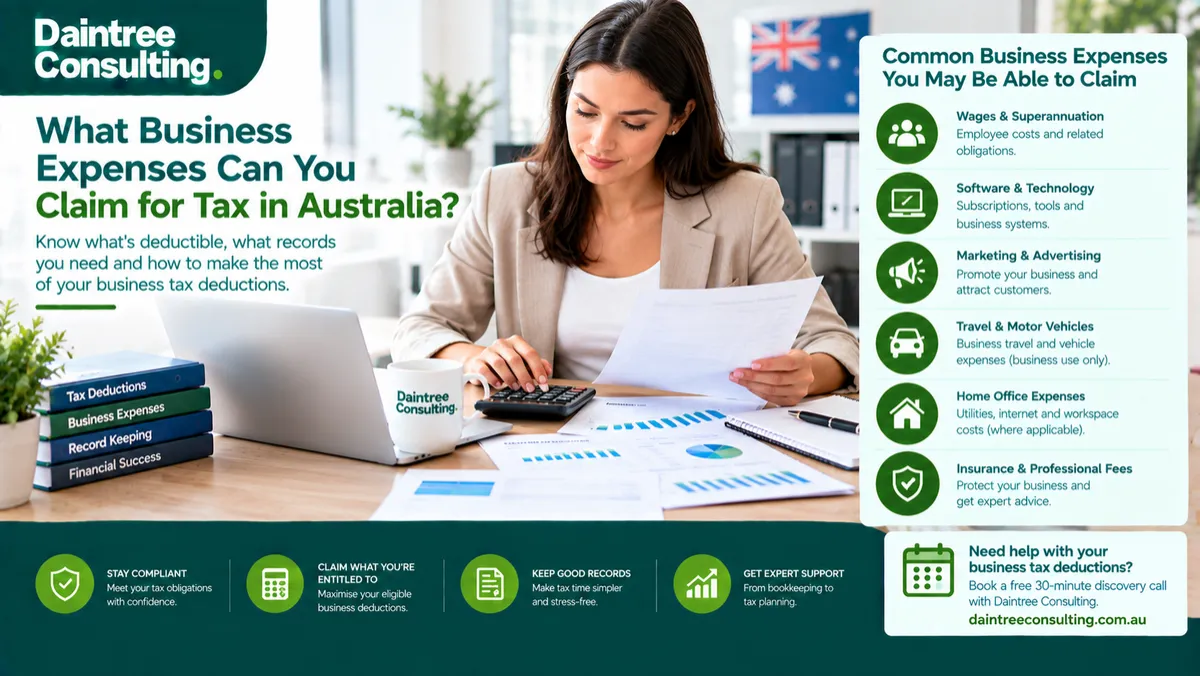
What Business Expenses Can You Claim for Tax in Australia?
Running a business comes with plenty of costs — from software subscriptions and professional fees to wages, advertising, travel and office expenses.
The good news is that many genuine business expenses can be claimed as tax deductions in Australia.
Want expert help? Daintree Consulting's tax and BAS services can take this off your plate. Book a free consultation.
The important part is understanding which expenses are deductible, which are only partly deductible, and which cannot be claimed at all.
For most business owners, the biggest issue is not simply knowing that an expense exists. It is knowing whether the expense has a sufficient connection to the business, how much of it can be claimed, what records need to be kept and whether special tax rules apply.
This guide explains the key principles behind business tax deductions in Australia, including common deductible expenses, mixed business and private costs, motor vehicles, travel, home-based businesses, capital purchases and expenses you generally cannot claim.
Quick answer: A business expense is generally deductible when it is genuinely connected with earning the business's assessable income, is not private or capital in nature, and is supported by appropriate records. If an expense is partly business and partly private, generally only the business portion can be claimed.
The three questions to ask before claiming a business expense
Before putting an expense through your business accounts and claiming it as a deduction, ask three questions.
1. Is the expense genuinely related to the business?
The expense should have a connection with earning assessable business income or carrying on the business.
For example, software used to manage your business operations will generally have a much clearer business connection than something purchased primarily for personal use.
The same principle applies to professional services, advertising, office supplies, employee costs and many other ordinary business expenses.
2. Is there a private component?
An expense can sometimes have both business and private elements.
If that happens, you generally need to separate the two and claim only the business-related portion.
For example, if a business owner uses a phone for both work and personal calls, claiming the entire cost without considering private use may not be appropriate.
The ATO's general approach is that mixed expenses need to be apportioned so that the deduction reflects the business use.
3. Can you prove the expense?
A deduction should be supported by appropriate records.
Depending on the expense, this may include invoices, receipts, tax invoices, contracts, bank records, calculations, logbooks, travel records or other documentation.
Good record keeping is therefore not just a bookkeeping exercise. It is part of supporting your tax position.
Common business expenses you may be able to claim
There is no single list that covers every business because deductible expenses depend on the nature of the business, its structure and how an expense was incurred.
However, many Australian businesses encounter the following categories.
1. Accounting and professional fees
Professional fees directly associated with running your business may be deductible.
Examples can include:
Accounting services
Bookkeeping services
Tax preparation and compliance work
Business advisory services
Certain legal or professional services
Financial reporting support
Audit and assurance-related costs where applicable
The exact treatment depends on what the professional service relates to.
It is worth separating ordinary business operating costs from expenses associated with acquiring capital assets, establishing structures or other activities that may have different tax treatment.
2. Wages, salaries and employee-related costs
Employee wages and salaries are common business expenses.
Depending on the circumstances, businesses may also incur deductible costs associated with:
Superannuation
Payroll processing
Workers' compensation
Certain employee benefits
Training and development
Recruitment
Other employment-related expenses
The tax treatment can differ for specific employee benefits, entertainment and fringe benefits, so businesses should not assume that every employee-related payment receives identical treatment.
The ATO includes salaries, wages and superannuation among common business expense categories.
3. Advertising and marketing
Advertising is another common business expense.
Depending on the circumstances, this could include:
Google or social media advertising
Website advertising
Business website costs
Graphic design
Marketing services
Promotional materials
Business photography
Certain sponsorship and promotional activities
The key question is whether the expense is genuinely connected with promoting or operating the business.
Keep invoices and supporting documentation showing what the expense was for and which business activity it relates to.
4. Office supplies and operating expenses
Businesses often incur relatively small expenses throughout the year that can be easy to overlook.
Examples can include:
Stationery
Printing
Postage
Business software
Cloud services
Office consumables
Business subscriptions
Internet and telecommunications
Small equipment and supplies
Rather than waiting until tax time to identify these expenses, it is better to record them consistently throughout the year.
A well-maintained bookkeeping system can make it much easier to identify deductible expenses and reconcile them against bank and credit-card transactions.
5. Software and technology
Modern businesses may have dozens of recurring technology expenses.
These can include:
Accounting software
Payroll software
CRM platforms
Project management tools
Cloud storage
Cybersecurity software
Website hosting
Business communication platforms
Design and marketing software
Where the expense is genuinely used for business purposes, it may be deductible.
However, businesses should pay attention to mixed-use technology.
If a service is used partly for personal purposes, the business and private portions may need to be separated.
6. Business travel
Travel undertaken for genuine business purposes can give rise to deductible expenses.
Depending on the circumstances, common business travel expenses can include:
Airfares
Train, bus and other public transport
Taxi and ride-sourcing fares
Business accommodation
Car hire
Fuel and tolls associated with business travel
Business-related parking
Meals while travelling overnight in circumstances where the expense is deductible
The private portion of a trip generally cannot simply be treated as a business deduction.
For example, adding a private holiday to the end of a business trip does not automatically make the holiday-related costs deductible.
The ATO states that businesses can claim travel expenses related to business travel but must exclude private costs. Additional record and travel-diary requirements can apply depending on the circumstances and length of travel.
Be careful with business and private travel
This is one area where business owners can easily get into trouble.
Consider a trip where you:
Attend a two-day business conference
Stay for two additional days for personal sightseeing
Bring a family member
Upgrade accommodation for private reasons
You should not simply put the entire trip through the business.
The business and private components need to be considered separately.
7. Motor vehicle expenses
Motor vehicle expenses can be deductible when a vehicle is used for business purposes.
Depending on the business structure, vehicle type and method being used, expenses may include:
Fuel
Repairs and servicing
Registration
Insurance
Lease costs
Interest in relevant circumstances
Charging costs for electric vehicles
Depreciation or decline in value
However, the treatment of motor vehicles can become complicated quickly.
A vehicle used for both business and private purposes generally requires the business-use component to be identified.
The ATO specifically states that businesses cannot automatically claim all costs simply because a vehicle is used by the business. Private use needs to be separated from business use, with records supporting the calculation.
Different rules can also apply depending on whether the business is operated as a sole trader, partnership, company or trust.
For example, companies and trusts generally use actual-cost methods for their motor vehicle claims rather than the methods available to eligible individuals and partnerships.
8. Home-based business expenses
Working from home does not automatically mean every household expense becomes a business deduction.
The amount you may be able to claim depends on factors such as:
How the home is used for the business
Whether the space has a business purpose
The nature of the expenses
How the expenses are calculated
Whether the business is operated through a sole trader, partnership, company or trust
Potential expenses may include certain:
Electricity
Internet
Phone costs
Occupancy costs in some circumstances
Office equipment
Repairs and maintenance
Depreciating assets
The important point is that home-based business deductions generally require a reasonable method for working out the business-use portion and appropriate records supporting the calculation.
This is an area where getting the structure and calculation right matters.
9. Repairs and maintenance
Repairs and maintenance associated with business assets or premises may be deductible where they meet the relevant requirements.
However, there is an important distinction between repairing something and improving or acquiring an asset.
For example, repairing existing business equipment is not necessarily treated in the same way as purchasing a significant new asset or making a substantial improvement.
The ATO notes that repairs of a capital nature are treated differently from ordinary repairs and that the business-use portion needs to be considered where an asset has mixed use.
This distinction is important because capital expenditure may need to be dealt with through depreciation or another specific tax provision rather than claimed immediately as an ordinary operating expense.
10. Business insurance
Insurance can be an important operating cost for many businesses.
Depending on the policy and circumstances, a business may have costs associated with:
Public liability insurance
Professional indemnity insurance
Business property insurance
Cyber insurance
Commercial vehicle insurance
Other business-related insurance
Keep the policy documentation and invoices so the nature of the expense is clear.
11. Rent and premises costs
Businesses operating from commercial premises may incur expenses such as:
Commercial rent
Utilities
Cleaning
Repairs and maintenance
Security
Certain property-related operating costs
The treatment depends on the type of expense and the arrangement under which the premises are occupied.
Businesses should also distinguish between ordinary premises expenses and capital expenditure, such as major improvements or structural works.
12. Interest and finance costs
Businesses may incur interest and other finance-related costs when borrowing money for business purposes.
Depending on the circumstances, deductions may be available for eligible interest and borrowing-related costs.
However, the purpose of the borrowing matters.
Borrowing to fund business activities is different from borrowing for private purposes, even if the same bank account or facility is involved.
If a loan is used for multiple purposes, careful records and appropriate allocation may be required.
13. Bad debts
If your business provides goods or services on credit, you may eventually have customers who fail to pay.
Bad debts can have specific tax treatment and should not simply be written off in the accounts without considering whether the relevant tax requirements have been met.
This is another example of why bookkeeping treatment and tax treatment are not always identical.
If a significant customer debt becomes doubtful or unrecoverable, it is worth discussing the situation with your accountant before making adjustments.
Expenses you generally cannot claim
Understanding what cannot be claimed is just as important as knowing what can.
Common examples include expenses that are:
Private or domestic in nature
Unrelated to earning business income
Capital in nature where a different tax treatment applies
Unsupported by appropriate records
Related to private portions of mixed expenses
Specifically denied by tax legislation
Entertainment is a particularly common area of confusion.
A business lunch may feel completely business-related, but business-related does not automatically mean tax deductible.
The ATO generally restricts deductions for entertainment expenses, including many forms of business entertainment. Specific exceptions can apply depending on the circumstances.
Traffic fines are another straightforward example of an expense that should not simply be treated as a deductible business cost.
What about business purchases that cost a lot?
Not every business purchase should be treated as an ordinary expense in the year you buy it.
A significant asset may instead be considered a capital expense.
Examples could include:
Business machinery
Major equipment
Commercial vehicles
Certain technology assets
Property improvements
Other long-term business assets
Depending on the asset and applicable rules, deductions may be available through depreciation or other capital allowance provisions.
This is why it is important to distinguish between:
Operating expenses
Costs associated with the ongoing operation of the business.
Capital expenses
Costs associated with acquiring or improving assets that provide longer-term benefits.
The tax treatment can be very different.
What records should you keep?
Good record keeping is one of the most important parts of claiming business tax deductions.
Your records should allow you to demonstrate:
What you purchased
When you purchased it
How much it cost
Who supplied it
Why it was a business expense
The business-use percentage where applicable
How you calculated the deduction
Any relevant GST treatment
Supporting details for unusual or significant expenses
Depending on the expense, records may include:
Tax invoices
Receipts
Bank statements
Supplier invoices
Contracts
Payroll records
Vehicle logbooks
Travel records
Calculation worksheets
Asset registers
Business-use diaries
The ATO emphasises the need for records supporting business deductions and the business-use proportion of relevant expenses.
Why good bookkeeping makes tax deductions easier
Tax deductions should not be something you try to reconstruct from a bank account a few days before your tax return is due.
A stronger approach is to maintain accurate records throughout the year.
Good bookkeeping can help you:
Identify business expenses as they occur
Separate business and private transactions
Reconcile bank and credit-card accounts
Keep supporting documentation organised
Identify unusual transactions
Track business-use percentages
Monitor cash flow
Prepare cleaner records for your accountant
Reduce the risk of missing legitimate deductions
Make tax-time discussions more efficient
This is particularly important as a business grows.
A business with hundreds or thousands of transactions each year needs more than a pile of receipts. It needs a consistent process for recording, categorising and reviewing financial information.
Don't confuse a tax deduction with getting the money back
One common misunderstanding is that claiming a tax deduction means the government refunds the full amount of the expense.
It does not.
A deduction generally reduces the amount of taxable income on which tax is calculated.
For example, if a business incurs a legitimate $1,000 deductible expense, that does not mean the business receives $1,000 back.
The actual tax effect depends on the business's circumstances and applicable tax rate.
This distinction is important when making spending decisions.
A business should not spend money simply because an expense is deductible.
The first question should always be whether the expense makes commercial sense.
Should you try to claim every possible deduction?
Not necessarily.
The goal should not be to maximise deductions at any cost.
The goal is to correctly identify expenses that the business is entitled to claim and maintain evidence to support those claims.
There is a significant difference between:
“Can I find a way to claim this?”
and
“Is this genuinely a deductible business expense, and can I substantiate it?”
The second question is the better one.
A strong accounting and tax process should help you claim legitimate deductions without turning every personal expense into a questionable business expense.
A practical business tax deduction checklist
Before finalising your business records for tax time, consider whether you have reviewed:
Business software and subscriptions
Accounting and professional fees
Advertising and marketing
Wages and employee costs
Superannuation
Office and operating expenses
Insurance
Rent and premises costs
Repairs and maintenance
Business travel
Motor vehicle expenses
Home-based business expenses
Interest and finance costs
Depreciating assets and capital purchases
Bad debts where applicable
Business-use percentages for mixed expenses
Supporting invoices and receipts
GST treatment where relevant
Private expenses that need to be excluded
Any unusual or significant transactions that need professional review
This review can help identify missing records before tax preparation begins.
When should you speak with your accountant?
Some expenses are straightforward.
Others are not.
It is worth getting professional advice when you are dealing with:
Large asset purchases
Property or premises
Business vehicles
Home-based businesses
Business travel with private components
Company or trust structures
Related-party transactions
Significant borrowing
Employee benefits
Entertainment
Business restructuring
New business purchases
Unusual or high-value expenses
The earlier you ask, the easier it can be to structure the transaction and maintain the right records.
Waiting until after the end of the financial year can limit your options and make the review more difficult.
Final thoughts: claim what you are entitled to, and keep the evidence
Understanding business tax deductions Australia is not about finding a way to classify every expense as deductible.
It is about knowing the difference between legitimate business costs, private expenses, mixed-use expenses and capital expenditure — and keeping the records needed to support the treatment.
For Australian business owners, a reliable process usually starts with accurate bookkeeping.
When expenses are recorded correctly throughout the year, it becomes much easier to identify deductible costs, separate private transactions, reconcile accounts and prepare the information your accountant needs.
If you are unsure about an expense, do not guess.
Get advice before claiming it.
Need help getting your business records ready for tax time?
Daintree Consulting provides accounting, bookkeeping and taxation support for Australian businesses.
Our team can help you maintain cleaner financial records, review business expenses, coordinate tax and BAS requirements and improve the financial information available for decision-making.
Book a free 30-minute discovery call with Daintree Consulting to discuss your business's accounting and tax requirements.
Frequently Asked Questions
What business expenses can I claim on tax in Australia?
You may be able to claim expenses that are directly related to earning your business income or carrying on your business, provided the expense meets the relevant tax requirements and you have appropriate records.
Common categories include wages, accounting fees, advertising, software, office costs, business travel, insurance, rent and certain vehicle expenses.
Can I claim an expense that is partly personal and partly for my business?
Potentially, but generally only the business-related portion can be claimed. You need a reasonable basis for working out the business-use percentage and records to support the calculation.
Can I claim my business vehicle?
Business vehicle expenses may be deductible, but the rules depend on the business structure, type of vehicle, ownership and how the vehicle is used.
If there is private use, the business portion generally needs to be separated and supported by appropriate records.
Can I claim business travel expenses?
Business travel expenses may be deductible where the travel is genuinely for business purposes. Private components of travel generally cannot be claimed. Additional record-keeping requirements can apply depending on the circumstances.
Can I claim meals as a business expense?
It depends on the circumstances.
Meals associated with certain business travel may be deductible, while many forms of business entertainment, including client entertainment, are generally subject to restrictions.
Can I claim equipment purchased for my business?
Potentially, but larger or longer-term assets may be treated as capital expenditure rather than an ordinary business expense. Depreciation or other specific rules may apply.
How long should I keep records for business tax deductions?
Record-keeping periods can vary depending on the type of record and transaction. Businesses should follow the current ATO requirements applicable to their circumstances rather than assuming that every record has the same retention period.
What happens if I don't have a receipt?
Do not assume an expense is deductible simply because it appears on a bank statement.
You need appropriate evidence to substantiate deductions, and the documentation required can depend on the type of expense.
Should I claim every expense my business pays for?
No.
An expense being paid from a business bank account does not automatically make it deductible.
You should consider whether the expense is genuinely business-related, whether any private component needs to be excluded, whether capital rules apply and whether you have sufficient records.
Talk to Daintree about your tax and BAS
Our ex-Big 4 team gives clear, senior-reviewed advice so you can act with confidence.
Book a free consultation →
Or explore our tax and BAS services.
