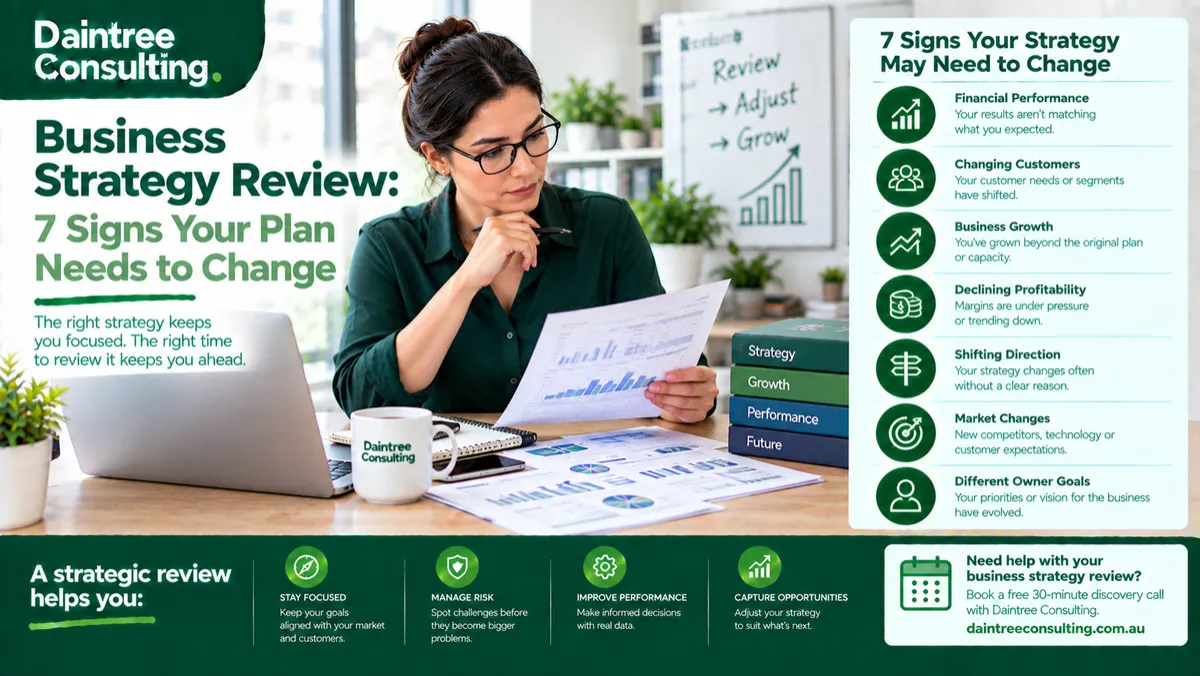
When Should a Business Review Its Strategy? 7 Signs Your Current Plan Needs to Change
A business strategy is not something you should write once and leave untouched for five years.
Markets change. Customer expectations change. Costs increase. Competitors enter the market. New technology changes how businesses operate. Even the goals of the owners can change.
Want expert help? Daintree Consulting's business advisory services can take this off your plate. Book a free consultation.
A strategy that made sense when the business was smaller may no longer be appropriate after significant growth.
That is why a regular business strategy review matters.
Reviewing your strategy does not necessarily mean starting again. In many cases, the purpose is to test whether your current direction still makes sense based on what has changed since the strategy was created.
For some businesses, that may mean making small adjustments. For others, it may mean reconsidering customers, services, pricing, investment priorities, operational structure or growth plans.
The key is recognising when the existing plan is no longer providing a useful framework for making decisions.
What is a business strategy review?
A business strategy review is a structured assessment of where the business is heading, whether its current strategy is working and whether changes are needed.
It can involve reviewing:
Business goals
Revenue and profitability
Customer segments
Products and services
Pricing
Market conditions
Competitive position
Operational capacity
Cash flow
Financial performance
Key business risks
People and capabilities
Investment priorities
Growth opportunities
Owner and leadership objectives
The purpose is not simply to ask whether the business is making money.
A business can be profitable while still having a strategy that is becoming less suitable for its next stage.
Likewise, a temporary decline in performance does not automatically mean the entire strategy is wrong.
A useful review looks at the underlying assumptions and evidence before deciding what, if anything, needs to change.
Why should a business review its strategy?
A strategy is based on assumptions about the business and its environment.
For example, you may assume that:
A particular customer group will continue buying
A product will remain profitable
Your pricing will remain competitive
Your current capacity will support growth
A particular market will continue expanding
Your current team can handle increased demand
Your cash flow can support planned investment
Your current operating model will remain efficient
Those assumptions may turn out to be correct.
But they may also change.
A strategy review gives the leadership team an opportunity to compare the plan with what is actually happening.
That can help identify whether the business should stay on its current path, adjust its priorities or consider a different direction.
7 signs your current business strategy may need to change
1. Your financial performance no longer matches the strategy
One of the clearest reasons to review a strategy is when the financial results consistently differ from what the business expected.
For example, perhaps the strategy was designed around:
Revenue growth
Higher margins
Expansion into a new market
Increased recurring revenue
Greater customer retention
Investment in new services
But the actual results are telling a different story.
Revenue may be growing while profitability is falling.
Sales may be increasing but cash flow may be under pressure.
A new service may be generating activity without producing an acceptable return.
Or the business may be achieving its revenue target but requiring significantly more working capital than expected.
A single disappointing month is not necessarily a strategic problem.
However, a persistent gap between strategic objectives and financial performance deserves investigation.
Start by asking:
What did we expect to happen, and what is actually happening?
Then determine why the difference exists.
The answer may be operational rather than strategic. But without reviewing the numbers, it is difficult to know.
2. Your customers' needs have changed
A strategy can become outdated when customer behaviour changes.
Customers may start demanding different services, faster delivery, different pricing models or new ways of interacting with the business.
You might also notice that the customer segment you originally targeted is no longer the segment generating most of your revenue.
For example, a business may have originally focused on smaller customers but gradually attract larger organisations.
That can create a strategic question.
Should the business continue serving the original market?
Should it develop its offering for the larger customers?
Should it serve both?
Or is trying to serve both creating operational complexity?
Customer changes can also affect profitability.
Not every customer contributes the same amount of revenue, margin or administrative effort.
A business strategy review should therefore consider not just who buys from you, but also:
Why they buy
What they value
How profitable they are
How long they stay
What they are likely to need next
How expensive they are to serve
If the customer base has changed significantly, your strategy may need to change with it.
3. Your business has grown beyond the original plan
Growth is often treated as automatically positive.
But growth can expose weaknesses in a strategy that were not visible when the business was smaller.
The business may have started with:
A small number of customers
A simple service offering
Informal processes
Owner-led decision-making
A small team
Limited financial reporting
As the business grows, those arrangements may become increasingly difficult to manage.
The strategy may also need to address new questions.
For example:
Should management responsibilities be delegated?
Should the business invest in new systems?
Should new leadership roles be created?
Is the current pricing structure still appropriate?
Can the existing team support the next stage of growth?
Does the business have enough working capital?
Should the business expand geographically?
Should some services or customers be prioritised?
A strategy designed for a $1 million business may not be appropriate for a business operating at a substantially different scale.
Growth is therefore a natural trigger for a strategic review.
4. Your profitability is moving in the wrong direction
Revenue is only one part of business performance.
If revenue is increasing but margins are declining, the strategy deserves closer examination.
This can happen for several reasons.
Costs may have increased.
Pricing may not have kept pace with costs.
The business may be winning lower-margin work.
Customer acquisition costs may be rising.
A new service may require more resources than expected.
Or operational complexity may be increasing faster than revenue.
This is where financial reporting becomes important.
A strategy review should look beyond total revenue and consider measures such as:
Gross margin
Operating profit
Profit margin
Revenue by customer
Revenue by service
Cost trends
Labour costs
Overheads
Cash flow
Working capital
The exact metrics will depend on the business.
The objective is to understand whether the strategy is producing the type of financial performance the business actually needs.
5. Your strategy keeps changing without a clear reason
Constantly changing direction can be just as problematic as refusing to change.
If the business regularly moves from one priority to another, launches initiatives without completing them or abandons plans whenever a new opportunity appears, the issue may not be the strategy itself.
It may be a lack of strategic discipline.
A useful strategy should provide a framework for deciding what the business will prioritise — and what it will not prioritise.
If leadership is constantly asking:
“What should we do next?”
without a clear connection to the broader business objectives, it may be time for a strategy review.
The review should establish:
What matters most
What the business is trying to achieve
Which activities support those goals
Which activities are distractions
What resources are available
How progress will be measured
The goal is not to create more plans.
It is to create clearer priorities.
6. Your market or competitive environment has changed
Businesses do not operate in isolation.
Changes outside the business can affect whether the current strategy remains appropriate.
These can include:
New competitors
Changes in customer expectations
New technology
Changes in supply costs
Changes in distribution channels
Industry consolidation
New products or services
Changes in regulation
Shifts in demand
You do not necessarily need to respond to every market change.
In fact, reacting to every external development can create its own problems.
The question is whether the change materially affects the assumptions behind your strategy.
For example, if a new competitor enters your market but your customer relationships, pricing and service model remain strong, the appropriate response may simply be to monitor the situation.
But if the competitor changes customer expectations or puts significant pressure on your margins, a strategic review may be appropriate.
The distinction is important.
A strategy review should be driven by meaningful changes, not by the assumption that every change requires a new strategy.
7. The owners or leadership team have different priorities now
Sometimes the biggest reason to review a business strategy has nothing to do with the market.
The owners' objectives may have changed.
A business may have originally been built around aggressive growth.
Several years later, the owners may prioritise:
More predictable income
Reduced workload
Greater operational independence
Building a management team
Preparing for a sale
Succession planning
Expanding into a new market
Reducing business risk
Improving profitability rather than revenue
There is nothing unusual about business objectives changing over time.
But if the strategy still reflects yesterday's objectives, it may no longer be appropriate.
This is particularly important for established privately owned businesses.
The strategy should reflect not only what the market can support but also what the owners are actually trying to achieve.
What should you review during a business strategy review?
A strategic review should look at the business from several angles.
Financial performance
Start with the numbers.
Review:
Revenue
Gross margin
Net profit
Cash flow
Working capital
Debtors
Creditors
Debt
Major expenses
Budget versus actual results
The purpose is to establish what the business's financial performance is actually telling you.
Financial information can help distinguish between a strategic problem and a short-term fluctuation.
Customers
Review who your customers are and how that has changed.
Look at:
Customer concentration
Revenue by customer
Customer profitability
Retention
Acquisition
Customer complaints
Repeat business
Changing customer requirements
The most valuable customers may not necessarily be the ones generating the highest revenue.
Products and services
Review which products or services are contributing to the business.
Consider:
Revenue
Gross margin
Delivery costs
Staff requirements
Customer demand
Growth potential
Complexity
Strategic relevance
A service that generates revenue but consumes disproportionate management time may need to be reconsidered.
Operations
Strategy and operations are closely connected.
A strategy may look attractive on paper but fail because the business does not have the capacity to deliver it.
Review:
Team capacity
Systems
Processes
Suppliers
Technology
Management structure
Operational bottlenecks
Quality issues
If the strategy requires capabilities the business does not currently have, those gaps need to be addressed.
Cash flow and funding
Growth often requires cash.
Before committing to expansion, consider:
Working capital requirements
Customer payment cycles
Supplier terms
Existing debt
Planned capital expenditure
Cash reserves
Funding requirements
A business can have strong sales and still experience financial pressure if growth consumes too much working capital.
This is why strategic planning should be connected to financial planning.
How often should a business conduct a strategy review?
There is no single review frequency that suits every business.
A stable business in a relatively predictable market may not need the same level of strategic review as a rapidly growing business operating in a highly competitive environment.
However, strategy should not be something leadership only discusses when there is a crisis.
A practical approach can include:
Monthly
Review key financial and operational indicators.
This does not need to be a full strategy meeting.
The focus is on identifying significant changes early.
Quarterly
Review progress against strategic priorities.
Ask:
Are we moving towards our objectives?
What has changed?
What is not working?
What assumptions have changed?
Do any priorities need adjustment?
Annually
Conduct a more comprehensive strategy review.
Look at the business's financial performance, market position, customers, operations, risks and objectives.
When something significant changes
Do not wait for the annual review if a major event occurs.
A strategic review may be appropriate following:
Major growth
A significant loss of customers
Acquisition or merger activity
A major change in ownership
Entry into a new market
Major investment
Significant changes in profitability
A new competitor
A major technology change
A significant change in operating costs
The bigger the change, the more important it is to test whether the existing strategy still makes sense.
What should you do if your strategy needs to change?
Identifying a problem is only the beginning.
Once the review identifies a gap, leadership needs to determine what should change.
Start by separating symptoms from causes.
For example:
Symptom: Profit margins are falling.
Possible causes might include:
Rising supplier costs
Underpricing
Lower-margin customers
Higher labour costs
Inefficient delivery
Increased overheads
Each cause could require a different response.
Similarly:
Symptom: Revenue growth has slowed.
Possible causes could include:
Reduced customer demand
Increased competition
Sales capacity
Pricing
Customer retention
Market saturation
Product-market fit
The objective is to avoid making a major strategic decision based on a superficial interpretation of one metric.
Turn strategic changes into measurable priorities
A strategy becomes more useful when it translates into specific priorities.
Instead of:
“Grow the business.”
Consider defining:
Target customer segments
Revenue objectives
Margin objectives
Service priorities
Investment requirements
Cash-flow targets
Operational milestones
Key performance indicators
The exact targets should be appropriate to the business.
The important point is that leadership should be able to determine whether the strategy is actually being implemented.
This is where business KPIs and management reporting can support the strategic process.
What if the strategy does not need to change?
A business strategy review does not have to result in a new strategy.
Sometimes the review confirms that the current direction remains appropriate.
That can be a valuable outcome.
The review may show that:
Financial performance is tracking expectations
Customer demand remains strong
Margins are stable
Operational capacity is sufficient
Market conditions remain favourable to the existing plan
The owner's objectives have not changed
In that situation, the appropriate response may simply be to continue executing the strategy and monitor the relevant indicators.
The value of the review comes from testing the strategy rather than assuming it is either correct or wrong.
How financial information supports a business strategy review
Strategic decisions should not be made entirely from financial reports.
But financial information provides an important foundation.
Management accounts, cash-flow reports, budgets, forecasts and KPI reporting can help leadership understand what is happening inside the business.
For example, financial reporting can help identify:
Which areas are profitable
Where costs are increasing
Whether growth is consuming cash
Whether actual performance matches the plan
Which customers or services contribute most to revenue
Whether investment is affordable
Where financial risks are developing
This is why strategic planning and financial management should work together.
A strategy that looks commercially attractive but cannot be supported by the business's cash flow may need to be reconsidered.
Likewise, a financially strong business may have opportunities that are not obvious from a basic profit-and-loss report.
How Daintree Consulting can help with a business strategy review
Daintree Consulting provides business advisory support for Australian business owners and leadership teams navigating growth, performance pressure, restructuring and important business decisions.
A strategic review can benefit from combining commercial thinking with reliable financial information.
Depending on the business and the engagement, this can involve reviewing:
Financial performance
Profitability
Cash flow
Working capital
Business KPIs
Growth opportunities
Operational pressures
Business risks
Strategic priorities
Financial forecasts
The objective is to help business owners understand what the numbers and broader business conditions are telling them so they can make informed decisions about what comes next.
If your current plan was created several years ago, your business has changed significantly or the results are no longer matching your expectations, a business strategy review may be worth considering.
Book a free 30-minute discovery call with Daintree Consulting to discuss your business's current position and strategic priorities.
Frequently Asked Questions
What is a business strategy review?
A business strategy review is a structured assessment of a business's goals, performance, market conditions, customers, operations, financial position and strategic direction. The purpose is to determine whether the current strategy remains appropriate or needs adjustment.
How often should a business review its strategy?
There is no universal schedule. Many businesses can benefit from monitoring strategic and financial indicators regularly, reviewing progress quarterly and conducting a more comprehensive strategic review annually. Significant changes in the business or market can also trigger an earlier review.
Does a strategy review mean the business needs a new strategy?
No. A review may confirm that the current strategy remains appropriate. It can also identify smaller adjustments rather than requiring a complete change in direction.
What are the signs that a business strategy needs to change?
Common indicators include sustained gaps between expected and actual financial performance, changing customer needs, significant business growth, declining profitability, changes in the competitive environment, operational constraints and changes in owner or leadership priorities.
What financial information should be reviewed during strategic planning?
Depending on the business, useful information can include revenue, profitability, margins, cash flow, working capital, debtors, creditors, budgets, forecasts and business KPIs. The relevant measures will depend on the business model and strategic objectives.
Can a small business benefit from a strategy review?
Yes. Strategic planning is not limited to large organisations. For a small business, a strategy review can provide an opportunity to step back from day-to-day operations and assess whether its customers, services, financial performance, resources and goals are aligned.
Final takeaway
A business strategy should provide direction, but it should not become a constraint when the circumstances behind it have changed.
The strongest reason to conduct a business strategy review is not simply that a new year has started.
It is that there is enough evidence to question whether the current plan still reflects the business you are actually running.
Your customers may have changed.
Your financial performance may have changed.
Your team may have changed.
Your market may have changed.
Your goals may have changed.
When those things happen, it is worth stepping back and testing the strategy rather than continuing simply because it was the original plan.
A good strategy review does not automatically lead to a new strategy.
It leads to a clearer understanding of whether the business should stay the course, adjust its priorities or rethink part of its direction.
Important Publishing Note: Business strategy, financial forecasting and business advisory decisions depend on the circumstances, structure, financial position and objectives of each business. Forecasts, budgets and projections are based on assumptions and professional judgement and are not guarantees of future results. This article provides general information only and should not be treated as personal financial or business advice. Daintree Consulting should confirm its current service scope and any business-specific claims before publication.
