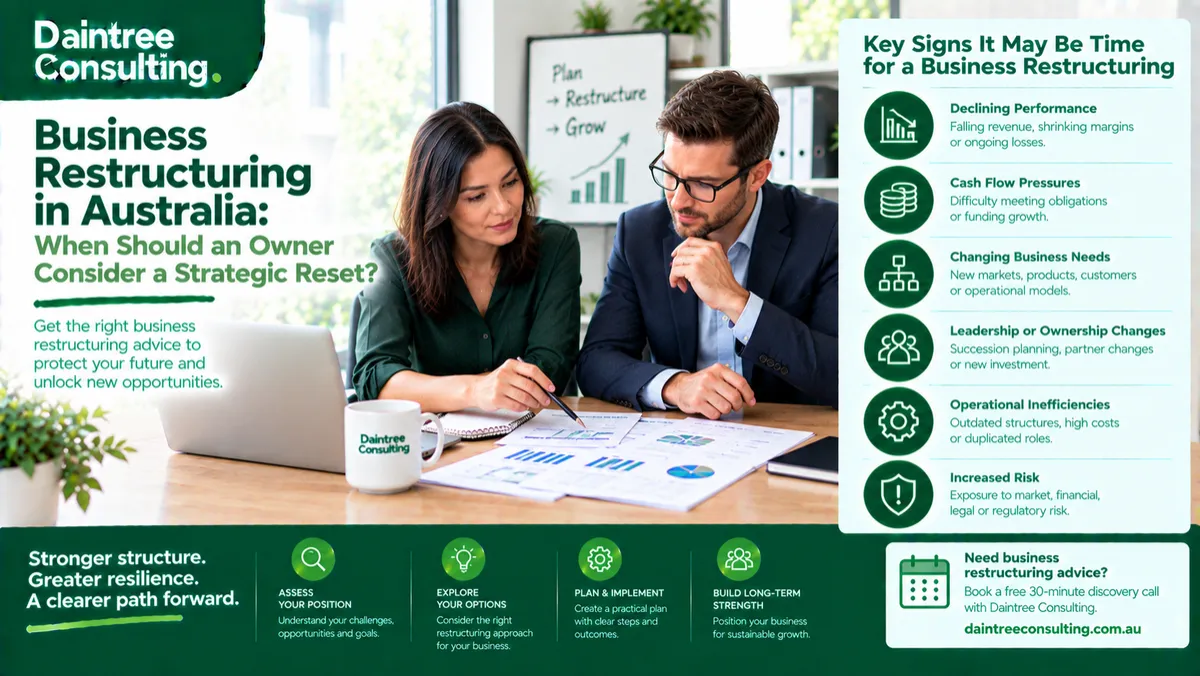
Business Restructuring in Australia: When Should an Owner Consider a Strategic Reset?
A business does not have to be failing before its owner considers restructuring.
Sometimes the current structure simply no longer fits the business.
Want expert help? Daintree Consulting's business advisory services can take this off your plate. Book a free consultation.
Revenue may have grown, but profitability has not kept pace. Costs may have become too high. The business may have expanded into too many products, locations or customer segments. Ownership may be changing. A founder may be preparing for succession. Or the business may need a simpler operating model to support its next stage of growth.
In these situations, business restructuring advice can help an owner step back and assess what needs to change before making major decisions.
Restructuring can involve changes to the business structure, ownership, operations, products, services, costs, management responsibilities or financial processes. Business.gov.au notes that businesses may change structure for reasons including growth, financial goals, risk management, ownership changes, succession planning and downsizing.
The important question is not simply, "Should we restructure?"
It is:
What is no longer working, what needs to change, and what should the business look like afterwards?
What Is Business Restructuring?
Business restructuring is the process of making significant changes to how a business is organised or operated.
Depending on the circumstances, this could include:
Changing the legal or business structure
Changing ownership
Bringing in or removing business partners
Simplifying products or services
Closing an underperforming division
Changing locations
Reducing unnecessary costs
Changing management responsibilities
Restructuring debt or finance arrangements
Improving financial processes
Preparing for succession
Preparing the business for sale
Combining or separating business activities
Restructuring does not always mean making the business smaller.
A restructuring can also be designed to support growth.
For example, an owner may restructure because the business has outgrown its current structure, needs new investment, is entering a new market or requires a clearer separation between different activities.
Business.gov.au identifies growth, financial reasons, risk management, ownership changes, succession planning and downsizing among reasons a business may change its structure.
The right approach depends on what the business is trying to achieve.
Strategic Restructuring vs Financial Distress
One of the most important distinctions is whether you are considering a strategic restructuring or responding to serious financial difficulty.
Strategic restructuring
A strategic restructuring may be appropriate when the business is still operating but its current model, structure or processes are no longer working as effectively as they should.
Examples include:
Simplifying operations
Changing ownership
Preparing for succession
Moving into a new market
Changing the business structure
Reducing unnecessary costs
Refocusing on profitable products
Preparing for growth
Improving management accountability
Financial distress restructuring
A different level of advice may be required when the business is experiencing serious financial difficulty.
Warning signs can include:
Ongoing losses
Severe cash-flow pressure
Overdue creditors
Difficulty paying debts when they fall due
Increasing tax debts
Difficulty obtaining finance
Pressure from creditors
Concerns about whether a company can continue trading
For companies, directors have a legal duty to prevent insolvent trading. ASIC's current guidance encourages directors to actively monitor solvency, investigate financial difficulties, obtain suitable professional advice where necessary and act in a timely manner.
This is an important boundary.
A business adviser or accountant can help analyse financial information and explore options, but if a company may be insolvent or approaching insolvency, the owner should obtain appropriate legal and insolvency advice promptly.
ASIC's formal small business restructuring process is specifically for eligible companies that are insolvent or likely to become insolvent and involves a restructuring practitioner. It is not the same thing as an ordinary strategic business restructure.
7 Signs Your Business May Need a Strategic Reset
There is no universal trigger for restructuring.
However, several patterns can indicate that the current model deserves a serious review.
1. Revenue Is Growing but Profit Is Not
Revenue growth can look positive while hiding underlying problems.
You may be selling more but keeping less.
This can happen because:
Costs are increasing faster than revenue
Gross margins are falling
Labour costs have increased
Discounting has become excessive
Overheads have grown
Low-margin products are taking too much time
Pricing has not kept pace with costs
If revenue continues to increase while profitability deteriorates, simply trying to sell more may not solve the underlying problem.
A restructuring review can help identify where profitability is being created and where it is being lost.
Start with the numbers.
Review:
Gross profit
Gross margin
Operating expenses
Net profit
Revenue by product or service
Revenue by customer
Labour costs
Overhead trends
The objective is to understand whether the business model itself needs to change.
2. Cash Flow Is Becoming Increasingly Difficult to Manage
Profit and cash flow are not the same thing.
A profitable business can still experience cash-flow pressure because of:
Slow customer payments
High inventory levels
Large capital purchases
Debt repayments
Rapid growth
Seasonal fluctuations
Increasing operating costs
If cash-flow problems are becoming a recurring feature of the business, it may be time to examine the underlying model.
Ask:
Are customers paying quickly enough?
Are margins sufficient?
Are fixed costs too high?
Is working capital being managed effectively?
Are debt commitments sustainable?
Is growth consuming more cash than expected?
Business.gov.au recommends reviewing financial information such as profit and loss, balance sheet and cash-flow forecasts when assessing a business's financial position, particularly when considering downsizing or significant changes.
3. The Business Has Become Too Complicated
Growth can create complexity.
A business that started with one service and a small team may eventually have:
Multiple service lines
Several locations
Different customer segments
Multiple software systems
Separate teams
Complex reporting
Different pricing models
Numerous suppliers
Several management layers
Complexity is not necessarily a problem.
But complexity that does not create enough value can become expensive.
You may find that employees spend too much time coordinating activities, fixing errors or maintaining processes that no longer make sense.
A restructuring review can ask:
What can we simplify without damaging the parts of the business that customers value?
4. Some Products or Services Are Consistently Underperforming
Not every revenue stream deserves equal attention.
A product may generate significant revenue but produce little profit.
A service may appear popular but consume excessive staff time.
A customer segment may create high administrative costs relative to its contribution.
A strategic restructuring can involve reviewing the business at a more detailed level and asking:
Which products are most profitable?
Which services have the strongest margins?
Which customers are commercially attractive?
Which activities consume disproportionate resources?
Which offerings are becoming difficult to deliver?
Which areas should be expanded?
Which areas should be reduced or discontinued?
Business.gov.au similarly recommends analysing sales and profitability when considering downsizing and focusing resources on products, services or customers that provide the most value.
This is not simply a cost-cutting exercise.
It is about deciding where the business should focus.
5. Ownership or Leadership Is Changing
A change in ownership can be a strong reason to review the business structure.
For example:
A founder wants to step back
A new partner is joining
A partner is leaving
Family members are becoming involved
The business is preparing for a sale
New investors are entering
Management responsibilities are changing
Ownership changes can affect more than who receives profits.
They may affect:
Business structure
Decision-making authority
Financing
Tax
Asset ownership
Employment arrangements
Contracts
Business registrations
Succession planning
Business.gov.au notes that ownership changes can require businesses to address tax, payment, registration, asset and record-transfer issues.
This is an area where accounting and legal advice should generally work together.
6. Your Current Business Structure No Longer Fits
A business structure that was appropriate when the business started may not necessarily remain appropriate as it grows.
For example, a sole trader may eventually consider incorporating.
A partnership may need to be reconsidered if ownership is changing.
A company may need changes to its internal structure as the business expands.
Business.gov.au notes that changing structure can affect legal obligations, tax obligations, personal liability, registrations and administration.
Changing structure should therefore not be treated as simply completing a registration form.
Before making the change, you may need to consider:
Why are we changing?
What will the new structure achieve?
What happens to existing assets?
What happens to contracts?
What happens to employees?
What are the tax consequences?
Will registrations need to change?
What happens to existing liabilities?
What happens to intellectual property?
What legal documentation is required?
Professional advice should be obtained before making a structural change where the consequences are significant.
7. The Business Is Becoming Too Dependent on the Owner
Owner dependence is easy to overlook.
If the owner personally:
Approves every major transaction
Manages most customer relationships
Handles sales
Oversees staff
Controls financial decisions
Manages suppliers
Solves operational problems
Holds most business knowledge
then the business may struggle to operate without them.
This can become a problem during:
Growth
Succession
Sale preparation
Extended owner absence
Ownership transition
A strategic reset can involve clarifying responsibilities, documenting processes and developing a management structure that allows the business to operate more independently.
This may improve the business even if no legal restructuring takes place.
What Does Business Restructuring Advice Actually Cover?
Business restructuring advice is not simply about choosing a new company structure.
Depending on the situation, it may involve reviewing several areas at the same time.
Financial performance
You need to understand the financial position before deciding what should change.
This may include:
Revenue
Gross margin
Profitability
Cash flow
Working capital
Debt
Fixed costs
Customer profitability
Product or service profitability
Business structure
Consider whether the current legal structure remains appropriate for the business's goals and circumstances.
Operations
Review:
Processes
Staffing
Suppliers
Locations
Technology
Product or service delivery
Management responsibilities
Customers and markets
Consider whether the business is serving the right customers and markets.
Ownership
Review whether ownership arrangements still reflect the future direction of the business.
Tax
A structural or ownership change can have tax implications.
For example, the ATO's small business restructure roll-over may allow eligible small businesses to transfer certain active assets between entities without an immediate income tax liability, subject to specific eligibility requirements.
This does not mean every restructure qualifies for rollover relief.
The transaction must be assessed against the applicable requirements, and other tax consequences may still need to be considered.
Legal considerations
Changing contracts, ownership, employment arrangements, leases, intellectual property or business structures may require legal advice.
A restructuring plan should therefore involve the right professionals for the issues being addressed.
Should You Restructure the Business or Just Cut Costs?
These are not necessarily the same thing.
Cutting costs can be useful when expenses are unnecessarily high.
But reducing costs without understanding the business model can create new problems.
For example, cutting staff may reduce payroll costs but also reduce the capacity to deliver profitable work.
Reducing marketing may improve short-term cash flow but reduce future sales.
Closing a location may save rent but remove an important customer base.
A restructuring process should therefore look beyond individual expenses.
Ask:
What is the business trying to achieve, and what structure allows it to achieve that sustainably?
Sometimes the answer involves reducing costs.
Sometimes it involves changing prices.
Sometimes it involves removing unprofitable services.
Sometimes it involves investing in systems or people.
Sometimes it involves changing ownership or structure.
The numbers should help inform the decision.
How to Assess Whether a Restructure Makes Financial Sense
Before making major changes, establish a financial baseline.
Review at least:
Profit and loss
Look at revenue, gross profit, operating expenses and profitability over time.
Balance sheet
Review assets, liabilities, working capital and debt.
Cash flow
Understand current cash movements and expected future requirements.
Customer profitability
Where practical, determine which customers generate value after considering the costs of servicing them.
Product and service profitability
Identify which offerings contribute most to the business.
Fixed costs
Identify costs that continue regardless of sales volume.
Debt commitments
Understand repayments, interest and other financing obligations.
Working capital
Assess how much cash is tied up in receivables, inventory and other operating requirements.
A restructure should be based on a realistic understanding of the current business rather than assumptions about what might be happening.
What Should a Business Restructuring Plan Include?
The plan will depend on the scale and purpose of the restructure.
However, a practical plan may include:
1. Current position
Document where the business is now.
2. Problem or opportunity
Clearly define why the restructure is being considered.
3. Desired outcome
What should be different after the restructure?
4. Options
Consider more than one possible approach where appropriate.
5. Financial impact
Estimate the expected costs, savings, investment requirements and cash-flow effects.
6. Implementation
Set out what needs to happen, when and who is responsible.
7. Risks
Identify operational, financial, legal, tax and people-related risks.
8. Measures of success
Determine how you will know whether the restructure is working.
Business.gov.au recommends having a clear understanding of what is changing, why it is changing and the desired outcome, followed by a change-management plan with responsibilities and measurable goals or milestones.
Do Not Wait Until the Numbers Become Critical
One of the biggest mistakes an owner can make is treating restructuring as something that only happens after a crisis.
A business can be structurally inefficient while still making money.
It can have excessive overheads while still generating revenue.
It can be too dependent on the owner while still appearing successful.
It can have an outdated business structure while still operating normally.
The earlier these issues are identified, the more options the owner may have.
This is particularly important when financial difficulty is emerging.
ASIC's current guidance for company directors emphasises active monitoring of solvency, investigating financial difficulties, obtaining appropriate professional advice and acting in a timely manner.
If there are concerns about insolvency, do not treat the situation as an ordinary business-planning exercise. Obtain appropriate professional advice promptly.
What If the Business Needs to Downsize?
Downsizing can be part of a strategic restructure.
It can involve:
Reducing premises
Closing a location
Reducing product lines
Reducing inventory
Simplifying operations
Reviewing suppliers
Automating repetitive processes
Reducing unnecessary subscriptions
Changing staffing requirements
Focusing on higher-value customers
Business.gov.au notes that downsizing can be a proactive strategic decision and does not necessarily mean a business is failing. It can be used to create a more sustainable or manageable business model.
However, downsizing can create costs and obligations of its own.
Depending on the circumstances, these may include:
Redundancy obligations
Lease termination costs
Contract termination costs
Asset disposal
Tax consequences
Changes to licences
Changes to registrations
Customer disruption
These should be considered before decisions are implemented.
What Happens When You Change Your Business Structure?
A change in legal structure can have practical consequences across the business.
Business.gov.au notes that changing structure can affect tax and legal obligations, personal liability and registrations.
Depending on the change, you may need to consider:
ABN requirements
Business name registrations
ASIC records
ATO registrations
GST
PAYG withholding
Asset transfers
Intellectual property
Contracts
Bank accounts
Insurance
Employee arrangements
Accounting systems
Financial reporting
Business registrations and details may also need to be updated when circumstances change.
This is why structural restructuring should be planned rather than treated as an administrative exercise.
Who Should Be Involved in a Business Restructure?
A restructure may require several different advisers.
Accountant
An accountant can help analyse financial information, model financial outcomes and consider accounting and tax implications within their scope.
Business adviser
A business adviser can help assess the commercial model, strategy, performance and implementation.
Lawyer
A lawyer may be needed for contracts, ownership arrangements, employment matters, asset transfers and legal structure.
Insolvency practitioner
If a company may be insolvent or is considering formal restructuring under the Corporations Act, an appropriately qualified insolvency professional may be required.
These roles are not interchangeable.
For example, a strategic business restructure is not the same as the formal small business restructuring process administered under the Corporations Act. ASIC's formal process involves an eligible company, a restructuring practitioner and a restructuring plan for creditors.
When Should an Owner Seek Business Restructuring Advice?
Consider obtaining advice before making major changes if:
Profitability is declining
Cash flow is becoming difficult
The business model has changed
Your current structure no longer fits
Ownership is changing
You are considering succession
You are preparing for a sale
Costs have become difficult to control
Products or services are underperforming
The business has become unnecessarily complex
The owner is overloaded
Growth is exposing weaknesses
You are considering major asset transfers
You are concerned about the company's solvency
The earlier you understand the options, the easier it may be to compare them before making an irreversible decision.
Business Restructuring Should Start With the Numbers
Restructuring decisions can involve significant operational, financial, tax and legal consequences.
That is why the first step should usually be understanding the current position.
You need reliable answers to questions such as:
Where is the business making money?
Where is it losing money?
What is driving cash flow?
What are the biggest fixed costs?
Which customers are profitable?
Which products or services are profitable?
How much debt does the business carry?
What would happen if revenue fell?
What would happen if costs increased?
How much working capital is required?
What does the business need to look like in three years?
Once those questions are understood, you can start evaluating the structural and strategic options.
How Daintree Consulting Can Help With Business Restructuring
Daintree Consulting provides commercially focused business advisory, accounting and financial support for Australian businesses navigating growth, performance pressure, restructuring and important decisions.
Restructuring support can involve helping owners understand:
Current financial performance
Cash-flow pressures
Profitability
Working capital
Cost structures
Business performance
Financial risks
Growth opportunities
Strategic options
Financial implications of proposed changes
The objective is not to recommend a restructure simply because the numbers are changing.
It is to help you understand the current position, assess the available options and build a practical path forward.
Where a restructure involves legal, tax or formal insolvency matters, the appropriate specialist advisers should also be involved.
Book a free 30-minute discovery call with Daintree Consulting to discuss your business restructuring and strategic planning needs.
Frequently Asked Questions
What is business restructuring?
Business restructuring involves making significant changes to how a business is structured, owned or operated. It can include changes to the legal structure, ownership, products, services, costs, operations, management or financial arrangements.
When should a business consider restructuring?
A business may consider restructuring when its current structure or operating model no longer supports its goals. Common triggers include declining profitability, cash-flow pressure, rapid growth, ownership changes, succession planning, excessive complexity or changing market conditions.
Is business restructuring only for struggling businesses?
No. Restructuring can be proactive. A business may restructure to support growth, simplify operations, change ownership, prepare for succession, improve profitability or prepare for a sale.
What is the difference between restructuring and downsizing?
Downsizing generally means reducing the size, scope or costs of a business. Restructuring is broader and can involve growth, ownership, legal structure, operations, management or strategic changes. Downsizing can be one component of a broader restructure.
Can changing a business structure affect tax?
Yes. Changing a business structure can affect tax obligations and may involve asset transfers or other tax consequences. Certain tax rollovers may be available for eligible transactions, but the requirements need to be assessed for the specific restructure.
Does restructuring mean changing from a sole trader to a company?
Not necessarily. Moving from sole trader to company is one example of a structural change, but business restructuring can involve many other changes, including ownership, operations, products, costs, management or financial processes.
When should I get business restructuring advice?
It is generally useful to obtain advice before making significant structural, ownership or financial changes. This can help you understand the commercial, accounting, tax and legal implications before decisions are implemented.
What if my company may be insolvent?
If you believe a company may be insolvent, treat the situation differently from an ordinary strategic restructure. Company directors have duties concerning insolvent trading, and ASIC recommends that directors monitor solvency, investigate financial difficulties, obtain appropriate professional advice and act promptly.
Can an accountant help with business restructuring?
An accountant can help with financial analysis, modelling, accounting and tax considerations within their professional scope. A broader restructure may also require business advisory and legal or insolvency professionals depending on the circumstances.
The Bottom Line
Business restructuring is not necessarily a sign that something has gone wrong.
Sometimes it is simply the next step in making the business fit its current size, ownership, financial position and future goals.
The important thing is to understand why a restructure is being considered before deciding what to change.
Review the numbers. Understand the current business model. Identify what is working and what is not. Consider the available options. Then assess the financial, tax, legal and operational consequences before implementing major changes.
And if financial distress or potential insolvency is involved, seek specialist advice early rather than treating it as an ordinary strategic reset.
For Australian business owners, good business restructuring advice should ultimately help answer one question:
What needs to change to give the business a stronger and more sustainable path forward?
Talk to Daintree about your next business decision
Our ex-Big 4 team gives clear, senior-reviewed advice so you can act with confidence.
Book a free consultation →
Or explore our business advisory services.
