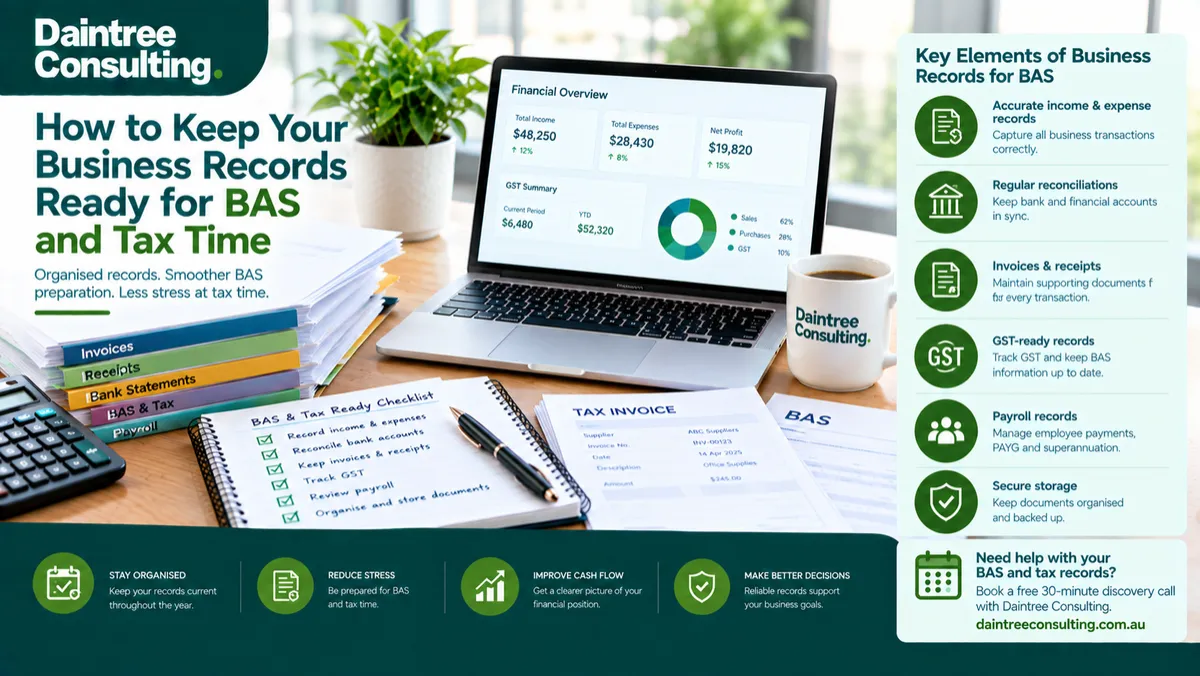
How to Keep Your Business Records Ready for BAS and Tax Time
Keeping business records organised is easy to postpone.
When sales are coming in, customers need attention and day-to-day work takes priority, receipts and financial documents can quickly become something you plan to sort out later.
Want expert help? Daintree Consulting's tax and BAS services can take this off your plate. Book a free consultation.
The problem is that “later” often arrives when your BAS is due or tax time is approaching.
Suddenly, you may need to find missing invoices, explain unfamiliar bank transactions, separate business and personal spending, reconcile months of records and work out whether your accounting information is complete.
Keeping reliable business records for BAS throughout the year can make this process far more manageable.
Good record-keeping is not about creating unnecessary paperwork. It is about maintaining accurate financial information so your business has the records needed for BAS preparation, tax-related work, financial reporting and better decision-making.
In this guide, we explain how Australian businesses can create a practical record-keeping process that stays organised throughout the year instead of becoming a last-minute tax-time project.
Quick Answer: How Do You Keep Business Records Ready for BAS and Tax Time?
To keep your business records for BAS and tax time organised, you should:
Record business income and expenses consistently
Keep invoices, receipts and other supporting documents
Reconcile bank and financial accounts regularly
Separate business and personal transactions
Keep accounts receivable and payable up to date
Record GST-related transactions appropriately
Review payroll records where applicable
Organise records in a secure system
Check for missing or duplicate transactions
Review financial reports regularly
Resolve unexplained balances promptly
Avoid letting bookkeeping fall months behind
The best approach is consistent record-keeping throughout the year.
Waiting until a BAS deadline or tax time to reconstruct your financial information usually creates more work and makes errors harder to identify.
Why Are Good Business Records Important?
Your accounting records are the foundation of your financial information.
If the underlying records are incomplete or inaccurate, it becomes harder to know:
How much income the business has earned
What the business has spent
Which customers still owe money
What suppliers need to be paid
How much GST-related activity has been recorded
Whether payroll records are complete
How the business is performing financially
What information is available for BAS and tax preparation
Good records can also reduce the time spent searching for documents or reconstructing historical transactions.
For a growing business, reliable records support more than compliance. They can provide better visibility over cash flow, expenses, profitability and financial performance.
That is why record-keeping should be treated as an ongoing finance process rather than a task completed only when a deadline approaches.
1. Keep Business and Personal Transactions Separate
One of the simplest ways to improve record-keeping is to keep business and personal finances clearly separated.
Using appropriate business bank accounts and payment methods can make it easier to identify which transactions relate to the business.
When personal and business transactions are mixed together, someone eventually needs to work through the records and determine:
Which transactions relate to the business
Which transactions are personal
Whether a transaction has been recorded correctly
What supporting documents are available
How the transaction should be treated
This can create unnecessary work during bookkeeping and BAS or tax preparation.
Clear separation does not remove the need to review transactions, but it can make the record-keeping process much more organised.
2. Keep Invoices and Receipts as Transactions Occur
A common mistake is assuming that a bank statement provides all the information needed about a transaction.
It usually does not.
A bank statement may show that money was received or paid, but supporting documentation can provide important context about what the transaction relates to.
Depending on the business and transaction, records may include:
Sales invoices
Supplier invoices
Tax invoices
Receipts
Expense records
Contracts
Loan documents
Asset purchase records
Payroll records
Other relevant financial documents
The easiest time to save this information is when the transaction occurs.
Waiting several months can lead to missing documents and transactions that nobody can clearly explain.
A consistent process for capturing records can make future bookkeeping considerably easier.
3. Keep Your Bookkeeping Up to Date
Businesses do not necessarily need to update their records every day.
However, bookkeeping should be completed regularly enough to prevent a large backlog from developing.
When records fall behind, problems can accumulate.
You may forget the purpose of a transaction. Supporting documents may be harder to locate. Payments may be duplicated or missed. Financial reports may no longer reflect the current position of the business.
A consistent bookkeeping schedule can help prevent this.
Depending on the business, transactions may be reviewed weekly, fortnightly, monthly or at another appropriate frequency.
The right schedule depends on factors such as:
Transaction volume
Number of bank accounts
Number of employees
Payment platforms used
GST and reporting arrangements
The complexity of the business
Management reporting needs
The important point is to avoid treating bookkeeping as a once-a-year clean-up exercise.
4. Reconcile Your Bank Accounts Regularly
Bank reconciliation is an important check when maintaining accurate business records.
The process compares transactions recorded in the accounting system with the transactions appearing in the relevant bank account.
This can help identify:
Missing transactions
Duplicate entries
Incorrect amounts
Unrecorded bank fees
Incorrect transaction dates
Unusual transactions
Unexplained differences
If the accounting records and bank information do not agree, the difference should be investigated.
The purpose of a reconciliation is not simply to make two balances match by entering an adjustment.
It is to understand why a difference exists and ensure the records reflect the underlying transactions accurately.
Regular reconciliation can also make BAS and tax-time preparation more efficient because errors are identified closer to when they occurred.
5. Reconcile More Than Just the Main Bank Account
Many businesses use more than one financial account.
Depending on your operations, this could include:
Business credit cards
Merchant facilities
Online payment platforms
E-commerce payment systems
Clearing accounts
Loan accounts
Other business accounts
These records should not be ignored simply because the main bank account has been reconciled.
For example, a payment platform may process sales, fees, refunds and transfers before money reaches the business bank account.
If those movements are not properly recorded, the financial records may be incomplete even when the main bank reconciliation appears correct.
Identify every significant financial account used by the business and establish a consistent process for maintaining the records.
6. Record Income Properly
Business income can come from several sources.
Depending on the business, you may receive payments through:
Customer invoices
Point-of-sale systems
Online stores
Payment platforms
Direct bank transfers
Recurring billing arrangements
Deposits or progress payments
Your record-keeping process should make it possible to understand what income has been earned and what payments have been received.
This is particularly important when customer payments do not occur at the same time as invoicing.
Without accurate records, it can become difficult to determine:
Which invoices are still outstanding
Which customers have paid
Whether a payment has been allocated correctly
Whether income has been recorded twice
Whether a credit or refund has been processed correctly
Keeping sales records current provides a stronger foundation for both financial reporting and BAS preparation.
7. Track Business Expenses Consistently
Expenses should be recorded with enough detail to understand what the business has spent money on.
Consistent categorisation can make financial reports more useful and help identify unusual movements.
Common categories may include:
Rent
Advertising and marketing
Software
Professional fees
Insurance
Office expenses
Equipment
Motor vehicle costs
Employee costs
Other operating expenses
The appropriate treatment of individual transactions depends on the circumstances.
The key record-keeping principle is consistency.
If similar transactions are recorded differently each month, it becomes harder to understand spending patterns and review the accuracy of financial reports.
When you are unsure how a transaction should be treated, it is generally better to seek appropriate professional advice than repeatedly guess.
8. Keep Records That Support GST and BAS Reporting
For businesses registered for GST, the quality of underlying records matters when preparing activity statements.
Your bookkeeping system should help maintain clear information about relevant sales, purchases and other transactions.
A practical BAS-ready process may include:
Recording transactions consistently
Keeping relevant invoices and supporting documents
Reviewing GST-related account balances
Reconciling financial accounts
Investigating unusual or uncategorised transactions
Reviewing the records before BAS information is prepared
The specific reporting and record-keeping requirements can depend on the business's circumstances and registrations.
For this reason, businesses should avoid relying on generic assumptions about how every transaction should be treated.
The best approach is to maintain accurate source records and make sure the relevant finance and tax responsibilities are clearly defined.
9. Keep Accounts Receivable Up to Date
If your business invoices customers before receiving payment, accounts receivable should be reviewed regularly.
Check:
Which invoices remain unpaid
How long invoices have been outstanding
Whether customer payments have been allocated
Whether credit notes have been processed
Whether old balances need investigation
Accurate receivables records are important for more than bookkeeping.
They can affect how you understand cash flow.
A business may show strong sales while still experiencing cash pressure because customer payments are delayed.
If the receivables ledger is inaccurate, management may not have a reliable view of what the business is actually owed.
10. Keep Supplier and Accounts Payable Records Organised
The same discipline should apply to supplier bills and other amounts owed by the business.
Record supplier invoices promptly and review outstanding balances regularly.
A good process can help identify:
Bills that have not been entered
Duplicate supplier invoices
Old balances
Payments that have not been allocated correctly
Credit notes requiring attention
Upcoming payment commitments
This can provide better visibility over the business's financial obligations.
It also reduces the need to search through emails and paper documents when someone needs to understand why an amount appears in the accounts.
11. Keep Payroll Records Connected to Your Accounting Records
If your business employs staff, payroll creates additional records that need to be maintained accurately.
Depending on the circumstances, this may involve information relating to:
Employee payments
PAYG withholding
Superannuation
Leave balances
Payroll liabilities
Other employment-related costs
Payroll should not be treated as completely separate from the accounting system.
Relevant payroll information needs to be reflected appropriately in the business's financial records.
Regular review can help identify discrepancies before they accumulate across multiple pay periods.
As payroll requirements can vary, businesses should make sure responsibilities between internal staff, payroll providers, bookkeepers and other advisers are clearly understood.
12. Create a Simple System for Storing Documents
Good record-keeping becomes much easier when everyone follows the same process.
You do not necessarily need a complicated document management system.
You need a reliable one.
For example, establish a clear process for:
Where supplier invoices are saved
Where receipts are uploaded
How sales documents are stored
Who can access financial records
How records are backed up
Who is responsible for reviewing missing documents
Digital storage can make records easier to organise and retrieve, provided the system is used consistently.
The objective is simple: when you need supporting information, you should know where to find it.
13. Review Unusual Transactions and Balances
A useful record-keeping process includes review, not just data entry.
Look for transactions or balances that do not make sense.
For example:
An expense is significantly higher than usual
A supplier balance has remained unresolved for months
A customer invoice appears unpaid despite receiving money
A bank reconciliation contains old unexplained items
A balance-sheet account has an unusual balance
A transaction has been posted to an unexpected category
An unusual result does not automatically mean there is an error.
It may have a legitimate explanation.
However, unusual movements should create a reason to investigate rather than being ignored.
14. Do Not Let Unresolved Items Carry Forward Indefinitely
A small unexplained balance may seem unimportant.
But unresolved items can build up over time.
Examples include:
Old reconciliation differences
Unexplained suspense-account balances
Unallocated payments
Old receivables
Old supplier balances
Incorrect opening balances
The longer these items remain unresolved, the harder they can become to investigate.
Information may be lost, staff may leave or nobody may remember the original transaction.
Build regular review of outstanding items into your bookkeeping process.
15. Establish a Month-End Record-Keeping Process
A defined month-end process can help prevent financial records from becoming disorganised.
Your process may include:
Recording outstanding transactions
Reconciling bank accounts
Reconciling credit cards and other financial accounts
Reviewing accounts receivable
Reviewing accounts payable
Reviewing payroll-related balances where applicable
Checking GST-related records
Reviewing unusual transactions
Investigating unexplained balances
Confirming important supporting documents are available
Reviewing key financial reports
The exact process should match the size and complexity of the business.
The important advantage is consistency.
Rather than hoping the records are complete, you have a repeatable process for checking them.
16. Review Your Financial Reports Before You Need Them
A BAS or tax deadline should not be the first time you look closely at your business records.
Regular financial review can help you identify whether the information appears reasonable.
Depending on your needs, this could include reviewing:
Profit and loss reports
Balance sheets
Cash-flow information
Accounts receivable ageing
Accounts payable ageing
Budget versus actual reports
Other management reports
Reviewing reports regularly also makes it easier to identify changes in business performance.
You may notice rising costs, slower customer payments or changes in margins while there is still time to investigate.
Common Record-Keeping Mistakes Before BAS and Tax Time
Leaving everything until the deadline
This often creates unnecessary pressure and increases the chance of missing information.
Relying only on bank statements
Bank statements show cash movements but may not provide all the supporting information needed to understand a transaction.
Mixing personal and business spending
This can create unnecessary work when determining which transactions belong in the business records.
Ignoring small reconciliation differences
Small unexplained differences can sometimes indicate a broader process problem.
Losing receipts and invoices
Missing documents can create difficulties when records need to be reviewed later.
Letting bookkeeping fall behind
A growing backlog can make errors harder to identify and correct.
Assuming accounting software automatically makes records accurate
Software can automate processes, but transactions still need appropriate review, categorisation and reconciliation.
Failing to review old balances
Unresolved balances should be investigated instead of automatically being carried into the next period.
A Practical Checklist for Keeping Business Records BAS and Tax Ready
Throughout the year, your business should aim to:
Keep business and personal transactions separate
Record income and expenses consistently
Save relevant invoices and receipts
Maintain organised financial documents
Keep bookkeeping current
Reconcile bank accounts
Reconcile credit cards and other financial accounts
Track customer invoices and payments
Track supplier invoices and payments
Review GST-related records where applicable
Review payroll-related records where applicable
Investigate unusual transactions
Resolve old unexplained balances
Review financial reports regularly
Keep responsibilities clear between your bookkeeper, accountant and other finance providers
The exact records required will vary based on the business's structure, activities and circumstances.
However, a consistent process can make it significantly easier to respond when BAS or tax-related information is needed.
When Should You Get Professional Help With Business Record-Keeping?
Professional support may be useful when record-keeping is becoming difficult to manage internally.
Common signs include:
Bookkeeping is consistently behind
BAS preparation becomes a last-minute rush
Bank accounts are not being reconciled
Supporting documents are difficult to locate
The owner does not trust the financial reports
Payroll responsibilities are becoming more complex
The business is growing quickly
Multiple bank accounts or payment platforms are involved
Historical records need to be cleaned up
No one internally has clear responsibility for the finance process
Getting support does not necessarily mean outsourcing every financial task.
A business may simply need clearer processes, regular bookkeeping support or better coordination between bookkeeping, accounting and tax responsibilities.
How Daintree Consulting Can Help Keep Your Business Records Organised
Daintree Consulting supports Australian businesses with connected bookkeeping, accounting, management reporting and taxation and BAS processes.
Depending on your business's needs, support can include:
Bookkeeping and transaction processing
Bank and balance-sheet reconciliations
Financial record reviews
Coordination with bookkeeping
Management accounts and reporting
GST and BAS support
Tax-related record preparation
Accounts and ledger oversight
Cash-flow and financial reporting
Assistance with improving finance processes
The goal is not simply to prepare records when a deadline arrives.
It is to help establish a more reliable process so financial information is maintained throughout the year.
When your records are current, reconciled and organised, BAS and tax-time preparation can begin with better information and fewer last-minute questions.
Need Help Getting Your Business Records Under Control?
If your bookkeeping is behind, your records are difficult to locate or BAS and tax preparation regularly becomes a stressful catch-up exercise, Daintree Consulting can help.
Book a free discovery call to discuss your business record-keeping, bookkeeping, accounting and BAS support requirements.
Frequently Asked Questions
What business records should I keep for BAS?
The records required depend on your business's activities and circumstances. Generally, businesses should maintain reliable records supporting relevant sales, purchases, expenses and other financial transactions, including appropriate invoices and other documentation. Record-keeping obligations should be checked against current Australian requirements for your specific circumstances.
How often should I update my business records?
The appropriate frequency depends on the size and transaction volume of the business. Records should be updated regularly enough to prevent a significant backlog and allow financial information to be reviewed and reconciled consistently.
Do I need to keep receipts and invoices if transactions appear in my bank account?
Bank records may show that money moved, but supporting documents can provide additional information about the purpose and nature of a transaction. Businesses should maintain the records required for their circumstances and applicable obligations.
Why should I reconcile my bank account before preparing BAS?
Bank reconciliation can help identify missing, duplicate or incorrectly recorded transactions. Completing reconciliations regularly can provide a more reliable starting point when reviewing financial information for BAS preparation.
Can poor record-keeping affect my business tax preparation?
Yes. Incomplete or inaccurate records can make tax-related preparation more time-consuming and may require transactions or supporting documents to be reconstructed or clarified.
What is the best way to organise business receipts?
The best system is one that is secure, organised and used consistently. Businesses may use accounting software, document-management tools or another structured digital process, provided relevant records can be maintained and retrieved when needed.
Should I keep business and personal expenses separate?
Keeping transactions separate can make bookkeeping and financial record review easier. Mixing transactions can create additional work when determining how individual items should be recorded.
Can a bookkeeper help keep my records BAS-ready?
Depending on the agreed scope and the relevant professional responsibilities, a bookkeeper can help maintain financial records, process transactions, complete reconciliations and organise information that supports BAS preparation.
How can Daintree Consulting help with business record-keeping?
Daintree Consulting can support businesses with bookkeeping, reconciliations, financial record review, accounting, management reporting and taxation and BAS support, depending on the agreed scope and business requirements.
Final Thoughts
Keeping business records for BAS and tax time organised does not require a last-minute clean-up project every few months.
The most effective approach is to maintain the records consistently throughout the year.
Record transactions promptly. Keep supporting documents. Reconcile accounts regularly. Review unusual balances. Keep business and personal finances separate. Resolve issues before they accumulate.
When these processes are working properly, your financial information can be more useful for more than BAS and tax preparation.
It can also support clearer reporting, better cash-flow visibility and more confident business decisions.
If keeping your records up to date is becoming increasingly difficult as your business grows, it may be time to review the process and get the right level of bookkeeping or accounting support.
Book a free discovery call with Daintree Consulting to discuss how we can help you establish more reliable financial records and a more organised approach to BAS and tax-time preparation.
Talk to Daintree about your tax and BAS
Our ex-Big 4 team gives clear, senior-reviewed advice so you can act with confidence.
Book a free consultation →
Or explore our tax and BAS services.
