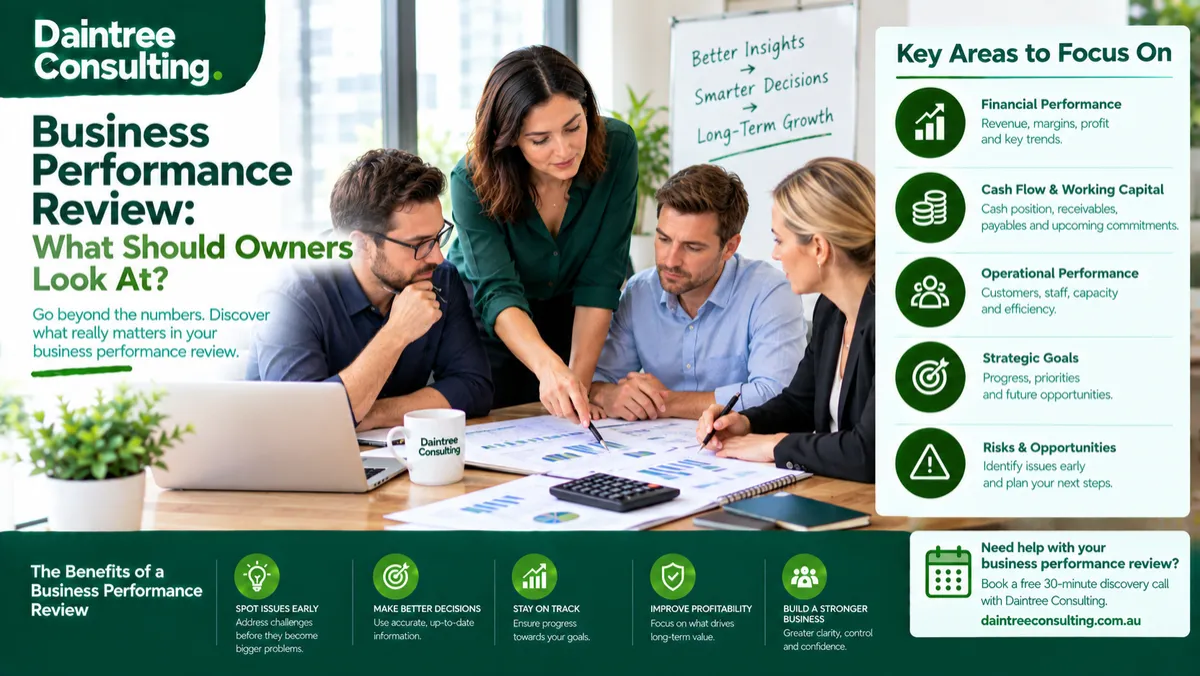
Business Performance Reviews: What Should Owners and Leadership Teams Look At?
Running a business involves making decisions with incomplete information.
Sales may be increasing, but profit margins could be falling. Cash in the bank may look healthy, while customer payments are taking longer to arrive. Revenue might be ahead of budget, but operating costs may have increased even faster.
Want expert help? Daintree Consulting's business advisory services can take this off your plate. Book a free consultation.
This is why a business performance review should involve more than asking whether the business made money last month.
A useful performance review brings together financial results, cash flow, operational activity and progress against business goals. It gives owners and leadership teams an opportunity to understand what actually happened, why it happened and what needs attention next.
For Australian businesses, regularly reviewing financial performance can help identify trends, unusual results and areas requiring action. Business.gov.au recommends reviewing key financial documents such as the profit and loss statement, balance sheet, cash flow statement and budget to understand the business's financial health and performance.
The important part is turning that information into a practical conversation.
Quick answer
A business performance review should look at more than revenue and profit.
Owners and leadership teams should typically review:
Revenue and sales performance
Gross profit and margins
Operating expenses
Net profit
Cash flow and available cash
Accounts receivable and overdue invoices
Accounts payable and upcoming commitments
Budget versus actual results
Key business KPIs
Customer and sales trends
Operational performance
Staffing and productivity
Major risks and financial pressures
Progress against strategic goals
Forecasts and upcoming cash requirements
Decisions that need to be made
The purpose is not to produce a long list of numbers.
It is to answer three practical questions:
What happened?
Why did it happen?
What should we do next?
What is a business performance review?
A business performance review is a structured assessment of how a business has performed over a defined period.
The review might be conducted:
Monthly
Quarterly
Half-yearly
Annually
Before a major business decision
During a period of rapid growth or financial pressure
The frequency should reflect the size, complexity and needs of the business.
A monthly review, for example, can help leadership identify changes while they are still relatively recent. A quarterly review can provide a broader view of trends and strategic progress.
The review should combine financial and non-financial information.
Financial information tells you what happened financially.
Operational information can help explain why.
For example, if revenue has fallen, leadership may need to investigate whether the cause was:
Fewer customers
Lower average transaction values
Reduced sales activity
Lost customers
Pricing changes
Capacity constraints
Staffing issues
Seasonal demand
Product or service changes
The numbers identify the result.
The review process investigates the drivers.
Why should business owners conduct performance reviews?
A business can appear busy without necessarily performing well.
Sales can increase while margins decline. Staff numbers can increase while productivity falls. Expenses can creep upwards without anyone noticing until the monthly profit is significantly affected.
Regular performance reviews create an opportunity to step back from day-to-day operations.
Business.gov.au recommends regularly reviewing financial information to understand whether a business is on track, identify unusual results and make better decisions. It specifically highlights reviewing the profit and loss statement, balance sheet, cash flow statement and budget.
For owners and leadership teams, a performance review can help:
Identify trends
One month rarely tells the whole story.
Comparing several periods can reveal whether a change is temporary or part of a broader trend.
Identify problems earlier
Falling margins, rising costs, overdue customer invoices or increasing debt may become easier to identify when performance is reviewed consistently.
Improve decision-making
Leadership teams can use current financial and operational information when deciding where to invest, where to reduce costs and which areas require attention.
Keep the business aligned with its goals
A business may have a strategic plan, but the performance review helps determine whether actual results are moving in the intended direction.
Create accountability
When responsibilities and targets are discussed regularly, leadership teams can identify who owns the next action and when it needs to happen.
1. Start with revenue and sales performance
Revenue is usually one of the first numbers owners look at.
But simply asking, “Did sales increase?” is not enough.
A useful business performance review should examine what is driving the revenue result.
Consider:
Total revenue
Revenue by product or service
Revenue by location
Revenue by customer segment
Number of customers
New customers
Repeat customers
Average transaction value
Sales pipeline
Customer retention
Major changes from previous periods
For example, revenue may have increased by 10%, but that increase might have come from one large customer rather than broad-based growth.
That creates a different business risk.
Likewise, revenue might be flat overall while one service line is growing quickly and another is declining.
Looking behind the total can produce much more useful information.
2. Review gross profit and margins
Revenue tells you how much the business sold.
Gross profit helps show what remains after the direct costs associated with generating that revenue.
Margins can be particularly important when a business is growing.
A business may generate significantly more revenue but see its gross margin decline because:
Supplier costs have increased
Pricing has not kept pace with costs
Product mix has changed
Labour costs have increased
Discounting has increased
Lower-margin products or services make up a larger proportion of sales
Leadership should therefore ask:
Are we growing profitably?
Not simply:
Are we growing?
A change in gross margin can sometimes reveal a problem before the overall profit figure makes the issue obvious.
3. Look at operating expenses
The next question is where the business's money is being spent.
Review major expense categories and compare them with previous periods and the budget.
Depending on the business, this might include:
Employee costs
Rent
Marketing
Software subscriptions
Professional fees
Insurance
Vehicles
Travel
Utilities
Finance costs
Equipment
Administration
Do not automatically assume that an expense increase is a problem.
Some expenses should increase as the business grows.
For example, hiring additional staff may increase payroll but also support greater revenue capacity.
The more useful question is:
What are we getting from the additional spending?
That turns expense review into a business performance discussion rather than a simple cost-cutting exercise.
4. Review profit, but understand what is behind it
Profit is an important performance measure, but it should not be reviewed in isolation.
Ask:
Is profit increasing or decreasing?
Is the margin changing?
Is the result consistent with expectations?
Which revenue streams are contributing most?
Which costs are putting pressure on profit?
Are there unusual or one-off items?
Is the result sustainable?
A strong profit result caused by a one-off event may not represent normal operating performance.
Likewise, a weaker month may have resulted from a temporary expense that should not be treated as a permanent change in business performance.
Understanding the composition of the result matters.
5. Review cash flow separately from profit
One of the most important parts of a business performance review is understanding cash.
Profit and cash are not the same thing.
A business can report a profit while experiencing cash pressure because customers have not yet paid, inventory has increased or large expenses are due before expected receipts arrive.
Business.gov.au recommends regularly tracking cash flow and comparing estimated and actual income and costs to identify potential shortfalls and make better financial decisions.
During a performance review, consider:
Cash available
Cash received
Cash paid
Accounts receivable
Accounts payable
Upcoming tax obligations
Payroll commitments
Loan repayments
Major planned purchases
Expected customer receipts
Short-term cash requirements
The leadership question should be:
Can the business comfortably fund its upcoming commitments?
6. Review accounts receivable
Revenue is only useful for cash flow when customers actually pay.
Review:
Total accounts receivable
Overdue invoices
Age of outstanding debts
Major overdue customers
Average payment timing
Disputed invoices
Changes from previous periods
If sales are increasing but receivables are growing even faster, the business may be converting sales into cash less efficiently.
This can be an important early warning signal.
A leadership team should know not only how much customers owe, but also when the business expects that money to arrive.
7. Review accounts payable and upcoming commitments
The other side of working capital is what the business owes.
Review:
Supplier balances
Overdue bills
Upcoming payments
Loan repayments
Tax obligations
Payroll and superannuation commitments
Major contracted expenses
Recurring subscriptions
A business performance review should consider whether upcoming commitments are consistent with expected cash inflows.
This is particularly important during periods of rapid growth, major investment or changing market conditions.
8. Compare actual results with the budget
A budget becomes more useful when it is compared with what actually happened.
Review:
Budget → Actual → Variance → Reason → Action
For example:
Revenue:
Budget: $500,000
Actual: $460,000
Variance: $40,000 below budget
The next question is not simply whether revenue was below budget.
Ask why.
Was it caused by:
Fewer customers?
Lower prices?
Delayed projects?
Lost contracts?
Seasonal conditions?
Capacity limitations?
The same process should be applied to expenses.
Business.gov.au specifically recommends comparing estimated and actual income and costs to identify shortfalls and determine whether budgets need to be revised.
Variance analysis is most useful when it leads to an explanation and an action.
9. Look at key business KPIs
Financial statements provide a foundation, but leadership teams may also need operational measures that explain business performance.
Depending on the business, these might include:
Customer acquisition
Customer retention
Average order value
Gross margin
Revenue per employee
Utilisation
Billable hours
Conversion rate
Customer concentration
Debtor days
Stock turnover
Project profitability
Sales pipeline
Recurring revenue
Not every business needs dozens of KPIs.
In many cases, a small number of carefully selected measures can provide a clearer picture than a large dashboard containing metrics nobody uses.
The important question is:
Which measures actually influence our decisions?
10. Review operational performance
Financial results are often the outcome of operational activity.
That means a good business performance review should not stop at the accounting reports.
Leadership should also consider:
Customers
Are customer numbers changing?
Are important customers being retained?
Are complaints increasing?
Is customer concentration becoming a risk?
Staff
Are staffing levels appropriate?
Are there productivity issues?
Are key roles understaffed?
Is overtime increasing?
Operations
Are projects being delivered on time?
Are costs increasing?
Are there bottlenecks?
Is capacity being used effectively?
Sales
Is the pipeline healthy?
Are conversion rates changing?
Is sales activity consistent with revenue targets?
This helps connect financial performance to the operational decisions behind it.
11. Review the balance sheet
The profit and loss statement shows performance over a period.
The balance sheet provides a snapshot of the business's assets and liabilities at a particular point in time. Business.gov.au notes that it can also help assess working capital and liquidity.
During a business performance review, consider:
Cash
Accounts receivable
Inventory
Fixed assets
Loans
Accounts payable
Tax liabilities
Other liabilities
Working capital
Net assets
A business may report a healthy profit while its balance sheet is becoming increasingly stretched.
That is why the balance sheet deserves attention alongside the income statement.
12. Review performance against strategic goals
Financial performance is only part of the picture.
A business might have goals such as:
Entering a new market
Launching a service
Increasing recurring revenue
Hiring key staff
Expanding locations
Improving customer retention
Reducing reliance on one major customer
Improving operating margins
Preparing for a future sale
The performance review should ask:
Are we actually making progress towards these objectives?
For each major goal, consider:
What was the target?
What has been completed?
What remains outstanding?
What is preventing progress?
Who is responsible?
What needs to happen next?
This keeps the meeting focused on business direction rather than only historical financial results.
13. Identify the biggest variances
Leadership teams do not need to investigate every small movement.
Instead, focus attention on the changes that could materially affect the business.
For example:
Revenue significantly below expectations
Gross margin deterioration
Major expense increases
Large overdue customer balances
Unexpected cash-flow pressure
Increasing debt
Significant changes in customer concentration
Unusual inventory levels
Major project cost overruns
For each significant variance, ask:
What changed?
Why did it change?
Is the change temporary or ongoing?
What are the financial consequences?
What action is required?
This creates a more useful discussion than simply reading numbers from a report.
14. Look forward, not only backwards
A performance review should not become a historical reporting exercise.
Once the team understands what happened, the conversation should move towards what happens next.
Review:
Updated revenue expectations
Cash-flow forecast
Upcoming expenses
Hiring plans
Planned capital expenditure
Debt repayments
Customer pipeline
Funding requirements
Growth opportunities
Potential risks
This is where historical reporting connects with forecasting and business planning.
For example, if the business has experienced a decline in sales for three consecutive months, leadership should not simply record the result.
It should consider what the current sales pipeline suggests about the next quarter.
15. Discuss risks and warning signs
A business performance review should provide an opportunity to identify issues before they become larger problems.
Potential warning signs can include:
Persistent cash-flow pressure
Increasing overdue invoices
Falling margins
Rising debt
Difficulty paying suppliers
Increasing tax or superannuation obligations
Heavy reliance on personal funds
Significant customer concentration
Repeated budget overruns
Declining sales
Rapidly increasing costs
ASIC's current guidance for small business directors highlights increasing cash-flow pressure, overdue tax or superannuation, unpaid suppliers and reliance on personal funds as potential warning signs of financial difficulty. ASIC also encourages directors to understand the company's financial position and seek appropriate advice early.
The purpose of identifying a warning sign is not to assume the business is in trouble.
It is to investigate the issue while there is still time to respond.
What should happen during the performance review meeting?
A useful performance review should result in decisions, not just discussion.
A practical meeting structure might be:
1. Review the previous period
What happened?
2. Compare against expectations
How did actual results compare with the budget or forecast?
3. Identify significant variances
Which results require explanation?
4. Discuss operational drivers
What caused the financial outcomes?
5. Review cash and working capital
What does the business need to fund in the near term?
6. Review strategic progress
Are major business objectives on track?
7. Identify risks
What could materially affect performance?
8. Agree on actions
What needs to change?
9. Assign responsibility
Who owns each action?
10. Set the next review point
When will progress be checked?
This final step is important.
A performance review has limited value if agreed actions disappear into the next month's workload.
How often should you conduct a business performance review?
There is no universal schedule for every business.
The appropriate frequency depends on:
Business size
Transaction volume
Industry
Financial complexity
Growth rate
Cash-flow sensitivity
Number of leadership decisions being made
Availability of reliable financial information
A growing business may benefit from monthly financial performance reviews, supported by deeper quarterly or annual strategic reviews.
Smaller or less complex businesses may use a different rhythm.
Business.gov.au recommends regular financial review and identifies an annual financial health check as a minimum useful exercise, while also recommending regular analysis of key financial documents.
The important point is consistency.
A review conducted regularly is generally more useful than waiting until a major problem forces attention onto the numbers.
Who should be involved?
The right participants depend on the size and structure of the business.
A performance review might include:
Business owner
Managing director
CEO
CFO or outsourced CFO
Finance manager
Operations manager
Sales leader
Other relevant department heads
Not everyone needs to attend every meeting.
The people involved should be able to explain the relevant results and make or implement decisions.
For companies, ASIC states that directors are expected to understand the company's operations and finances and stay informed about its financial position, even where tasks such as bookkeeping are delegated.
What makes a business performance review useful?
The best performance reviews tend to have a few things in common.
The information is current
Outdated financial information makes it harder to respond to changing conditions.
The numbers are reliable
Reports should be based on properly maintained and reconciled accounting records.
Variances are investigated
The team does not simply note that a number changed. It investigates why.
Financial and operational information are connected
The review considers what is happening inside the business, not just what appears in the accounts.
Actions are specific
Instead of “reduce expenses”, an action might be “review software subscriptions and supplier contracts before the next review”.
Someone owns the action
Every significant action should have a responsible person.
The review looks forward
Historical results should inform future decisions.
Common mistakes to avoid
Focusing only on revenue
Higher revenue does not automatically mean better business performance.
Looking only at profit
Profit can hide cash-flow problems and balance-sheet pressures.
Reviewing too many metrics
More numbers do not necessarily create more insight.
Ignoring operational information
Financial results often have operational causes.
Comparing only one month
Short-term movements can be misleading without context.
Treating the budget as fixed
Budgets are useful reference points, but significant changes in business conditions may require updated forecasts and assumptions.
Having no action plan
A meeting that produces observations but no actions may not improve performance.
Waiting for year-end
Business.gov.au recommends regular financial review rather than relying only on year-end information.
When should an owner bring in professional support?
A business may benefit from additional financial support when performance reviews become difficult to prepare or interpret.
Consider professional support if:
Financial reports are consistently delayed
The owner does not have time to review the numbers
Cash flow is becoming harder to predict
The business is growing quickly
There are multiple revenue streams
Margins are changing unexpectedly
Management reporting is inconsistent
The business is considering expansion
Funding or investment is being considered
Leadership needs better forecasting
Financial information is not translating into clear decisions
The role of an adviser is not simply to produce more reports.
The value comes from helping leadership understand the information and use it appropriately.
How Daintree Consulting can support business performance reviews
A useful business performance review depends on reliable financial information.
Daintree Consulting helps Australian businesses connect accounting, management reporting, cash-flow information and business advisory support so owners and leadership teams can have clearer conversations about performance.
Depending on the business's needs, this can include:
Management accounts
Budget-to-actual reporting
Variance analysis
Cash-flow reporting
Financial dashboards
KPI development
Forecasting
Working-capital analysis
Business performance reviews
Strategic planning support
The aim is to move beyond simply producing financial reports and help business owners understand what the numbers mean for the decisions ahead.
If your leadership team has financial reports but still finds it difficult to answer “What is happening in the business, why is it happening, and what should we do next?”, a more structured performance-review process may help.
Book a free 30-minute discovery call with Daintree Consulting to discuss your reporting and business advisory needs.
Frequently Asked Questions
What is a business performance review?
A business performance review is a structured assessment of financial and operational performance over a defined period. It examines results, identifies significant changes, investigates their causes and determines what actions should follow.
What should be included in a business performance review?
A review can include revenue, gross margin, expenses, profit, cash flow, accounts receivable, accounts payable, budget versus actual results, KPIs, operational performance, strategic goals, risks and forecasts.
How often should a business conduct a performance review?
The appropriate frequency depends on the business. Many growing businesses use monthly financial reviews with broader quarterly or annual strategic reviews. The key is to establish a consistent process suited to the business.
Should a business performance review focus on financial results?
Financial results are important, but they should not be the only focus. Operational performance, customers, staffing, sales activity, capacity and strategic progress can help explain the financial results.
What is the difference between a business performance review and a financial review?
A financial review focuses primarily on financial information such as profit, cash flow, balance-sheet position and budget performance. A broader business performance review combines financial information with operational and strategic measures.
What reports should owners review?
Common reports include the profit and loss statement, balance sheet, cash-flow information, budget-to-actual reports and relevant management or KPI reports. The exact reporting pack should reflect the business's needs.
What should you do when actual results differ from the budget?
First identify the variance, then determine why it occurred and whether it is temporary or ongoing. Leadership can then decide whether action is required or whether the budget or forecast should be updated.
Can an outsourced CFO help with business performance reviews?
Yes. An outsourced CFO can help design management reporting, review financial performance, analyse variances, monitor cash flow and support leadership discussions where the business does not require a full-time CFO.
Final takeaway
A business performance review should be more than a meeting where someone reads through last month's financial reports.
It should help owners and leadership teams understand the business from several perspectives.
Look at revenue.
Look at margins.
Look at expenses.
Look at profit.
Look at cash.
Look at working capital.
Look at operational performance.
Look at strategic progress.
Then ask the most important questions:
What changed?
Why did it change?
Does it matter?
What should we do next?
A consistent performance-review process can turn financial reporting from a historical record into a practical management tool.
For growing Australian businesses, that distinction can make financial information much more useful when making decisions about cash flow, people, investment, growth and future direction.
Talk to Daintree about your next business decision
Our ex-Big 4 team gives clear, senior-reviewed advice so you can act with confidence.
Book a free consultation →
Or explore our business advisory services.
