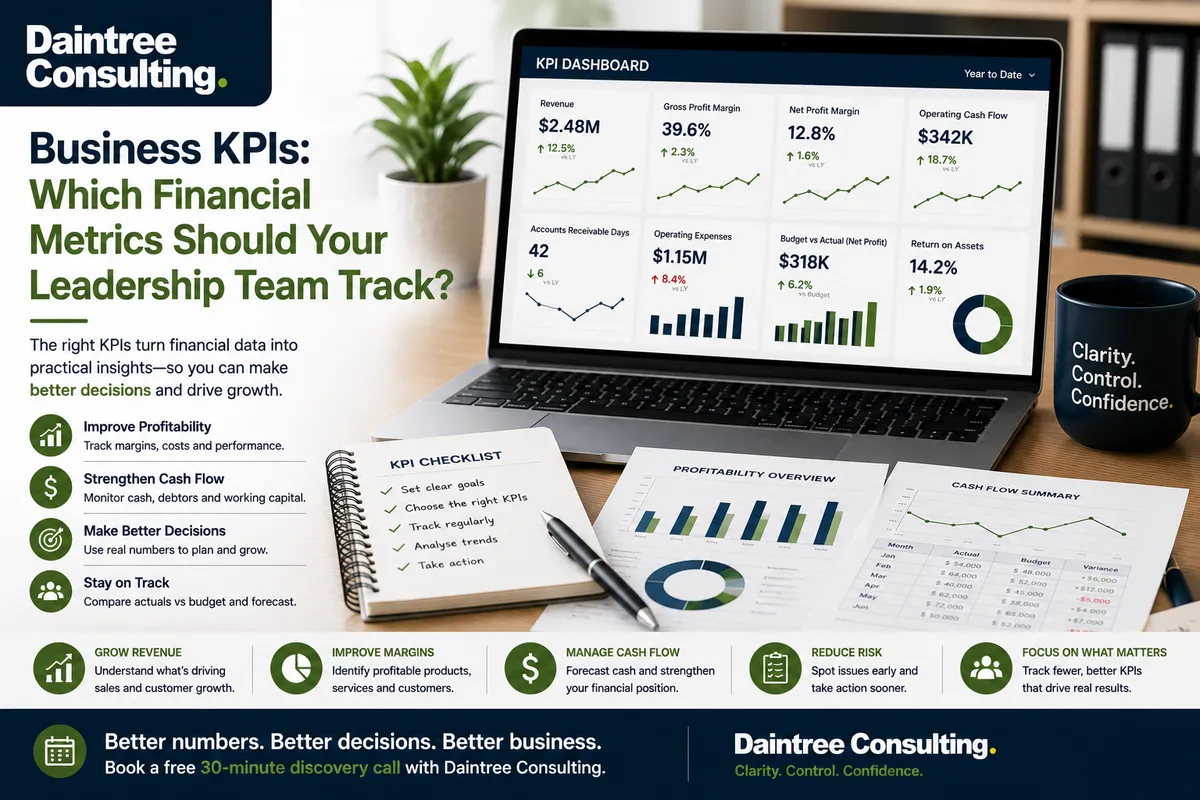
Business KPIs: Which Financial Metrics Should Your Leadership Team Track?
Running a growing business means making decisions constantly.
Should you hire another employee?
Can you afford to expand?
Are your prices high enough?
Which customers are actually profitable?
Why is revenue increasing but cash still tight?
Want expert help? Daintree Consulting's business advisory services can take this off your plate. Book a free consultation.
The challenge is that revenue alone cannot answer these questions.
This is where business KPIs become important.
Business KPIs, or Key Performance Indicators, give leadership teams a structured way to understand whether the business is performing as expected and where attention is needed.
The right KPIs turn financial data into practical information.
Instead of simply looking at last month's profit and loss statement, leadership can see whether margins are improving, cash flow is strengthening, expenses are under control and the business is moving towards its goals.
For Australian SMEs, the most useful approach is not to track dozens of numbers. It is to identify a focused group of financial and operational KPIs that directly connect to the way the business makes money.
Quick Answer: What Business KPIs Should You Track?
The right KPIs depend on your industry, business model and objectives, but most leadership teams should consider monitoring:
Revenue growth — Is the business generating more sales over time?
Gross profit margin — How much is left after direct costs?
Net profit margin — How profitable is the business overall?
EBITDA or operating profit — How is the underlying operation performing?
Operating expenses — Are overheads growing faster than revenue?
Cash flow — Is the business generating enough cash to fund operations?
Accounts receivable days — How quickly are customers paying?
Accounts payable position — How effectively is the business managing supplier obligations?
Working capital — Does the business have enough short-term financial capacity?
Budget vs actual performance — Is the business performing in line with expectations?
Customer profitability — Which customers, products or services generate the best returns?
Return on investment — Are major investments producing the expected results?
The key is not simply tracking these numbers.
Leadership teams need to understand what each KPI means, why it matters and what action should follow when the number moves in the wrong direction.
What Are Business KPIs?
A KPI is a measurable indicator used to evaluate progress towards an important business objective.
Not every business metric is a KPI.
For example, your accounting system may contain hundreds or thousands of financial data points. But only some of them are genuinely useful for leadership decision-making.
A good KPI should help answer a meaningful question.
For example:
Revenue:
How much did we sell?
Gross margin:
How much are we retaining after the direct cost of delivering those sales?
Cash conversion:
How quickly are sales turning into available cash?
Budget variance:
Are actual results tracking against our plan?
The best KPIs provide context rather than simply producing another number on a spreadsheet.
Why Business KPIs Matter for Leadership Teams
Small businesses can sometimes operate based on instinct.
The owner knows the customers, understands the team and can often see problems developing before they appear in the accounts.
As the business grows, that becomes harder.
More employees, customers, suppliers, locations, products and transactions create complexity.
Leadership can no longer rely entirely on intuition.
Business KPIs create a common financial language across the leadership team.
They can help you:
Identify problems earlier
Understand what is driving profitability
Monitor cash-flow pressure
Compare actual results with budgets
Measure progress against strategic goals
Make better hiring and investment decisions
Identify inefficient spending
Understand customer and product profitability
Create accountability across management
Plan for future growth
The objective is not to produce more reports.
The objective is to make better decisions with reliable information.
1. Revenue Growth
Revenue is one of the most obvious business KPIs, but it still needs to be analysed properly.
Simply knowing that revenue increased by 10% does not tell you whether the business became healthier.
You need to understand:
What caused the increase?
Was the growth profitable?
Did prices increase?
Did sales volume increase?
Did a small number of customers account for most of the growth?
Is the growth sustainable?
Did costs increase faster than revenue?
For example, a business could increase revenue substantially while seeing its profit margin fall.
That means revenue growth alone is not enough.
What to monitor
Consider tracking:
Monthly revenue
Year-on-year revenue growth
Revenue by product or service
Revenue by customer
Revenue by location
Recurring vs one-off revenue
The most useful revenue KPI depends on how your business actually generates sales.
2. Gross Profit Margin
Gross profit margin is one of the most important financial KPIs for many businesses.
It measures how much revenue remains after direct costs associated with delivering the product or service.
For example, if a business generates $1 million in revenue and has $600,000 in direct costs, gross profit is $400,000.
The gross profit margin is therefore 40%.
The formula is:
Gross Profit ÷ Revenue × 100
A declining gross margin can be an early warning sign.
It may indicate:
Rising supplier costs
Discounting
Pricing problems
Product mix changes
Labour cost increases
Inefficient production
Poor project management
A leadership team should not only track the margin but understand why it changes.
3. Net Profit Margin
Gross margin tells you how effectively the business generates profit after direct costs.
Net profit margin looks further down the income statement.
It considers the overall profitability of the business after operating expenses and other relevant costs.
The formula is:
Net Profit ÷ Revenue × 100
A business can have an excellent gross margin and still produce disappointing net profit if overheads are too high.
Tracking net profit margin over time helps leadership understand whether the business is becoming more or less efficient.
It can also help identify whether revenue growth is translating into genuine bottom-line improvement.
4. Operating Expenses
Revenue and profit receive most of the attention, but leadership teams should also understand where the money is going.
Operating expenses may include:
Wages and salaries
Rent
Software
Insurance
Marketing
Professional fees
Vehicles
Utilities
Office expenses
Other administrative costs
The important question is not necessarily whether expenses increased.
Growing businesses should expect some costs to increase.
The better question is:
Are operating expenses increasing at a reasonable rate compared with revenue and business growth?
For example, if revenue increases by 15% but overheads increase by 40%, leadership should understand why.
5. Cash Flow
Profit and cash are not the same thing.
A business can report a profit while experiencing serious cash-flow pressure.
This can happen when:
Customers take too long to pay
Inventory absorbs cash
Large expenses need to be paid upfront
Debt repayments are high
The business is growing faster than its working capital can support
That makes cash flow one of the most important business KPIs for leadership.
Useful cash-flow measures can include:
Operating cash flow
Cash balance
Monthly cash movement
Cash-flow forecast
Cash conversion
Working capital requirements
A strong leadership team should understand not only how much cash the business has today, but what its cash position is likely to look like several months from now.
6. Accounts Receivable Days
If your business sells on credit, how quickly customers pay can have a major impact on cash flow.
Accounts receivable days help measure the average time customers take to pay outstanding invoices.
If your sales are increasing but customers are taking longer to pay, cash-flow pressure can increase even though revenue looks healthy.
Leadership should monitor:
Total accounts receivable
Overdue invoices
Average collection time
Debtor concentration
Significant overdue customers
A business does not necessarily have a sales problem when cash is tight.
Sometimes it has a collection problem.
7. Working Capital
Working capital provides insight into the business's short-term financial position.
It generally relates to current assets and current liabilities.
For leadership teams, the important question is:
Does the business have enough short-term financial capacity to operate comfortably while meeting its obligations?
Working capital can become particularly important during periods of rapid growth.
A business may receive more orders, hire more employees and purchase more stock, all of which can require cash before customers pay.
Growth can therefore consume cash.
Understanding working capital helps leadership plan for that reality instead of discovering it when the bank balance becomes uncomfortable.
8. Budget vs Actual Performance
A budget is useful only if leadership compares it with what actually happened.
Budget vs actual reporting highlights the difference between planned and actual performance.
For example:
Budget revenue: $500,000
Actual revenue: $460,000
That variance creates a question.
Why was revenue $40,000 below budget?
Perhaps:
A major customer delayed an order
Sales volume was lower
Pricing changed
A project moved into the next month
The original budget assumption was unrealistic
The same principle applies to expenses.
If marketing expenditure is significantly above budget, leadership needs to understand whether the additional spending produced additional revenue.
Budget vs actual reporting turns financial reporting into a management conversation.
9. Customer Profitability
Revenue by customer can be useful.
But profitability by customer can be much more revealing.
One customer might generate $300,000 of annual revenue but require extensive support, discounting, account management and customised delivery.
Another customer might generate $150,000 with significantly higher margins and fewer demands on the business.
Looking only at revenue could make the first customer appear more valuable.
Customer profitability can reveal a different picture.
Depending on the business, leadership may want to analyse:
Revenue per customer
Gross margin per customer
Service costs
Acquisition costs
Customer retention
Average customer value
This can help determine where the business should focus its sales and service resources.
10. EBITDA or Operating Profit
For businesses where it is relevant, EBITDA or operating profit can provide useful insight into underlying operating performance.
The exact metric you use should depend on your business structure and reporting objectives.
The important point is to avoid relying on one headline profit number without understanding the underlying drivers.
Leadership should be able to answer:
Is operating profitability improving?
What is driving the change?
Is growth improving operating leverage?
Are overheads increasing faster than gross profit?
Are unusual items distorting the result?
Your accountant or business advisor can help determine which profitability measure is most appropriate for your management reporting.
11. Return on Investment
Not every business decision should be evaluated solely on immediate revenue.
Leadership teams often make significant investments in:
Marketing
Technology
Equipment
Employees
New locations
Product development
Acquisitions
A useful KPI is whether the investment is producing the expected return.
For example, if the business spends $50,000 implementing a new system, leadership should establish what success looks like.
Will the system:
Reduce labour costs?
Increase capacity?
Improve customer retention?
Reduce errors?
Increase revenue?
Save management time?
Without a defined measure of success, it becomes difficult to determine whether an investment actually delivered value.
12. KPIs Should Connect to Business Goals
One of the biggest mistakes businesses make is choosing KPIs because they are easy to measure.
The better approach is to start with the business objective.
For example:
Goal: Improve profitability
Relevant KPIs may include:
Gross profit margin
Net profit margin
Operating expenses
Customer profitability
Goal: Improve cash flow
Relevant KPIs may include:
Operating cash flow
Accounts receivable days
Overdue invoices
Working capital
Cash-flow forecast
Goal: Grow sustainably
Relevant KPIs may include:
Revenue growth
Gross margin
Customer retention
Customer acquisition cost
Operating profit
Cash-flow position
The KPI should support the goal.
How Many Business KPIs Should You Track?
More is not always better.
A leadership dashboard containing 50 metrics may look impressive but become almost impossible to manage.
The leadership team should focus on the relatively small number of KPIs that genuinely influence important decisions.
A practical approach is to divide them into categories such as:
Growth
Revenue, sales pipeline and customer growth.
Profitability
Gross margin, operating profit and net profit margin.
Cash
Cash balance, operating cash flow, receivables and working capital.
Efficiency
Operating expenses, productivity and cost ratios.
Strategic performance
Customer profitability, return on investment and progress against strategic goals.
The exact combination should be tailored to the business.
How Often Should Leadership Review Business KPIs?
The appropriate frequency depends on the KPI.
Some indicators should be reviewed monthly.
Others may be more useful weekly or quarterly.
For example:
Weekly
Cash position
Sales activity
Major overdue invoices
Critical operational indicators
Monthly
Revenue
Gross margin
Net profit
Operating expenses
Cash flow
Budget vs actual
Accounts receivable
Quarterly
Strategic performance
Customer profitability
Major investment returns
Forecast assumptions
Growth plans
The important thing is consistency.
A KPI only becomes useful when leadership reviews it regularly and acts on what it reveals.
What Makes a Good KPI Dashboard?
A useful dashboard should make important information easy to understand.
Leadership should be able to quickly see:
What happened?
Why did it happen?
Is it better or worse than expected?
What is likely to happen next?
What action should we take?
This is why management reporting should not simply reproduce accounting reports.
A good management report provides context.
For example, instead of showing:
Gross margin: 36%
the report might show:
Gross margin: 36% — down from 40% last month, primarily due to supplier price increases and a higher proportion of lower-margin sales.
That is much more useful for decision-making.
Common Business KPI Mistakes
Tracking too many metrics
Too many KPIs create noise and make it difficult to identify what actually matters.
Looking only at revenue
Revenue growth without margin and cash-flow analysis can create a misleading picture.
Ignoring cash flow
A profitable business can still experience financial stress if cash is tied up in receivables, inventory or growth.
Reviewing KPIs too late
If leadership only reviews performance several months after the fact, the information has limited value for immediate decision-making.
Not comparing actual results with expectations
Without a budget, forecast or historical benchmark, it can be difficult to determine whether a result is genuinely good or bad.
Tracking KPIs without assigning responsibility
Someone should be responsible for understanding significant movements and identifying appropriate actions.
Using unreliable financial data
No dashboard can compensate for inaccurate bookkeeping.
If the underlying numbers are wrong, the KPIs can create false confidence rather than clarity.
How Accurate Bookkeeping Supports Better KPIs
Business KPIs are only as reliable as the information behind them.
If bank accounts are not reconciled, transactions are incorrectly coded or invoices are missing, management reporting can become misleading.
This is why bookkeeping and management reporting should work together.
A strong financial process typically looks like:
Accurate bookkeeping → Reconciled accounts → Reliable financial reports → KPI analysis → Better decisions
The goal is not simply to keep the accounting system tidy.
It is to create financial information leadership can trust.
When Should Your Business Start Using Financial KPIs?
You do not need to wait until your business becomes large.
Even smaller businesses can benefit from monitoring a focused set of financial KPIs.
The need becomes particularly important when:
Revenue is growing quickly
You have multiple employees
Cash flow is becoming harder to predict
Profit margins are changing
You have multiple products or services
The owner is making increasingly large financial decisions
You are considering expansion
You have investors or lenders
Different parts of the business are performing differently
You are no longer able to understand the entire business from the bank account
At this stage, regular management reporting can give leadership a much clearer view of what is actually happening.
How Daintree Consulting Can Help
At Daintree Consulting, we help Australian businesses turn financial information into practical management insight.
Business KPIs are most useful when they are connected to accurate bookkeeping, reliable reporting and a clear understanding of the business's objectives.
Our support can include:
Bookkeeping and accounting
Management accounts
Management reporting
Budget vs actual reporting
Cash-flow reporting
Forecasting
Business advisory
Financial modelling
Performance analysis
Outsourced CFO support
The objective is not to overwhelm business owners with financial reports.
It is to identify the numbers that matter and use them to support better decisions.
For a growing business, that can mean understanding where profitability is being created, where cash is being consumed and what needs to happen next.
Ready to Get More From Your Business Numbers?
If your leadership team receives financial reports but still struggles to answer "What is actually happening in the business?", your reporting may need to go beyond basic financial statements.
A focused KPI framework can help turn accounting data into practical management information.
Book a free 30-minute discovery call with Daintree Consulting to discuss your current reporting process, financial priorities and the level of management insight your business needs.
Frequently Asked Questions
What are the most important business KPIs?
The most important business KPIs depend on the business, but common financial KPIs include revenue growth, gross profit margin, net profit margin, cash flow, operating expenses, accounts receivable days and budget vs actual performance.
What financial KPIs should a small business track?
A small business can start with a focused group of KPIs such as revenue, gross margin, net profit, cash flow, outstanding receivables and operating expenses. The KPIs should reflect the business's goals and financial risks.
How often should business KPIs be reviewed?
Many financial KPIs are reviewed monthly, while cash and selected operational metrics may need more frequent monitoring. Strategic KPIs may be reviewed quarterly.
What is the difference between a KPI and a financial report?
A financial report provides financial information about the business. A KPI focuses attention on a specific measure of performance that is important to achieving a business objective.
Can KPIs help improve business profitability?
Yes. Well-designed KPIs can help leadership identify margin problems, excessive costs, unprofitable customers and other performance issues. The value comes from using the information to make changes.
Why is cash flow an important business KPI?
Cash flow shows how money is moving through the business. A company can be profitable while still experiencing cash shortages, particularly during periods of rapid growth.
Should every business track the same KPIs?
No. The right KPIs depend on the business model, industry, size, financial structure and strategic objectives. A service business may need different KPIs from a construction company, retailer or professional practice.
Can an accountant help set up business KPIs?
Yes. An accountant or business advisor with management reporting and advisory experience can help identify appropriate financial KPIs, establish reporting processes and interpret the results.
What is KPI reporting?
KPI reporting is the process of regularly measuring and presenting key performance indicators so leadership can assess business performance and make informed decisions.
How can Daintree Consulting help with business KPIs?
Daintree Consulting can support businesses with bookkeeping, management accounts, financial reporting, forecasting, business advisory and outsourced CFO services, helping leadership teams turn reliable financial data into useful decision-making information.
Important Publishing Note
Financial KPIs, reporting methods, accounting treatments and performance measures can vary depending on the business structure, industry and individual circumstances. Examples and formulas in this article are provided for general information and should be reviewed against the business's actual reporting requirements before making financial or strategic decisions.
For publication, Daintree Consulting should confirm that any specific financial claims, examples or recommendations remain appropriate for the relevant business context and current Australian accounting and tax requirements.
Talk to Daintree about your next business decision
Our ex-Big 4 team gives clear, senior-reviewed advice so you can act with confidence.
Book a free consultation →
Or explore our business advisory services.
