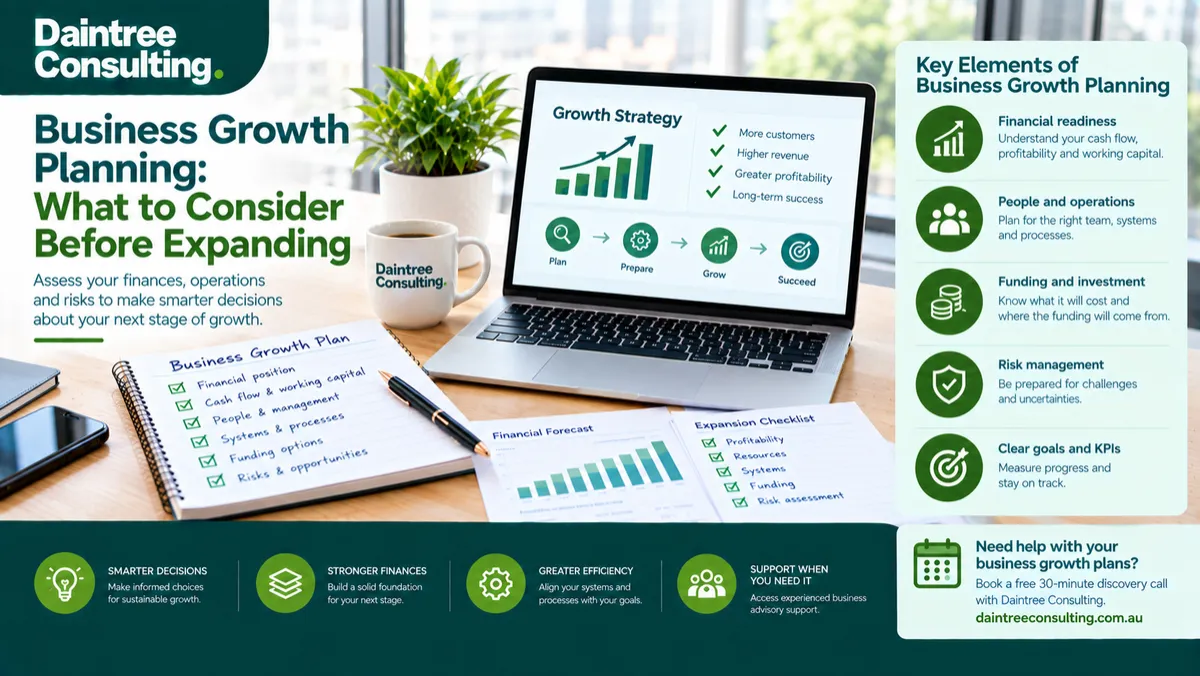
Business Growth Planning: What Should Australian Business Owners Consider Before Expanding?
Business growth can be exciting.
More customers, higher revenue, new staff, additional locations or expansion into new markets can all represent significant opportunities.
Want expert help? Daintree Consulting's business advisory services can take this off your plate. Book a free consultation.
But growth also creates financial and operational pressure.
A business that is profitable at its current size may not automatically be ready to expand. Hiring employees, increasing inventory, taking on premises, investing in equipment or entering a new market can require significant cash before the additional revenue arrives.
That is why business growth planning should happen before expansion begins.
Good growth planning is not about predicting exactly what will happen. It is about understanding what the business can realistically support, identifying the resources expansion will require and preparing for the risks that could arise along the way.
For Australian business owners, this means looking beyond revenue targets and considering cash flow, profitability, people, systems, financing, customers, operations and the financial information needed to make decisions.
Quick Answer: What Should You Consider Before Expanding a Business?
Before expanding, Australian business owners should consider:
Whether the existing business is financially stable
Whether growth is generating sustainable profit
How much additional cash expansion will require
Whether working capital is sufficient
How quickly customers are likely to pay
Whether additional employees are needed
Whether current systems can handle increased activity
Whether management has enough capacity
How expansion will affect costs and margins
Whether additional funding is required
What could happen if growth is slower than expected
Whether the business has reliable financial reporting
Which risks need to be addressed
What financial and operational KPIs should be monitored
How the expansion will affect the owner's role and the wider business
The objective is not to eliminate every risk.
It is to make sure growth is deliberate rather than reactive.
What Is Business Growth Planning?
Business growth planning is the process of deciding how a business intends to grow and determining what financial, operational and organisational resources are needed to support that growth.
Growth can take many forms.
A business might expand by:
Increasing sales to existing customers
Entering a new geographic market
Opening another location
Adding new products or services
Hiring additional employees
Increasing production capacity
Acquiring another business
Expanding through partnerships
Investing in technology
Moving into a new customer segment
Each approach creates different requirements and risks.
For example, increasing sales through an existing business model may require additional staff and working capital.
Opening a new location may introduce rent, fit-out, equipment, staffing and marketing costs before the new location becomes profitable.
Acquiring another business can introduce financing, integration and operational risks.
The growth strategy needs to match the business's financial capacity and operational capability.
1. Start With the Current Financial Position
Before planning the next stage of growth, understand where the business stands today.
That means looking at more than the amount appearing in the bank account.
Review:
Revenue
Gross margins
Operating expenses
Net profit
Cash flow
Working capital
Accounts receivable
Accounts payable
Existing debt
Tax and other liabilities
Major upcoming expenditure
Reliable financial records are particularly important at this stage.
If the underlying accounting information is incomplete or inconsistent, it becomes difficult to determine whether the business is genuinely ready for expansion.
Growth decisions should be based on a clear picture of the current position rather than assumptions.
2. Understand Whether Revenue Growth Is Actually Profitable
More revenue does not necessarily mean a stronger business.
If additional sales require disproportionately higher costs, margins can fall as revenue increases.
Before expanding, consider:
Which products or services generate the strongest margins?
Which customers are most profitable?
Are margins consistent?
What happens to costs as sales increase?
Are some revenue streams consuming excessive resources?
Will expansion change the cost structure?
This distinction matters.
A business can grow rapidly while creating additional financial pressure if the economics of that growth are not understood.
Growth planning should therefore consider profitable growth, not simply higher turnover.
3. Build a Cash-Flow Forecast
One of the biggest mistakes businesses can make is assuming that profitable growth automatically produces enough cash.
It does not always work that way.
A business may need to pay for additional staff, inventory, equipment, premises and marketing before receiving payment from the additional customers those investments are intended to generate.
A cash-flow forecast can help show:
Expected customer receipts
Supplier payments
Payroll costs
Tax-related obligations
Loan repayments
Capital expenditure
Other major cash movements
Expected cash balances over time
The forecast should reflect realistic assumptions rather than simply extending recent revenue growth indefinitely.
It can also be useful to model different scenarios.
For example:
Base case: growth progresses broadly as expected.
Slower-growth case: sales take longer to develop.
Higher-growth case: demand exceeds expectations and additional resources are required sooner.
This helps management understand how much financial flexibility the business actually has.
4. Calculate the Cost of Expansion
Before committing to growth, identify the full cost.
Some costs are obvious.
Others are easy to underestimate.
Depending on the strategy, expansion could involve:
New employees
Recruitment costs
Training
Premises
Rent
Fit-out
Equipment
Technology
Inventory
Vehicles
Marketing
Professional fees
Insurance
Software
Working capital
Financing costs
There may also be indirect costs.
Management may spend more time supervising staff, opening a new location or implementing new systems.
Existing employees may become less productive during the transition.
Customers may require additional support.
These factors should be considered when estimating the true cost of expansion.
5. Determine How Much Working Capital You Need
Working capital becomes particularly important during periods of growth.
As sales increase, the business may need to fund additional inventory, wages and supplier payments before customers pay their invoices.
Consider:
How quickly customers pay
How quickly suppliers need to be paid
Inventory requirements
Payroll commitments
Existing cash reserves
Expected changes in receivables
Expected changes in payables
A business with strong sales can still experience cash-flow pressure if too much money is tied up in outstanding invoices or inventory.
Understanding the working-capital cycle before expansion can help identify funding requirements early.
6. Review Your Existing Business Model
Before scaling something, make sure it works.
Ask whether your current business model can support significantly more customers without creating unacceptable pressure.
Consider:
How customers are acquired
How services are delivered
How products are produced
How orders are processed
How customer support is handled
How suppliers are managed
Where bottlenecks currently exist
If the business is already struggling to manage its current workload, rapid growth may magnify those problems.
Expansion should ideally build on processes that are already reasonably stable.
7. Consider Whether Your Systems Can Handle Growth
Systems that work for a small business may become inadequate as transaction volumes increase.
You may need to review:
Accounting software
Payroll systems
Customer relationship management
Inventory systems
Project management
Reporting
Cybersecurity
Document management
Payment processes
Internal controls
The goal is not to purchase technology simply because the business is growing.
Instead, identify where existing systems may become a constraint.
A system that depends heavily on manual spreadsheets or one person's knowledge can create significant operational risk as the business becomes more complex.
8. Make Sure Your Financial Reporting Can Keep Up
Growth increases the value of timely financial information.
When a business is small, an owner may have a close understanding of day-to-day activity without relying heavily on formal reporting.
As the business grows, that becomes harder.
Management may need regular information about:
Revenue
Gross margin
Operating costs
Cash flow
Debtors
Working capital
Profitability
Budget versus actual results
Key business KPIs
Management accounts and financial dashboards can help turn accounting data into information that supports decisions.
The reporting does not need to be complicated.
It needs to be relevant, timely and reliable.
9. Think Carefully About Hiring
People are often one of the largest costs associated with expansion.
Hiring too early can place pressure on cash flow.
Hiring too late can create operational bottlenecks and reduce service quality.
Before recruiting, consider:
What role is actually required?
What problem will the role solve?
Can existing staff absorb the workload temporarily?
What will the total employment cost be?
How quickly should the position become productive?
Is the role permanent or linked specifically to the expansion?
What management capacity is required?
Employment costs extend beyond base wages.
The overall cost needs to be considered when modelling the financial impact of expansion.
10. Consider the Impact on Business Owners and Management
Growth does not only affect the company's finances.
It can significantly change the owner's role.
An owner who currently manages sales, customers, finance and operations personally may find that those responsibilities become difficult to maintain as the business expands.
Ask:
What should the owner continue doing?
What should be delegated?
Which decisions require management-level oversight?
Who will manage new employees?
Who will monitor financial performance?
Who will manage suppliers and customers?
What external expertise is required?
If the business grows faster than its management structure, the owner can quickly become the bottleneck.
Planning the management side of growth is therefore just as important as planning the financial side.
11. Identify Potential Funding Requirements
Some businesses can fund expansion from existing cash flow.
Others may need external finance.
Depending on the expansion strategy, funding could potentially involve:
Business loans
Equipment finance
Working-capital facilities
Investor funding
Additional owner capital
Other financing arrangements
The appropriate option depends on the business, its circumstances and the purpose of the funding.
Before seeking finance, it is useful to understand:
How much funding is required
Why it is required
When the funds will be needed
How the funds will be used
How repayments could affect cash flow
What happens if growth takes longer than expected
A clear financial forecast can make this discussion more practical.
12. Model Different Growth Scenarios
A single forecast can create false confidence.
Business growth is uncertain.
Instead of asking only, “What happens if everything goes according to plan?”, consider several possible outcomes.
For example:
Scenario 1: Expected growth
Sales increase according to the current business plan and costs develop broadly as expected.
Scenario 2: Slower growth
Customer acquisition takes longer, revenue arrives later and fixed costs remain.
Scenario 3: Faster growth
Demand is stronger than expected, requiring more employees, stock, equipment or working capital.
Scenario planning helps management understand the financial consequences of different outcomes.
The purpose is not to predict the future perfectly.
It is to prepare for a range of possibilities.
13. Set Clear Growth KPIs
Revenue alone is rarely enough to measure whether expansion is working.
Depending on the business, useful KPIs could include:
Sales growth
Gross margin
Net profit margin
Customer acquisition cost
Customer retention
Average transaction value
Accounts receivable days
Cash conversion
Staff utilisation
Revenue per employee
Recurring revenue
Operating expenses
Working capital
The right KPIs depend on the business model.
Choose measures that help management understand whether growth is producing the intended commercial outcome.
14. Review Your Risk Exposure
Expansion creates new risks.
These may include:
Financial risk
Customer concentration
Supplier dependency
Employment risk
Operational risk
Technology risk
Cybersecurity risk
Contractual risk
Regulatory requirements
Reputation risk
You do not need to eliminate every risk before expanding.
But significant risks should be identified and considered.
Ask what could go wrong, how likely it is and what the financial or operational impact could be.
Then determine whether the business needs additional controls, insurance, specialist advice or contingency planning.
15. Consider Tax and Structural Implications
Business expansion can sometimes raise questions about the business's existing structure, transactions, tax position or other obligations.
For example, a change in activities, ownership, locations or investment may create issues that should be reviewed before commitments are made.
Do not assume that the structure that worked for the business at an earlier stage will automatically remain appropriate as the business becomes more complex.
Where expansion involves significant structural or tax considerations, obtain appropriate professional advice before making decisions.
The exact implications depend on the business's circumstances.
16. Review Contracts and Commercial Arrangements
Growth often means entering into new agreements.
These might involve:
Suppliers
Employees
Landlords
Customers
Distributors
Technology providers
Business partners
Finance providers
Before signing significant commitments, understand the financial and operational obligations involved.
Pay particular attention to:
Contract length
Termination provisions
Minimum commitments
Payment terms
Price increases
Service obligations
Liability provisions
Renewal arrangements
Commercial commitments can continue even if the expected growth does not occur.
That makes them particularly important when modelling downside scenarios.
17. Decide What Success Will Actually Look Like
Growth for its own sake is not always the objective.
For some business owners, success means significantly increasing revenue.
For others, it may mean:
Increasing profitability
Building a management team
Reducing dependence on the owner
Expanding into a new market
Creating a more valuable business
Preparing for succession
Increasing recurring revenue
Improving operational capacity
Defining the desired outcome helps determine which growth strategy makes sense.
A strategy that increases revenue but creates excessive complexity may not be the right strategy for every owner.
Common Business Growth Planning Mistakes
Focusing only on revenue
Higher sales do not necessarily mean higher profit or stronger cash flow.
Underestimating working capital
Expansion can require cash before additional revenue is collected.
Hiring too quickly
Additional employees create ongoing costs that should be incorporated into realistic forecasts.
Assuming current systems will scale
Processes that work with ten customers may not work with several hundred.
Ignoring management capacity
Owners can become overwhelmed when every major decision still depends on them.
Using only one forecast
Scenario planning provides a better understanding of what happens if assumptions change.
Expanding before fixing existing problems
Growth can magnify weaknesses in systems, processes and financial controls.
Making decisions using outdated financial information
Growth planning requires current, reliable numbers.
A Practical Business Growth Planning Checklist
Before committing to a major expansion, ask:
Is the existing business financially stable?
Are current margins sustainable?
Is cash flow sufficiently strong?
How much additional working capital will be required?
What will the expansion cost?
When will the additional revenue realistically arrive?
What happens if growth is slower than expected?
What additional staff are required?
Can current systems handle increased activity?
Does management have sufficient capacity?
What funding might be required?
Which KPIs will determine whether expansion is successful?
What new risks will the expansion create?
Have important contracts and commitments been reviewed?
Do tax, accounting or structural considerations need professional advice?
What does successful growth actually mean for the owner?
If several of these questions cannot be answered confidently, it may be worth doing more planning before committing significant resources.
When Should You Get Professional Help With Business Growth Planning?
You do not need to wait until the business is already under pressure before getting advice.
Professional business advisory support can be particularly useful when:
Revenue is growing quickly
You are considering a second location
You are planning to hire significantly
Cash flow is becoming harder to predict
You are considering external funding
The business is entering a new market
Financial reporting is no longer sufficient
You are considering an acquisition
The owner is becoming a bottleneck
You want to understand different growth scenarios
You need help turning financial information into a practical growth plan
The earlier these issues are considered, the more options the business generally has.
How Daintree Consulting Can Help With Business Growth Planning
Daintree Consulting provides commercially grounded Business Advisory support for Australian business owners and leadership teams navigating growth, performance pressure, restructuring and important decisions.
Growth planning can involve looking at the numbers from several angles, including:
Profitability
Cash flow
Working capital
Financial performance
KPIs
Forecasts and scenarios
Strategic priorities
Business structure and risk considerations
Management reporting
Daintree can also connect business advisory work with accounting, financial reporting and outsourced CFO support where a broader finance function is required.
The objective is not to create a complicated strategy document that sits in a drawer.
It is to help business owners understand the numbers, identify the practical implications of their growth plans and make decisions with better financial visibility.
Planning to Expand Your Business?
Before committing to another location, significant hiring, new equipment, a major marketing investment or a new market, make sure you understand what the expansion will require financially and operationally.
Book a free 30-minute discovery call with Daintree Consulting to discuss your growth plans, financial position and the level of business advisory support that may be appropriate for your business.
Frequently Asked Questions
What is business growth planning?
Business growth planning is the process of determining how a business intends to grow and assessing the financial, operational, people and management resources needed to support that growth.
It helps business owners evaluate opportunities while considering the costs, risks and cash-flow requirements involved.
Why is cash flow important when expanding a business?
Growth can require significant spending before additional customer revenue is collected. Businesses may need to fund employees, inventory, equipment, premises and other costs during the expansion period.
A cash-flow forecast can help identify potential funding requirements and periods of financial pressure.
How do I know if my business is ready to expand?
There is no single financial test that applies to every business. However, owners should consider profitability, cash flow, working capital, financial reporting, operational capacity, systems, management resources and the risks associated with expansion.
Should I create a financial forecast before expanding?
A financial forecast can be a useful part of the planning process because it helps estimate expected revenue, costs, cash flow and funding requirements.
Scenario modelling can make the forecast more useful by showing what could happen under different growth outcomes.
How much money should I have before expanding my business?
There is no universal amount. The required financial buffer depends on the expansion strategy, existing cash flow, costs, working-capital cycle, financing arrangements and expected timing of additional revenue.
A business should assess its specific requirements rather than relying on a generic cash reserve figure.
Should I hire employees before or after expanding?
It depends on the expansion strategy and when additional capacity is required.
Hiring too early can increase costs before revenue arrives, while hiring too late can create operational bottlenecks. The timing should be considered as part of the financial and operational growth plan.
What KPIs should I track during business expansion?
The right KPIs depend on the business. Common measures can include revenue growth, gross margin, profitability, cash flow, customer retention, accounts receivable, working capital and revenue per employee.
The most useful KPIs are those that help management understand whether growth is producing the intended result.
Can a business advisor help with expansion planning?
Yes. Depending on the agreed scope, a business adviser can help analyse financial performance, cash flow, KPIs, strategic options, risks and growth scenarios.
The appropriate support depends on the business's circumstances and the decisions being considered.
When should I start business growth planning?
Ideally, planning should begin before significant expansion commitments are made.
The earlier you understand the financial and operational requirements, the more time you have to adjust the strategy, secure resources and address potential risks.
Final Thoughts
Successful expansion rarely happens simply because a business has found more customers.
It happens when the business has the financial capacity, systems, people and management capability to support those customers.
That is why business growth planning should look beyond revenue targets.
Understand your current financial position. Model cash flow. Calculate the real cost of expansion. Review working capital. Consider people and systems. Test different scenarios. Identify risks. Decide what success actually means.
Most importantly, make sure the numbers behind the growth strategy are reliable.
If you are considering expansion and are unsure whether the business is financially or operationally ready, getting an independent perspective can help turn a broad growth idea into a more practical decision-making process.
Book a free 30-minute discovery call with Daintree Consulting to discuss your business growth plans and the financial and advisory support available to help you move forward.
Talk to Daintree about your next business decision
Our ex-Big 4 team gives clear, senior-reviewed advice so you can act with confidence.
Book a free consultation →
Or explore our business advisory services.
