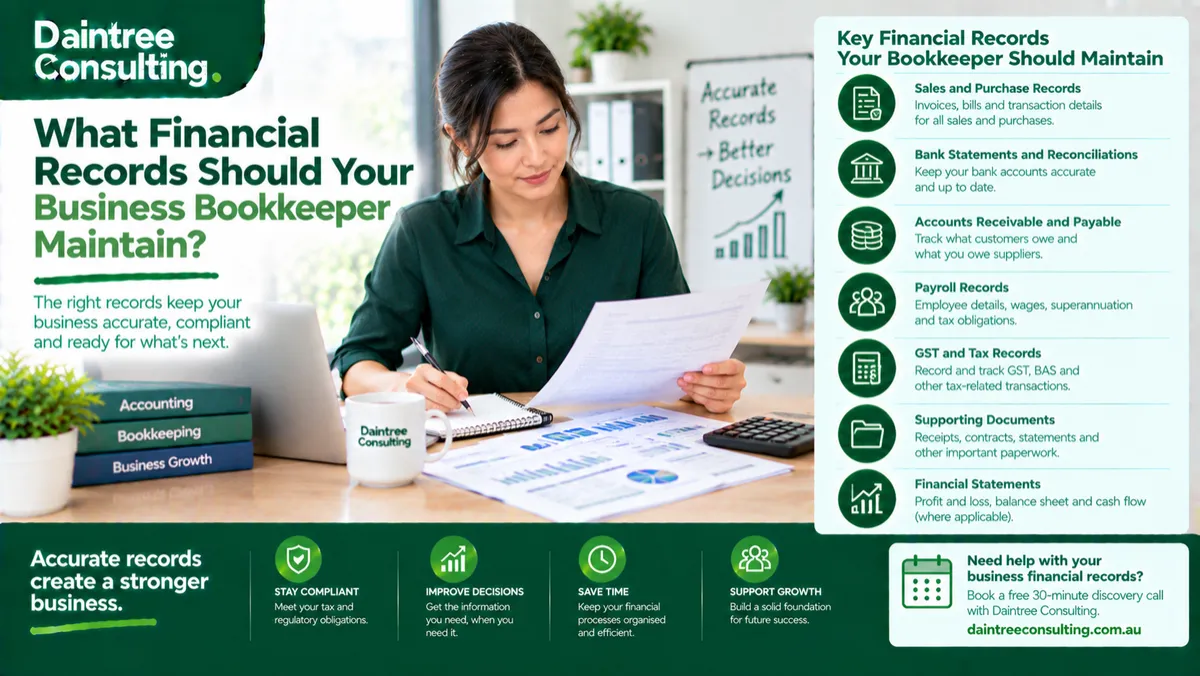
What Financial Records Should Your Business Bookkeeper Maintain?
Your bookkeeping records are more than a list of transactions. They form the financial foundation your business relies on for BAS preparation, tax reporting, cash-flow management, financial reporting and day-to-day decision-making.
But what exactly should a business bookkeeper maintain?
Want expert help? Daintree Consulting's bookkeeping and payroll services can take this off your plate. Book a free consultation.
The answer depends on your business structure, industry, transactions, employees and tax obligations. However, most Australian businesses need an organised system for recording income, expenses, banking, accounts receivable, accounts payable, payroll, GST and the supporting documents behind those transactions.
If these records are incomplete or poorly maintained, it becomes harder to know whether your financial reports are accurate, whether customers have paid, what you owe suppliers and whether your business has enough cash available for upcoming obligations.
This guide explains the key business financial records your bookkeeper should maintain and why each category matters.
What Are Business Financial Records?
Business financial records are the documents and accounting information that explain your business's financial transactions and position.
They can include:
Sales invoices and receipts
Purchase invoices and supplier bills
Bank statements and transaction records
Accounts receivable records
Accounts payable records
Payroll information
GST and BAS-related records
Expense documentation
Asset and equipment records
Loan and finance records
Financial reports
Supporting documents for business transactions
These records can be maintained electronically through accounting software and document-management systems, provided the records meet the applicable requirements.
Australian Government guidance states that businesses need to keep records of transactions relevant to their tax, superannuation and registration obligations. Good records can also help businesses understand their financial position, manage cash flow and make better decisions.
The important point is that bookkeeping should create a reliable financial trail from the original transaction through to the financial reports and tax obligations that depend on it.
1. Sales and Income Records
Your bookkeeper should maintain accurate records of the income your business earns.
Depending on your business, this may include:
Sales invoices
Customer receipts
Point-of-sale transactions
Online sales
Service invoices
Recurring billing
Credit notes
Refunds
Customer payments
Other business income
The records should make it possible to understand what was sold, when it was sold, how much was charged and whether the customer has paid.
For businesses selling products or services on credit, the bookkeeping system should also connect sales transactions with accounts receivable.
This matters because recording a sale is only one part of understanding your financial position. You also need to know whether the money has actually been collected.
Clear invoices and receipts can help businesses track sales and payments, reduce disputes and support record-keeping and tax obligations.
Why sales records matter
Accurate sales records help you:
Monitor revenue
Track outstanding customer payments
Reconcile bank transactions
Prepare financial reports
Support BAS and tax reporting
Identify changes in sales performance
Understand cash-flow timing
A business can appear to be growing strongly based on sales alone while still experiencing cash-flow pressure if customers are taking too long to pay.
That is why sales records and payment records need to work together.
2. Purchase and Expense Records
Your bookkeeper should also maintain records of the costs your business incurs.
These may include:
Supplier invoices
Bills
Business subscriptions
Rent
Utilities
Insurance
Advertising and marketing
Professional fees
Travel expenses
Motor vehicle expenses
Office expenses
Equipment purchases
Other operating costs
The supporting documentation is important.
A transaction appearing in your accounting software does not necessarily provide all the information needed to understand or substantiate the expense. Your business may also need the underlying invoice, receipt or other supporting documentation.
Australian Government guidance states that records supporting business tax deductions need to substantiate the expenses being claimed. Generally, expenses need to relate directly to earning business income and have appropriate records supporting the claim.
Why expense records matter
Good expense records help you:
Understand where money is being spent
Identify unnecessary or increasing costs
Calculate profitability
Support tax deductions where applicable
Reconcile business transactions
Prepare financial reports
Monitor spending against a budget
Your bookkeeper should not simply record expenses as they appear. The records should be organised consistently so that management and your accountant can understand what those expenses represent.
3. Bank and Payment Records
Bank reconciliation is one of the fundamental parts of maintaining reliable business financial records.
Your bookkeeping system should account for the transactions passing through your business bank accounts and other relevant payment accounts.
This can include:
Business bank accounts
Credit cards
Payment platforms
Merchant accounts
Direct debit transactions
Electronic payments
Other business payment accounts
The transactions recorded in your accounting system should be reconciled against the relevant statements or transaction records.
This helps identify:
Missing transactions
Duplicate transactions
Incorrect entries
Unidentified payments
Bank fees
Timing differences
Errors in the accounting records
Separating personal and business transactions can also make financial administration easier. Business.gov.au notes that keeping private and business transactions separate can save time and make it easier to prepare financial documents, activity statements and tax returns.
Regular reconciliation is therefore more than an administrative task. It helps establish whether the accounting records reflect what actually happened through the business's bank and payment accounts.
4. Accounts Receivable Records
If your business allows customers to pay after receiving goods or services, accounts receivable records are particularly important.
Your bookkeeper should be able to maintain information showing:
Outstanding invoices
Invoice dates
Due dates
Customer payments
Overdue amounts
Credit notes
Adjustments
Unallocated receipts
This gives the business visibility over money that has been earned but not yet collected.
For example, a business could report $500,000 in annual sales but still experience cash-flow pressure if a significant amount remains outstanding from customers.
A properly maintained accounts receivable ledger helps owners see that distinction.
What should you review?
Depending on the size and complexity of the business, management may want to review:
Total outstanding receivables
Current invoices
Overdue invoices
Older debts
Large customer balances
Average payment timing
This information can feed into cash-flow planning and decisions about customer payment terms.
5. Accounts Payable and Supplier Records
Your bookkeeper should also maintain records of what the business owes suppliers and other creditors.
This may include:
Supplier invoices
Bills
Payment dates
Outstanding balances
Credit notes
Supplier statements
Recurring expenses
Finance-related payments
Good accounts payable records help prevent bills from being missed or paid twice.
They also help management understand upcoming cash commitments.
This becomes increasingly important as a business grows. More customers, suppliers, employees and transactions generally mean more financial information needs to be organised and reviewed.
A reliable bookkeeping process should make it clear not only how much cash the business has today, but also what obligations are approaching.
6. Payroll Records
Businesses with employees have another important category of financial records: payroll.
Depending on the business and its systems, payroll records can include:
Employee details
Hours worked
Gross wages
PAYG withholding
Superannuation information
Leave records
Allowances
Deductions
Payroll reports
Payment records
Employment-related adjustments
Payroll records need to be accurate because payroll affects both employees and the business's financial obligations.
Payroll also connects with the broader bookkeeping system.
Wages affect expenses. Superannuation creates obligations. PAYG withholding needs to be accounted for. Payroll payments affect cash flow.
For that reason, payroll should not operate as an isolated process.
It should feed accurately into the business's financial records and reporting.
7. GST and BAS Records
If your business is registered for GST, GST-related records are another essential part of your bookkeeping system.
Your bookkeeper may need to maintain records relating to:
GST collected on sales
GST paid on eligible business purchases
Tax invoices
GST adjustments
GST-related payments
BAS information
Relevant accounting transactions
The exact obligations depend on your circumstances, including your GST registration and business activities.
The important principle is that GST records should be supported by accurate underlying transactions.
Before a BAS is prepared or lodged, the underlying bookkeeping should be sufficiently up to date to allow the relevant figures to be reviewed and reconciled.
This is one reason accurate bookkeeping throughout the year is generally more useful than trying to reconstruct transactions immediately before a BAS deadline.
8. Asset and Equipment Records
Businesses that own equipment, vehicles, machinery, technology or other assets should maintain appropriate records for those assets.
Depending on the circumstances, this can include:
Purchase invoices
Purchase dates
Purchase costs
Asset descriptions
Disposal information
Sale proceeds
Improvement costs
Finance information
Asset registers
Supporting documentation
Asset records can become particularly important when preparing financial statements or determining applicable depreciation and tax treatment.
They can also help management understand what the business owns and how much capital has been invested in equipment and other assets.
Business.gov.au specifically identifies records relating to business assets and stock as part of the financial information businesses may need to maintain.
9. Loan and Finance Records
If your business has loans, leases or other financing arrangements, the bookkeeping records should capture the relevant transactions.
These may include:
Loan statements
Repayments
Interest
Fees
Principal movements
Finance agreements
Equipment finance
Lease-related transactions
Correctly separating principal and interest components can matter for financial reporting and tax treatment.
It also gives the business a clearer picture of its outstanding debt and future cash commitments.
For businesses carrying significant debt, this information can become an important part of financial planning and management reporting.
10. Supporting Documents
One of the most overlooked areas of bookkeeping is the supporting documentation behind the numbers.
Examples include:
Receipts
Tax invoices
Contracts
Supplier statements
Bank statements
Expense documentation
Asset purchase records
Loan documents
Payroll records
Credit notes
Adjustment documentation
Think of the accounting system as the summary of what happened and the supporting documents as the evidence behind those entries.
If a transaction is questioned later, you want to be able to understand where the number came from.
This is particularly important when records are needed for tax, audit, financing, business reviews or other financial purposes.
11. Financial Reports
Bookkeeping creates the underlying data used to produce financial reports.
Depending on the business, useful reports may include:
Profit and loss statement
Balance sheet
Cash-flow information
Accounts receivable report
Accounts payable report
General ledger
Trial balance
Budget-versus-actual reports
Management reports
A profit and loss statement, for example, shows sales, expenses and the resulting profit or loss. Business.gov.au notes that businesses commonly prepare profit and loss statements monthly, quarterly or annually depending on their needs.
The purpose of bookkeeping is therefore not simply to keep transactions recorded.
It is to create reliable financial information that the business can actually use.
How Often Should a Bookkeeper Update Financial Records?
There is no single frequency that suits every business.
A business with a small number of transactions may have different bookkeeping needs from a business processing hundreds or thousands of transactions every month.
Factors that can affect the appropriate frequency include:
Transaction volume
Number of bank accounts
Number of employees
Payroll frequency
GST reporting obligations
Customer payment terms
Supplier volume
Business complexity
Management reporting requirements
Cash-flow sensitivity
For some businesses, monthly bookkeeping may be sufficient.
For others, weekly or more frequent updates may provide better visibility.
The key question is not simply, "How often can we update the books?"
It is:
How current does our financial information need to be for us to manage the business effectively?
If the owner is making decisions based on financial information that is several months out of date, the bookkeeping process may not be providing enough visibility.
What Happens When Business Financial Records Are Poorly Maintained?
Poor bookkeeping can create problems that extend well beyond accounting.
1. You may not know your true financial position
If transactions are missing or incorrectly classified, financial reports may not accurately reflect the business.
2. Cash-flow problems can be harder to identify
Without current accounts receivable, accounts payable and bank information, it becomes harder to see what money is coming in and going out.
3. BAS preparation can become more difficult
Incomplete or unreconciled records can create additional work before activity statements can be prepared.
4. Tax preparation can take longer
Your accountant may need to spend additional time correcting, clarifying or reconstructing records.
5. Financial decisions may be based on incomplete information
Business owners may make decisions about hiring, investment, pricing or expansion without having a reliable view of current performance.
6. Errors can remain hidden
Regular bookkeeping and reconciliation can help identify unusual transactions, missing information and discrepancies earlier.
Good records are also useful when dealing with banks, lenders and other stakeholders who may need evidence of your business's financial position.
Does Your Bookkeeper Need to Keep Everything?
Not necessarily.
A bookkeeper's role is to maintain the accounting records and processes that apply to your business, but the exact scope depends on the engagement.
For example, one business may use a bookkeeper for:
Transaction processing
Bank reconciliation
Accounts payable
Accounts receivable
Payroll
BAS preparation support
Monthly bookkeeping
Another business may have a broader outsourced finance arrangement that includes:
Management reporting
Budget-versus-actual analysis
Cash-flow reporting
Financial dashboards
Month-end close
Management accounts
It is important to distinguish bookkeeping from accounting and broader financial management.
Your bookkeeper maintains and organises the underlying financial information. Your accountant may use that information for tax, financial reporting and other professional services. Your leadership team may then use the resulting reports to make business decisions.
These functions work best when the responsibilities are clearly defined.
How to Keep Business Financial Records Organised
A reliable bookkeeping process should make it easy to answer basic questions about the business.
At any point, you should ideally be able to determine:
How much have we sold?
How much do customers owe us?
What bills are outstanding?
How much cash is available?
What expenses have we incurred?
What are our payroll costs?
What GST-related amounts need to be accounted for?
What assets does the business own?
What debt does the business have?
Is the business making a profit?
How does current performance compare with expectations?
To support this, consider establishing consistent processes for:
Use a consistent chart of accounts
Transactions should be categorised consistently so financial reports remain meaningful from month to month.
Reconcile regularly
Bank and relevant payment accounts should be reconciled so discrepancies can be identified rather than accumulating.
Keep supporting documents
Invoices, receipts and other relevant documentation should be stored systematically with appropriate access and backup arrangements.
Review outstanding invoices
Accounts receivable should be monitored so overdue customer balances do not become an unexpected cash-flow problem.
Review supplier obligations
Accounts payable information should be kept current so upcoming payments are visible.
Keep payroll integrated
Payroll information should flow accurately into the broader financial records.
Review financial reports
Do not wait until the end of the financial year to discover that something has changed significantly.
Regular review can help identify trends and unusual items earlier.
How Long Should Business Financial Records Be Kept?
Record-keeping periods depend on the type of record, the business structure and the obligation involved.
As a general rule, many Australian business records need to be retained for at least five years, although some records have longer retention requirements. For example, company financial records can be subject to different requirements under the Corporations Act.
This means businesses should not assume that every document can simply be deleted after a standard period.
Your record-retention process should consider the specific requirements that apply to your business.
Electronic record keeping can also be practical, provided the records remain accessible and usable when required.
The ATO's record-keeping guidance recognises electronic records as part of modern record-keeping systems, subject to applicable requirements.
If you are unsure how long a particular record needs to be retained, check the current requirements that apply to your business or obtain professional advice.
When Should You Review Your Bookkeeping Process?
You may need to review your bookkeeping process when:
Transaction volumes are increasing
Your business is employing more people
You are adding new payment platforms
You have more suppliers
Customer debts are increasing
Financial reports are consistently delayed
BAS preparation is becoming difficult
You are spending too much time correcting bookkeeping errors
Your accountant regularly needs to request missing information
You cannot easily determine current cash flow
Business decisions are being made without current financial information
Growth is often when weaknesses in a bookkeeping process become more obvious.
A system that worked for a small business with 50 transactions a month may not work as effectively when the business is processing hundreds or thousands of transactions.
The answer is not necessarily more software.
Sometimes the issue is the process around the software: who enters information, who reviews it, when accounts are reconciled, how supporting documents are stored and how financial reports are prepared.
Bookkeeping Is the Foundation of Better Financial Management
Your business financial records should do more than satisfy a compliance requirement.
They should give you a reliable picture of what is happening inside the business.
When sales, expenses, banking, payroll, GST, receivables, payables and supporting documents are properly maintained, you have a stronger foundation for financial reporting and decision-making.
From there, businesses can move beyond basic bookkeeping into management reporting, budgeting, cash-flow planning and broader financial oversight.
That distinction becomes particularly important as a business grows.
If you want to know more than simply whether transactions have been entered, your bookkeeping process may need to connect with a broader accounting and reporting system.
Need Help Managing Your Business Financial Records?
Daintree Consulting provides bookkeeping, payroll and accounting support for Australian businesses that need accurate records and clearer financial visibility.
Support can include bookkeeping, bank and control-account reconciliations, accounts payable and receivable, payroll coordination, BAS-ready records and coordination with broader accounting requirements.
The objective is not simply to keep your books updated.
It is to help create reliable financial information that you can use to understand your business and make better decisions.
Book a free 30-minute discovery call with Daintree Consulting to discuss your bookkeeping and financial reporting needs.
Frequently Asked Questions
What financial records should a business bookkeeper maintain?
A bookkeeper may maintain records covering sales, purchases, expenses, bank transactions, accounts receivable, accounts payable, payroll, GST, assets, loans and supporting documentation. The exact records required depend on the business's structure, activities and obligations.
Why are business financial records important?
Business financial records help show what the business has earned, spent, owns and owes. They can also support tax and other obligations, cash-flow management, financial reporting and business decision-making.
Should a bookkeeper reconcile bank accounts?
Bank reconciliation is an important bookkeeping process for many businesses. It helps compare accounting records against bank transactions and identify missing, duplicated or incorrect entries.
How often should bookkeeping be updated?
The appropriate frequency depends on transaction volume, business complexity, reporting needs and financial obligations. Some businesses may require monthly bookkeeping, while others benefit from weekly or more frequent updates.
How long should business financial records be kept in Australia?
Many business records generally need to be kept for at least five years, but some records may need to be retained for longer. The correct period depends on the record and the business's circumstances.
Does bookkeeping include payroll?
It can. Depending on the engagement, bookkeeping services may include payroll processing, payroll records, superannuation information and related financial entries. Payroll responsibilities should be clearly defined between the business, bookkeeper and other advisers.
Can a bookkeeper prepare financial reports?
A bookkeeper can maintain the financial information used to produce reports, and some bookkeeping engagements may include preparation of basic financial reports. More detailed management reporting, financial analysis or accounting services may require a broader scope of support.
The Bottom Line
Accurate bookkeeping gives your business a reliable financial foundation.
Your bookkeeper should maintain the records needed to explain your business transactions, including sales, expenses, banking, receivables, payables, payroll, GST, assets and supporting documentation where applicable.
But good bookkeeping is not just about recording yesterday's transactions.
The real value comes when those records are accurate, current and organised well enough to support BAS and tax requirements, financial reporting, cash-flow management and better business decisions.
As your business grows, reviewing whether your bookkeeping process still gives you the information you need can be just as important as keeping the records themselves.
Talk to Daintree about your bookkeeping and payroll
Our ex-Big 4 team gives clear, senior-reviewed advice so you can act with confidence.
Book a free consultation →
Or explore our bookkeeping and payroll services.
