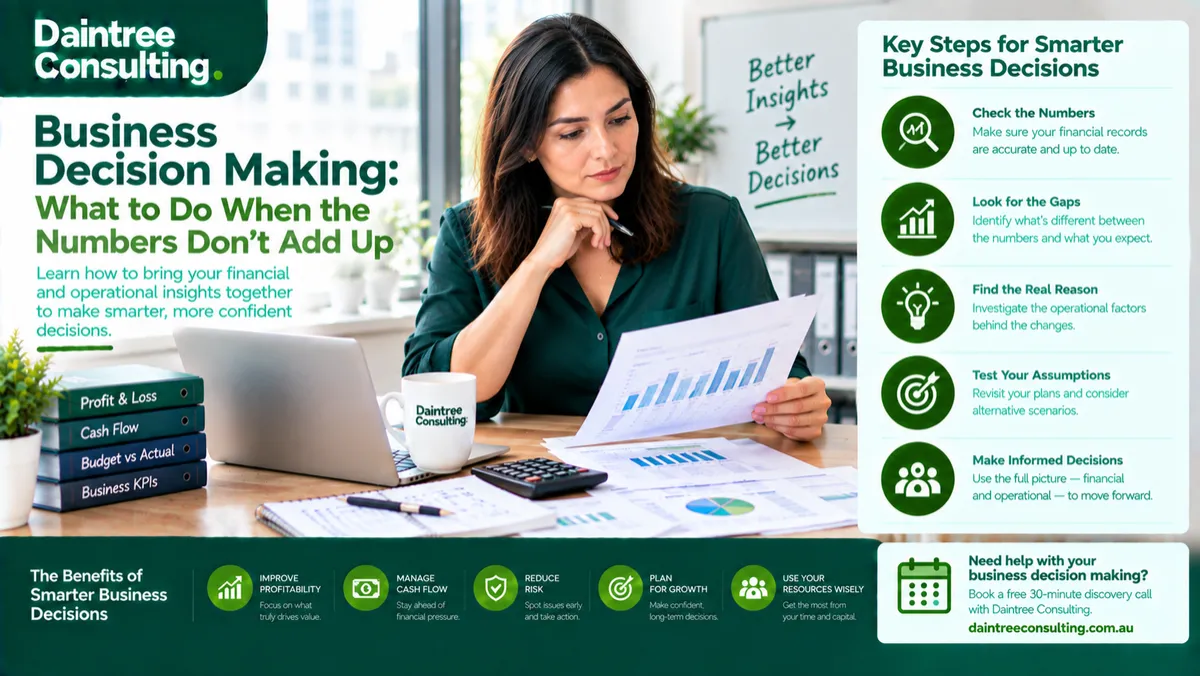
How to Make Better Business Decisions When the Numbers Tell a Different Story
Business owners often make decisions based on what they can see happening around them.
Sales feel strong. Customers seem happy. The team is busy. The pipeline looks healthy.
Want expert help? Daintree Consulting's business advisory services can take this off your plate. Book a free consultation.
Then the financial reports arrive.
Profit is lower than expected. Cash is tighter than it should be. Gross margin has fallen. Debtors are taking longer to pay. Expenses have increased even though revenue has grown.
Suddenly, the story looks different.
This is where business decision making becomes more than simply looking at a profit and loss statement and choosing what to do next.
When operational experience and financial information appear to tell different stories, the answer is usually not to ignore one of them. The better approach is to understand why they differ.
Financial information can reveal something the day-to-day operation does not. At the same time, business owners often have operational knowledge that explains movements in the numbers.
The goal is to bring the two together before making a significant decision.
Quick answer: What should you do when business numbers do not match what you expected?
When the numbers tell a different story, don't immediately assume either the financial report or your business observations are wrong.
Instead:
Check that the underlying accounting records are accurate and complete.
Identify exactly which numbers have changed.
Compare actual results with budget, forecast and previous periods.
Look beyond revenue and examine margins, costs and cash flow.
Separate timing issues from genuine changes in performance.
Investigate the operational reason behind unusual movements.
Test whether the original assumptions are still valid.
Consider different scenarios before committing to a major decision.
Focus on the financial drivers that actually influence the decision.
Document the assumptions and information supporting the decision.
The ATO notes that accurate and complete business records help owners understand income and expenses, prepare tax and BAS information and make informed business decisions.
For company directors, ASIC also emphasises the importance of understanding the company's financial position and considering how decisions may affect business performance, particularly when significant amounts of money or reputation are involved.
Why can the numbers tell a different story?
Financial reports and operational experience measure different things.
Your team might tell you:
"We're busier than ever."
The financial reports might show:
revenue is up but gross margin is down
accounts receivable has increased
operating costs are growing faster than revenue
cash reserves are falling
profit has not increased despite higher sales.
None of these necessarily contradict the team's experience.
The business can genuinely be busier while becoming less profitable or more difficult to fund.
This is one of the most important concepts in effective business decision making:
Activity is not the same as financial performance.
A full order book does not automatically mean strong cash flow.
Higher revenue does not automatically mean higher profit.
A profitable month does not necessarily mean there is enough cash available to fund expansion.
And lower profit does not necessarily mean the underlying business model is failing.
The numbers need to be interpreted in context.
1. Start by checking whether the numbers are reliable
Before making a major decision based on financial information, make sure the information itself is reliable.
This sounds obvious, but it is easy to overlook.
If the bookkeeping is incomplete, reconciliations are outstanding or transactions have been incorrectly classified, the reports may not provide a reliable picture of current performance.
Check:
bank reconciliations
accounts receivable
accounts payable
payroll
GST and tax-related accounts
inventory where applicable
fixed assets
loans and financing
accruals and prepayments
unusual journals
one-off transactions.
The ATO recommends keeping accurate and complete records as transactions occur because good records help businesses understand their financial position and make informed decisions.
If the numbers are questionable, don't build a major decision on top of them.
2. Identify exactly what doesn't make sense
Avoid saying:
"The numbers don't look right."
That is too broad.
Instead, identify the specific disconnect.
For example:
Revenue increased 20%, but profit increased only 3%.
Sales are strong, but cash at bank is falling.
Customer numbers are growing, but gross margin is declining.
The business is busy, but the owner is working longer hours for little additional return.
Expenses have increased significantly without an obvious increase in capacity.
The forecast showed strong cash flow, but actual cash is much lower.
A new service is generating revenue but appears to be producing little contribution to profit.
Once the problem is specific, it becomes easier to investigate.
3. Look beyond revenue
Revenue is one of the easiest financial numbers to focus on.
It is also one of the easiest to misunderstand.
Imagine a business increases annual revenue from $4 million to $5 million.
At first glance, that appears to be strong growth.
But suppose:
gross margin has fallen
wages have increased
supplier costs have risen
customer payment times have increased
overheads have expanded.
The business may now have substantially more activity without a proportionate improvement in profitability or cash flow.
That changes the decision.
Instead of asking:
"How do we generate more sales?"
the more useful question might be:
"Which sales are actually creating an acceptable return?"
That is a very different business decision.
4. Compare profit, cash flow and working capital
One of the most common sources of confusion is the difference between profit and cash.
A business can report a profit while experiencing cash pressure.
This can happen because:
customers have not paid yet
inventory has increased
suppliers are being paid sooner
loan repayments are using cash
capital expenditure has increased
tax or other liabilities are due
working capital requirements have changed.
If management looks only at the profit and loss statement, the cash pressure may come as a surprise.
If management looks only at the bank balance, it may miss the underlying profitability issue.
Good business decision making often requires looking at the relationship between:
Profit → Cash flow → Working capital → Funding requirements
These measures answer different questions.
5. Compare actual results with the original plan
A budget is not useful simply because it exists.
Its value comes from comparing what actually happened with what was expected.
Look at:
actual revenue versus budget
actual gross margin versus budget
actual wages versus budget
actual overheads versus budget
actual operating profit versus budget
actual cash flow versus forecast
actual debtor days versus assumptions
actual capital expenditure versus plan.
Then investigate the material variances.
For example, if revenue is below budget, ask why.
Was the sales pipeline weaker?
Were projects delayed?
Did customers cancel?
Was pricing changed?
Was capacity limited?
Likewise, if expenses are above budget, determine whether the increase was:
temporary
structural
deliberate
unexpected
linked to growth
caused by inefficiency.
The purpose of variance analysis is not to find someone to blame.
It is to understand what changed.
6. Separate timing issues from structural problems
Not every unexpected number requires a major change in strategy.
A business can have a weak month because of timing.
For example:
a large customer invoice was delayed
a project moved into the following month
an annual insurance payment was made
a major supplier invoice arrived earlier than expected
a large sale was recognised in a different reporting period.
That may produce an unusual financial result without representing a permanent change.
But repeated variances are different.
If the same problem appears month after month, it may indicate a structural issue.
This is why reviewing financial information over multiple periods can be more useful than reacting to one isolated month.
7. Ask what is happening operationally behind the number
Financial reports tell you what happened.
The next question is:
Why?
Suppose gross margin has fallen.
Possible explanations include:
supplier prices increased
discounts increased
product mix changed
low-margin products became a larger proportion of sales
labour costs increased
projects took longer than expected
pricing has not kept pace with costs
wastage increased.
The financial report may identify the problem, but operational information often explains it.
This is where business owners, managers, sales teams and finance teams need to work together.
The strongest decisions usually come from combining financial evidence with operational knowledge.
8. Challenge the assumptions behind the numbers
Financial models, budgets and forecasts are built using assumptions.
Those assumptions might include:
sales growth
pricing
customer acquisition
conversion rates
staffing requirements
wages
supplier costs
debtor collection times
interest rates
capital expenditure
inventory requirements.
If actual results differ significantly from the forecast, don't simply change the forecast to make it look better.
Ask whether the underlying assumptions have changed.
For example:
Original assumption: Sales will grow 15%.
Actual experience: Sales are growing 8%.
The important question is not just how to make the forecast show 15%.
It is whether the business now has evidence that 15% growth remains realistic.
ASIC notes that companies should support financial information with appropriate analysis and that forward-looking information should have a reasonable basis in the circumstances where relevant.
For management forecasting, the same principle is useful: assumptions should be explicit, explainable and reviewed when circumstances change.
9. Don't make a major decision based on one metric
A single KPI rarely tells the complete story.
Consider a business considering opening another location.
Revenue growth might support the decision.
But management should also consider:
gross margin
customer retention
staffing capacity
cash reserves
working capital
rent and occupancy costs
debt obligations
expected break-even point
implementation costs
management capacity
downside scenarios.
Similarly, deciding to hire more employees should not be based solely on the fact that the team is busy.
You need to understand whether the additional capacity is financially sustainable and whether the additional revenue or productivity is likely to justify the cost.
The more significant the decision, the broader the financial and operational analysis should be.
10. Use scenarios instead of one forecast
When the future is uncertain, one forecast can create false confidence.
Scenario analysis can provide a better way to think about a decision.
For example, when considering expansion, management could examine:
Base case
The business performs broadly in line with current expectations.
Higher-growth case
Sales grow faster and additional capacity is utilised quickly.
Lower-growth case
Sales growth is slower while the additional costs still need to be paid.
Then ask:
How much cash would each scenario require?
When would the investment break even?
What happens if sales are delayed?
What happens if costs increase?
How much working capital is required?
What assumptions have the greatest impact?
This shifts the conversation from:
"Will this work?"
to:
"What would need to be true for this decision to work, and what happens if those assumptions are wrong?"
That is a more useful approach to business decision making.
11. Investigate the unit economics
A business can look profitable at an overall level while individual products, services, customers or projects perform very differently.
Depending on the business, consider analysing:
revenue per customer
gross profit per customer
margin by product
margin by service
contribution by project
labour hours per job
acquisition cost
customer retention
average transaction value
recurring revenue
delivery costs.
This can uncover situations where growth itself is not the problem.
The problem may be what the business is growing.
For example, a service line may generate strong revenue but require disproportionate labour.
Another may generate less revenue but produce a stronger contribution margin.
That distinction can materially change decisions about pricing, marketing, staffing and resource allocation.
12. Check whether cash flow supports the strategy
Growth can consume cash.
A business may need to spend money on:
additional employees
inventory
equipment
premises
technology
marketing
professional services
deposits
working capital.
This means a decision can make sense strategically while still creating a short-term cash requirement.
Before committing to major growth, consider:
How much cash will the decision require before the expected return arrives?
That question can be more important than the headline profit projection.
Cash flow forecasting can help management understand when cash is expected to come in and go out, and where funding pressure may arise.
13. Consider whether the financial report needs better management reporting
Sometimes the problem isn't that the business lacks data.
It is that the available reports aren't answering the questions management needs to ask.
A standard profit and loss statement might tell you:
revenue
cost of sales
gross profit
expenses
net profit.
But management may actually need to understand:
profitability by service
customer concentration
gross margin trends
debtor days
cash conversion
budget variances
sales pipeline
labour utilisation
working capital
forecast cash position.
Management reporting should be designed around the decisions the business needs to make.
ASIC states that high-quality financial information should be timely and supported by appropriate analysis and documentation, particularly in formal financial reporting contexts.
For private businesses, the same broader principle applies: useful financial information should help management understand what is happening and what requires attention.
14. Don't ignore information that doesn't fit the preferred story
One of the biggest risks in decision making is confirmation bias.
If an owner strongly believes an expansion will work, they may naturally focus on:
strong sales
customer demand
positive feedback
a growing pipeline.
At the same time, they may give less attention to:
declining margins
increasing debtors
rising costs
staff shortages
cash pressure.
The opposite can happen too.
An owner who is worried about a particular investment may focus heavily on the negative information while overlooking evidence that the underlying economics have improved.
A better approach is to deliberately ask:
"What information would change my mind?"
That question can improve the quality of the decision before money or resources are committed.
15. Decide what information matters most
Not every number deserves equal attention.
When making a decision, identify the financial drivers that actually affect the outcome.
For a hiring decision, that might include:
additional salary cost
expected productivity
revenue capacity
gross margin
cash impact.
For a pricing decision:
current price
gross margin
customer demand
competitor positioning
variable costs
expected volume change.
For an expansion decision:
investment required
fixed costs
working capital
expected revenue
break-even point
funding capacity
downside scenario.
This prevents management from becoming overwhelmed by reports that contain plenty of information but little decision value.
16. Create a decision trail
For significant decisions, document the reasoning behind them.
Record:
the decision being considered
the relevant financial information
operational information
key assumptions
risks identified
scenarios considered
expected financial impact
who is responsible
when the decision will be reviewed.
This creates a useful reference point.
If the decision produces a different outcome from what was expected, management can compare the original assumptions with what actually happened.
For companies, ASIC specifically highlights the importance of directors understanding the company's financial position and making enquiries where financial information raises questions.
A practical framework for better business decision making
When the numbers and the business story don't appear to match, use this sequence:
1. Confirm the data
Are the accounting records complete, accurate and reconciled?
2. Identify the variance
What specifically is different from expectations?
3. Find the driver
Which revenue, cost, margin, working capital or operational factor caused the change?
4. Investigate the reason
Is the movement caused by timing, a one-off event or a structural change?
5. Reassess assumptions
Are the assumptions behind the budget or forecast still reasonable?
6. Model scenarios
What happens under a base, upside and downside case?
7. Assess cash impact
How will the decision affect cash and working capital?
8. Decide on the key action
What needs to happen now?
9. Assign responsibility
Who will implement or monitor the decision?
10. Review the result
When will you compare the actual outcome with the original expectation?
This turns financial reporting into a management process rather than a reporting exercise.
When the numbers tell a different story, don't automatically choose one story
The financial numbers and the operational story can both contain useful information.
If sales are strong but cash is weak, investigate working capital.
If revenue is growing but profit is flat, investigate margins and costs.
If the team is busy but profitability is falling, investigate productivity, pricing and service economics.
If the forecast looks strong but actual results continue to miss expectations, revisit the assumptions.
The objective is not to make the numbers agree with what you hoped would happen.
It is to understand what the numbers are telling you.
That is the foundation of better business decision making.
How Daintree Consulting can help
Business decisions become harder when financial information is delayed, difficult to interpret or disconnected from what is happening operationally.
Daintree Consulting helps Australian businesses bring accounting, reporting and commercial decision making closer together.
Depending on your needs, this can include:
management reporting
financial performance analysis
cash flow visibility
budget-to-actual reporting
forecasting
KPI development
working capital analysis
business improvement planning
strategic business advice
outsourced CFO support.
The aim is not simply to produce more reports.
It is to give business owners and leadership teams clearer information to help them understand performance, assess options and plan their next move.
Book a free 30-minute discovery call with Daintree Consulting to discuss your business's financial reporting and decision-making needs.
Frequently Asked Questions
What is business decision making?
Business decision making is the process of evaluating information, alternatives, risks and expected outcomes before choosing a course of action.
Financial information is an important part of the process, but operational, commercial and strategic information can also be relevant.
Why don't financial reports always match what is happening in the business?
Financial reports measure financial transactions and outcomes, while business owners and managers may be observing operational activity such as customer demand, workload, staffing or sales opportunities.
Timing differences, working capital, margins, accounting treatments and changes in costs can also cause the financial results to look different from the operational picture.
Should I trust the numbers or what I see in the business?
Neither should automatically be accepted without investigation.
First check whether the financial information is reliable. Then use operational information to understand the reasons behind the financial results.
The two sources of information can complement each other.
What financial reports are most useful for business decisions?
The answer depends on the decision.
Commonly useful information includes:
profit and loss
balance sheet
cash flow
budget versus actual reporting
accounts receivable
accounts payable
working capital
financial forecasts
relevant KPIs.
The most useful reporting pack is usually the one that answers the questions management actually needs to make decisions.
How often should business owners review financial performance?
The appropriate frequency depends on the size, complexity and circumstances of the business.
Many growing businesses benefit from regular monthly reporting rather than waiting until year-end to understand performance.
The important point is that financial information should be available early enough to support decisions.
Can a profitable business still have cash flow problems?
Yes.
Profit and cash flow are different measures. A business can report accounting profit while cash is tied up in receivables, inventory or other working capital requirements, or while significant cash payments are being made.
What should I do if my forecast keeps missing actual results?
Start by identifying the specific assumptions that are consistently wrong.
Review sales, pricing, costs, staffing, payment timing and other major drivers. Then determine whether the forecast needs to be updated because circumstances have changed or whether the underlying planning process needs improvement.
How can a CFO or business adviser help with decision making?
A CFO or business adviser can help management interpret financial information, identify key drivers, build forecasts and scenarios, assess cash flow and structure information around important decisions.
The exact support required depends on the business and its circumstances.
Important Publishing Note
Financial forecasts, budgets, scenarios and business recommendations depend on assumptions, available information and the specific circumstances of the business. Forecasts are not guarantees of future performance. This article provides general information only and should not be treated as accounting, tax, financial or legal advice. Where a decision has significant financial, legal or regulatory consequences, obtain advice appropriate to the circumstances.
Talk to Daintree about your next business decision
Our ex-Big 4 team gives clear, senior-reviewed advice so you can act with confidence.
Book a free consultation →
Or explore our business advisory services.
