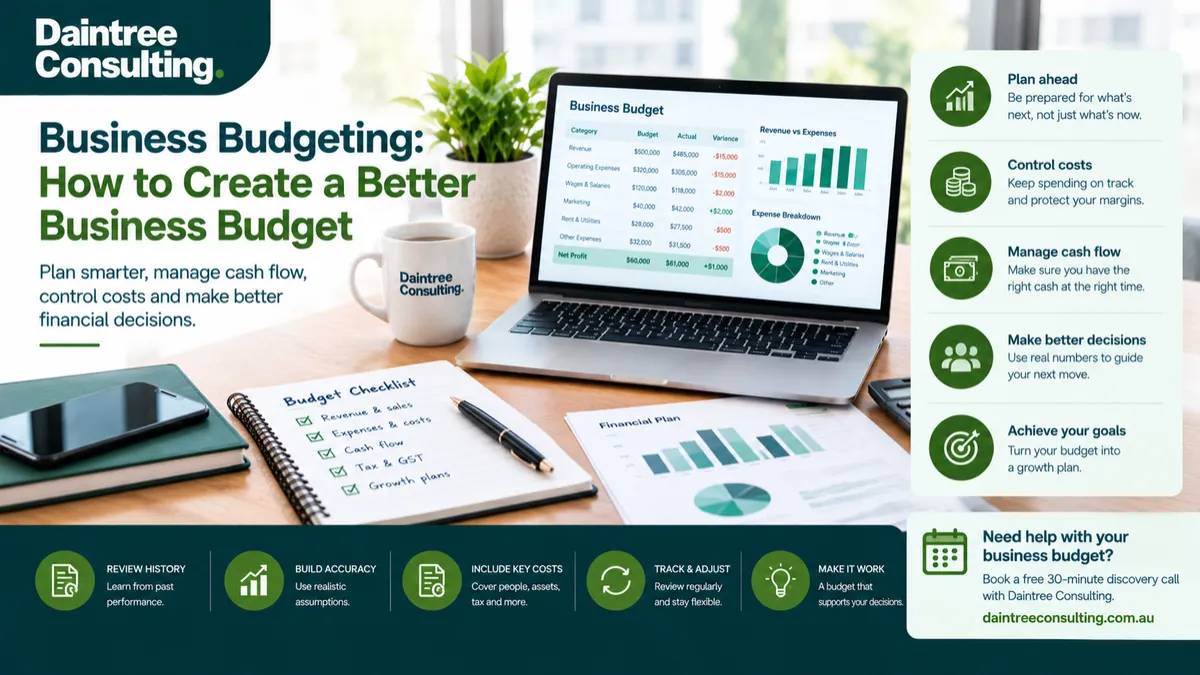
How to Create a Business Budget That Supports Better Financial Decisions
A business budget should do more than predict whether you will make a profit.
A useful budget helps you understand how much money the business needs, where it is going, what you can afford, and what needs attention before a financial problem becomes urgent.
Want expert help? Daintree Consulting's business advisory services can take this off your plate. Book a free consultation.
Yet many business owners create a budget once a year, save it in a spreadsheet and rarely look at it again.
That is not really budgeting. It is forecasting without follow-through.
Effective business budgeting is a practical management process. It connects your expected revenue, costs, cash flow and business priorities so you can make better decisions throughout the year.
Whether you run a small professional services firm, retail business, construction company or growing Australian SME, the principles are similar: start with realistic assumptions, build the numbers around how your business actually operates, and regularly compare the budget with what is happening in reality.
This guide explains how to create a business budget that can become a useful decision-making tool rather than just another spreadsheet.
Quick Answer: How Do You Create a Business Budget?
A practical business budget can be built in these steps:
Review your historical financial results.
Set realistic revenue targets.
Identify your fixed and variable costs.
Budget for wages and other people costs.
Include planned investments and major purchases.
Build a cash-flow forecast alongside the profit budget.
Account for tax, GST and other obligations.
Create realistic best-case and downside scenarios.
Set measurable financial targets.
Compare actual results against the budget regularly.
Investigate significant variances.
Adjust your plans when business conditions change.
The key is not simply creating the budget.
The value comes from using it to make decisions.
What Is Business Budgeting?
Business budgeting is the process of estimating your expected income, expenses, cash position and financial requirements over a future period.
A budget might cover:
The next financial year
The next 12 months
A quarter
A particular project
A new business initiative
A period of expansion
A restructuring or turnaround
A budget normally starts with revenue assumptions and then builds out the costs required to achieve that revenue.
But a strong budget goes further.
It asks questions such as:
How much revenue do we realistically expect?
What does it cost us to generate that revenue?
How much cash will the business need?
When will customers actually pay?
When do major expenses fall due?
Can we afford to hire another employee?
What happens if sales are 10% below target?
What happens if costs increase?
Can we fund a planned investment?
How much working capital do we need?
These questions turn a budget from a financial document into a management tool.
Why Is Business Budgeting Important?
Running a business based only on the bank balance can be dangerous.
You might have cash in the bank today while facing significant expenses next month.
You might also be profitable on paper but have insufficient cash because customers have not paid yet.
A budget provides a forward-looking view.
It can help you:
Plan ahead
Instead of reacting to financial pressure, you can identify upcoming requirements earlier.
Control costs
Budgeting gives you a benchmark against which actual spending can be assessed.
Manage cash flow
A cash-flow budget can highlight periods where additional working capital may be required.
Make hiring decisions
You can model the financial effect of additional employees before committing to the cost.
Evaluate growth
A revenue increase is not automatically beneficial if the additional revenue requires disproportionately higher costs or working capital.
Set priorities
A budget can help leadership decide which investments deserve funding and which can wait.
Step 1: Start With Your Historical Financial Data
Before creating next year's budget, look at what actually happened previously.
Review:
Revenue
Gross profit
Operating expenses
Wages
Rent
Software
Marketing
Professional fees
Finance costs
Other recurring expenses
Cash flow
Debtor balances
Major capital purchases
If your accounting records are reliable, historical data can provide a useful starting point.
For example, if revenue has increased by approximately 8% each year but your proposed budget assumes 30% growth, you should be able to explain what will drive the difference.
Perhaps you are:
Opening a new location
Launching a new service
Increasing prices
Expanding your sales team
Entering a new market
Taking on a major customer
The budget should reflect the business strategy.
It should not simply contain numbers that look attractive.
Step 2: Build a Realistic Revenue Budget
Revenue is usually the starting point for the budget.
But "we want to make $5 million" is not a revenue forecast.
You need to understand what will actually generate the revenue.
Consider:
Number of customers
Average transaction value
Sales volume
Pricing
Conversion rates
Recurring revenue
Customer retention
Seasonal patterns
Sales pipeline
Existing contracts
New products or services
For example, a professional services business might forecast revenue based on:
Number of billable staff × available hours × utilisation × average billing rate
A retail business may use:
Expected transactions × average transaction value
A subscription business might focus on:
Opening customers + new customers − churned customers
The model should match the economics of your business.
Step 3: Separate Fixed and Variable Costs
Once you have a revenue forecast, identify the costs required to generate and support that revenue.
Fixed costs generally remain relatively stable over a period, although they can still change.
Examples include:
Rent
Insurance
Software subscriptions
Certain salaries
Professional fees
Base telecommunications costs
Variable costs may change as activity increases or decreases.
Examples include:
Materials
Freight
Sales commissions
Payment fees
Certain contractor costs
Product costs
Understanding this difference is important when modelling growth.
If revenue increases by 20%, not every expense should automatically increase by 20%.
Some costs may stay relatively stable.
Others may rise faster than revenue.
That distinction affects profitability.
Step 4: Budget for People Costs
For many businesses, employees are one of the largest expenses.
Your budget should consider more than base wages.
Depending on your circumstances, people costs may include:
Salaries
Superannuation
Payroll-related costs
Recruitment
Training
Bonuses or commissions
Leave-related costs
Contractors
Benefits
Additional management costs
If you are planning to hire someone halfway through the year, model the actual timing rather than including a full year's salary.
This gives you a more realistic view of the financial impact.
Step 5: Include Planned Capital Expenditure
Businesses often forget major purchases when building an operating budget.
Think about whether you expect to purchase:
Vehicles
Computers
Machinery
Equipment
Furniture
Fit-outs
Technology
Property
Other significant assets
These purchases can have a substantial impact on cash flow even if the accounting treatment differs from ordinary operating expenses.
A good budget should therefore consider both profitability and cash requirements.
Step 6: Build a Cash-Flow Budget
This is one of the most important parts of business budgeting.
Profit and cash are not the same thing.
Imagine your business signs a $100,000 contract in July.
You may recognise revenue under the applicable accounting approach, but if the customer does not pay until September, the cash does not arrive in July.
Meanwhile, you may still need to pay:
Employees
Suppliers
Rent
Tax obligations
Loan repayments
Other operating expenses
A cash-flow budget helps you understand the timing.
It should consider:
Cash coming in
Customer receipts
Deposits
Financing
Other receipts
Cash going out
Supplier payments
Wages
Superannuation
Rent
Tax
Loan repayments
Equipment purchases
Other commitments
This can reveal periods where the business may need additional working capital even when the underlying business is profitable.
Step 7: Account for Tax and Other Obligations
Your budget should not treat tax and statutory obligations as an afterthought.
Depending on the business, consider:
GST
PAYG withholding
Superannuation
Income tax
Payroll-related obligations
Other applicable taxes and charges
The timing of these payments can affect your cash position.
This is another reason why a cash-flow forecast should sit alongside the profit budget.
A business that appears financially comfortable on a profit-and-loss forecast can still experience cash pressure if large obligations fall due at the wrong time.
Step 8: Create Different Budget Scenarios
One of the biggest weaknesses in business budgets is relying on one set of assumptions.
The future is uncertain.
Instead, consider creating at least three scenarios:
Base case
What you reasonably expect to happen.
Upside case
What happens if sales outperform expectations or costs are lower than anticipated.
Downside case
What happens if revenue falls, customers pay more slowly or costs increase.
For example, you could model:
Revenue 10% below target
Revenue 10% above target
Higher wage costs
Higher supplier costs
Delayed customer payments
A major customer leaving
A planned hire being delayed
Scenario planning can help management identify decisions that remain sensible across different conditions.
Step 9: Set Financial Targets
A budget should translate into measurable targets.
Depending on the business, these might include:
Revenue
Gross margin
Net profit
Operating expenses
Debtor days
Cash balance
Working capital
Labour percentage
Customer acquisition cost
Average transaction value
Don't create dozens of KPIs just because your accounting software can produce them.
Focus on the numbers that influence decisions.
For example, a growing business might need to watch revenue, gross margin, cash balance and debtor collections closely.
Another business may need to focus heavily on labour utilisation and project margins.
The right measures depend on the business model.
Step 10: Compare Budget vs Actual Results
This is where business budgeting becomes genuinely useful.
Once the month ends, compare:
What did we expect to happen?
against
What actually happened?
This is often called budget vs actual reporting.
For example:
Your budget forecasts:
Revenue: $250,000
Operating expenses: $150,000
Operating profit: $100,000
Actual results show:
Revenue: $225,000
Operating expenses: $165,000
Operating profit: $60,000
The important question isn't simply:
"Why is profit lower?"
You need to investigate the drivers.
Perhaps:
Revenue was lower than expected.
One major customer delayed an order.
Contractor costs increased.
Marketing spending was higher.
A one-off expense occurred.
Understanding the variance is more useful than simply observing it.
What Is a Budget Variance?
A variance is the difference between the budget and the actual result.
Some variances are positive.
Others are negative.
But not every variance is a problem.
For example, revenue being $20,000 above budget may look positive.
However, if the additional revenue required $30,000 of additional costs, the result may not be as attractive as expected.
Likewise, spending $10,000 less than budget might appear favourable, but if that spending was supposed to generate new sales, the saving may not actually be beneficial.
The key question is:
What caused the variance, and what does it mean for the next decision?
Don't Treat Your Budget as a Fixed Document
A budget should provide direction, not become a financial straightjacket.
Business conditions change.
You may:
Win a major contract.
Lose an important customer.
Increase prices.
Add staff.
Enter a new market.
Experience unexpected cost increases.
Change your product mix.
Acquire another business.
Delay a major investment.
When something significant changes, revisit the assumptions.
This doesn't necessarily mean constantly rewriting the original budget.
Instead, you can maintain the original budget as a benchmark while using updated forecasts to understand where the business is heading.
That distinction can be valuable:
Budget = What we originally planned
Forecast = What we now expect to happen
Both can be useful.
Common Business Budgeting Mistakes
1. Being overly optimistic about revenue
Growth assumptions should have a commercial basis.
2. Forgetting cash flow
Profit does not automatically mean cash is available.
3. Using last year's numbers without questioning them
Historical results are useful, but the future may look different.
4. Ignoring timing
Annual numbers can hide monthly cash-flow problems.
5. Not budgeting for people costs properly
Hiring decisions can have a much larger financial impact than base salary alone.
6. Treating all expenses as variable
Some costs will remain relatively stable as revenue changes.
7. Never reviewing the budget
A budget that is never compared with actual performance provides limited management value.
8. Creating an unnecessarily complicated spreadsheet
If nobody understands the model, it will be difficult to maintain.
9. Focusing only on profit
Cash, working capital and operational metrics also matter.
10. Using the budget to justify a decision rather than test it
A budget should challenge assumptions, not simply make a preferred decision look financially attractive.
How Often Should You Review Your Business Budget?
For most growing businesses, an annual budget should not be the end of the process.
A practical rhythm might include:
Monthly
Review:
Revenue
Key expenses
Cash
Budget vs actual
Major variances
Quarterly
Review:
Forecast
Sales assumptions
Cost trends
Working capital
Cash requirements
Business priorities
When something significant changes
Update your assumptions when a major event changes the financial outlook.
The exact review frequency depends on the size, complexity and volatility of the business.
What Makes a Business Budget Actually Useful?
A useful budget has five characteristics.
1. It is realistic
The assumptions can be explained and supported.
2. It is connected to operations
The numbers reflect actual sales activity, staffing, pricing and costs.
3. It considers cash
The business understands not just profitability, but when money will move.
4. It is reviewed regularly
Actual performance is compared with expectations.
5. It drives decisions
The information changes what management does.
That last point is the most important.
If the budget does not influence hiring, pricing, spending, investment, financing or growth decisions, it may simply be a reporting exercise.
When Should You Get Help With Business Budgeting?
Business owners often start budgeting themselves using spreadsheets.
That can work well while the business is relatively simple.
Professional support can become useful when:
Revenue is growing quickly.
The business has multiple revenue streams.
Margins are becoming harder to understand.
Cash flow is unpredictable.
You are considering significant hiring.
You are planning expansion.
The business has substantial debt.
You are seeking external funding.
Management needs regular financial reporting.
Budget vs actual results are not being reviewed consistently.
You want scenario modelling before making a major decision.
The objective is not to create a complicated financial model for its own sake.
It is to give leadership a clearer view of the financial consequences of different choices.
Daintree Consulting's business advisory and outsourced CFO services can support areas including financial analysis, cash-flow and working-capital review, KPI reporting, forecasting and scenario planning. Daintree Consulting Business Advisory Daintree Consulting Outsourced CFO Services
Business Budgeting Checklist
Before finalising your next budget, ask:
Have we reviewed reliable historical financial data?
Is our revenue forecast based on realistic assumptions?
Have we separated fixed and variable costs?
Have we included wages and other people costs?
Have we included planned asset purchases?
Have we considered GST and other relevant obligations?
Have we built a cash-flow forecast?
Have we considered customer payment timing?
Have we modelled downside scenarios?
Have we set meaningful financial targets?
Will we compare actual results with the budget?
Do we have a process for investigating significant variances?
Will we update our forecast when circumstances change?
If you cannot answer several of these questions, your current budget may not be giving you the visibility you need.
Frequently Asked Questions About Business Budgeting
What is business budgeting?
Business budgeting is the process of planning expected revenue, expenses, cash flow and financial requirements over a future period. It helps businesses plan spending, manage cash and make informed financial decisions.
How far ahead should a business budget?
Many businesses create an annual budget and then maintain a rolling forecast for the months ahead. The appropriate period depends on the business's size, complexity and planning requirements.
What should a small business budget include?
A small business budget should generally consider revenue, operating expenses, wages, taxes and other obligations, capital expenditure, cash flow and expected working-capital requirements.
What is the difference between a budget and a forecast?
A budget generally represents the financial plan established for a future period. A forecast is an updated estimate of what the business now expects to happen based on actual performance and changing assumptions.
Why is cash flow important in business budgeting?
A business can be profitable while experiencing cash shortages because revenue and expenses do not necessarily occur at the same time as cash receipts and payments. A cash-flow budget helps identify the timing of expected cash movements.
How often should I review my business budget?
Many businesses review financial performance monthly and revisit their forecasts quarterly or when significant business conditions change. The appropriate frequency depends on the business.
Can an accountant help create a business budget?
Yes. An accountant, business adviser or outsourced CFO can help develop budgets, review assumptions, build cash-flow forecasts, analyse variances and connect financial information with business decisions.
Turn Your Budget Into a Better Decision-Making Tool
A good budget should answer more than "How much money will we make?"
It should help you answer:
Can we afford this?
What happens if sales fall?
When will we need more cash?
Can we hire another person?
Is this investment likely to be sustainable?
Are our costs moving in the right direction?
Are we actually performing as planned?
That is the real purpose of business budgeting.
When your budget is connected to reliable accounting records, cash-flow reporting and regular management review, it becomes much more than an annual spreadsheet. It becomes a framework for making better financial decisions.
If you want more clarity around your business's financial position, forecasting, cash flow or future plans, Daintree Consulting can help connect the numbers with the decisions that matter.
Book a free 30-minute discovery call with Daintree Consulting to discuss your business's financial reporting, budgeting and advisory needs.
Talk to Daintree about your next business decision
Our ex-Big 4 team gives clear, senior-reviewed advice so you can act with confidence.
Book a free consultation →
Or explore our business advisory services.
