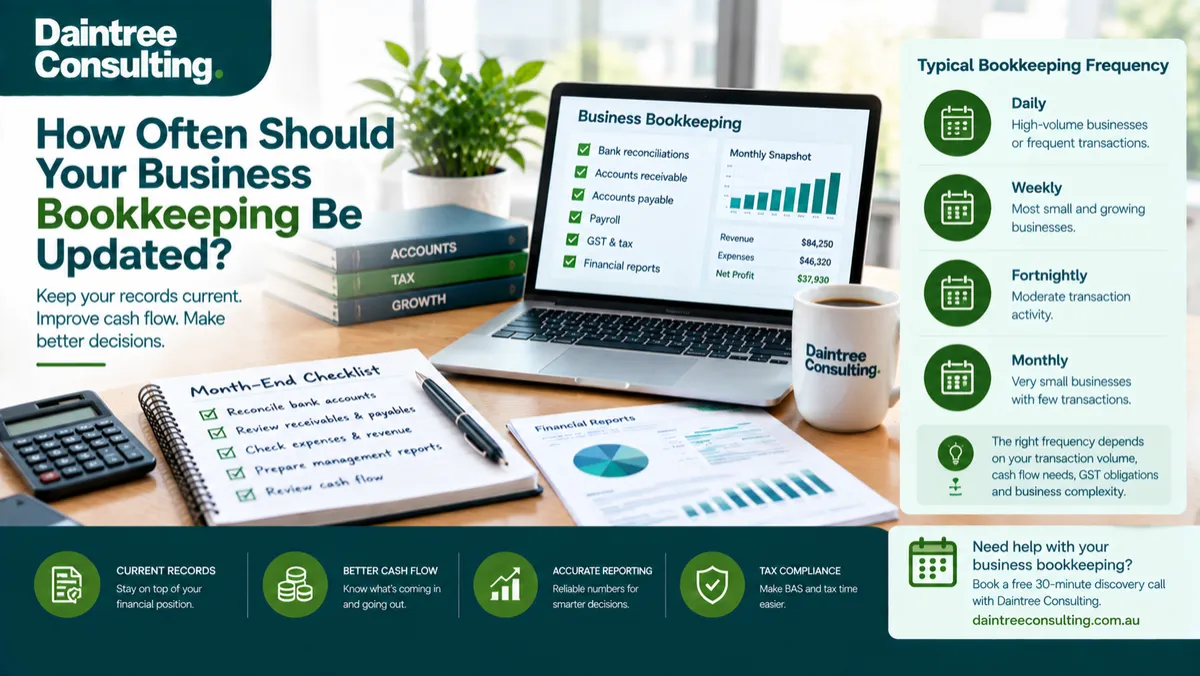
How Often Should Your Business Bookkeeping Be Updated?
How often should your business bookkeeping be updated?
For some small businesses, bookkeeping happens once a month. For others, transactions are recorded every few days or even daily.
Want expert help? Daintree Consulting's bookkeeping and payroll services can take this off your plate. Book a free consultation.
There is no single schedule that works for every Australian business. The right frequency depends on your transaction volume, payroll, GST obligations, cash-flow needs, business size and how quickly you need reliable financial information.
But one principle is worth keeping in mind:
The more often your financial information changes, the more often your bookkeeping should be updated.
If your bookkeeping is several weeks behind, you may not have a clear picture of how much cash you have, what customers owe you, which bills are coming due or whether the business is actually making money.
For a growing business, keeping the books current isn't just an administrative task. It creates the foundation for accurate reporting, tax compliance and better decisions.
Quick Answer: How Often Should Bookkeeping Be Updated?
For most Australian businesses, business bookkeeping should be updated at least weekly, with higher-volume or more complex businesses often benefiting from daily or near-daily processing.
A practical approach is:
Daily: high-volume businesses with frequent transactions
Weekly: many small and growing businesses
Fortnightly: businesses with moderate transaction activity
Monthly: very small businesses with relatively few transactions
Monthly bookkeeping can be sufficient in some circumstances, but it may not provide enough visibility for a business that needs to monitor cash flow, payroll, receivables or expenses closely.
The key question isn't simply "How often can we update the books?"
It is:
"How often does the business need reliable financial information to operate effectively?"
Why Does Business Bookkeeping Need to Be Updated Regularly?
Bookkeeping records what is happening financially inside your business.
Every sale, supplier bill, payment, receipt, expense, payroll transaction and bank movement can affect your financial position.
If those transactions aren't recorded promptly, your accounting records can fall behind reality.
For example, imagine your business has:
$80,000 in the bank
$25,000 in unpaid customer invoices
$18,000 in supplier bills
$12,000 in upcoming payroll and other commitments
Looking only at the bank balance might make the business appear comfortable.
Looking at the complete financial picture tells a different story.
Regular bookkeeping helps bring those pieces together.
It gives you a better understanding of:
Cash position
Revenue
Expenses
Accounts receivable
Accounts payable
Profitability
GST-related transactions
Payroll-related transactions
Outstanding commitments
Without current records, business owners can end up making decisions based on incomplete information.
How Often Should Small Business Bookkeeping Be Updated?
For many small businesses, weekly bookkeeping is a good practical starting point.
Weekly processing provides a balance between keeping records current and avoiding unnecessary administrative work every day.
It can allow the business to regularly:
Reconcile bank transactions
Record sales
Enter supplier bills
Match payments and receipts
Review outstanding invoices
Track expenses
Check cash flow
Identify unusual transactions
It also means that problems are more likely to be identified while the relevant transaction is still fresh.
For example, if a bank transaction cannot be identified, it is generally easier to investigate it a few days after it occurred than several months later.
When Should Bookkeeping Be Done Daily?
Daily bookkeeping isn't necessary for every business.
However, it can make sense when the business has a high volume of transactions or needs very current financial information.
Daily or near-daily bookkeeping may be useful for businesses such as:
Retail businesses
Hospitality businesses
E-commerce businesses
Businesses with high transaction volumes
Businesses with multiple payment platforms
Businesses with significant daily cash movements
Fast-growing businesses
The benefit isn't simply that the records are updated every day.
It is that the business can identify changes quickly.
If sales suddenly fall, expenses increase or cash movements don't look right, management can investigate sooner rather than discovering the issue weeks later.
When Is Weekly Bookkeeping Enough?
Weekly bookkeeping can work well when a business has:
A moderate number of transactions
Straightforward operations
Regular sales
A manageable number of supplier bills
A relatively simple payroll structure
An accounting system such as Xero or MYOB
No immediate need for daily financial reporting
The important thing is consistency.
A business is generally better off following a reliable weekly process than planning to update its books daily and repeatedly falling behind.
A consistent process creates better financial visibility over time.
Can Bookkeeping Be Updated Monthly?
Yes, monthly bookkeeping may be appropriate for some very small or low-transaction businesses.
For example, a business with relatively few transactions may not need every transaction processed every day.
However, there are risks in leaving bookkeeping until the end of the month.
By the time the books are updated:
Some transactions may be difficult to remember
Receivables may already be significantly overdue
Supplier bills may have accumulated
Errors can be harder to trace
Cash-flow information may be outdated
Management may have been making decisions without current figures
Monthly bookkeeping can therefore be appropriate in some circumstances, but it shouldn't automatically be considered the ideal frequency for every business.
7 Signs Your Bookkeeping Is Being Updated Too Infrequently
Sometimes the business itself tells you that the current bookkeeping schedule isn't working.
1. You Don't Know Your Current Cash Position
If your accounting records are weeks behind, your reported cash position may not tell you what is happening today.
This can make cash-flow management unnecessarily difficult.
2. You Regularly Find Unpaid Bills You Didn't Know About
Supplier invoices can easily accumulate when accounts payable isn't kept current.
That can create unexpected cash commitments.
A business might think it has spare cash available for a purchase or investment, only to discover that a significant amount is already committed to suppliers.
3. Customer Invoices Are Going Overdue
Bookkeeping and accounts receivable management are closely connected.
If invoices aren't recorded and reviewed regularly, overdue debts can be missed.
That can affect cash flow even when sales appear strong.
4. You Can't Tell Whether You're Making Money
Revenue isn't the same as profit.
To understand profitability, you need reasonably current information about both income and expenses.
If your records are significantly behind, your profit and loss report may not provide a useful picture of current performance.
5. BAS Preparation Becomes a Last-Minute Exercise
When bookkeeping isn't kept current, BAS preparation can become a scramble to reconstruct transactions and resolve discrepancies.
A more consistent bookkeeping process can make the information required for compliance easier to review.
The exact BAS obligations and reporting frequency depend on the business's circumstances and registrations.
6. Your Accountant Is Always Cleaning Up Old Transactions
If your accountant regularly has to spend significant time fixing months of unreconciled or incorrectly coded transactions, the bookkeeping process may need to be reviewed.
Accounting support is generally more valuable when the underlying records are organised and current.
7. You Make Business Decisions Without Looking at the Numbers
This may be the biggest warning sign.
If you regularly decide whether to hire someone, purchase equipment, increase spending or invest in growth without knowing your current financial position, your bookkeeping may not be supporting the business properly.
What Should Be Updated During Bookkeeping?
Keeping bookkeeping current isn't just about entering sales.
A useful bookkeeping process can include:
Bank transactions
Bank accounts should be reconciled regularly so the accounting records agree with the actual transactions.
Credit cards
Business credit-card transactions should also be recorded and reconciled.
Sales
Customer invoices, receipts and other sales transactions should be recorded accurately.
Accounts receivable
Outstanding customer invoices should be monitored so management knows what is owed and how long debts have been outstanding.
Accounts payable
Supplier invoices should be recorded so the business knows what it owes and when payments are due.
Expenses
Business expenses should be correctly recorded and supported by appropriate documentation.
Payroll
Payroll transactions and related records should be kept current.
Superannuation
Relevant payroll and superannuation records should be properly maintained.
GST and other tax-related transactions
Relevant tax accounts should be kept up to date so information is available when compliance work is required.
Fixed assets
Significant asset purchases and disposals should be recorded appropriately.
The exact bookkeeping requirements depend on the structure and activities of the business.
Bookkeeping Frequency Should Match Your Business
There is no reason a business with 50 transactions a month needs exactly the same bookkeeping schedule as a business processing 5,000 transactions.
Your bookkeeping frequency should reflect the business.
Consider these factors.
Transaction volume
More transactions generally mean more frequent bookkeeping is appropriate.
Payroll frequency
If you have regular payroll processing, keeping payroll-related records current becomes particularly important.
Cash-flow sensitivity
If cash flow is tight or changes quickly, more current financial information can be valuable.
Number of bank accounts
Businesses with multiple accounts may require more frequent reconciliation.
Number of entities
Businesses operating through multiple entities generally have more accounting information to manage.
Inventory
Inventory-based businesses may need more frequent financial and stock-related monitoring.
GST and reporting obligations
The business's tax registrations and reporting requirements can influence how often financial information needs to be reviewed.
Management reporting
If management wants monthly financial reports, bookkeeping needs to be sufficiently current to support those reports.
Bookkeeping vs Accounting: Why Both Matter
Bookkeeping and accounting are related, but they aren't identical.
Bookkeeping focuses primarily on recording and maintaining financial transactions.
Accounting takes that information further through reconciliation, financial reporting, analysis and interpretation.
For example:
Bookkeeping:
A customer pays a $10,000 invoice.
Accounting:
The transaction is reconciled, correctly classified and incorporated into the financial reporting.
Management reporting:
The business reviews how the $10,000 sale affects revenue, margin, cash flow and performance against budget.
This is why accurate bookkeeping is the foundation of useful accounting.
If the underlying transactions are incomplete or incorrect, the reports built on top of them can also be unreliable.
How Often Should Bank Accounts Be Reconciled?
Bank reconciliations should generally be performed regularly rather than left until the end of the financial year.
For many businesses, weekly reconciliation is practical.
Businesses with high transaction volumes may benefit from more frequent reconciliation.
A regular bank reconciliation can help identify:
Missing transactions
Duplicate transactions
Incorrect entries
Bank fees
Unexplained differences
Timing issues
Incorrect coding
This makes reconciliation an important part of maintaining reliable business bookkeeping.
How Often Should You Review Your Accounts Receivable?
Ideally, accounts receivable should be monitored regularly rather than only when cash becomes tight.
A business should know:
Who owes money
How much they owe
When invoices were due
Which customers are overdue
Whether there are disputed invoices
What cash is expected to come in
For businesses that rely heavily on customer payments, a weekly review can provide useful visibility.
The more dependent your cash flow is on collecting outstanding invoices, the more important regular monitoring becomes.
How Often Should You Review Accounts Payable?
Supplier bills should also be kept current.
Regular accounts payable review helps the business understand:
What bills are outstanding
Which payments are due
What commitments are coming up
Whether invoices have been duplicated
Whether expenses have been correctly recorded
This supports better cash-flow planning.
It also reduces the risk of being surprised by accumulated supplier obligations.
How Bookkeeping Frequency Affects Cash Flow
One of the biggest benefits of current bookkeeping is better cash-flow visibility.
Consider two businesses.
Business A
Bookkeeping is updated once every six weeks.
The owner sees a healthy bank balance but has limited visibility over unpaid invoices, supplier commitments and upcoming expenses.
Business B
Bookkeeping is updated weekly.
The owner can see:
Current bank balances
Customer debts
Supplier obligations
Recent expenses
Payroll commitments
Expected cash movements
Neither business is automatically more profitable.
But Business B has more current information to support cash-flow decisions.
That difference can matter significantly when cash is tight or the business is growing quickly.
What Happens When Bookkeeping Falls Behind?
Falling behind by a few days may not create a major problem.
But when a business consistently falls weeks or months behind, the consequences can compound.
You may experience:
Unreconciled accounts
Inaccurate management reports
Missed invoices
Delayed collections
Unclear cash flow
Difficult BAS preparation
More year-end accounting work
Greater risk of errors
Poorer business decisions
The longer the backlog becomes, the more effort it can take to restore accurate records.
This is why prevention is generally easier than a major bookkeeping clean-up.
How to Create a Practical Bookkeeping Schedule
A good bookkeeping process doesn't need to be complicated.
Start by deciding what needs to happen and who owns each task.
Daily
For higher-volume businesses:
Record sales
Process receipts
Monitor bank activity
Record important transactions
Weekly
For many small and growing businesses:
Reconcile bank accounts
Reconcile credit cards
Record outstanding bills
Review customer invoices
Process expenses
Check payroll-related transactions
Review cash position
Monthly
At month end:
Complete key reconciliations
Review balance-sheet accounts
Review income and expenses
Check unusual transactions
Prepare management accounts
Review budget vs actual results
Review cash-flow performance
This creates a simple rhythm:
Record → Reconcile → Review → Report → Act
The exact schedule should be adjusted to suit the business.
Should You Outsource Your Bookkeeping?
Outsourcing can make sense when the business owner or internal team is spending too much time maintaining the books.
It can also be useful when:
Bookkeeping consistently falls behind
The business is growing
Transaction volume has increased
Payroll has become more complicated
Management needs better financial visibility
The existing bookkeeper is overloaded
There is no clear owner of the process
Year-end clean-up takes too much time
Outsourcing doesn't necessarily mean handing over everything.
A business may outsource:
Bookkeeping only
Payroll only
Month-end bookkeeping
Reconciliations
Accounts payable and receivable
A broader connected finance function
The right arrangement depends on what your business already has internally.
How Daintree Consulting Can Help
Keeping business bookkeeping current is much easier when there is a clear process, defined responsibilities and regular review.
Daintree Consulting provides bookkeeping and payroll support for Australian businesses that need reliable financial records and clearer ownership of recurring finance tasks.
Support can include:
Bank and credit-card reconciliations
Accounts payable
Accounts receivable
Payroll processing and records
Superannuation processing support
Month-end bookkeeping close
BAS-ready records
Coordination with your accountant
Working with your existing accounting software
Transitioning from an internal bookkeeper
Daintree can provide bookkeeping support as a standalone service or as part of a broader connected finance function.
That means you don't necessarily need to replace your existing team. The goal can simply be to take pressure off your internal staff and make the financial process more reliable.
If your bookkeeping is regularly falling behind, your reports aren't ready when you need them or you're spending too much time chasing financial records, it may be worth reviewing the process.
Learn more about Daintree Consulting's Bookkeeping & Payroll Services and see how the service can fit alongside your existing finance team.
Frequently Asked Questions
How often should business bookkeeping be updated?
For many Australian small and growing businesses, weekly bookkeeping is a practical starting point. Higher-volume businesses may benefit from daily processing, while very small businesses with few transactions may be able to update their books monthly.
Is weekly bookkeeping enough for a small business?
Often, yes. Weekly bookkeeping can provide a good balance between keeping records current and managing administrative workload, provided the business's transaction volume and reporting needs are relatively straightforward.
Can I do bookkeeping once a month?
Yes, monthly bookkeeping may work for some low-volume businesses. However, leaving records for several weeks can reduce cash-flow visibility and make it harder to identify errors or overdue invoices promptly.
Should bank accounts be reconciled every week?
For many businesses, weekly reconciliation is a practical approach. Higher-volume businesses may benefit from more frequent reconciliation.
How often should I review accounts receivable?
Accounts receivable should generally be reviewed regularly. Weekly monitoring can be useful for businesses that depend heavily on customer payments and need close control over cash flow.
Does bookkeeping frequency affect BAS preparation?
It can. When bookkeeping is current and reconciled, the information needed for BAS preparation is generally easier to review. The exact BAS reporting obligations depend on the business's circumstances.
What happens if bookkeeping falls behind?
A backlog can lead to outdated financial reports, unclear cash flow, unreconciled accounts, missed invoices and more work during tax or year-end accounting.
Should I outsource my bookkeeping?
Outsourcing may make sense if bookkeeping is consistently falling behind, transaction volumes are increasing or your internal team doesn't have enough capacity to maintain reliable records.
Final Takeaway
There is no universal bookkeeping schedule for every Australian business.
But for many businesses, weekly business bookkeeping is a sensible starting point.
The right frequency depends on how quickly transactions occur, how important current cash-flow information is and how much financial reporting management needs.
The goal is not to update the books as often as possible.
The goal is to keep them accurate, current and useful.
When bookkeeping is consistently maintained, your business has a stronger foundation for:
Cash-flow management
Financial reporting
BAS preparation
Payroll
Tax work
Budgeting
Business planning
Better financial decisions
If your bookkeeping is always several weeks behind, the problem may not simply be that you need to "catch up". Your business may need a more sustainable process.
Daintree Consulting can help Australian businesses maintain reliable bookkeeping, payroll and month-end processes without requiring everything to be managed internally.
Book a free discovery call to discuss your bookkeeping requirements and find a structure that works for your business.
Talk to Daintree about your bookkeeping and payroll
Our ex-Big 4 team gives clear, senior-reviewed advice so you can act with confidence.
Book a free consultation →
Or explore our bookkeeping and payroll services.
