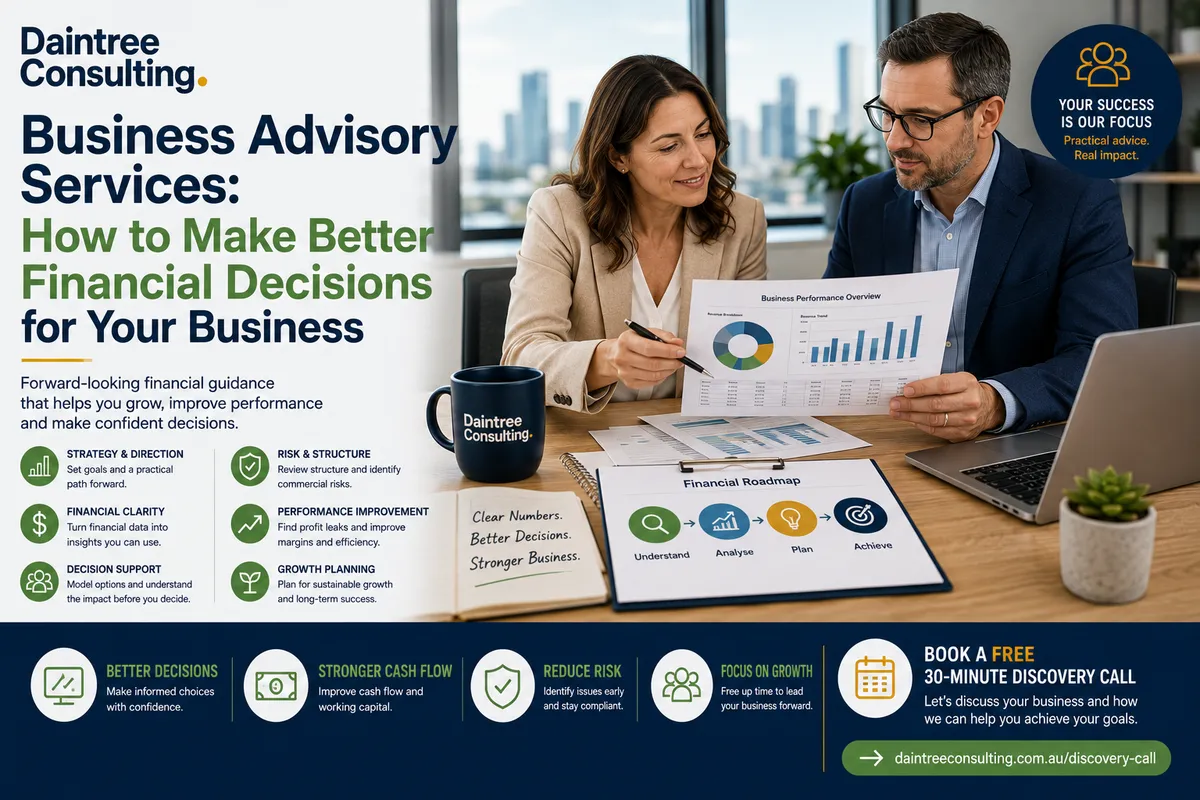
Business Advisory Services: How to Make Better Financial Decisions for Your Business
Making the right business decision is rarely just about looking at last month’s profit and loss statement.
When you are deciding whether to hire, expand, increase prices, invest in equipment, improve margins or manage a cash-flow squeeze, you need to understand what the numbers mean — and what they could mean for the future.
Want expert help? Daintree Consulting's business advisory services can take this off your plate. Book a free consultation.
That is where business advisory services can add value.
Business advisory is about turning financial information into practical guidance for the decisions ahead. Instead of simply reporting what happened, an advisor helps you understand your options, evaluate trade-offs, identify risks and establish practical next steps.
For Australian business owners, this can mean greater financial clarity, stronger performance and more confidence when making important decisions.
Daintree Consulting describes its approach as commercially grounded advice for owners and leadership teams navigating growth, performance pressure, restructuring or important decisions.
Quick Answer: What Are Business Advisory Services?
Business advisory services help business owners and leadership teams make better commercial and financial decisions.
Depending on the business and the engagement, this can include:
Business performance and profitability analysis
Strategic planning and priority setting
Cash-flow and working-capital reviews
KPI and management dashboard design
Scenario planning and decision modelling
Growth and investment planning
Business structure and risk discussions
Succession and transition planning
Ongoing performance monitoring and accountability
The important distinction is that business advisory is forward-looking.
Accounting helps establish reliable financial information. Business advisory uses that information to help you decide what to do next.
Why Financial Information Alone Is Not Enough
Most business owners have access to financial information.
The problem is often knowing what to do with it.
You may have a monthly profit and loss statement showing that revenue increased. But does that mean the business is actually more profitable?
Perhaps revenue is up 20%, but wages have increased by 30%.
Or sales have grown, but customers are taking longer to pay.
Or the business is profitable on paper but consistently short of cash.
These situations demonstrate why financial reporting and financial decision-making are not always the same thing.
A business advisor helps connect the numbers to the commercial reality of the business.
The objective is to move from:
What happened?
to:
Why did it happen?
and ultimately:
What should we do next?
1. Business Advisory Helps You Understand Business Performance
One of the first areas an advisor can help with is understanding how the business is actually performing.
Revenue is important, but revenue alone does not tell you whether the business is healthy.
A useful performance review may examine:
Revenue growth
Gross profit margins
Net profit margins
Operating expenses
Customer or product profitability
Working capital
Cash conversion
Debt levels
Key operational costs
Performance against budget
This creates a more complete picture of the business.
For example, two businesses could generate the same revenue while producing very different levels of profit.
One may have strong margins, efficient operations and healthy cash flow.
The other may have high overheads, slow-paying customers and significant working-capital pressure.
Business advisory helps identify these differences so owners can focus on the issues that actually matter.
2. Make Better Decisions About Growth
Growth sounds positive, but not all growth is financially sustainable.
Taking on more customers may require additional staff.
Opening another location may require significant capital.
Launching a new product may increase inventory requirements.
Winning a large contract may create working-capital pressure before the customer pays.
Before making a major growth decision, it can be useful to understand the financial consequences.
Business advisory services can help model different scenarios and answer questions such as:
Can the business afford the additional investment?
How much additional revenue is required to break even?
What happens to cash flow if costs increase?
How many employees will be required?
What happens if revenue grows more slowly than expected?
What level of working capital will be required?
When should the investment begin generating a return?
Daintree's business advisory service specifically includes strategic planning, performance analysis, cash-flow review and growth planning support.
3. Improve Cash Flow and Working Capital
A profitable business can still experience cash-flow problems.
This is one of the most important financial realities for growing businesses.
You might issue invoices today but not receive payment for 30, 60 or 90 days.
At the same time, wages, suppliers, tax obligations and other expenses still need to be paid.
Business advisory can help you understand the relationship between profitability and cash flow.
An advisor may review:
Debtor payment times
Supplier payment terms
Inventory levels
Tax obligations
Loan repayments
Payroll commitments
Working-capital requirements
Expected cash inflows and outflows
The objective is not simply to identify a cash shortage after it happens.
It is to improve visibility so you can identify potential pressure before it becomes a problem.
Daintree lists cash-flow and working-capital reviews as part of its business advisory service scope.
4. Use KPIs That Actually Help You Manage the Business
Many businesses track numbers without knowing whether those numbers are useful.
Revenue may be increasing, but perhaps customer acquisition costs are also increasing.
Profit may be growing, but perhaps one customer represents an excessive percentage of total revenue.
Employee numbers may be increasing, but productivity may not be keeping pace.
The right KPIs depend on the business.
Depending on the industry, useful measures may include:
Revenue growth
Gross margin
Net profit margin
Average transaction value
Customer acquisition cost
Customer retention
Debtor days
Inventory turnover
Labour utilisation
Revenue per employee
Cash conversion
Working-capital requirements
The goal is not to create dozens of reports.
It is to identify the small number of measures that help management understand whether the business is moving in the right direction.
Daintree's current business advisory service includes KPI and management dashboard design to help create useful performance measures and accountability.
5. Evaluate Pricing and Profitability
Increasing revenue does not automatically increase profit.
Sometimes the problem is pricing.
A business may be selling more but earning too little from each sale.
An advisor can help examine:
Gross margins
Product or service profitability
Pricing structures
Discounts
Direct costs
Labour costs
Customer profitability
Break-even points
This can reveal opportunities that are difficult to see when looking only at total revenue.
For example, a business may discover that one service generates significantly more profit than another despite producing less revenue.
That information could influence where the business directs its sales and marketing efforts.
6. Assess Major Financial Decisions Before You Commit
Business owners regularly face decisions where the consequences can last for years.
Examples include:
Hiring a senior employee
Purchasing equipment
Opening another location
Taking on debt
Changing suppliers
Expanding into another market
Acquiring another business
Investing in technology
Changing pricing
Launching a new product or service
The challenge is that every decision involves assumptions.
What happens if sales are lower than expected?
What happens if costs increase?
What happens if the investment takes longer to pay back?
Scenario modelling can help you compare different possibilities before committing capital.
This does not eliminate uncertainty.
It gives you a clearer understanding of it.
7. Create a Practical Financial Plan
A business plan should not sit in a document that nobody reviews.
Financial planning becomes more useful when it connects directly to the decisions management is making.
A practical financial plan may include:
Revenue targets
Expense expectations
Cash-flow forecasts
Profitability targets
Capital requirements
Hiring plans
Investment requirements
Debt obligations
Key risks
Performance indicators
For businesses facing significant growth or change, longer-term financial roadmaps can also help connect today's decisions with future objectives.
Daintree's advisory approach is designed around defining the decision or pressure point, building an accurate view of performance, evaluating options and agreeing actions with a review rhythm.
8. Identify Financial Risks Before They Become Bigger Problems
Risk management is another important part of business advisory.
Some risks are obvious.
Others are hidden inside normal business operations.
Examples include:
Customer concentration
High debt exposure
Poor cash reserves
Unprofitable products or services
Weak internal controls
Over-reliance on one supplier
Rapid cost increases
Poor financial reporting
Lack of succession planning
Owner dependence
An advisor can help identify these issues and discuss practical ways to reduce exposure.
Where specialist legal, tax or other professional advice is required, the appropriate specialist should be involved. Daintree also notes that business advisory and related professional services can involve different responsibilities and regulatory requirements.
Business Advisory Services vs Accounting
It is common for business owners to use the terms "accounting" and "business advisory" interchangeably.
They are related, but they serve different purposes.
Accounting focuses on creating accurate financial records, reporting and meeting relevant compliance obligations.
Business advisory takes that financial information and applies it to business decisions, performance and future direction.
A strong relationship can combine both.
Reliable accounting provides the foundation.
Advisory provides the interpretation and decision support.
This connected approach is part of Daintree's broader model, which links accurate records, reporting, compliance and senior financial guidance.
When Should You Consider Business Advisory Services?
You do not necessarily need business advisory from the first day you start trading.
However, the need often becomes more obvious as the business becomes larger or more complex.
You may benefit from advisory support if:
Revenue is growing but profit is not
Cash flow remains unpredictable
You are making major decisions without reliable forecasts
Financial reports arrive too late to be useful
You are unsure which products or services are most profitable
You are considering expansion
You are preparing for funding
You are planning an acquisition
The business is becoming increasingly dependent on the owner
You want to prepare for succession or a future sale
Your leadership team needs clearer KPIs
You want an independent commercial perspective
Daintree states that its advisory service can support startups, growing SMEs and established organisations where there is a defined commercial need.
How Business Advisory Services Typically Work
A good advisory relationship should not begin with a generic strategy presentation.
It should begin with understanding the business.
A practical process can look like this:
Step 1: Understand the Situation
The advisor learns about the business, its financial position, challenges, goals and the decision that needs to be made.
Step 2: Establish Financial Clarity
Relevant financial information is reviewed to establish an accurate picture of performance, cash flow and constraints.
Step 3: Evaluate the Options
Different scenarios are considered, including potential benefits, costs, risks and trade-offs.
Step 4: Agree Priorities
The business identifies the actions that are most likely to create value.
Step 5: Implement and Review
Progress is monitored through agreed KPIs, reporting and regular conversations.
Daintree describes its wider engagement model as Discover, Clarify, Design and Move Forward, with support able to expand or contract as the organisation's needs change.
Why Integrated Accounting and Advisory Can Be Valuable
Business advice is only as good as the information behind it.
If financial records are incomplete, reporting is delayed or bookkeeping contains errors, forecasts and decisions can be affected.
That is why some businesses prefer an integrated finance function.
The same relationship can potentially connect:
Bookkeeping
Payroll
Accounting
Taxation and BAS
Management reporting
Business advisory
Outsourced CFO support
Daintree positions its services around this connected approach, allowing businesses to start with the capability they need and add greater financial depth as complexity increases.
Why Daintree Consulting's Business Advisory Approach Is Different
Daintree Consulting focuses on commercially grounded advice rather than generic recommendations.
Its business advisory service is designed around the actual decision or pressure point facing the business.
The current service scope includes performance and profitability analysis, strategic planning, cash-flow and working-capital review, KPI design, growth planning and succession or transition support.
Daintree also operates from Brisbane and supports organisations across Australia. Its stated approach combines senior expertise, connected accounting and advisory, practical support and Australia-wide delivery.
The objective is straightforward:
Clearer information. Better decisions. A more confident path forward.
Ready to Make Better Financial Decisions?
You do not need to wait until a financial problem becomes urgent before getting another perspective.
If you are facing a growth decision, profitability challenge, cash-flow pressure, restructuring question or another important commercial decision, business advisory support can help you understand the situation and evaluate your options.
Daintree offers a focused 30-minute discovery call to discuss the situation, identify where financial clarity may be breaking down and determine a practical next step.
Book a free 30-minute discovery call and start with the decision in front of you — without pressure or obligation.
Book your free discovery call with Daintree Consulting
Frequently Asked Questions
What are business advisory services?
Business advisory services provide practical financial and commercial guidance to help business owners and leadership teams make better decisions. This can include performance analysis, forecasting, cash-flow reviews, strategic planning, KPI development and growth planning.
What is the difference between accounting and business advisory?
Accounting focuses primarily on establishing accurate financial information and meeting relevant reporting and compliance requirements. Business advisory uses financial information to support decisions, improve performance and plan for the future.
Are business advisory services only for large businesses?
No. Business advisory can support startups, growing SMEs and established organisations when there is a defined commercial need. The level of support should match the complexity and decisions facing the business.
Can a business advisor help with cash flow?
Yes. Cash-flow and working-capital reviews can help identify upcoming pressure points, understand cash requirements and improve financial visibility.
Can a business advisor help with growth decisions?
Yes. Advisory support can help owners evaluate growth options, model scenarios, assess financial requirements and understand the risks and trade-offs associated with different decisions.
Do I need a business advisor if I already have an accountant?
Not necessarily. Some accounting relationships include significant advisory support. The important question is whether your current provider gives you the forward-looking analysis and decision support your business needs.
How much do business advisory services cost?
The cost depends on the scope, complexity and level of involvement required. A focused project will generally have different requirements from an ongoing advisory relationship. The appropriate scope should be determined after understanding the business and the specific commercial need.
Can Daintree work with my existing accountant or finance team?
Daintree's model can work as a focused specialist, alongside an existing team, or as part of a connected outsourced finance function.
