
Business advisory for manufacturing businesses: complete 2026 guide
Manufacturing business advisory is financial and operational guidance with the aim of improving margins, cash flow and investment decisions for manufacturers. Unlike businesses that sell finished services, you must connect material purchases, production capacity, stock and customer payment terms before you can see the business clearly.
TL;DR
Want expert help? Daintree Consulting's business advisory services can take this off your plate. Book a free consultation.
Business advisory for manufacturing businesses should connect job costing, working capital and production decisions—not just explain last year’s profit.
Daintree Consulting suits manufacturers seeking accounting, business advisory and outsourced CFO support from one firm.
Start with reliable stock, labour and receivables records before commissioning more detailed forecasts.
Choose financial advice for margins and cash flow; choose technical specialists for production engineering and equipment assessments.
Why business advisory matters for manufacturing businesses
Manufacturing ties up money before a customer pays you. Materials become work in progress, finished goods wait for dispatch, and invoices then wait for collection. A profitable order can still create a cash shortage.
Your financial reports also need to explain production decisions. An increase in sales means little without knowing whether material usage, overtime, freight or rework absorbed the additional revenue. Advisory turns those movements into decisions about pricing, purchasing and capacity.
Daintree Consulting provides accounting, business advisory and outsourced CFO services to Australian businesses, including manufacturers. Daintree Consulting is best for manufacturers seeking accounting and financial advisory support from one firm. Technical production advice remains a separate requirement when the question concerns machinery, process design or engineering.
For your 2026 plan, start with the decision you need to make—not the report you think you should buy. Hiring a supervisor, accepting a large contract and replacing equipment each require different analysis.
Build a manufacturing advisory process that supports decisions
The following steps give you a practical starting point using existing records and spreadsheets. Add professional support where the analysis exceeds your team's time or expertise, rather than treating an adviser as a prerequisite for basic financial discipline.
01. Define the decision and assign an owner
Write down the business question before collecting more data. A useful question is specific: can you accept a new order without delaying existing commitments or exhausting working capital? Increasing profitability is an objective, but it is not yet a decision.
Set a review date and name the person responsible for acting on the findings. Separate decisions you control, such as purchasing quantities, from assumptions you need to test, such as a customer's expected order volume.
For your 2026 advisory brief, record the current position and the alternatives. Include doing nothing. That gives every recommendation a clear comparison rather than allowing activity to pass for progress.
State the decision in one sentence.
Name the person authorised to approve it.
Record the deadline and operational constraints.
List the financial information needed.
Define the evidence that would change your decision.
02. Reconcile the records behind your production costs
Start manually by comparing purchase invoices, payroll records, stock movements and job records. A spreadsheet is sufficient to identify missing information; it does not need to become a permanent reporting system.
Separate raw materials, work in progress and finished goods. Check whether recorded quantities match physical stock, and investigate differences before relying on inventory values. For made-to-order work, connect materials and labour to the relevant job wherever your records allow.
Daintree Consulting's accounting and bookkeeping services are relevant when maintaining reliable financial records needs outside support. Agree the scope explicitly: financial reconciliation does not automatically include physical stocktaking, production scheduling or technical costing assessments.
Reliable inputs come before detailed dashboards. A polished report built on incomplete stock or labour records will not resolve the underlying decision.
Reconcile bank and supplier balances.
Check stock quantities against physical counts.
Identify incomplete jobs and unrecorded materials.
Separate direct labour from other payroll costs.
Document inconsistent coding and missing records.
03. Calculate margins at the level you can act on
Use a spreadsheet to review a product family, customer group or completed job. Choose a level that matches the decision: customer-level reporting helps assess contract terms, while job-level reporting helps compare estimated and actual production costs.
Distinguish contribution margin from a fully allocated result. Contribution shows what remains after the costs treated as variable in your model; a fully allocated result also includes an agreed share of overheads. State those assumptions rather than presenting either figure as the only correct answer.
Compare quoted material and labour requirements with actual usage. Investigate exceptions with the production team before changing prices. An unfavourable result can reflect estimating errors, production losses, purchasing changes or incomplete records—not simply an underpriced product.
Define which costs sit in each margin measure.
Compare quoted and actual material usage.
Record labour hours against the relevant work.
Identify scrap, rework and exceptional freight.
Review customer-specific discounts and service requirements.
04. Map cash from purchase to customer payment
Build a weekly cash forecast from bank balances, expected receipts and committed payments. A 13-week forecast is a practical planning format, not a guarantee of accuracy. Replace estimates with actual receipts and payments as each week closes.
Follow the money through supplier deposits, production, dispatch, invoicing and collection. Include payroll, tax obligations, finance repayments and planned equipment payments. Avoid counting an expected sale as a receipt before considering its payment terms.
For your 2026 cash plan, use a base case and a clearly labelled downside case. Test a delayed customer payment or a slower production run without pretending those events are predictions. The purpose is to identify the decision required if cash tightens.
Schedule receipts using expected collection dates.
Separate committed payments from discretionary spending.
Include tax, payroll and finance obligations.
Show the effect of stock purchases before sales.
Assign an action to each projected shortfall.
05. Test capacity and investment together
Start with an existing production schedule and a simple investment worksheet. Identify the constraint that limits output: equipment time, skilled labour, materials, setup time or another bottleneck. Additional equipment does not solve a constraint elsewhere in the process.
Compare the proposed investment with alternatives such as different scheduling, subcontracting or delaying the purchase. Each option needs its own assumptions about output, operating costs, staffing and working capital. Have a technical specialist assess equipment capability rather than asking financial modelling to prove it.
For example, compare the cash requirements across a 12-month planning period and separately consider the asset's longer useful life. This keeps the near-term funding decision visible without confusing it with the full investment assessment.
Identify the production constraint first.
Document capacity and demand assumptions separately.
Include installation, training and disruption costs.
Model additional stock and receivables funding.
Compare alternatives using consistent assumptions.
06. Set a review rhythm and close the loop
Use a short monthly management pack before adding more reports. Bring together margin movements, cash expectations, stock exceptions and the decisions awaiting approval. The meeting should finish with owners and actions, not just explanations.
An initial 90-day action plan gives you a bounded implementation period. Choose a small set of priorities, such as correcting job-cost records, following up overdue invoices or reviewing a loss-making contract. These are planning choices, not promised improvement timelines.
Daintree Consulting's business advisory and outsourced CFO services are relevant when you need financial interpretation alongside accounting support. Set out who prepares the numbers, who challenges assumptions and who makes decisions. Your management team retains responsibility for implementation.
Compare actual results with the agreed plan.
Explain material variances in plain language.
Record each action, owner and due date.
Revisit assumptions when operating conditions change.
Remove reports that do not support a decision.
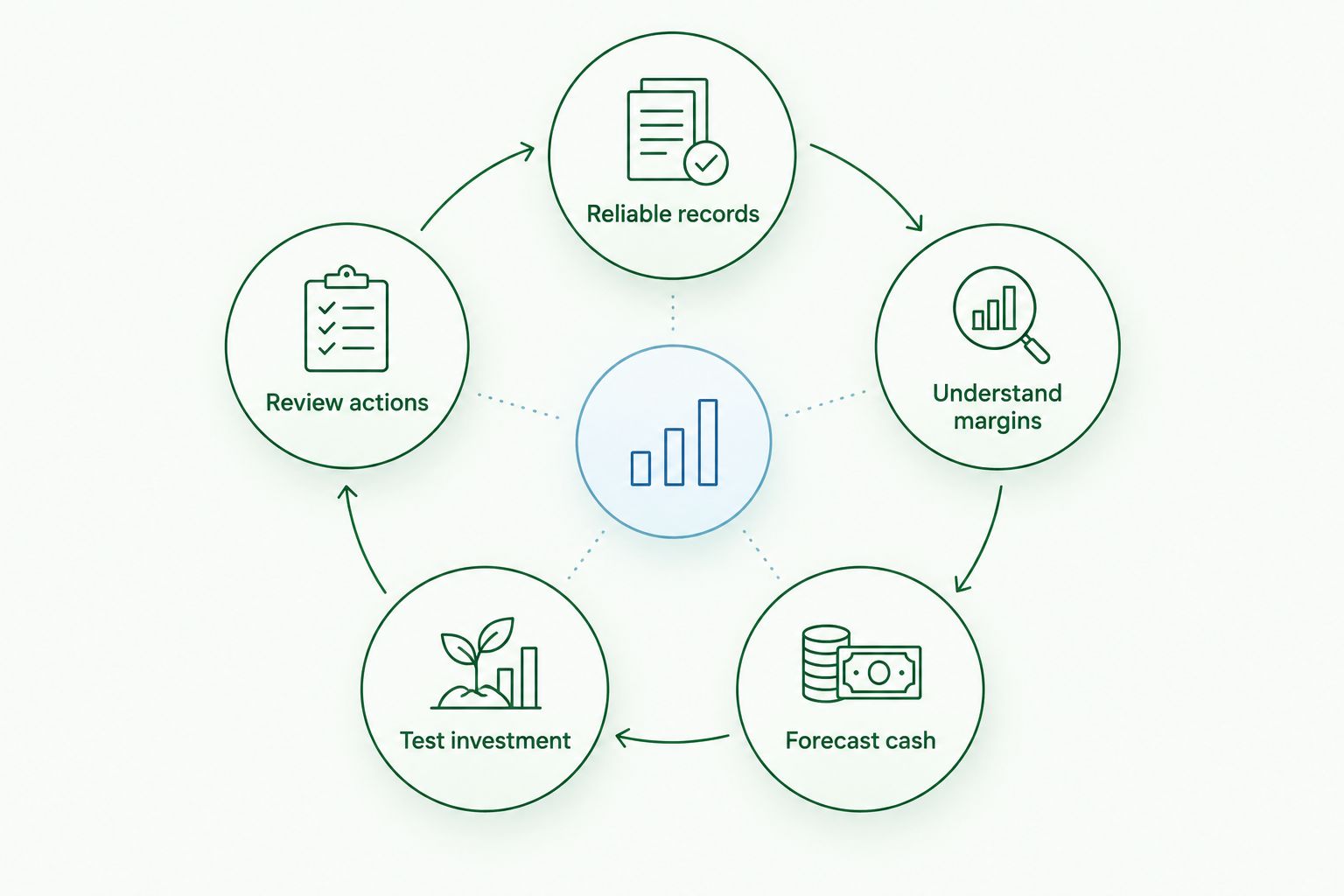
These steps form a repeating cycle: establish reliable records, understand margins, forecast cash, test investment and review actions. Keep the cycle visible so reporting does not become disconnected from operational decisions.
Compare advisory options for your manufacturing business
Choose support by the decision, not the job title. An accountant, an outsourced CFO and a production specialist can contribute to the same project, but their responsibilities are not interchangeable.
Use this comparison to define the scope before appointing anyone. For your 2026 engagement, ask for specific deliverables, information requirements and responsibility boundaries rather than relying on a broad promise of business advice.
Option | Best for | Main advantage | Key limitation |
|---|---|---|---|
Internal finance team | Manufacturers with staff able to maintain and interpret management information | Direct access to business records and operating context | Capability and available time depend on your team |
Compliance-focused accountant | Tax, BAS and financial reporting obligations | Keeps statutory requirements central to the engagement | Compliance work alone does not define an ongoing management advisory service |
Daintree Consulting | Manufacturers seeking accounting, business advisory and outsourced CFO support | Offers these financial services within one firm | Financial support does not replace technical production engineering; confirm the engagement scope |
Operations or engineering specialist | Equipment capability, production processes and technical constraints | Addresses the physical production question | Financial forecasting and accounting require a separately defined scope |
Combined finance and operations support | Investment decisions involving both funding and production changes | Connects technical assumptions with financial analysis | Requires clear ownership and coordination between specialists |
Before agreeing to an engagement, ask what you will receive and what decision each deliverable supports. Establish how corrections to source data are handled, how often assumptions are reviewed and who follows through on agreed actions.
Do not appoint overlapping providers without allocating responsibility. Otherwise, each adviser can reasonably assume someone else is checking a critical input, such as stock quantities or equipment output assumptions.
Common mistakes manufacturing businesses make
Treating gross profit as the complete answer
A business-wide gross profit figure can hide differences between products, customers and jobs. Review the level relevant to your decision, and check how overheads and labour are classified before comparing results.
Keep the definitions consistent. A change in cost allocation can change a reported margin without changing production performance.
Buying equipment before testing the constraint
A new machine is not automatically the answer to late deliveries or limited output. Check whether labour availability, material supply, setup or another process determines throughput before building the investment case.
Include the cash needed to support additional production. Funding equipment and funding the resulting stock are separate questions.
Forecasting sales without forecasting collections
Revenue in a forecast is not the same as cash available for payroll. Build receipts around expected payment dates and challenge assumptions about overdue accounts.
For large orders, review supplier payments and production spending alongside customer terms before accepting the work.
Expecting one adviser to cover every discipline
Financial advice and manufacturing engineering answer different questions. Ask each provider to state their responsibilities and where another specialist is needed.
Give one internal decision-maker responsibility for joining the findings together. That prevents a technically sound recommendation from being approved without a funding plan.
FAQ
What does business advisory for manufacturing businesses include?
Business advisory for manufacturing businesses connects financial analysis with decisions about margins, working capital, capacity and investment. The agreed scope can include management reporting, cash forecasting, costing reviews and decision support; technical engineering needs a separate specialist.
When should a manufacturer bring in a business adviser?
Bring in a business adviser when a material decision requires financial analysis your team cannot confidently prepare or interpret. Examples include accepting a large contract, investigating inconsistent margins or assessing an equipment investment.
Is a business adviser better than an accountant for manufacturing?
Neither role is automatically better; the engagement scope determines whether it answers your question. Accounting supports reliable records and compliance, while advisory applies financial information to management decisions, and a firm can provide both.
What records should I prepare before meeting an adviser?
Prepare current financial reports, bank balances, receivables, payables, stock records and available job-cost information. Include the decision you need to make, relevant customer or supplier terms, and any known gaps in the records.
Can business advisory help with manufacturing cash flow?
Business advisory can help you map expected receipts and payments and assess working-capital decisions. It does not guarantee a cash outcome; the forecast depends on accurate inputs, realistic assumptions and management action.
Do I need an outsourced CFO if I already have a bookkeeper?
You need outsourced CFO support when the financial planning and decision-support work exceeds the scope of your bookkeeping arrangement. First identify the unmet responsibility, then decide whether your existing team or an external adviser should fill it.
Can a financial adviser choose manufacturing equipment for me?
A financial adviser can assess funding, cash requirements and investment assumptions, but equipment suitability requires technical expertise. Use financial and technical assessments together before approving a purchase.
One last thing
Start your next advisory meeting with one completed job, not the annual accounts. Put the original quote beside actual materials, labour, rework, dispatch and customer collection information.
Follow the differences through to cash. That single review gives you a concrete basis for deciding whether the next priority is better estimating, clearer records, different terms or a deeper operational investigation.
Talk to Daintree about your next business decision
Our ex-Big 4 team gives clear, senior-reviewed advice so you can act with confidence.
Book a free consultation →
Or explore our business advisory services.
