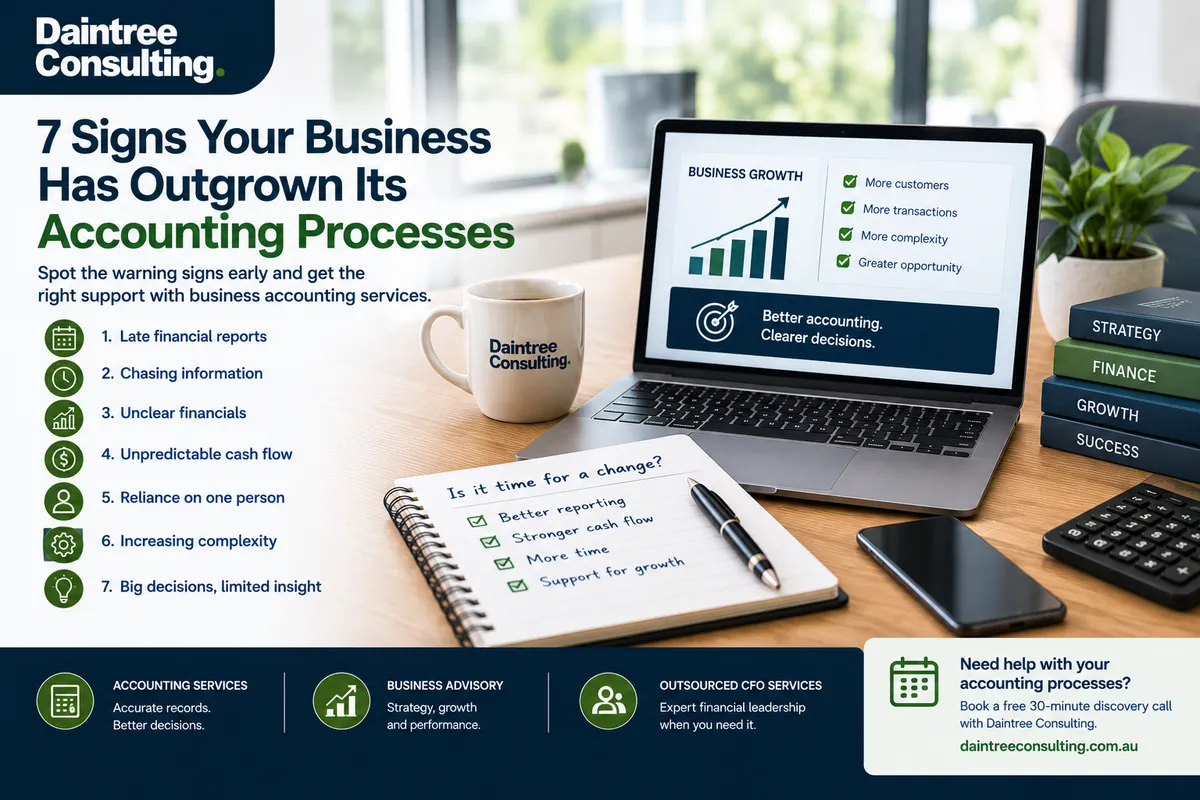
7 Signs Your Business Has Outgrown Its Accounting Processes
As a business grows, its accounting processes rarely become more sophisticated at the same pace.
What worked when there were only a handful of transactions, one bank account and a simple monthly routine can become increasingly fragile as the business adds employees, customers, suppliers, assets, locations, projects and financial obligations.
Want expert help? Daintree Consulting's accounting services can take this off your plate. Book a free consultation.
The warning signs are not always obvious.
You might still be getting your accounts completed. Your accountant may still be lodging the required returns. Your bookkeeping software may still be working.
But if your financial information is consistently late, difficult to understand or heavily dependent on one person, the problem may be bigger than bookkeeping.
Your business may have outgrown its current accounting processes.
That is where the right business accounting services can make a practical difference—not by adding unnecessary complexity, but by creating a more reliable financial foundation for the size and stage of your business.
Daintree Consulting works with Australian businesses that need accurate records, management reporting and financial oversight that can keep pace with growth. Its accounting service includes management accounts, reconciliations, budget-to-actual reporting, cash-flow reporting, financial dashboards and coordination with bookkeeping, tax and advisory work.
Here are seven signs it may be time to rethink how your accounting function works.
Quick Answer: How Do You Know When Your Business Has Outgrown Its Accounting Processes?
Your business may have outgrown its current accounting processes if:
Financial reports arrive too late to help you make decisions.
You are spending too much time chasing or assembling financial information.
Your accounts are technically complete but difficult to understand.
Cash flow is becoming harder to predict.
Your accounting depends heavily on one person or one manual process.
Growth has created more transactions, entities, assets or reporting requirements.
You are making important decisions without reliable management information.
One sign alone does not necessarily mean you need a complete finance overhaul.
Several signs occurring at the same time are much harder to ignore.
1. Your Financial Reports Arrive Too Late
Financial information only has real commercial value when it reaches you in time to act on it.
If you receive financial reports weeks or months after the period has ended, they may tell you what happened—but not necessarily help you decide what to do next.
This is one of the clearest signs that accounting processes may need to change.
For example, imagine your business has just completed a strong sales month.
Revenue is up.
You might assume the business is performing well.
But once the accounts are finally prepared, you discover:
gross margins have fallen
overheads have increased
debtor days have deteriorated
a major customer has not paid
labour costs are higher than expected
cash reserves are under pressure
The information may be accurate, but if you only see it after the opportunity to respond has passed, the reporting process is not serving the business effectively.
What better accounting processes can provide
A growing business may need a defined month-end or periodic reporting process that produces information consistently.
This could include:
management accounts
reconciled balance sheets
profit and loss reporting
cash-flow reporting
budget-to-actual analysis
variance explanations
key financial indicators
The goal is not simply to produce more reports.
The goal is to make sure the right information arrives at the right time.
2. You Spend Too Much Time Chasing Financial Information
Ask yourself how often you hear:
"I'll need to check."
That phrase is normal occasionally.
It becomes a problem when basic financial questions routinely require significant investigation.
For example:
How much cash do we actually have available?
What are our outstanding receivables?
Which customers are overdue?
What did we spend last month?
Are we on budget?
What is our current gross margin?
How much can we afford to invest?
Why did expenses increase?
What are our biggest financial risks?
If answering these questions requires someone to open multiple spreadsheets, download reports, reconcile different systems and manually piece everything together, your accounting process may have become too dependent on manual work.
Daintree's accounting service specifically addresses this type of issue by focusing on reconciled financial records, timely management reporting, cash-flow visibility and a dependable reporting rhythm.
The hidden cost of fragmented information
The problem is not just the time spent gathering numbers.
There is also the risk of:
using outdated information
working from different versions of a spreadsheet
overlooking transactions
duplicating work
misunderstanding balances
delaying decisions
As a business grows, the value of having one dependable financial view increases.
3. Your Accounts Are Complete—but You Still Don't Know What They Mean
This is a surprisingly common problem.
A business can have properly maintained accounts and still struggle to use them.
You may receive a profit and loss statement that shows revenue, expenses and net profit.
But what does it actually tell you about the business?
For example:
Revenue increased by 20%.
That sounds positive.
But if costs increased by 30%, margins may have deteriorated.
Or perhaps:
Profit increased by $100,000.
That sounds encouraging.
But if receivables also increased substantially, the business may still be experiencing cash pressure.
This is why accounting for a growing business needs to go beyond producing historical numbers.
Management reporting adds context
Useful management reporting can help answer questions such as:
What changed?
Why did it change?
Is the change temporary or ongoing?
Are we ahead or behind budget?
Which areas are performing well?
Where are costs increasing?
What is happening to cash?
What should management investigate next?
Budget-to-actual and variance reporting can be particularly useful because it moves the conversation from "What happened?" to "Why did it happen?"
That distinction becomes increasingly important as the business grows.
4. Cash Flow Is Becoming Harder to Predict
Growing revenue does not automatically mean growing financial security.
In fact, growth can sometimes create greater pressure on cash.
You may need to:
employ more people
purchase inventory
invest in equipment
spend more on marketing
provide customers with payment terms
pay suppliers before customers pay you
fund expansion
increase working capital
This can create a situation where the business is profitable on paper but still feels financially uncomfortable.
If you regularly find yourself asking:
"Where did all the cash go?"
that is a signal worth investigating.
Your accounting processes should make it easier to understand the relationship between profit, working capital and cash.
Daintree identifies cash-flow reporting and financial dashboards as part of its accounting service, helping businesses develop clearer visibility over their financial position.
Better accounting can improve visibility—not guarantee cash
It is important to distinguish between visibility and outcomes.
Better accounting cannot guarantee that a business will have sufficient cash.
But accurate records and timely reporting can make cash pressures easier to identify and manage.
That gives management more time to consider options.
5. Too Much of Your Finance Process Depends on One Person
This is a major operational risk.
Perhaps your entire financial process depends on:
one bookkeeper
one finance employee
the business owner
one external accountant
a particular spreadsheet
someone's personal system of reminders and procedures
When that person is unavailable, the process slows down.
When they leave, the business may struggle to understand what needs to happen.
This is not necessarily a reflection of poor performance by that individual.
It can simply mean the business has grown beyond an informal finance process.
Growing businesses need repeatable processes
A more mature accounting function should have clearly defined:
responsibilities
deadlines
reconciliation processes
approval procedures
reporting responsibilities
month-end routines
document requirements
communication points
The objective is continuity.
Your accounting process should be a business system—not knowledge that exists primarily inside one person's head.
6. Growth Has Made Your Accounting More Complicated
Growth often creates accounting complexity that was not present when the business was smaller.
You may now have:
more employees
multiple revenue streams
larger supplier networks
higher transaction volumes
new assets
finance arrangements
multiple locations
new business entities
more complex reporting requirements
greater tax and compliance responsibilities
external investors or lenders
management or board reporting requirements
A system that worked perfectly for a small business can become increasingly inefficient as these factors accumulate.
This is where "good enough" becomes a risk
You may be able to continue using the same spreadsheets, processes and reporting structure.
The question is whether you should.
If your accounting team spends increasing amounts of time fixing, reconciling or manually manipulating information, the process may be consuming resources that should be spent elsewhere.
Daintree's approach is to assess the existing ledger, reporting and controls before agreeing on the appropriate reporting pack, responsibilities and timetable.
That is important because not every growing business needs the same solution.
Sometimes the answer is process improvement.
Sometimes it is better bookkeeping.
Sometimes it is management reporting.
Sometimes the business needs broader outsourced finance support.
And sometimes the existing accounting setup simply needs to be cleaned up and properly structured.
7. You're Making Major Business Decisions Without Reliable Numbers
This is perhaps the biggest warning sign.
Growth creates decisions.
Should you:
hire another employee?
open another location?
purchase equipment?
increase marketing spend?
take on debt?
invest in technology?
acquire another business?
increase prices?
enter a new market?
change your operating structure?
These decisions involve uncertainty.
But uncertainty becomes much greater when you do not have reliable financial information.
For example, before hiring, you may want to understand:
What does this employee need to generate in additional revenue or productivity to make the investment commercially sensible?
Before expanding, you may want to understand:
How will the additional fixed costs affect cash flow under different revenue scenarios?
Before investing, you may want to understand:
What does the business's current financial position actually allow?
Accounting does not make those decisions for you.
But good accounting can give you a much stronger foundation for making them.
What Happens If You Ignore These Warning Signs?
The biggest risk is not necessarily an accounting error.
It is decision-making based on incomplete or outdated information.
As a business becomes larger, small inefficiencies can become expensive.
For example:
A five-minute manual task performed once a month may not matter.
A 45-minute task performed every day across several employees is different.
Likewise, a minor reporting delay may not matter to a small business.
But if management is making a major investment decision based on information that is several months old, the consequences can be much more significant.
Poor financial visibility can contribute to:
slower decision-making
unnecessary administrative work
missed cash-flow pressures
difficulty identifying underperforming areas
budget overruns
owner dependence
duplicated finance work
frustration between finance and management
difficulty planning for growth
The answer is not always "hire more finance staff".
It is often about determining what financial capability the business actually needs now.
Does Outgrowing Your Accounting Mean You Need a New Accountant?
Not necessarily.
This is an important distinction.
Your existing accountant may be doing exactly what they were engaged to do.
For example, an accountant may primarily provide:
tax compliance
annual financial statements
BAS support
tax planning
statutory reporting
Those services can remain valuable.
But your business may also need more frequent management information.
That is a different requirement.
Daintree explains the distinction clearly: accounting establishes reliable financial information, while business advisory applies that information to choices, performance and future direction.
You may therefore need to add capability rather than replace an existing adviser.
For example, Daintree can work alongside an existing bookkeeper, accountant or internal team rather than automatically replacing them.
What Should Better Business Accounting Services Look Like?
The right solution depends on your business.
However, a more mature accounting process will generally have several characteristics.
1. Reliable records
Your underlying accounts should be accurate, reconciled and maintained consistently.
2. Defined reporting deadlines
Everyone should understand when information needs to be available.
3. Management reporting
Reports should be designed around the decisions management needs to make.
4. Cash-flow visibility
Management should have a clearer understanding of current and expected cash requirements.
5. Budget-to-actual analysis
Actual results should be compared with expectations so significant variances can be identified.
6. Clear responsibilities
Everyone should know who owns each recurring finance task.
7. A scalable process
The system should be capable of handling increasing transaction volumes and complexity without relying entirely on manual work.
8. Useful financial conversations
The numbers should lead to questions and decisions—not simply be filed away.
You Don't Necessarily Need More Accounting. You May Need Better Accounting.
This is the distinction many growing businesses miss.
The objective should not be to create more paperwork.
It should be to create better financial visibility with less unnecessary friction.
If your business has outgrown its current accounting processes, the first step should be understanding where the actual gap exists.
Is it:
bookkeeping?
reconciliations?
month-end close?
management reporting?
cash-flow reporting?
budgeting?
financial controls?
accounting software configuration?
financial oversight?
decision support?
Once you identify the real problem, you can choose the appropriate level of support.
Daintree's approach starts with understanding the business, systems, pressure points and desired outcome, then clarifying the records, responsibilities and priorities before designing the appropriate service scope.
That avoids the common mistake of buying a larger service package simply because the business is growing.
When Should You Consider Business Accounting Services?
You do not need to wait until your accounting function is failing.
Consider reviewing your current processes when:
your revenue or transaction volume has increased significantly
your current reporting is consistently late
management spends too much time chasing numbers
cash flow has become difficult to understand
your finance team is overloaded
your business relies heavily on manual spreadsheets
your accountant primarily provides compliance but you now need management reporting
you are preparing for significant growth
you are considering funding or investment
you have started managing a more complex structure
you need better visibility over business performance
The right time to review your accounting processes is often before they become a major operational problem.
How Daintree Consulting Can Help
Daintree Consulting provides accounting and financial oversight for Australian businesses that need reliable numbers and clearer decisions.
Its accounting services can include:
Monthly or periodic management accounts
Balance-sheet and control-account reconciliations
Budget-to-actual and variance reporting
Cash-flow reporting and financial dashboards
Fixed-asset and ledger oversight
Coordination with bookkeeping, tax and advisory work
The service can be structured around the business rather than forcing every client into the same model.
Daintree can work as a focused specialist, alongside an existing finance team, or as part of a broader outsourced finance function.
That can be particularly useful when a business has reached the point where its existing finance processes are no longer providing the clarity management needs—but a full-time finance leadership team is not necessarily the right next step.
Final Thoughts: Growth Should Not Make Your Numbers Less Clear
Business growth is a good problem to have.
But growth changes what your business needs from its accounting function.
The processes that worked at $500,000 of revenue may not be appropriate at $2 million.
The spreadsheets that worked with three employees may become a liability with 30.
And annual financial statements that once gave you enough information may no longer provide the visibility you need to manage the business confidently.
The important question is not:
"Do we need more accounting?"
It is:
"Does our current accounting process give us accurate, timely and useful information for the decisions we are making now?"
If the answer is increasingly no, it may be time to review your accounting processes.
Explore Daintree Consulting's Accounting Services
Frequently Asked Questions
What are business accounting services?
Business accounting services can cover the financial processes and reporting a business needs to maintain reliable records and understand its financial position. Depending on the engagement, this may include reconciliations, management accounts, financial reporting, cash-flow reporting, budget-to-actual analysis and coordination with bookkeeping and tax work.
How do I know if my business has outgrown its accountant?
Outgrowing your current accounting processes does not necessarily mean you have outgrown your accountant.
You may simply need additional management reporting, cash-flow visibility or financial oversight alongside your existing tax and compliance services.
What should a growing business's accounting process include?
The appropriate setup depends on the business, but growing organisations commonly benefit from accurate reconciliations, consistent month-end processes, management reporting, cash-flow visibility, budget-to-actual analysis and clearly defined finance responsibilities.
Is bookkeeping the same as accounting?
No.
Bookkeeping generally focuses on maintaining financial records and processing recurring transactions. Accounting can involve interpreting financial information, preparing reports, reconciliations, financial oversight and supporting management with useful financial information.
The exact scope varies between providers and engagements.
Can I keep my existing accountant and use business accounting services?
Yes.
A business does not necessarily need to replace its existing accountant. An accounting service can potentially work alongside an existing accountant, bookkeeper or internal finance team, depending on responsibilities and the engagement structure. Daintree specifically states that it can work alongside an existing bookkeeper or internal team.
How often should a growing business receive financial reports?
There is no universal frequency that applies to every business.
Monthly reporting is often useful for businesses that need regular performance visibility, while quarterly reporting may be appropriate for some organisations. The reporting rhythm should reflect the decisions, obligations and complexity of the business.
Can accounting services help improve cash-flow visibility?
Yes. Accurate reconciliations, timely reporting and dedicated cash-flow reporting can give management a clearer picture of the financial position.
However, reporting improves visibility; it does not guarantee a particular cash-flow outcome.
What if my accounting records are already messy?
That does not necessarily mean you need to start again.
A review can identify the period, records and processes that need attention before an ongoing reporting structure is established. Daintree states that its discovery process can identify the period and scope of historical clean-up before ongoing reporting begins.
Ready to Find the Gap in Your Accounting Process?
If your business is growing but your financial processes are starting to feel slower, more complicated or less reliable, it may be worth taking a closer look before the problem gets bigger.
Daintree Consulting offers a free 30-minute discovery call to discuss where your finance process is creating pressure, what capability may be missing and what a practical next step could look like.
Book a free 30-minute discovery call with Daintree Consulting
Important Note
The appropriate accounting processes, reporting frequency and level of financial support will vary depending on the business's structure, size, systems, industry, obligations and management needs. This article is general information only and should not be treated as accounting, tax, legal or financial advice for a particular business. Daintree's current website also notes that accounting and taxation services are provided under an agreed written engagement and that the accuracy of reporting depends on complete and timely information supplied by the client.
Talk to Daintree about your accounting
Our ex-Big 4 team gives clear, senior-reviewed advice so you can act with confidence.
Book a free consultation →
Or explore our accounting services.
