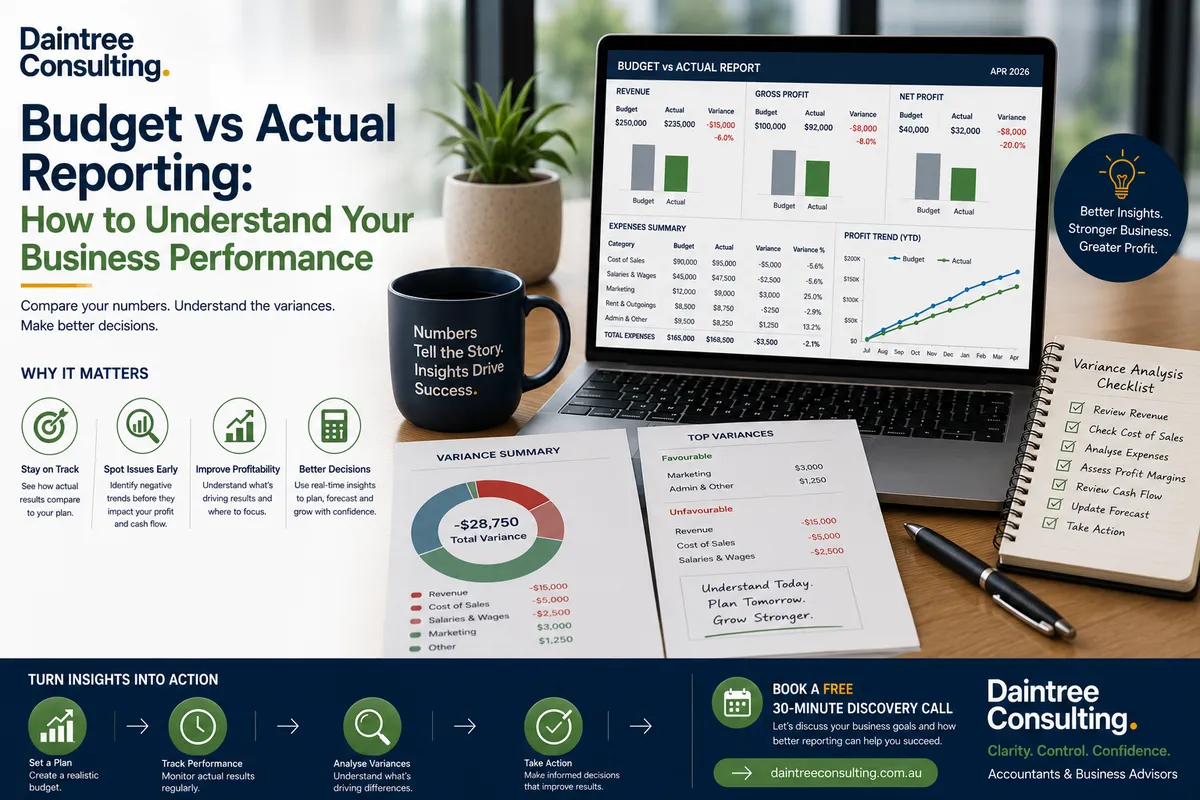
Budget vs Actual Reporting: How to Understand Your Business Performance
A budget tells you what you expected your business to achieve. Your actual results tell you what really happened.
Budget vs actual reporting brings those two together so you can understand where your business is performing as expected, where it is falling behind, and where there may be an opportunity to improve.
Want expert help? Daintree Consulting's business advisory services can take this off your plate. Book a free consultation.
For Australian business owners, this is one of the most practical forms of management reporting. Instead of waiting until the end of the financial year to discover that costs increased, margins declined or revenue missed expectations, you can identify changes while there is still time to act.
The goal is not to create a budget and then treat it as a fixed target that can never change.
A good budget is a financial benchmark. Comparing it with actual results helps you understand what is happening inside the business and make better decisions based on current information.
Important publishing note: Budgeting and financial reporting practices should be tailored to the business's circumstances, accounting system and reporting needs. Where this article refers to financial or tax-related information, businesses should confirm the applicable requirements with their accountant or the relevant Australian authority.
The ATO also recommends monitoring budgets and paying attention to significant differences between budgeted amounts and actual results as business circumstances change.
Quick Answer: What Is Budget vs Actual Reporting?
Budget vs actual reporting is the process of comparing a business's planned financial results with its actual financial results over a particular period.
For example, a business might budget for $200,000 in monthly revenue but generate $180,000.
At the same time, it might have expected $60,000 in operating expenses but actually spend $70,000.
The report highlights these differences, known as variances, so management can investigate what caused them and decide whether action is required.
The real value is not simply identifying whether the business is above or below budget.
It is understanding why the difference occurred and what it means for the business going forward.
Why Budget vs Actual Reporting Matters
Running a business based purely on historical financial statements can leave you reacting too late.
Your profit and loss statement may tell you that expenses increased last month.
Budget vs actual reporting adds another important question:
Were those expenses higher than expected?
That distinction matters.
An expense can increase without necessarily being a problem if the increase was already included in the budget.
Likewise, revenue can increase while profitability deteriorates if costs are rising faster than sales.
Regular budget vs actual analysis can help business owners:
Identify financial problems earlier
Understand changes in revenue and expenses
Monitor profitability
Improve cash-flow planning
Test whether business assumptions remain realistic
Make better hiring and investment decisions
Monitor key performance indicators
Update forecasts when circumstances change
Identify opportunities for improvement
Reduce unexpected financial surprises
For growing businesses, this can turn financial reporting from a historical record into a practical management tool.
What Is a Variance in Budget vs Actual Reporting?
A variance is the difference between what you budgeted and what actually happened.
There are two broad categories.
Favourable Variance
A favourable variance generally means the actual result is better than the budgeted result.
For example:
Revenue was higher than expected
Operating costs were lower than expected
Gross margin was stronger than forecast
However, favourable does not always mean positive.
Suppose marketing expenditure is significantly below budget because a planned campaign was never launched.
The lower expense may appear favourable, but it could actually represent a missed growth opportunity.
Unfavourable Variance
An unfavourable variance generally means actual performance was worse than expected.
Examples include:
Revenue below budget
Labour costs above budget
Higher supplier costs
Lower gross margins
Unexpected operating expenses
Again, the number itself does not tell the whole story.
The important question is:
What caused the variance?
How to Read a Budget vs Actual Report
A useful budget vs actual report should make it easy to understand:
What you expected.
What actually happened.
Why the difference matters.
Start with the financial areas that have the greatest impact on the business rather than focusing on every small transaction.
Revenue
Compare actual sales with the budget.
If revenue is below expectations, investigate whether the difference relates to:
Lower customer numbers
Reduced average transaction value
Seasonal changes
Lost customers
Pricing
Sales conversion
Delayed projects
Changes in market conditions
If revenue is above budget, determine whether the increase is sustainable or simply a one-off result.
Cost of Sales
Revenue growth is not necessarily profitable growth.
Review whether direct costs are increasing faster than sales.
Supplier pricing, product mix, labour costs and production efficiency can all affect gross margin.
Gross Profit
Gross profit can be more informative than revenue alone.
A business can generate more sales while making less money from every dollar of revenue.
Monitoring actual gross profit against budget can highlight margin pressure earlier.
Operating Expenses
Review major expense categories such as:
Wages
Rent
Marketing
Software
Insurance
Professional fees
Vehicle expenses
Office expenses
Technology
Contractors
Not every variance requires immediate action.
The objective is to identify variances that are material, recurring or strategically important.
Net Profit
Finally, review whether actual profitability is tracking against expectations.
If revenue is on budget but profit is significantly below budget, expenses or margins may require closer attention.
Budget vs Actual Reporting Is More Than Comparing Numbers
One of the biggest mistakes businesses make is treating budget vs actual reporting as a simple scorecard.
A variance is a signal, not necessarily a problem.
Suppose your business budgeted $100,000 in sales but achieved $120,000.
That appears positive.
But what if generating the additional $20,000 in revenue required $30,000 in additional costs?
The business generated more revenue but potentially reduced its profitability.
Likewise, spending $10,000 below budget may appear positive.
But if the underspend occurred because an important maintenance program was delayed, it could create a larger cost later.
This is why good management reporting combines financial numbers with business context.
Common Reasons Actual Results Differ From the Budget
Budgets are based on assumptions, and assumptions can change.
Some of the most common causes of budget variances include:
Changes in Sales
Customer demand may be higher or lower than expected.
Pricing Changes
Discounting, price increases or changes in product mix can affect both revenue and margins.
Staffing Changes
Hiring earlier than planned, overtime, salary increases or unexpected vacancies can affect labour costs.
Supplier Price Increases
Higher input costs can reduce gross margins.
One-Off Expenses
Legal costs, repairs, professional services or unexpected equipment purchases may create temporary variances.
Seasonal Fluctuations
Some businesses naturally experience significant differences between months or quarters.
Timing Differences
Revenue or expenses may have been budgeted for one period but recorded in another.
Changes in Strategy
Management may deliberately spend more than budget because a new opportunity has emerged.
This is why business owners should avoid reacting to a variance before understanding its cause.
How Often Should You Review Budget vs Actual Results?
For many growing businesses, monthly budget vs actual reporting provides a practical balance between detail and efficiency.
Monthly reporting gives management enough information to identify trends without creating unnecessary administrative work.
However, the appropriate frequency depends on the business.
For example:
Cash flow may need weekly monitoring
Sales may be monitored daily or weekly
Payroll may be reviewed each pay cycle
Management reporting may be reviewed monthly
Strategic budgets may be reviewed quarterly
The right approach depends on the size, complexity and financial needs of the business.
What Should a Good Budget vs Actual Report Include?
A useful management report should focus on information that helps management make decisions.
Depending on the business, this may include:
Revenue
Cost of sales
Gross profit
Operating expenses
Net profit
Major expense categories
Cash position
Key business KPIs
Budget
Actual results
Variances
Year-to-date performance
Larger businesses may also monitor departmental performance, project profitability, customer profitability or individual business locations.
The objective is not to create the longest report possible.
It is to create a report that management can understand and actually use.
How to Perform a Budget vs Actual Analysis
A practical budget vs actual analysis can be broken into five steps.
1. Compare Actual Results With the Budget
Start with the current month and year-to-date position.
Identify the largest differences.
Do not immediately focus on every minor variance.
Look for movements that could materially affect profitability or cash flow.
2. Investigate the Cause
Ask why the variance occurred.
Was it:
Timing?
A genuine increase or decrease?
A one-off event?
A change in customer behaviour?
A pricing issue?
A cost increase?
An incorrect budgeting assumption?
This is where financial reporting becomes useful business analysis.
3. Determine Whether the Variance Is Temporary or Ongoing
A one-month variance may not require a budget change.
But if the same variance appears repeatedly, your original assumptions may no longer reflect reality.
For example, if wages have exceeded budget for six consecutive months, the business may need to reconsider its labour assumptions.
4. Decide Whether Action Is Required
Depending on the cause, the appropriate response might include:
Adjusting pricing
Reducing unnecessary costs
Changing staffing plans
Revising sales targets
Improving margins
Changing purchasing arrangements
Increasing marketing investment
Updating cash-flow forecasts
5. Update the Forecast
A budget is normally created as a financial plan.
A forecast can be updated as new information becomes available.
This distinction is important.
Budget = what you originally expected.
Forecast = what you currently expect based on the latest information.
Your original budget can remain useful as a benchmark even when your forecast changes.
Budget vs Actual Reporting vs Forecasting
These three concepts are closely related but serve different purposes.
A budget establishes the original financial plan.
Actual results show what happened.
A forecast estimates what is likely to happen next based on current information.
For example, a business may originally budget for $5 million in annual revenue.
After six months, actual results and market conditions may indicate that $4.5 million is now a more realistic expectation.
The original budget should not simply be erased.
Instead, management can compare:
Original budget → Actual performance → Revised forecast
This provides a clearer picture of both past performance and future expectations.
How Budget vs Actual Reporting Helps With Cash Flow
Profit does not automatically mean strong cash flow.
A business can report a healthy profit while still experiencing cash pressure because of:
Slow customer payments
Inventory purchases
Loan repayments
GST and tax obligations
Large capital expenditure
Timing differences between revenue and expenses
This is why budget vs actual reporting should ideally work alongside cash-flow forecasting.
If actual expenses are consistently higher than budget, management can assess the potential impact on future cash requirements before the situation becomes urgent.
The ATO specifically recommends monitoring cash-flow budgets and reviewing significant differences between budgeted and actual results as business circumstances change.
Common Budget vs Actual Reporting Mistakes
Creating a Budget and Never Reviewing It
A budget that sits in a spreadsheet for twelve months provides limited management value.
Focusing Only on Revenue
Revenue matters, but margins, expenses, cash flow and profitability matter too.
Treating Every Variance as a Problem
Some variances are expected, temporary or strategically intentional.
Ignoring Small Recurring Variances
A small monthly overspend can become significant over a full year.
Using Unreliable Accounting Data
If the bookkeeping is incomplete or incorrectly coded, the report may provide management with a misleading picture.
Accurate financial records are important not only for management reporting but also for meeting Australian tax and record-keeping obligations.
Producing Reports Nobody Understands
Management reporting should be clear enough for decision-makers to use without having to decode accounting terminology.
Failing to Take Action
The purpose of reporting is not to admire the numbers.
It is to make better decisions.
What Business Owners Should Ask When Reviewing the Report
When reviewing your monthly budget vs actual results, ask:
Are we ahead or behind budget?
Why?
Is the variance temporary or likely to continue?
Does it affect profitability?
Does it affect cash flow?
Was the original budget assumption realistic?
Do we need to change our approach?
Does the forecast need to be updated?
These questions turn a financial report into a management conversation.
When Should You Consider Professional Management Reporting?
Basic accounting reports may be enough when a business is small and relatively simple.
As the business grows, however, financial information becomes more difficult to interpret.
Professional management reporting may become particularly valuable when:
Revenue is growing quickly
You have multiple employees or departments
Cash flow is becoming harder to predict
Profit margins are changing
You are making significant investments
You are considering expansion
You have multiple entities
The owner is spending too much time interpreting financial information
Decisions are being made without reliable forecasts
At that point, the value is not simply in producing reports.
It is in understanding what the numbers mean and what should happen next.
How Daintree Consulting Can Help
At Daintree Consulting, we believe financial reporting should help business owners make better decisions — not simply produce another set of numbers.
Our approach can combine accurate bookkeeping and accounting with practical management reporting, budgeting, forecasting and business advisory support.
This can help business owners answer practical questions such as:
Are we actually on track?
Where is profitability changing?
Why are costs increasing?
Can we afford the next hire?
What happens to cash flow if revenue falls?
Are our margins strong enough?
What should we prioritise next?
For growing Australian businesses, having reliable numbers is only the first step.
The real value comes from using those numbers to make confident decisions.
Ready to Get a Clearer View of Your Business Performance?
If you are comparing actual results with a budget but still feel unsure about what the numbers are telling you, it may be time to improve your management reporting.
Book a free 30-minute discovery call with Daintree Consulting.
We can discuss your current reporting, budgeting process and financial priorities and identify practical ways to improve financial visibility and decision-making — with no pressure and no obligation.
Frequently Asked Questions
What is budget vs actual reporting?
Budget vs actual reporting compares a business's planned financial results with its actual results. The differences, or variances, help management understand performance and identify areas that may require attention.
Why is budget vs actual reporting important?
It helps business owners identify financial trends, understand unexpected changes, monitor profitability and make decisions based on current business performance rather than assumptions alone.
What is a favourable budget variance?
A favourable variance generally means actual performance is better than the original budget. However, the underlying reason should still be investigated because a favourable variance is not automatically positive.
What is an unfavourable budget variance?
An unfavourable variance generally means actual performance is worse than budget. It may result from lower revenue, higher expenses, reduced margins or other changes.
How often should a business review budget vs actual results?
For many Australian SMEs, monthly reporting provides a practical balance. Businesses with more complex operations or significant cash-flow exposure may need to monitor certain financial indicators more frequently.
What is the difference between a budget and a forecast?
A budget represents the original financial plan. A forecast reflects what the business currently expects to happen based on actual results and updated assumptions.
Can budget vs actual reporting improve cash flow?
Yes. Regular reporting can highlight unexpected cost increases, revenue shortfalls and other changes that may affect future cash flow. It works particularly well when combined with cash-flow forecasting.
Does Daintree Consulting provide management reporting?
Daintree Consulting provides accounting and business advisory support designed to give Australian businesses clearer financial information and practical guidance for decision-making.
