Bookkeeping Workflow for Small Business: A Practical Guide
Bookkeeping can become difficult surprisingly quickly.
A business might start with a few invoices, a business bank account and a spreadsheet. But as sales increase, more suppliers are added, employees are hired and transactions become more frequent, bookkeeping can turn into a recurring administrative problem.
Want expert help? Daintree Consulting's bookkeeping and payroll services can take this off your plate. Book a free consultation.
The issue is not always the amount of work.
Often, it is the lack of a consistent process.
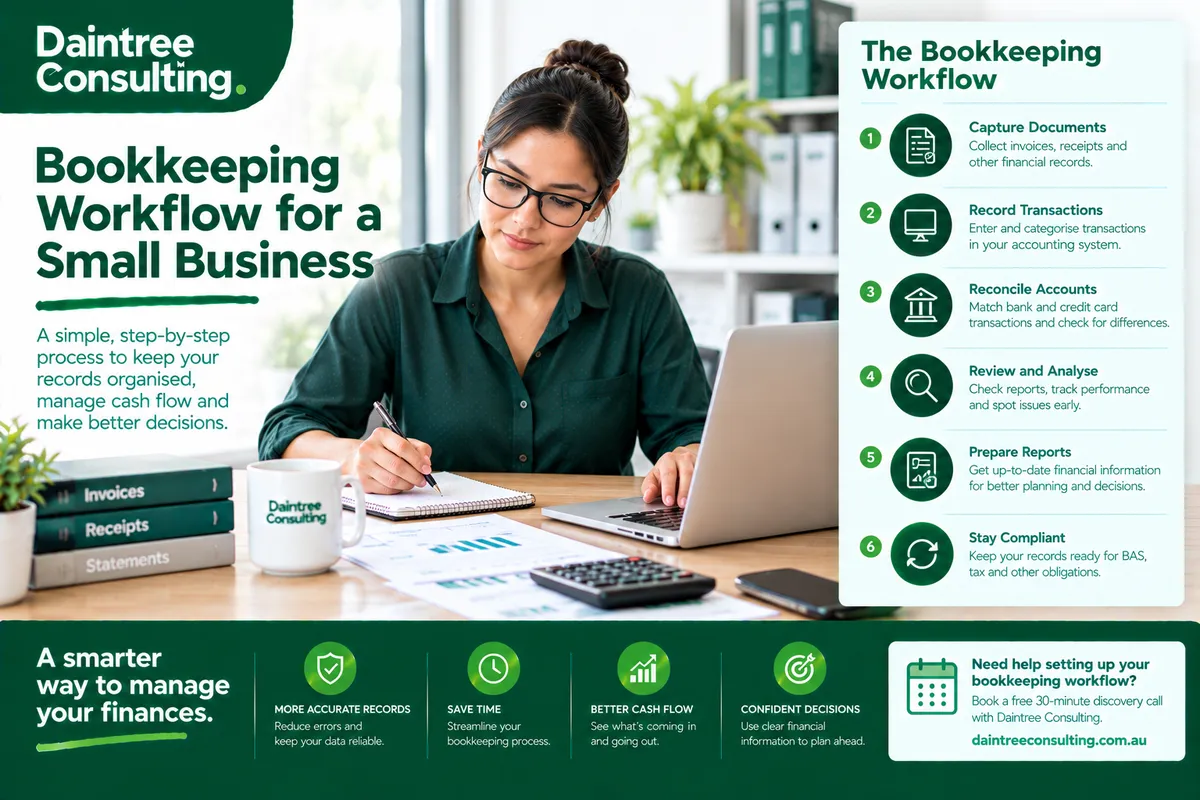
A bookkeeping workflow for small business creates a repeatable system for capturing financial information, recording transactions, reconciling accounts, reviewing the numbers and keeping records organised.
Instead of waiting until BAS time or the end of the financial year to sort everything out, the business handles financial tasks as part of its normal operating rhythm.
That can make bookkeeping easier to manage and give business owners more reliable financial information throughout the year.
What Is a Bookkeeping Workflow?
A bookkeeping workflow is the process a business follows to manage its financial records from the moment a transaction occurs through to reconciliation and reporting.
A basic workflow might look like this:
Capture → Record → Reconcile → Review → Report → Act
For example:
A customer pays an invoice.
The transaction enters the accounting system.
The payment is matched to the outstanding invoice.
The relevant bank account is reconciled.
The accounts receivable balance is reviewed.
The transaction becomes part of the business's financial reporting.
The exact workflow will depend on the business.
A sole trader with a small number of transactions may need a relatively simple process. A growing company with employees, inventory, multiple bank accounts, credit cards and several revenue streams will need more structure.
The goal is not to create unnecessary administration.
The goal is to make sure financial information moves through the business consistently and does not depend on someone remembering what needs to be done.
Why Does a Small Business Need a Bookkeeping Workflow?
Without a defined workflow, bookkeeping often becomes reactive.
Receipts are collected when someone needs them. Bank transactions are coded in batches. Supplier invoices sit in email inboxes. Customer payments are chased inconsistently. Reconciliations are postponed. Reports are produced only when someone asks for them.
That approach may appear manageable when transaction volumes are low.
It becomes much harder as the business grows.
A structured workflow can help a business:
Keep financial records current
Reduce duplicated work
Identify missing information sooner
Keep bank and credit-card accounts reconciled
Track amounts owed by customers and to suppliers
Prepare for BAS and tax requirements
Produce more reliable financial reports
Improve cash-flow visibility
Make responsibilities clearer
Reduce the amount of bookkeeping that falls back on the owner
Good record keeping also supports better business decisions and cash-flow management. Australian Government guidance recommends keeping records of relevant income, expenses, banking, GST and employee or contractor information, with most business records generally needing to be retained for at least five years, although some records have longer requirements.
Step 1: Map What Happens in Your Business
Before choosing software or creating bookkeeping rules, understand how money actually moves through the business.
Start by mapping the main financial activities.
For example:
Sales
How do customers buy from you?
Online
Direct invoice
Point-of-sale system
Subscription
Marketplace
Contract or project billing
Purchases
How does the business buy goods and services?
Supplier invoices
Credit cards
Direct debit
Online subscriptions
Purchase orders
Employee reimbursements
Banking
Which accounts are used?
Business bank account
Savings account
Credit cards
Loan accounts
Payment platforms
Merchant accounts
Payroll
If you employ staff, how are:
Timesheets approved?
Payroll processed?
PAYG amounts recorded?
Superannuation tracked?
Payroll transactions transferred into the accounting system?
Documents
Where are invoices, receipts, bills and supporting documents stored?
Mapping these processes first makes it much easier to identify where bookkeeping tasks belong.
Step 2: Separate Business and Personal Finances
A clean bookkeeping workflow starts with clean financial separation.
For many businesses, using a dedicated business bank account makes it easier to identify business income and expenses and maintain accurate records. The requirements depend on the business structure, but Australian Government guidance notes that separate business banking can make financial management, reporting and tax preparation easier.
If personal and business transactions are mixed together, every transaction requires an additional decision:
Is this business or personal?
That creates unnecessary bookkeeping work.
It can also make reconciliation and reporting more difficult.
Where a personal transaction does occur through a business account, it should be clearly identified and handled according to the business's accounting requirements rather than simply being left unexplained.
Step 3: Choose the Right Bookkeeping System
The next step is deciding how transactions and supporting documents will be recorded.
A business may use:
Accounting software
Cloud bookkeeping platforms
Spreadsheets
Point-of-sale systems
Expense management tools
Receipt-capture systems
Payroll software
Integrated payment platforms
Australian Government guidance recognises both manual and digital record keeping, while noting that digital systems can make records easier to store, access, back up and use for reporting.
For many small businesses, accounting software can form the centre of the workflow.
But software alone does not create a good bookkeeping process.
The software needs to be configured properly.
That includes setting up:
Chart of accounts
Bank feeds
GST settings where applicable
Invoice templates
Supplier records
Customer records
Payment terms
User permissions
Bank and credit-card accounts
Reporting categories
A badly configured accounting system can simply automate bad bookkeeping.
Step 4: Create a Process for Capturing Receipts and Invoices
One of the most common weaknesses in small-business bookkeeping is inconsistent document capture.
A transaction may exist in the bank account, but the supporting invoice or receipt is missing.
That creates questions later.
What was the purchase?
Who supplied it?
Was GST included?
Was it a business expense?
Which account should it be coded to?
A better workflow establishes a standard process for getting documents into the accounting system or document-storage system.
For example:
Supplier invoice received → Invoice captured → Transaction recorded → Payment matched → Document stored
For expenses:
Purchase made → Receipt captured → Expense recorded → Payment matched → Supporting document retained
The exact system can vary, but the principle is simple:
Do not rely on someone remembering to find the document months later.
Step 5: Record Transactions Consistently
Once documents are being captured, transactions need to be recorded using consistent rules.
This is where the chart of accounts becomes important.
For example, a business might have separate categories for:
Advertising
Software subscriptions
Motor vehicle expenses
Professional fees
Office expenses
Insurance
Rent
Wages
Cost of goods sold
The appropriate structure depends on the business.
The aim is to make financial reports meaningful.
If similar transactions are coded differently from month to month, financial reports become harder to interpret.
Consistency also makes it easier to compare actual performance with previous periods and budgets.
Step 6: Set a Bookkeeping Frequency
One of the biggest mistakes is treating bookkeeping as something that only needs attention when a deadline approaches.
A better approach is to establish a regular timetable.
For example:
Daily
Depending on the business:
Issue invoices
Capture receipts
Process sales
Review important payments
Record cash transactions
Weekly
Process transactions
Review unpaid invoices
Capture outstanding documents
Review unusual transactions
Follow up missing information
Reconcile selected accounts where appropriate
Monthly
Reconcile bank accounts
Reconcile credit cards
Review accounts receivable
Review accounts payable
Check payroll-related balances
Review GST-related accounts where applicable
Complete month-end bookkeeping
Review financial reports
Quarterly
Where applicable:
Prepare BAS records
Reconcile BAS figures to accounting records
Review financial performance
Review cash flow
Investigate significant variances
Prepare information for the accountant or BAS agent
The appropriate frequency depends on transaction volume and business complexity.
A high-volume business may need daily or weekly processing.
A smaller business may have a simpler timetable.
The important point is consistency.
Step 7: Reconcile Bank and Credit-Card Accounts
Reconciliation is one of the most important parts of a bookkeeping workflow.
A reconciliation compares the transactions recorded in the accounting system with the transactions shown by the bank or other financial institution.
The purpose is to identify differences.
These might include:
Missing transactions
Duplicate transactions
Incorrect amounts
Unmatched payments
Bank fees
Direct debits
Incorrect transaction coding
Timing differences
Without regular reconciliation, a business may have financial reports that appear complete but do not accurately reflect what has happened.
Reconciliation should therefore be treated as a normal part of the bookkeeping cycle rather than a task reserved for tax time.
Step 8: Keep Accounts Receivable and Payable Current
Bookkeeping is not only about recording transactions.
It should also help the business understand money coming in and going out.
Accounts receivable
Track:
Outstanding customer invoices
Invoice dates
Payment due dates
Overdue amounts
Customer payments
Credit notes or adjustments
Clear invoicing and payment processes can help businesses track sales and payments and reduce avoidable disputes or payment delays.
Accounts payable
Track:
Supplier invoices
Amounts owing
Payment dates
Recurring bills
Supplier credits
Payment status
Keeping these records current gives the business a clearer picture of short-term cash commitments.
It also reduces the risk of paying the same invoice twice or overlooking an important supplier bill.
Step 9: Build Reconciliation Into Your BAS Process
For GST-registered businesses, bookkeeping and BAS preparation are closely connected.
Your bookkeeping workflow should therefore make it easier to reconcile the information that supports the BAS.
Before a BAS is prepared or lodged, relevant records should be reviewed and reconciled.
Business.gov.au specifically advises businesses to reconcile BAS figures with their records and check that purchases and sales are reported in the correct period.
This is one reason why leaving bookkeeping until BAS time can create unnecessary pressure.
If the records are already current and reconciled, BAS preparation can become a more structured review rather than a large catch-up exercise.
The applicable BAS frequency and lodgement requirements depend on the business's circumstances, so businesses should follow their current ATO requirements and BAS instructions.
Step 10: Create a Month-End Close
A month-end close is a structured process for making sure the accounting records are reasonably complete and reviewed for the period.
A small-business month-end checklist might include:
Bank reconciliations completed
Credit-card accounts reconciled
Outstanding invoices reviewed
Supplier bills reviewed
Payroll transactions checked
GST-related accounts reviewed where applicable
Loan accounts reviewed
Asset purchases identified
Unusual transactions investigated
Profit and loss reviewed
Balance sheet reviewed
Cash position reviewed
The exact checklist will depend on the business.
The purpose is not to create a complicated corporate finance process.
It is to establish a clear point where the business can say:
We have completed the bookkeeping for this period and reviewed the numbers.
Step 11: Review the Financial Reports
Bookkeeping should ultimately produce information that helps the business understand what is happening financially.
At a minimum, many businesses will benefit from reviewing:
Profit and loss
This helps management understand revenue, expenses and profitability over a period.
Balance sheet
This provides information about assets, liabilities and equity.
Cash-flow information
This helps management understand actual and expected movements in cash.
Accounts receivable
This shows how much customers owe and how long amounts have remained outstanding.
Accounts payable
This shows what the business owes suppliers and other creditors.
Australian Government guidance recommends regularly reviewing financial documents such as the balance sheet, profit and loss statement, cash-flow statement and budget to understand business performance and identify trends or unusual results.
The key is not simply producing the reports.
Someone needs to review them.
Step 12: Assign Clear Responsibility
A bookkeeping workflow becomes much easier to maintain when everyone knows who owns each task.
For example:
Task | Responsibility |
|---|---|
Sales invoices | Business or accounts team |
Supplier bills | Bookkeeper |
Bank reconciliation | Bookkeeper |
Payroll inputs | Manager/owner |
Payroll processing | Payroll/bookkeeping function |
Payment approval | Authorised business representative |
BAS review | Business owner and registered BAS agent, where engaged |
Management reporting | Accountant/bookkeeper/adviser, depending on scope |
The actual responsibilities will vary.
The important thing is to avoid a situation where everyone assumes someone else is handling the task.
A good workflow should also separate preparation from approval where appropriate.
For example, a bookkeeper may prepare a payment file while an authorised person reviews and approves payments.
That provides an additional control over the process.
Step 13: Document the Workflow
Once the process works, document it.
This becomes particularly important if:
The business has employees
More than one person handles bookkeeping
A bookkeeper takes leave
You outsource bookkeeping
Staff responsibilities change
The business adopts new software
The owner wants to reduce their involvement
Your bookkeeping procedure might document:
What happens when a sale occurs
How invoices are issued
How supplier bills are captured
Where receipts are stored
Who codes transactions
When accounts are reconciled
Who reviews reports
Who approves payments
How missing information is handled
When month-end close occurs
How BAS information is prepared
Where records are retained
This turns bookkeeping from individual knowledge into a repeatable business process.
Common Small-Business Bookkeeping Workflow Problems
Even businesses with accounting software can develop weak workflows.
Some of the most common problems include:
Bookkeeping is only done at BAS time
This creates large amounts of catch-up work and makes it harder to know the current financial position.
Receipts are stored everywhere
Documents may be spread across email, phones, paper folders and cloud storage.
Bank reconciliations are delayed
Errors and missing transactions can remain unidentified for too long.
Nobody owns the process
Tasks fall between the owner, bookkeeper and accountant.
The owner approves everything
This can create a bottleneck and make the owner the only person who understands the workflow.
The accounting system is poorly configured
Incorrect account structures or inconsistent coding can undermine otherwise good bookkeeping.
Reports are produced but not reviewed
The business has financial information but does not turn it into useful management insight.
Personal and business transactions are mixed
This increases the amount of work required to identify and correctly treat transactions.
There is no month-end routine
Every month becomes a different bookkeeping exercise.
A workflow should reduce these points of friction rather than simply adding more bookkeeping tasks.
Should You Use Accounting Software for a Small Business?
For many small businesses, accounting software can make bookkeeping more efficient.
Software can help with:
Bank feeds
Invoicing
Transaction recording
Recurring transactions
Expense capture
Reconciliation
Financial reporting
Document storage
Payroll integration
BAS-related information
But automation should be treated as part of the workflow, not a replacement for review.
A bank feed can import a transaction.
It cannot necessarily determine the correct accounting treatment for every transaction.
An automated rule can save time.
It can also create repeated errors if the rule is configured incorrectly.
The strongest workflows generally combine automation with human review.
When Should You Outsource Your Bookkeeping Workflow?
You do not necessarily need to outsource bookkeeping simply because the business is growing.
However, professional support may become useful when:
The owner spends too much time on bookkeeping
Transactions are consistently behind
Bank reconciliations are not current
BAS preparation becomes stressful
Payroll creates administrative pressure
Financial reports cannot be trusted
The business has outgrown spreadsheets
There are multiple accounts or payment platforms
Nobody internally owns the bookkeeping process
The owner wants more time to focus on operations and growth
Outsourcing can also be useful when the business already has a bookkeeping system but needs someone to improve the workflow, document responsibilities and establish a consistent timetable.
The right question is not simply:
"Can we afford a bookkeeper?"
It is:
"What is the cost of having an unreliable or inefficient bookkeeping process?"
How Daintree Consulting Can Help Set Up a Bookkeeping Workflow
Daintree Consulting provides bookkeeping and payroll support designed around the actual financial processes of Australian businesses.
Its current bookkeeping and payroll service includes bank and credit-card reconciliations, accounts payable and receivable support, payroll processing and records, superannuation processing support, month-end bookkeeping close, BAS-ready records and accountant coordination.
The process can begin by mapping the current workflow, systems, deadlines, responsibilities and approval controls before transitioning recurring tasks into an agreed timetable.
This can be useful for a small business that has reached the point where bookkeeping is becoming dependent on the owner, spreadsheets are becoming difficult to manage or management cannot see a current financial position.
The aim is not simply to take bookkeeping tasks off your hands.
It is to create a more reliable financial process that keeps records current and gives the business better information to work with.
Book a free 30-minute discovery call with Daintree Consulting to discuss your current bookkeeping process, the gaps in your workflow and what a more structured approach could look like.
Frequently Asked Questions
What is a bookkeeping workflow for a small business?
A bookkeeping workflow is a repeatable process for capturing financial documents, recording transactions, reconciling accounts, reviewing financial information and maintaining business records.
How often should small-business bookkeeping be done?
The appropriate frequency depends on transaction volume and business complexity. Some businesses may need daily or weekly processing, while others can operate with a simpler schedule. The important thing is that bookkeeping is completed consistently rather than left until BAS or tax time.
What should be included in a bookkeeping workflow?
A workflow may include document capture, invoicing, expense recording, transaction coding, bank and credit-card reconciliation, accounts receivable, accounts payable, payroll, month-end close, reporting and record storage.
Do I need accounting software for my small business?
Not every business needs the same system. Digital accounting software can automate parts of bookkeeping and make reporting easier, but the right solution depends on transaction volume, business structure, reporting needs and the complexity of the business.
How often should bank accounts be reconciled?
The appropriate frequency depends on transaction volume and business needs. Higher-volume businesses may reconcile more frequently, while smaller businesses may use a regular weekly or monthly schedule. The key is to reconcile often enough to identify errors and maintain reliable financial information.
Can a bookkeeper prepare my BAS?
The scope of services depends on the provider and their registration. BAS preparation and related services may need to be performed by a registered BAS agent or another appropriately authorised professional. Business owners should confirm the provider's registration and the exact services included.
What records should a small business keep?
Business records generally include income and sales records, expense records, bank records, GST records where applicable, asset records and employee or contractor records. Record requirements depend on the business structure and obligations, and some records may need to be kept longer than the general five-year period.
Is bookkeeping the same as accounting?
No. Bookkeeping generally focuses on recording and maintaining financial transactions and records. Accounting can include broader activities such as financial reporting, tax, analysis, budgeting, forecasting and business advice, depending on the services provided.
The Bottom Line
A good bookkeeping workflow does not need to be complicated.
It needs to be clear, consistent and appropriate for the business.
The basic process is straightforward:
Capture the information.
Record the transactions.
Reconcile the accounts.
Review the numbers.
Keep the records organised.
Repeat the process consistently.
As the business grows, the workflow can become more sophisticated.
You may introduce more automation, more frequent reporting, payroll integration, approval controls, management reporting or professional bookkeeping support.
But the principle remains the same.
Bookkeeping should not be something the business desperately catches up on every few months.
It should be a reliable financial process that runs alongside the business.
When the workflow is working properly, the business has cleaner records, fewer surprises and better information for managing cash flow, meeting obligations and making decisions.
Talk to Daintree about your bookkeeping and payroll
Our ex-Big 4 team gives clear, senior-reviewed advice so you can act with confidence.
Book a free consultation →
Or explore our bookkeeping and payroll services.
