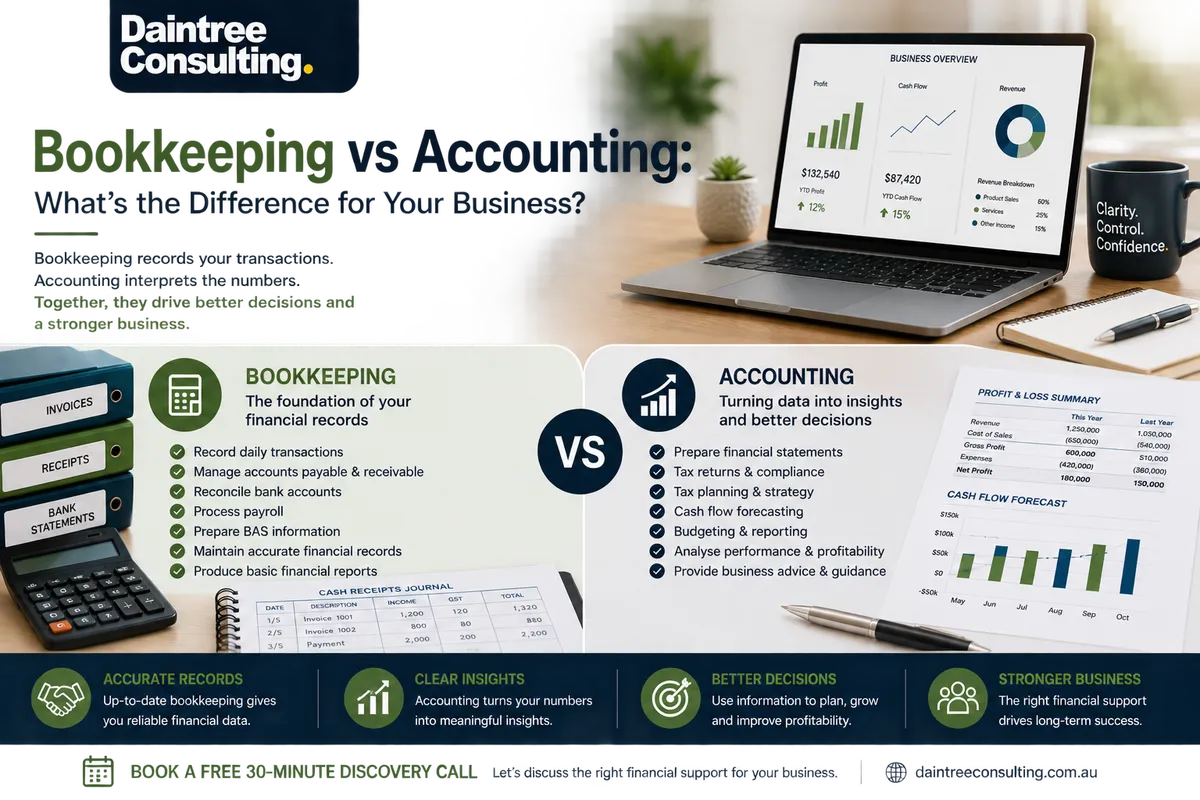
Bookkeeping vs Accounting: What’s the Difference?
If you run a business, you have probably heard the terms bookkeeping and accounting used interchangeably.
They are closely connected, but they are not the same thing.
Want expert help? Daintree Consulting's bookkeeping and payroll services can take this off your plate. Book a free consultation.
Bookkeeping is primarily about recording and organising financial transactions. Accounting goes further by interpreting that financial information, supporting compliance and helping business owners understand what the numbers mean.
For a growing Australian business, you may need both.
Good bookkeeping gives you reliable financial data. Good accounting turns that data into useful information for tax, reporting, planning and decision-making.
The important question is not simply whether you need a bookkeeper or an accountant. It is whether your business has the right level of financial support for its current size, complexity and goals.
Quick Answer: What Is the Difference Between Bookkeeping and Accounting?
The simplest way to understand the difference is:
Bookkeeping = recording and organising the numbers.
Accounting = interpreting, reporting and using those numbers.
A bookkeeper may handle tasks such as recording transactions, reconciling bank accounts, managing accounts payable and receivable, and maintaining accurate financial records.
An accountant may use those records to prepare financial reports, assist with tax and compliance requirements, analyse business performance and provide financial guidance.
The two functions work together.
If bookkeeping is inaccurate or incomplete, the accountant may not have reliable information to work from.
What Does a Bookkeeper Do?
Bookkeeping is the foundation of your business's financial records.
A bookkeeper typically helps ensure that transactions are recorded correctly and that the accounting system reflects what is happening in the business.
Depending on the business and the service agreement, bookkeeping may include:
Recording sales and expenses
Categorising transactions
Reconciling bank and credit card accounts
Managing accounts payable
Managing accounts receivable
Recording receipts and invoices
Maintaining financial records
Processing payroll where offered
Preparing information for BAS and tax reporting
Maintaining accounting software
Producing basic financial reports
The objective is straightforward: keep the financial records accurate, complete and up to date.
For a small business, this can make a significant difference.
When bookkeeping is left until the end of the financial year, owners may be making decisions based on incomplete information. Up-to-date bookkeeping gives you a much clearer picture of what is happening financially.
What Does an Accountant Do?
Accounting generally involves a higher level of analysis, reporting, compliance and financial interpretation.
An accountant may help with:
Financial statements and reporting
Tax return preparation
Tax planning
BAS and GST-related matters
Financial analysis
Budgeting and forecasting
Business structure considerations
Profitability analysis
Cash-flow planning
Business performance reviews
Financial decision support
Business advisory
The exact services depend on the accountant, the business and the engagement.
An accountant can take the information generated through bookkeeping and help explain what it means.
For example, your bookkeeping might show that revenue increased by 20%.
An accountant or business advisor can help you investigate the more important questions:
Did profit increase by the same amount?
Are margins improving or declining?
Is cash flow keeping pace with revenue?
Which products or customers are most profitable?
Can the business afford another employee?
That is where accounting becomes more than simply recording numbers.
Bookkeeping vs Accounting: Why Both Matter
Think of bookkeeping as the financial foundation and accounting as the interpretation and application of that information.
You cannot make reliable decisions from unreliable data.
Imagine your business has $2 million in annual revenue, but your bookkeeping is several months behind.
You may know how much you have sold, but you may not have a reliable picture of:
Current expenses
Outstanding invoices
Supplier obligations
GST position
Payroll costs
Actual profitability
Available cash
Upcoming financial commitments
That lack of visibility can make business decisions much harder.
Accurate bookkeeping gives your accountant and leadership team better information to work with.
Bookkeeper vs Accountant: Which One Do You Need?
The answer depends on what your business needs.
You may primarily need bookkeeping support if:
Your financial records are falling behind
Bank reconciliations are not being completed regularly
You have a growing number of transactions
Invoices and expenses are becoming difficult to manage
Payroll administration is taking too much time
You are spending hours maintaining accounting software
Your accountant is constantly asking you for missing records
In these circumstances, strengthening your bookkeeping function may be the first priority.
You may need accounting support if:
You need help with tax and compliance
You need financial statements prepared
You want to understand business profitability
You need financial planning or forecasting
You are considering a major investment
You are restructuring the business
You are preparing for funding, sale or succession
You need more strategic financial guidance
You may need both if:
Your business is growing and financial administration has become more complex.
Many established SMEs benefit from having bookkeeping, accounting and advisory capabilities working together rather than treating each function as completely separate.
What Is the Difference Between Bookkeeping and Accounting for Small Businesses?
For a small business, the distinction can sometimes feel less important because one person or firm may provide both services.
That is perfectly normal.
A small business might have a bookkeeper maintaining the accounting records while an accountant handles tax, financial reporting and higher-level financial matters.
In some cases, the same firm provides both.
The advantage of an integrated approach is that the people responsible for your accounting and advisory work can access the underlying financial information without relying on multiple disconnected systems or repeated handovers.
This can make financial administration more efficient.
Bookkeeping Is More Than Data Entry
One common misconception is that bookkeeping is simply entering numbers into accounting software.
Modern bookkeeping can involve much more.
A professional bookkeeper may help maintain the integrity of the financial information that the rest of your finance function depends on.
This includes identifying discrepancies, reconciling accounts, maintaining records and ensuring transactions are properly recorded.
Good bookkeeping can also make your accountant's job easier.
When the records are clean and organised, less time may be required for catch-up work and corrections.
That can ultimately improve the efficiency of your overall finance function.
Accounting Is More Than Tax
Another common misconception is that accountants only deal with tax returns.
Tax is an important part of accounting, but accounting can cover much more.
Depending on the accountant and the business, accounting support can include:
Financial reporting
Tax planning
Business performance analysis
Budgeting
Forecasting
Cash-flow analysis
Management reporting
Business structure considerations
Strategic financial support
For a growing business, this broader perspective can become increasingly valuable.
The numbers should not simply tell you what happened last year.
They should help you understand what is happening now and what decisions may make sense next.
When Should You Move From Basic Bookkeeping to More Financial Support?
There is no universal revenue figure that determines when a business needs more sophisticated accounting support.
The trigger is usually complexity and decision pressure, rather than turnover alone.
You may need additional support when:
Revenue is growing quickly
You have started employing more people
Cash flow is becoming harder to predict
You have multiple revenue streams
Your business has multiple entities
You are considering expansion
You are taking on significant debt
You are investing in equipment or property
You are preparing for a sale
You need regular management reporting
You are making important decisions without reliable financial information
At that point, simply keeping the books up to date may no longer be enough.
You may need accounting and business advisory support that helps you interpret the information and plan ahead.
Can One Firm Handle Both Bookkeeping and Accounting?
Yes.
Many Australian accounting firms offer both bookkeeping and accounting services.
For business owners, an integrated arrangement can have several advantages.
Fewer handovers
Your bookkeeper and accountant can work from the same financial information.
Better consistency
Financial records, reports and compliance work can be managed within a connected process.
Easier communication
Instead of explaining the same financial issue to multiple providers, you may have one team that understands the wider context.
Better visibility
Accurate bookkeeping can support more timely reporting and financial analysis.
A path for growth
As your business becomes more complex, you can potentially add services such as management reporting, forecasting or outsourced CFO support without completely changing providers.
The right setup will depend on your business and the scope of services required.
How Bookkeeping Supports Better Business Decisions
It is easy to think of bookkeeping as an administrative function that has little connection to strategy.
In reality, the quality of your bookkeeping directly affects the quality of your financial information.
For example, if expenses are incorrectly categorised, invoices are missing or bank accounts are not reconciled, your reports may not accurately reflect the business.
That can affect decisions about:
Pricing
Hiring
Spending
Cash management
Tax planning
Growth
Investment
Better decisions start with better information.
That is why bookkeeping should not be treated as an afterthought.
How Accounting Supports Business Growth
Once reliable financial information is available, accounting can help turn that information into insight.
For example, your accountant may help you understand:
Profitability: Which parts of the business generate the strongest margins?
Cash flow: Is the business generating enough cash to support its current commitments?
Costs: Which expenses are increasing faster than revenue?
Tax: What tax obligations and planning considerations should be addressed?
Growth: Can the business financially support another employee, location or investment?
Risk: Are there financial or structural issues that should be reviewed?
These questions become increasingly important as the business grows.
Bookkeeping vs Accounting: Don't Choose Based on Price Alone
When comparing financial service providers, it can be tempting to choose the cheapest option.
But the lowest monthly fee does not necessarily represent the lowest overall cost.
Poor bookkeeping can create additional work later.
Incomplete records can lead to:
More catch-up work
Delayed reporting
Difficult BAS preparation
Unclear financial performance
More accountant time
Greater risk of errors
Poorer decision-making
Likewise, paying for accounting services that your business does not actually need may not be efficient either.
The objective should be to find the right level of financial support for your business.
How to Choose Between a Bookkeeper and Accountant
Before engaging a provider, ask what you actually need help with.
Consider:
1. Do you need your financial records maintained?
If yes, bookkeeping may be the immediate requirement.
2. Do you need tax or compliance support?
If yes, accounting or tax services may be required.
3. Do you need regular management reports?
You may need accounting or business advisory support beyond basic bookkeeping.
4. Do you need help making business decisions?
This may point toward business advisory or outsourced CFO support.
5. Is your business becoming more complex?
If so, an integrated finance function may provide greater value than separate providers.
The right answer can change as your business develops.
How Daintree Consulting Can Help
At Daintree Consulting, bookkeeping and accounting are treated as connected parts of the broader finance function.
The aim is not simply to keep records up to date.
It is to give Australian business owners greater financial clarity, control and confidence.
Depending on your needs, support can include:
Bookkeeping
Payroll
BAS and compliance
Accounting
Taxation
Financial reporting
Business advisory
Outsourced CFO support
An integrated approach can help ensure that the financial information being recorded is also useful for reporting, planning and decision-making.
For growing businesses, this creates a pathway from accurate financial records to more informed financial leadership.
Ready to Improve Your Business's Financial Clarity?
If you are unsure whether your business needs bookkeeping, accounting or a combination of both, the first step is to understand where the current gaps are.
You may simply need cleaner bookkeeping.
Or you may have reached a stage where your business needs more regular reporting, forecasting and financial guidance.
Book a free 30-minute discovery call with Daintree Consulting to discuss your current setup and identify a practical next step.
Frequently Asked Questions
What is the main difference between bookkeeping and accounting?
Bookkeeping focuses primarily on recording, organising and reconciling financial transactions. Accounting uses that financial information for reporting, compliance, analysis, tax and financial decision-making.
Is bookkeeping part of accounting?
Bookkeeping is a fundamental part of the broader accounting process, but the two functions are not identical. Bookkeeping focuses on maintaining financial records, while accounting generally involves greater analysis, reporting and interpretation.
Do I need a bookkeeper if I already have an accountant?
Possibly. If your accountant does not provide day-to-day bookkeeping, a bookkeeper can keep your financial records current and organised so your accountant has reliable information to work with.
Can an accountant do bookkeeping?
Some accountants offer bookkeeping as part of their services, while others focus primarily on accounting, taxation and advisory work. Always confirm exactly what is included in the engagement.
Is a bookkeeper cheaper than an accountant?
Bookkeeping and accounting involve different responsibilities, so comparing them purely on price is not always useful. The appropriate service depends on the work your business actually requires.
When should a small business hire a bookkeeper?
Consider professional bookkeeping when financial administration is taking too much of your time, records are falling behind, reconciliations are incomplete or you no longer have confidence in the accuracy of your financial information.
When should a business hire an accountant?
An accountant can be particularly valuable when you need tax and compliance support, financial reporting, financial analysis, planning or guidance around important business decisions.
Should bookkeeping and accounting be with the same firm?
They can be. An integrated provider can reduce handovers and give the finance team a more complete understanding of the business. However, the best arrangement depends on your business's circumstances and the capabilities of the providers involved.
Does Daintree Consulting provide bookkeeping and accounting?
Yes. Daintree Consulting provides integrated accounting, bookkeeping, payroll, taxation, BAS, business advisory and outsourced CFO services for Australian businesses.
Important Publishing Note
The exact accounting, tax, BAS and compliance services a business requires can depend on its structure, circumstances, transactions and applicable Australian requirements.
For publication, avoid presenting general information in this article as personalised financial, tax or legal advice. Where specific obligations, thresholds or deadlines are discussed, readers should confirm the requirements that apply to their business with the ATO or an appropriately qualified professional.
