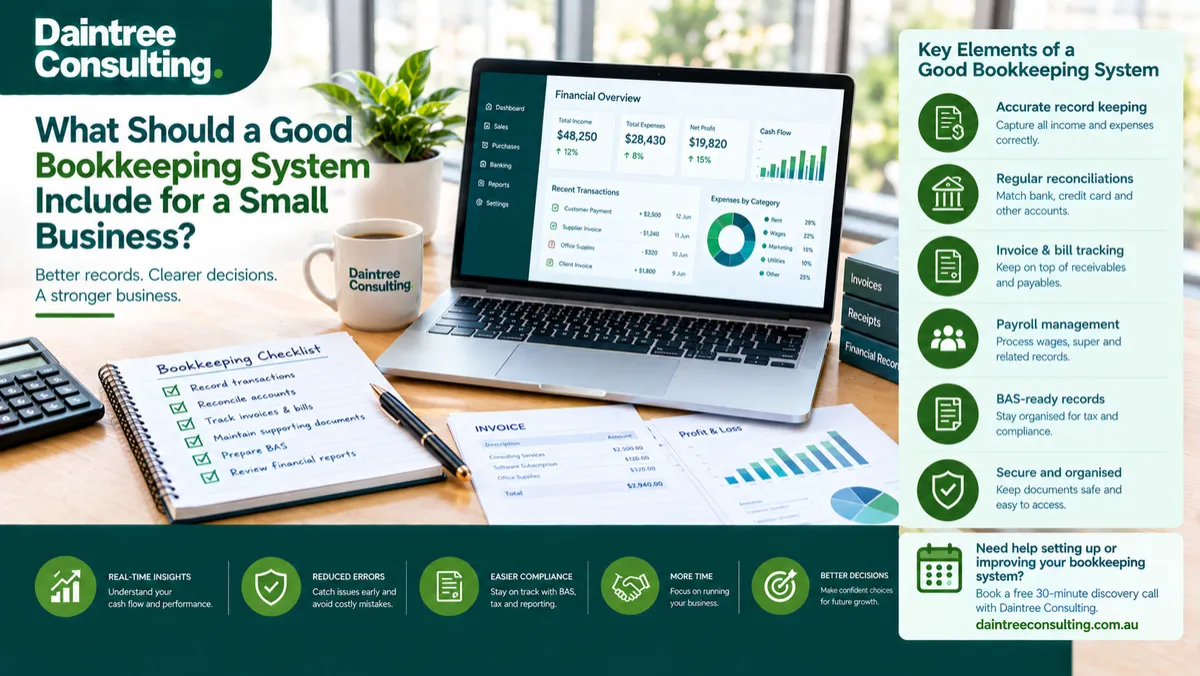
What Should a Good Bookkeeping System Include for a Small Business?
Running a small business means making decisions about money every day. Are customers paying on time? Can you afford another employee? Are expenses under control? Is there enough cash to cover upcoming bills? Are your BAS and tax records in order?
A reliable bookkeeping system for small business helps answer those questions without forcing you to piece together information from bank statements, invoices, spreadsheets and accounting software.
Want expert help? Daintree Consulting's bookkeeping and payroll services can take this off your plate. Book a free consultation.
Good bookkeeping is more than entering transactions. It is about creating a consistent system for recording, checking and organising financial information so your business has reliable numbers to work with.
For some businesses, that system may be managed internally. For others, bookkeeping may be outsourced to a professional provider. Either way, the underlying processes should be clear, consistent and appropriate for the size and complexity of the business.
Quick Answer: What Should a Small Business Bookkeeping System Include?
A good bookkeeping system should generally include:
Accurate recording of income and expenses
Regular bank and credit-card reconciliations
Accounts receivable and accounts payable tracking
Proper invoice and receipt management
Payroll records where applicable
GST and BAS-ready records
Consistent transaction categorisation
Supporting documentation for transactions
Regular review and correction of errors
Secure document storage and backups
Clear month-end processes
Defined responsibilities for bookkeeping tasks
Financial reporting that supports business decisions
The goal is not to create unnecessary administration. It is to make sure your financial information is complete, accurate and available when you need it.
Why Does a Good Bookkeeping System Matter?
Small businesses often start with simple financial processes.
The owner might record expenses in a spreadsheet, send invoices manually and check the bank account whenever there is a question about cash flow.
That can work for a while.
But as the business grows, the number of transactions increases. More customers, suppliers, employees, subscriptions, payment platforms and bank accounts can quickly make an informal system difficult to manage.
The problem is not simply that bookkeeping takes more time.
Poor bookkeeping can make it harder to know what is actually happening financially.
You may have revenue coming in but not know how much is still outstanding. You may have cash in the bank but significant bills due shortly. You may have accounting software showing figures that have not been properly reconciled.
A good bookkeeping system creates a reliable financial foundation.
It gives your accountant, adviser or finance team better information to work with and gives you greater confidence when making decisions.
1. A Reliable Accounting System
At the centre of a modern bookkeeping system is usually accounting software.
The specific software will depend on the business, but the important point is that it should be configured properly and used consistently.
Your accounting system should make it possible to:
Record income and expenses
Reconcile bank accounts
Track invoices
Manage bills
Record relevant GST information
Maintain supplier and customer records
Process or integrate payroll where appropriate
Produce useful financial reports
Simply having accounting software does not mean your bookkeeping system is effective.
A poorly configured or inconsistently maintained accounting file can still produce unreliable information.
The system needs appropriate account categories, tax settings, user permissions and processes for recording transactions.
2. Regular Bank Reconciliations
Bank reconciliation is one of the most important parts of a bookkeeping system for small business.
A reconciliation compares the transactions recorded in the accounting system with the transactions appearing in the relevant bank account.
This helps identify issues such as:
Missing transactions
Duplicate entries
Incorrect transaction amounts
Unpresented payments
Unrecorded receipts
Incorrect account classifications
Unusual transactions requiring investigation
The frequency of reconciliation should suit the business.
A business with a high volume of daily transactions may benefit from frequent reconciliations. A smaller business with fewer transactions may have a different appropriate schedule.
The important thing is that reconciliations should not simply be left until the end of the financial year.
Regular checking gives you a better chance of identifying problems while they are still easy to investigate.
3. Credit Card and Payment Platform Reconciliations
Bank accounts are not the only financial accounts that may need reconciliation.
Many small businesses now use:
Business credit cards
Online payment platforms
E-commerce platforms
Digital wallets
Merchant facilities
Multiple bank accounts
Each can create transactions that need to be correctly recorded and reconciled.
For example, a payment received through an online platform may not arrive in the bank account for the same amount because of fees, refunds or other adjustments.
If these transactions are not handled consistently, the accounting records can become difficult to reconcile.
A good bookkeeping system identifies these accounts and establishes a repeatable process for each one.
4. Clear Income and Sales Recording
Your bookkeeping system should provide a reliable record of business income.
Depending on how your business operates, this might involve recording:
Customer invoices
Direct payments
Point-of-sale transactions
Online sales
Recurring subscriptions
Deposits
Other business income
The system should make it reasonably easy to determine what has been invoiced, what has been paid and what remains outstanding.
This is particularly important for cash-flow management.
A business can appear profitable on paper while experiencing cash-flow pressure because customers are taking too long to pay.
Good bookkeeping helps separate those issues.
5. Accounts Receivable Tracking
If your business sells on credit, tracking outstanding invoices should be part of the bookkeeping process.
Your system should help you understand:
Which invoices remain unpaid
How long they have been outstanding
Which customers owe money
Whether follow-up is required
How outstanding receivables may affect cash flow
This does not necessarily mean your bookkeeper needs to perform every collection activity.
However, the financial records should provide enough visibility for the business owner or relevant team member to manage customer payments appropriately.
Consistent accounts receivable processes can also reduce the risk of invoices being forgotten.
6. Accounts Payable and Supplier Records
The other side of the equation is money your business owes.
A good bookkeeping system should keep track of supplier bills and other business expenses that need to be paid.
This can help you understand upcoming financial commitments rather than relying entirely on your bank balance.
Useful processes may include:
Recording supplier invoices promptly
Checking invoices before payment
Assigning expenses to appropriate accounts
Tracking unpaid bills
Maintaining supporting documentation
Reviewing outstanding payables regularly
This becomes increasingly important as a business grows and starts dealing with more suppliers.
7. Consistent Expense Categorisation
Not every business expense should simply be recorded under a generic “expenses” category.
Consistent categorisation helps make financial reports more useful.
For example, a business may need to distinguish between:
Advertising and marketing
Software subscriptions
Motor vehicle costs
Rent
Professional fees
Insurance
Office expenses
Equipment
Wages and related costs
The appropriate categories depend on the business and its accounting requirements.
The key is consistency.
If similar transactions are classified differently from month to month, financial reports become harder to interpret.
A good bookkeeping system establishes clear rules for common transactions and uses them consistently.
8. Proper Documentation
Bookkeeping records should be supported by appropriate documentation.
Depending on the transaction, this might include:
Tax invoices
Receipts
Supplier invoices
Contracts
Expense records
Payroll records
Bank statements
Asset purchase documents
Other supporting financial information
Good documentation makes it easier to understand where a transaction came from and why it was recorded.
It can also make future reviews, tax work and other financial processes more efficient.
Instead of searching through emails or paper files months later, supporting information can be organised as part of the normal bookkeeping process.
9. Payroll and Superannuation Processes
If your business employs staff, payroll should be properly integrated into the wider bookkeeping and financial process.
Payroll records can involve:
Employee wages
PAYG withholding
Leave records
Superannuation
Payroll reporting
Employee payment records
Payroll should not be treated as an isolated administrative task.
The amounts processed through payroll need to flow correctly into the accounting records and be reflected appropriately in financial reporting.
For small businesses, payroll can become particularly challenging when the business starts employing more people or when payroll responsibilities sit with someone who is already managing several other tasks.
A clear process helps reduce the risk of missed steps and inconsistent records.
10. BAS-Ready Financial Records
For businesses with GST and other relevant obligations, bookkeeping should support the preparation of accurate activity statements.
This means financial transactions need to be recorded and categorised appropriately throughout the relevant reporting period.
Waiting until a BAS deadline approaches before reviewing months of transactions can create unnecessary pressure.
A better system keeps records current so that GST, sales, purchases and other relevant information can be reviewed as part of an established process.
The exact obligations and reporting arrangements depend on the business, its registrations and circumstances.
That is why bookkeeping should work alongside the business's broader tax and compliance processes rather than operating separately from them.
11. A Regular Month-End Process
A useful bookkeeping system should have a defined process for closing each month.
This does not need to be complicated.
A month-end process may include:
Completing bank reconciliations
Reconciling credit cards and other accounts
Reviewing outstanding invoices
Checking unpaid supplier bills
Reviewing payroll-related balances
Checking unusual or uncategorised transactions
Ensuring supporting documents are available
Reviewing key balance-sheet accounts
Identifying errors or items requiring clarification
Finalising the bookkeeping records for the period
The benefit is consistency.
Instead of asking, “Is everything up to date?”, the business has a defined process for answering that question.
12. Regular Financial Review
Bookkeeping should not stop at data entry.
Once records have been reconciled and maintained, someone should review the information for obvious issues and unusual movements.
For example:
Has an expense category increased significantly?
Are customer payments taking longer?
Has a supplier balance grown?
Are there unusual transactions?
Are there accounts that have not been reconciled?
Does the financial information make sense compared with the previous period?
This review can help catch problems before they become bigger problems.
It can also turn bookkeeping data into useful information for business decision-making.
13. Clear Ownership of Responsibilities
One of the most overlooked parts of a bookkeeping system is deciding who is responsible for each task.
In a small business, bookkeeping might involve the owner, an administrator, an internal bookkeeper, payroll staff and an external accountant.
Without clear ownership, tasks can fall between the cracks.
A good system should establish:
Who enters transactions
Who approves payments
Who manages invoices
Who performs reconciliations
Who processes payroll
Who reviews bookkeeping
Who prepares information for the accountant
Who follows up outstanding information
Clear responsibilities reduce duplication and make it easier to identify what needs attention.
14. Secure Storage and Access Controls
Financial records contain sensitive business information.
Your bookkeeping system should therefore include sensible controls around access, passwords, document storage and backups.
Not everyone in the business necessarily needs access to every financial function.
For example, the person entering supplier bills may not need the same permissions as someone approving payments.
Access should be appropriate to each person's responsibilities.
It is also important to have a process for maintaining supporting documents so they can be located when required.
15. A Process for Fixing Errors
Even a well-designed bookkeeping system can contain mistakes.
What matters is how those mistakes are identified and corrected.
Your process should make it possible to investigate:
Duplicate transactions
Incorrect classifications
Missing entries
Incorrect amounts
Reconciliation differences
Unusual balances
Corrections should be properly documented rather than simply making unexplained changes to historical records.
Regular review is generally much easier than discovering a large number of problems at the end of the financial year.
What Does a Good Bookkeeping System Look Like as a Business Grows?
The right bookkeeping system for a sole trader with a small number of transactions will not necessarily be appropriate for a growing company with employees, multiple revenue streams and several bank accounts.
As the business grows, the bookkeeping system may need to become more structured.
You may need:
More frequent reconciliations
Better accounts receivable processes
Stronger expense controls
More formal approval processes
Integrated payroll
More detailed management reporting
Defined month-end procedures
Clear separation of responsibilities
Better coordination between bookkeeping, accounting and tax
The objective is not to create bureaucracy.
It is to make sure the financial system keeps pace with the business.
Should You Manage Bookkeeping Yourself or Outsource It?
There is no single answer for every small business.
Managing bookkeeping internally may work when the business has relatively straightforward transactions and someone has the time, knowledge and discipline to keep records current.
Outsourcing may make more sense when:
Bookkeeping is taking too much owner time
Records are frequently behind
Reconciliations are not being completed
Payroll is becoming difficult to manage
BAS preparation creates last-minute pressure
The business has multiple accounts or payment systems
Financial reports cannot be relied upon
No one internally has clear responsibility for bookkeeping
The business is growing quickly
Outsourcing does not mean giving up control.
A good outsourced bookkeeping arrangement should give the business clearer ownership, more reliable records and better visibility over what has been completed.
How Daintree Consulting Can Help With Small Business Bookkeeping
For a growing Australian business, bookkeeping should provide more than a collection of transactions.
It should create a dependable financial foundation for accounting, tax, payroll, reporting and decision-making.
Daintree Consulting provides bookkeeping and payroll services for Australian businesses, including bank and credit-card reconciliations, accounts payable and receivable, payroll processing and records, superannuation processing support, month-end bookkeeping and BAS-ready records.
The service can be structured around your existing team and software, or bookkeeping and payroll can be outsourced as part of a broader finance function.
Daintree can also work alongside your accountant, internal staff and other advisers so responsibilities are clearer and financial information flows more effectively between each part of the business.
If your bookkeeping is becoming harder to keep up with, the issue may not simply be that you need to work faster. You may need a better process, clearer ownership or additional support.
Book a free 30-minute discovery call with Daintree Consulting to discuss what your business needs and where your current bookkeeping process could be improved.
Frequently Asked Questions
What is a bookkeeping system for a small business?
A bookkeeping system is the combination of software, processes, records and responsibilities used to record and maintain a business's financial transactions.
It should help the business keep accurate records, reconcile accounts, track income and expenses, manage invoices and bills, maintain supporting documentation and prepare reliable financial information.
How often should a small business update its bookkeeping?
There is no single frequency that suits every business. It depends on transaction volume, business structure, staffing and reporting requirements.
The important principle is to keep records sufficiently current that the business can monitor its finances and meet relevant obligations without a large backlog developing.
What is the most important part of a bookkeeping system?
Regular and accurate reconciliation is one of the most important controls because it helps confirm that recorded transactions agree with the underlying financial accounts.
However, good bookkeeping depends on the entire process working together, including documentation, categorisation, invoices, bills, payroll and regular review.
Can accounting software replace a bookkeeper?
Accounting software can automate many bookkeeping tasks, but it does not necessarily replace the need for someone to configure the system, review transactions, reconcile accounts, investigate discrepancies and maintain accurate records.
Automation works best when supported by sound processes and appropriate oversight.
When should a small business outsource bookkeeping?
Outsourcing may be worth considering when bookkeeping is taking significant owner time, records are regularly behind, payroll is becoming difficult, reconciliations are incomplete or the business needs more reliable financial information.
The decision should be based on the business's workload, complexity and internal capabilities.
Does bookkeeping include payroll?
It can. Some bookkeeping providers offer payroll as part of their service, while others focus only on bookkeeping.
The important thing is to establish clear responsibility for payroll processing, records and related accounting entries.
Can a bookkeeper help prepare records for BAS?
A bookkeeper can maintain and organise financial records that support BAS preparation, depending on the agreed scope of work and the relevant professional responsibilities.
Businesses should make sure responsibilities between their bookkeeper and tax or BAS professional are clearly defined.
Final Thoughts
A good bookkeeping system for small business does not have to be complicated.
It needs to be consistent.
Transactions should be recorded properly, accounts reconciled regularly, documents retained, invoices and bills tracked, payroll handled appropriately and financial information reviewed before problems accumulate.
As a business grows, those processes may need to become more structured.
If your bookkeeping currently depends on catching up at the end of the month—or worse, at tax time—it may be a sign that the system needs attention.
Getting the bookkeeping foundation right can make the rest of your financial processes easier to manage and give you more confidence in the numbers you're using to run the business.
Need help improving your bookkeeping process? Book a free 30-minute discovery call with Daintree Consulting to discuss your current setup and the support your business needs.
Talk to Daintree about your bookkeeping and payroll
Our ex-Big 4 team gives clear, senior-reviewed advice so you can act with confidence.
Book a free consultation →
Or explore our bookkeeping and payroll services.
