
Bookkeeping services for not-for-profits: complete 2026 guide
Not-for-profit bookkeeping is the recording and reconciliation of an organisation’s finances with the aim of protecting funds and supporting its purpose. This 2026 guide explains bookkeeping for not-for-profits in Australia, where grant conditions, restricted donations and board oversight require more than an accurate bank balance.
TL;DR
Want expert help? Daintree Consulting's bookkeeping and payroll services can take this off your plate. Book a free consultation.
Bookkeeping for not-for-profits should separate restricted funding, reconcile balances and explain what money remains available.
Daintree Consulting suits organisations seeking bookkeeping alongside accounting, tax and advisory support.
Choose support by transaction complexity, funding conditions and reporting responsibilities—not organisation size alone.
Agree who prepares, reviews and approves financial information before handing over the books.
Why bookkeeping matters for not-for-profits
Your bank balance does not show how much money your organisation can spend freely. Part of that balance might belong to a restricted grant, cover employee obligations or fund services already promised.
Good bookkeeping connects each transaction to its purpose and supporting evidence. It gives your committee or board a clear picture of available funds, outstanding commitments and the financial effect of its decisions.
Daintree Consulting provides bookkeeping, payroll, accounting, tax and advisory services. For your 2026 review, start by defining the work and reporting your organisation needs, rather than choosing a service package by name.
Australian not-for-profits do not all have the same obligations. Charity registration, legal structure, tax registrations, governing documents and funding agreements determine which requirements apply; not-for-profit status alone does not settle them.
How to organise bookkeeping for your not-for-profit
01. Map your funding and reporting obligations
Start with a spreadsheet listing every funding source, reporting deadline and responsible person. You can build this manually from grant agreements, donation conditions, membership records and your governing documents.
Distinguish legal requirements from contractual requirements and internal management preferences. A funder’s expenditure report serves a different purpose from a board report, even when both draw on the same accounting records.
For your 2026 reporting calendar, identify which obligations apply to your particular organisation. Registered charities should check their Australian Charities and Not-for-profits Commission requirements; tax and activity statement obligations require a separate check with the Australian Taxation Office.
Record who confirms each requirement. A deadline without an owner is not a working control.
List grants, donations, memberships, trading income and other funding separately.
Record restrictions and eligible expenditure from each agreement.
Identify required reports and their recipients.
Assign preparation, review and approval responsibilities.
Include payroll, activity statement and annual reporting dates where applicable.
02. Separate restricted funds from general operations
Review the purpose of each receipt before deciding how to record it. A donation with no spending restriction is different from funding committed to a named programme, and grant income recognition requires consideration of the agreement and applicable accounting requirements.
Begin with a simple funding register and consistent transaction labels. Record the funding source, approved purpose, spending period and remaining commitments without creating unnecessary accounts for every minor activity.
A separate bank account can help meet an agreement’s requirements or strengthen oversight, but bank separation does not replace accounting records. You still need to explain what was received, spent, committed and left over.
Choose categories that your treasurer and programme managers can understand. Excessive detail creates coding errors; insufficient detail makes acquittals difficult.
Separate restricted funding from unrestricted income in your records.
Use project or fund tracking consistently.
Record grant conditions alongside the funding register.
Agree how shared expenditure is allocated between programmes.
Ask an accountant to resolve uncertain income recognition treatments.
03. Establish a repeatable reconciliation process
Download bank transactions and compare them with your accounting records, invoices and receipts. Resolve differences rather than carrying unexplained amounts into the next reporting period.
Bank feeds reduce data entry, but a feed is not a completed reconciliation. Missing transactions, duplicate entries, merchant fees and transfers still need review, while cash collections need evidence independent of the bank deposit.
Document the manual process first: who gathers records, who enters transactions and who checks balances. Daintree Consulting’s bookkeeping and payroll services are an option when you want external support with this work; confirm responsibilities and the reporting scope before appointing any provider.
A service provider does not remove your organisation’s responsibility for approving expenditure and supplying complete records. Keep those boundaries explicit.
Reconcile bank accounts and payment platforms to their statements.
Match transactions to invoices, receipts or documented explanations.
Review unpaid supplier bills and outstanding customer balances.
Reconcile payroll liabilities and relevant tax control accounts.
Assign unresolved items to a named person with a completion date.
04. Build approval controls around a small team
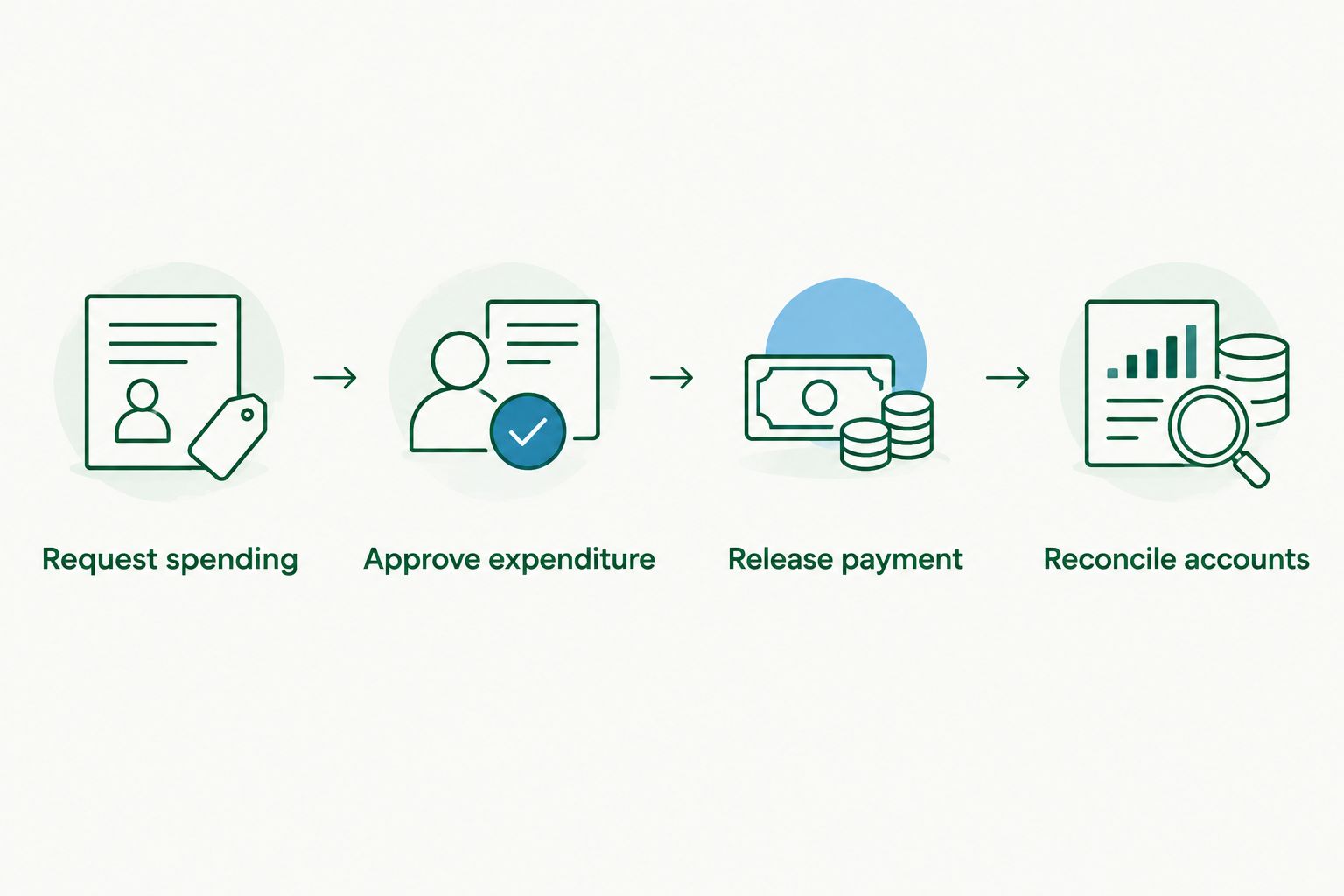
Write down who can request spending, approve it, release payment and reconcile the account. A shared spreadsheet and a short approval policy are enough to make the responsibilities visible before introducing more systems.
Where staffing allows, separate payment approval from bank reconciliation. In a small organisation, ask a committee member who did not process payments to review statements, supporting documents and unusual transactions.
Use the same controls for staff, volunteers and officeholders. Personal familiarity is not a substitute for evidence, particularly when an expense involves someone connected with the organisation.
The diagram below follows the payment sequence. Each stage needs an identifiable person and a record of what happened.
Request spending with a purpose and supporting document.
Approve expenditure within the organisation’s delegated authority.
Release payment after checking payee details independently.
Reconcile accounts against statements and approved records.
05. Give the board a usable financial picture
Start with a manually prepared board pack using reconciled accounting reports and a short written explanation. Report what changed, why it changed and which decisions need attention; attaching a ledger without interpretation leaves that work to your board.
Include the operating result, balance sheet, cash position and funding restrictions. Compare actual results with an approved budget, and distinguish timing differences from changes that affect the organisation’s ability to deliver services.
For your 2026 planning cycle, consider a 13-week cash forecast updated as receipts and commitments change. This is a practical planning recommendation, not a reporting requirement, and it should distinguish expected receipts from confirmed funds.
Give your board enough time to read the pack before meeting. Use a suggested 30-minute finance review to focus discussion on exceptions, upcoming commitments and decisions rather than reading every line aloud.
Explain material differences between actual results and budget.
Show restricted balances separately from freely available cash.
Include committed expenditure that has not yet been paid.
Highlight overdue receivables and uncertain funding receipts.
Record decisions, responsible people and follow-up dates.
06. Choose support around the work you cannot safely absorb
List the tasks your team can complete reliably before seeking outside help. A volunteer treasurer might understand the organisation well but lack time for payroll reconciliations, grant tracking or a disciplined reporting timetable.
Compare providers against your actual funding arrangements and approval structure. Ask who performs the work, who reviews it, how exceptions reach management and what happens when your usual contact is absent.
Jurisdiction also matters. The accounting questions raised by bookkeeping for not-for-profits in the UAE belong within the relevant local rules; an Australian organisation must assess its own legal structure, tax registrations and funding terms rather than importing another jurisdiction’s compliance checklist.
For a 2026 provider review, request a written scope and a sample reporting format. Give providers the same task list so you can compare responsibilities rather than differently named packages.
Identify tasks requiring specialist knowledge or independent review.
Confirm experience with your funding and reporting requirements.
Agree document handover and reporting deadlines.
Clarify account access, record ownership and exit arrangements.
Separate routine processing from accounting advice and assurance work.
Compare bookkeeping support options
Choose the option that covers your control gaps, not simply the one that processes transactions. The right arrangement depends on transaction complexity, staff capacity, funding restrictions and the decisions your board needs to make.
Option | Best for | Main advantage | Key limitation |
|---|---|---|---|
Volunteer-led bookkeeping | Small organisations with straightforward records and dependable volunteer capacity | Keeps organisational knowledge close to the transactions | Continuity and review depend on volunteer availability and capability |
In-house bookkeeper | Organisations needing regular access to someone familiar with daily operations | Supports close coordination with staff and programme managers | Requires supervision, leave cover and access to accounting advice |
Outsourced bookkeeping provider | Organisations with a defined processing and reconciliation workload | Creates a documented external service scope | Reporting interpretation, tax advice and grant support need explicit inclusion |
Daintree Consulting | Organisations seeking bookkeeping alongside accounting, tax and advisory support | Offers related financial services through one firm | You must confirm not-for-profit experience, grant reporting coverage and the engagement scope |
Separate advisory or assurance support | Organisations needing advice or assurance beyond routine bookkeeping | Addresses work outside transaction processing | Requires clear coordination and appropriate independence arrangements |
These arrangements are not mutually exclusive. An internal administrator can collect documents while an external bookkeeper reconciles accounts and an accountant resolves technical issues. The important point is that no task falls between the roles.
An audit or review is also different from bookkeeping. Where assurance is required, confirm the applicable requirements and independence arrangements rather than assuming the person preparing the records can perform every role.
Common mistakes not-for-profits make
Treating every dollar in the bank as available
A healthy-looking balance can include restricted funding and money needed for existing commitments. Report available operating cash separately so your board does not approve spending against funds allocated elsewhere.
Rebuilding grant records at acquittal time
Reconstructing expenditure from bank statements leaves gaps in purpose, approval and supporting evidence. Code expenditure to the relevant fund throughout the reporting period and investigate unclear items while the people involved still remember them.
Assuming a volunteer handover transfers all knowledge
Access credentials do not explain coding decisions, unresolved balances or reporting commitments. Use a written handover covering outstanding work, account permissions, funding conditions and the next reporting deadlines.
Confusing not-for-profit status with automatic exemptions
Not-for-profit status does not automatically resolve charity registration, income tax exemption or GST treatment. Confirm the position for your organisation rather than copying another association’s approach.
Buying processing when the board needs interpretation
Accurate entries do not explain whether a programme is financially sustainable or whether cash will cover commitments. If your board needs forecasts or advice, include those deliverables explicitly rather than expecting them within a basic bookkeeping engagement.
FAQ
What does bookkeeping for not-for-profits include?
Bookkeeping for not-for-profits includes recording transactions, reconciling accounts, maintaining supporting documents and tracking funds against their intended purposes. Payroll, grant reporting and board reports should be specified separately in the service scope.
Does a small not-for-profit need a professional bookkeeper?
A small not-for-profit needs bookkeeping arrangements that match its complexity, not automatically a professional appointment. Professional support becomes relevant when volunteers cannot reliably maintain records, reconcile balances or meet reporting obligations.
Do restricted grants need a separate bank account?
A separate bank account is required when the funding agreement or another applicable requirement specifies it. Otherwise, assess the control benefits, while maintaining records that identify receipts, eligible expenditure and remaining commitments.
Can the treasurer also do the bookkeeping?
A treasurer can perform bookkeeping where the organisation’s rules and applicable requirements allow it. Arrange independent review of payments and reconciliations so preparation and oversight do not rest entirely with the same person.
How often should a not-for-profit reconcile its accounts?
Reconcile accounts frequently enough to support reliable reporting and catch errors before they accumulate. Set the timetable around transaction volume, payroll, payment activity and reporting deadlines, and complete reconciliations before issuing financial reports.
Is bookkeeping the same as an audit?
Bookkeeping maintains financial records; an audit is an assurance engagement examining financial information under applicable requirements. Appointing a bookkeeper does not satisfy a separate audit obligation.
What should we ask before outsourcing our bookkeeping?
Ask which tasks, reports, deadlines and review responsibilities the engagement includes. Also confirm funding-related experience, system access, record ownership, handover arrangements and which technical questions require separate accounting advice.
One last thing
Ask your treasurer and bookkeeper to answer the same question independently: How much money can the organisation spend without breaching restrictions or missing existing commitments? If the answers differ, trace the difference before approving new expenditure.
Make that your next 2026 finance action. A reconciled bank balance is essential, but an agreed view of available funds is what supports a sound spending decision.
Talk to Daintree about your bookkeeping and payroll
Our ex-Big 4 team gives clear, senior-reviewed advice so you can act with confidence.
Book a free consultation →
Or explore our bookkeeping and payroll services.
