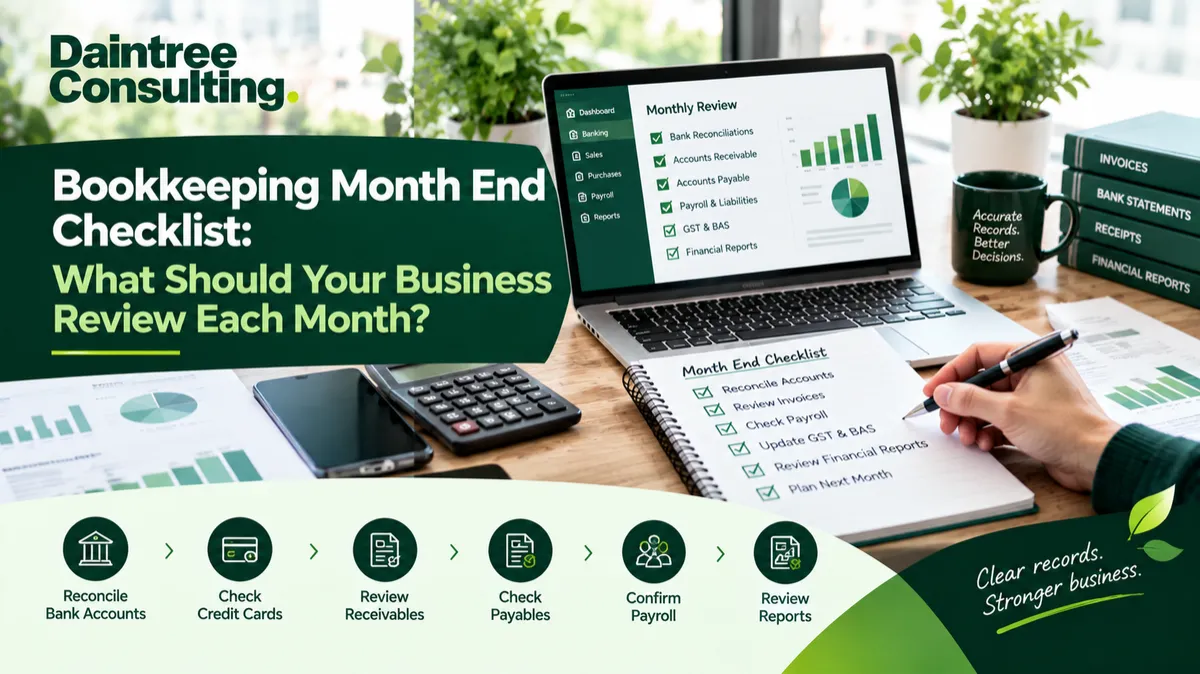
Bookkeeping Month End Checklist for Australian Businesses
A month can close quickly. Sales are processed, bills are paid, payroll runs and bank transactions accumulate — and before you know it, the next month has started.
Without a consistent bookkeeping month end checklist, small issues can remain hidden until BAS time, tax time or the end of the financial year.
Want this handled for you? Daintree Consulting's bookkeeping and payroll services keep your month-end on track. Book a free consultation.
A proper month-end review gives your business a structured opportunity to check that transactions have been recorded, accounts have been reconciled and important financial information is up to date. It also gives owners and management a more reliable basis for understanding performance and making decisions.
For Australian businesses, good record keeping is more than an administrative exercise. The ATO requires businesses to keep records relating to their income, expenses, tax, superannuation and registration obligations.
Quick answer: What should be on a bookkeeping month end checklist?
A practical bookkeeping month end checklist should usually cover:
Bank and credit-card reconciliations
Sales and accounts receivable
Supplier bills and accounts payable
Payroll and payroll liabilities
GST and BAS-related records
Expense coding and supporting documents
Loans and finance accounts
Fixed assets and significant purchases
Accruals and prepayments where relevant
Unusual or missing transactions
Balance-sheet reconciliations
Profit and loss review
Cash-flow position
Outstanding bookkeeping issues
Management review and follow-up actions
The exact checklist should reflect the size, industry, accounting system and complexity of the business.
Why does a month-end bookkeeping process matter?
Bookkeeping is not just about entering transactions.
The quality of your bookkeeping affects the financial information available to the business.
If transactions are missing, incorrectly coded or unreconciled, management may be looking at financial reports that do not accurately reflect the business.
For example, you might think:
Revenue has fallen when invoices have not been recorded.
Expenses have increased when a transaction has been incorrectly coded.
Cash is available when upcoming payments have not been considered.
Profit margins have deteriorated when costs have been allocated incorrectly.
Customers are paying slowly when some receipts have not been matched correctly.
A month-end process provides a regular checkpoint.
Daintree's current Bookkeeping & Payroll service specifically includes bank and credit-card reconciliations, accounts payable and receivable support, payroll records, month-end bookkeeping close and BAS-ready records.
Bookkeeping Month End Checklist: 15 Things to Review
1. Reconcile all bank accounts
Start with the bank accounts.
Compare the transactions recorded in the accounting system with the actual bank statements and identify any differences.
Check for:
Missing transactions
Duplicate transactions
Unpresented payments
Unmatched deposits
Incorrect transaction dates
Bank fees
Interest
Direct debits
Transfers between accounts
Transactions that have been incorrectly coded
Bank reconciliation is one of the simplest ways to identify bookkeeping problems before they flow into financial reports.
If the bank account cannot be reconciled, it is worth investigating the difference rather than simply carrying it forward.
Why it matters
Your accounting system may show a cash balance that does not agree with what is actually in the bank.
Until the difference is understood, other financial reports may also be less reliable.
2. Reconcile credit cards and other payment accounts
Do not stop with the business bank account.
If the business uses:
Credit cards
Business debit cards
Payment platforms
Merchant facilities
Online payment accounts
Other transaction accounts
these should also be reviewed as appropriate.
Make sure transactions have been captured and correctly allocated.
Pay particular attention to:
Personal transactions accidentally charged to business cards
Duplicate expenses
Merchant fees
Refunds
Foreign-currency transactions
Transfers between accounts
The objective is to make sure the accounting records reflect the underlying transactions.
3. Review sales and accounts receivable
Next, review the money customers owe the business.
Check:
Has all completed work been invoiced?
Are sales invoices recorded correctly?
Have customer payments been allocated?
Are there overdue invoices?
Are credit notes accounted for?
Are there unusual balances?
Have any invoices been duplicated?
Are there disputed customer balances?
Aged receivables can be particularly useful because they show which customers are overdue and where cash collection may require attention.
For a business experiencing cash-flow pressure, accurate accounts receivable information can be just as important as the profit and loss statement.
You need to know not only what you have sold, but when you expect to receive the money.
4. Review supplier bills and accounts payable
Accounts payable should receive the same attention.
Check whether:
Supplier invoices have been entered
Payments have been matched
Duplicate bills exist
Credit notes have been processed
Old unpaid bills are still valid
Supplier balances make sense
Major purchases have been recorded correctly
Also consider whether the business has received goods or services that have not yet been invoiced.
Depending on the accounting circumstances, this may require an accrual or other adjustment.
This is one reason month-end bookkeeping is more than data entry. The process should help identify what the accounts may still be missing.
5. Check payroll and payroll-related balances
If your business employs staff, payroll should form part of the month-end review.
Compare payroll records with the accounting system and investigate differences.
Depending on the business, the review may include:
Gross wages
PAYG withholding
Superannuation liabilities
Net wages
Leave balances
Payroll clearing accounts
Employee reimbursements
Payroll-related journals
A payroll-to-general-ledger reconciliation can help identify situations where payroll and bookkeeping records have drifted apart. Daintree's current content also highlights month-end payroll reconciliation as an important control for keeping wages, PAYG and super balances aligned.
Payroll requirements can change, so businesses should ensure their payroll process reflects current Australian obligations rather than relying on an old checklist.
6. Review GST and BAS-related records
For businesses registered for GST, month-end is a useful opportunity to identify GST coding issues before the BAS preparation deadline.
Review:
GST-coded transactions
GST-free transactions
Transactions with unusual GST treatment
Missing tax invoices
Large or unusual purchases
Private-use adjustments where relevant
Sales coding
Credit notes
Reimbursements
The purpose is not necessarily to prepare the BAS every month.
It is to keep the underlying records organised so that BAS preparation is based on reconciled and reviewed information.
The ATO requires businesses to retain records that support their tax and BAS obligations, including income and expense records.
7. Check that expenses are coded correctly
A month-end review should look beyond whether an expense exists.
Ask whether it has been allocated to the appropriate account.
Common issues include:
Repairs coded as assets
Assets coded as ordinary expenses
Owner or private expenses coded as business expenses
Software subscriptions coded inconsistently
Motor vehicle costs incorrectly classified
Loan repayments recorded entirely as expenses
GST treatment applied incorrectly
Consistent coding makes monthly reports easier to compare.
It also reduces the amount of clean-up required later.
8. Check supporting documents
Every significant transaction should have appropriate supporting evidence.
Depending on the transaction, this could include:
Tax invoices
Receipts
Supplier statements
Contracts
Payroll records
Bank statements
Loan statements
Asset purchase documentation
Credit notes
A useful monthly habit is to attach documents to transactions within the accounting system where the system supports this.
The ATO states that businesses are legally required to keep records relating to their tax, superannuation and registration affairs, including records of business income and expenses.
Keeping documentation organised throughout the year is generally easier than trying to reconstruct the records at year-end.
9. Review loans and finance accounts
If the business has loans or other financing arrangements, reconcile those accounts as well.
Check:
Opening balance
Payments made
Interest
Fees
Principal repayments
Closing balance
New borrowings
Refinancing or restructuring transactions
A loan payment may contain both principal and interest, so the entire payment should not necessarily be treated as an expense.
The loan balance in the accounting system should be compared with supporting statements where appropriate.
10. Review fixed assets and significant purchases
Consider whether any significant purchases during the month should be reviewed separately.
Examples might include:
Vehicles
Machinery
Computers
Office equipment
Fit-outs
Other significant business assets
Ask:
Was the purchase coded correctly?
Is it an asset or an expense?
Is the asset register up to date?
Was GST treated correctly?
Is supporting documentation available?
Has the asset been placed into use?
Correct treatment can affect both financial reporting and tax outcomes, so significant or unusual purchases may warrant professional review.
11. Review accruals and prepayments where relevant
Some businesses need adjustments because the timing of payments does not perfectly match the period to which an expense relates.
For example, a business might pay an annual insurance premium upfront.
The entire cash payment may not represent an expense belonging to one month.
Similarly, a business may have received professional services during the month but not yet received the supplier's invoice.
Depending on the circumstances, the accounts may need to recognise the relevant expense and liability.
This is where a month-end bookkeeping process starts to connect with broader accounting procedures.
12. Look for unusual transactions
A month-end checklist should not only confirm that routine transactions were processed.
It should also ask:
What looks unusual this month?
Review:
Large expenses
Unexpected revenue
Significant refunds
Unusual journals
Large transfers
New suppliers
New financing
Significant asset purchases
Unexpected changes in margins
Material movements in balance-sheet accounts
An unusual transaction is not necessarily an error.
It is simply something that deserves a closer look.
13. Review balance-sheet accounts
Many businesses focus heavily on the profit and loss statement.
But the balance sheet can reveal problems that are not immediately obvious from the income statement.
Depending on the business, review:
Cash
Accounts receivable
Inventory
Prepayments
Fixed assets
Loans
Accounts payable
Payroll liabilities
GST accounts
Other significant liabilities
Equity accounts
A balance-sheet reconciliation asks whether the balance shown in the accounting system can be supported.
This can uncover old balances that have been carried forward for months without explanation.
14. Review the profit and loss statement
Once the bookkeeping has been reconciled, review the monthly profit and loss.
Look at:
Revenue
Gross profit
Gross margin
Wages
Rent
Software
Marketing
Professional fees
Other major operating expenses
Net profit
Then compare the results with previous periods where useful.
Ask:
Why did revenue change?
Why did margins change?
Which costs increased?
Were any expenses unusual?
Are there missing transactions?
Is the result consistent with what management expected?
The purpose is not simply to produce a report.
It is to understand what the numbers are saying.
15. Review cash flow and outstanding bookkeeping issues
Finally, look at the cash position and any unresolved bookkeeping matters.
Ask:
How much cash is available?
What major payments are coming up?
Which customers owe money?
Which suppliers need to be paid?
Are there upcoming tax or payroll obligations?
Are there unresolved reconciliation differences?
Is any bookkeeping work still outstanding?
This helps move bookkeeping from a historical record-keeping function towards useful financial visibility.
Daintree describes its bookkeeping service as helping businesses maintain current, reconciled records and better information for reporting and decisions.
A simple monthly bookkeeping workflow
The checklist becomes more useful when it is turned into a repeatable process.
Step 1: Set a month-end deadline
Choose a consistent date by which the bookkeeping should be substantially complete.
For example:
Month ends → transactions processed → reconciliations completed → review performed → reports issued.
The exact timeframe depends on the size and complexity of the business.
Step 2: Complete transaction processing
Make sure the month's:
Sales
Purchases
Expenses
Receipts
Payments
Payroll
Transfers
have been captured.
Step 3: Reconcile
Complete the relevant bank, card, payroll, accounts receivable, accounts payable and balance-sheet reconciliations.
Step 4: Investigate exceptions
Do not simply mark a reconciliation as complete if unexplained differences remain.
Document issues that require follow-up.
Step 5: Review reports
Look at the profit and loss, balance sheet and cash information.
Step 6: Escalate important issues
If the review identifies a significant accounting, tax, payroll or cash-flow issue, make sure the appropriate person knows about it.
Step 7: Close the month
Once the agreed checks have been completed, finalise the reporting period according to the business's accounting procedures.
How often should bookkeeping be updated?
Month-end should not be the only time bookkeeping happens.
For many businesses, transactions should be processed and reconciled throughout the month.
A useful rhythm might look like:
Weekly or fortnightly
Process transactions
Reconcile bank and card accounts
Capture receipts and invoices
Review accounts receivable
Review accounts payable
Monthly
Complete month-end reconciliations
Review payroll
Review GST coding
Review balance-sheet accounts
Produce management reports
Investigate unusual movements
Quarterly
Prepare or review records for BAS where applicable
Review trends
Consider whether financial reporting needs to change
The appropriate frequency depends on transaction volume, business size and management requirements.
Daintree's own published bookkeeping guidance describes a similar cadence of regular transaction processing and reconciliation, monthly month-end review and quarterly BAS preparation from reconciled accounts.
What happens when a business skips month-end bookkeeping?
The consequences are not always immediately visible.
A business can continue operating for months with bookkeeping that is technically incomplete.
But problems can accumulate.
1. Financial reports become less reliable
Management may be making decisions using incomplete information.
2. BAS preparation becomes harder
GST coding and missing documentation may need to be investigated under time pressure.
3. Cash-flow visibility deteriorates
Outstanding invoices and upcoming bills may not be reflected clearly.
4. Errors remain unresolved
A small coding mistake can become much harder to identify after several months.
5. Year-end becomes more expensive
Instead of maintaining clean records throughout the year, the business has to reconstruct them later.
6. Management loses confidence in the numbers
Perhaps the biggest problem is when the owner stops trusting the reports.
Once that happens, even accurate information may not be useful because nobody is confident enough to rely on it.
How can you tell if your month-end process needs improvement?
Your bookkeeping process may need attention if:
Reports are consistently late
Bank accounts are not reconciled regularly
BAS preparation involves extensive clean-up
The owner has to chase bookkeeping tasks personally
Accounts receivable balances are unclear
Supplier balances cannot be explained
Payroll does not reconcile to the ledger
Old balance-sheet items remain unresolved
The profit and loss changes significantly after review
Bookkeeping is performed only immediately before BAS or tax deadlines
Nobody is clearly responsible for month-end close
These are often process problems rather than individual bookkeeping mistakes.
A growing business may simply have outgrown an informal approach.
When should you outsource bookkeeping?
Outsourcing may be worth considering when bookkeeping is taking management away from running the business or when the internal process is becoming difficult to maintain.
It can be particularly useful when:
Transaction volumes have increased
The business has multiple bank accounts
Payroll has become more complex
BAS preparation is taking too much time
Financial reports are consistently delayed
The business needs more regular reconciliations
The owner is still doing most of the bookkeeping
There is no clear month-end owner
The business needs more consistent financial information
Daintree's current service offering is built around structured bookkeeping and payroll support, including reconciliations, accounts payable and receivable, payroll and month-end close.
The goal is not simply to outsource data entry.
It is to establish a reliable finance process that gives the business current, useful information.
How Daintree Consulting can help with month-end bookkeeping
A strong month-end process should fit the business rather than forcing every business into the same checklist.
Daintree Consulting provides bookkeeping and payroll support as part of a broader connected finance function for Australian businesses. Its current service model includes current reconciled bookkeeping, clear ownership of recurring finance tasks and month-end bookkeeping close.
That can provide a foundation for better reporting and decision-making.
For businesses that have moved beyond basic bookkeeping, Daintree can also connect bookkeeping with accounting, taxation, business advisory and outsourced CFO support.
The practical question is not:
“Are my books technically entered?”
It is:
“Can I rely on my financial information when I need to make a decision?”
Need help getting your month-end process under control?
If bookkeeping is consistently falling behind, reports are arriving too late or month-end requires repeated clean-up, it may be time to review the process itself.
Book a free 30-minute discovery call with Daintree Consulting. You can discuss where the finance process is breaking down and identify a practical next step — with no pressure or obligation.
Frequently Asked Questions
What is a bookkeeping month end checklist?
A bookkeeping month end checklist is a structured set of tasks used to review and finalise a business's financial records for the month. It commonly includes reconciliations, sales, purchases, payroll, GST records, accounts receivable, accounts payable and financial reports.
What should I check at month-end?
At minimum, consider bank reconciliations, credit cards, sales, supplier bills, payroll, GST coding, supporting documents, loans, significant purchases, balance-sheet accounts and the profit and loss statement.
Why should businesses reconcile their accounts every month?
Regular reconciliation helps identify missing, duplicated or incorrectly recorded transactions while the information is still relatively recent. It can also improve the reliability of monthly financial reports.
Should bookkeeping be done monthly or weekly?
For many businesses, transaction processing and reconciliations should happen throughout the month, while a more structured month-end review is completed monthly. The appropriate frequency depends on transaction volume and the business's reporting needs.
Does month-end bookkeeping include BAS preparation?
Not necessarily. Month-end bookkeeping helps keep the underlying records organised and reconciled. BAS preparation and lodgement are separate activities that depend on the business's circumstances and GST obligations.
When should a business outsource bookkeeping?
Outsourcing may be appropriate when bookkeeping is consuming too much owner or management time, records are regularly behind, reconciliations are inconsistent or the business needs more reliable monthly financial information.
Get your bookkeeping sorted with Daintree
Our ex-Big 4 team reviews every month-end, so your records are reliable when you need them.
Book a free consultation →
Or explore our bookkeeping and payroll services.
