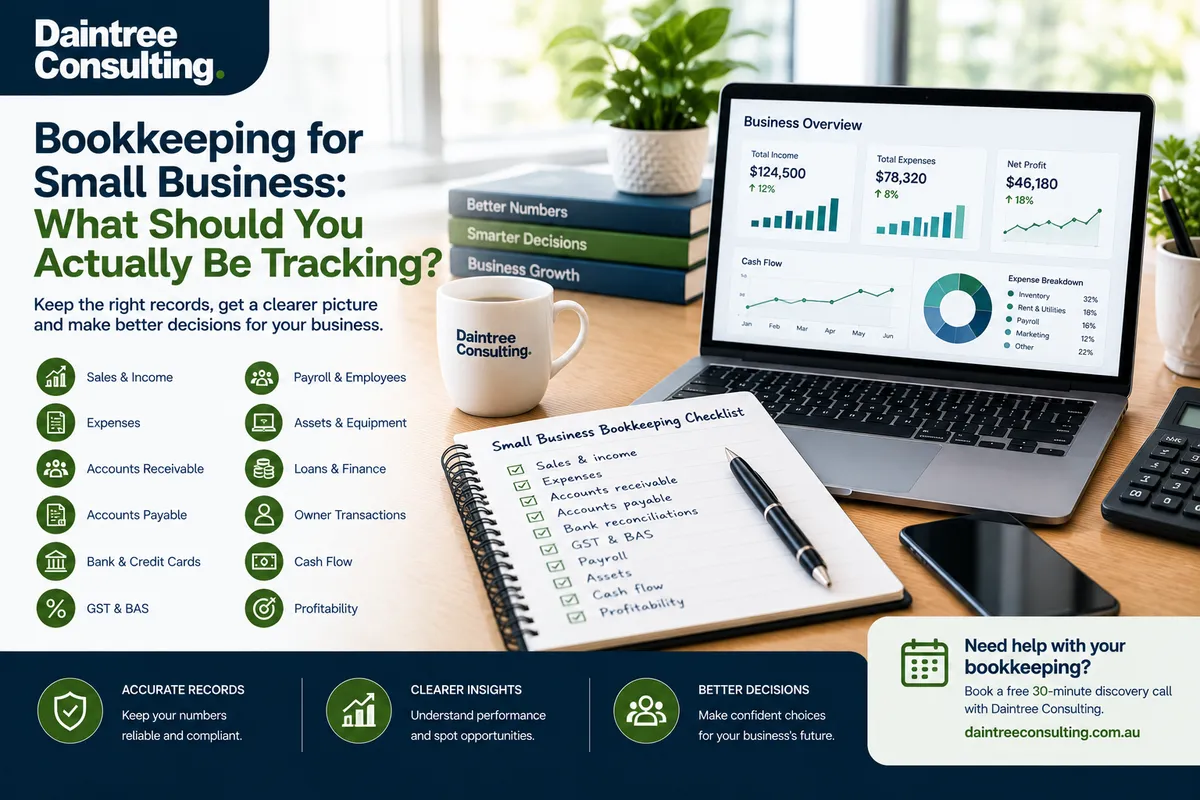
Bookkeeping for Small Business: What Should You Actually Be Tracking?
Bookkeeping is often treated as a task you simply need to get done.
Record the transactions. Reconcile the bank account. Send the invoices. Enter the expenses. Run the reports.
Want expert help? Daintree Consulting's accounting services can take this off your plate. Book a free consultation.
Done.
But good bookkeeping for small business is about more than keeping the books tidy.
Your bookkeeping should help you understand what is happening inside the business while there is still time to do something about it.
Are customers paying on time?
Are expenses creeping up?
Is your cash position improving or tightening?
Are you actually making money on the work you're doing?
Are GST and other obligations being captured correctly?
Do you know what you owe suppliers?
Can you explain why this month's result is different from last month's?
If your bookkeeping system cannot answer those questions, you may be tracking transactions without really tracking the business.
For Australian small businesses, accurate record keeping also supports tax, GST, superannuation and other obligations. Government guidance recommends keeping records of income, expenses, bank transactions, GST where applicable, assets, employees and contractors, among other records depending on the business.
So, what should you actually be tracking?
Let's break it down.
Quick Answer: What Should a Small Business Track?
At a minimum, your bookkeeping system should give you a reliable view of:
Sales and income
Business expenses
Accounts receivable
Accounts payable
Bank and credit-card transactions
GST and BAS-related information, where applicable
Payroll and employee-related transactions
Assets and equipment
Loans and finance
Owner or director transactions
Cash flow
Profitability
But simply recording these items isn't enough.
The real value comes from keeping them accurate, reconciled, current and useful for decision-making.
1. Track Every Sale and Source of Income
Your bookkeeping starts with knowing where your money is coming from.
That means recording your sales accurately and consistently.
Depending on the business, this could include:
Product sales
Service income
Recurring subscriptions
Project revenue
Consulting fees
Online sales
POS transactions
Interest or other income
Other business-related receipts
You should be able to look at your records and understand not just how much you sold, but where that revenue came from.
For example, a service business might want to distinguish between:
consulting
project work
retainers
recurring services
one-off fees
A business selling multiple products may need to track different product categories.
Why this matters
If all revenue is lumped into one number, you lose useful information.
You may know that revenue increased, but not:
which service drove the increase
which product is performing best
whether recurring revenue is growing
whether a particular revenue stream is declining
whether sales growth is translating into profit
Good bookkeeping creates the foundation for better financial reporting later.
2. Track Business Expenses Properly
Knowing what you spend is just as important as knowing what you earn.
Business expenses may include:
Rent
Utilities
Software subscriptions
Insurance
Marketing
Advertising
Professional fees
Vehicle costs
Travel
Office expenses
Materials
Inventory
Contractors
Wages
Equipment
Finance costs
But don't stop at simply recording the total.
Where appropriate, expenses should be categorised consistently so you can identify spending patterns.
For example, if your marketing expenses doubled over six months, you should be able to see that clearly.
The same applies to software, wages, contractors or other significant costs.
The question to ask
Don't just ask:
"Did we record the expense?"
Ask:
"Will our bookkeeping allow us to understand what we're spending and why?"
That is a much more useful standard.
3. Track Accounts Receivable
This is one of the most important areas for a small business.
Accounts receivable is essentially money customers owe the business.
If you issue invoices, you need to know:
What has been invoiced?
What has been paid?
What remains outstanding?
Which invoices are overdue?
How long have customers owed the money?
Are overdue balances increasing?
A business can appear profitable while experiencing cash-flow pressure because customers are taking too long to pay.
This is particularly important for businesses that operate on payment terms rather than receiving payment immediately.
Don't confuse sales with cash
Imagine you invoice a customer $20,000.
You may record the sale.
But until the customer pays, the business does not have that $20,000 sitting in its bank account.
That difference matters.
Government guidance notes that accrual accounting records sales and expenses when they occur, allowing the business to see amounts owed to it and amounts it owes to others.
Your bookkeeping should make outstanding customer balances visible.
4. Track Accounts Payable
The other side of the equation is money your business owes to suppliers and other parties.
You should have visibility over:
Supplier invoices
Payment due dates
Outstanding bills
Overdue bills
Recurring commitments
Major upcoming payments
This helps you understand what cash will need to leave the business.
It also reduces the risk of bills being forgotten or paid late.
A simple question
Ask:
"If I looked at the business today, could I quickly estimate what we owe suppliers?"
If the answer is no, your bookkeeping process may need attention.
5. Reconcile Your Bank Accounts Regularly
Bank reconciliation is one of those bookkeeping tasks that can seem routine until you realise how much depends on it.
Your accounting records should be compared against your actual bank transactions so discrepancies can be identified.
You may have:
missed transactions
duplicate entries
incorrectly coded expenses
payments recorded against the wrong account
deposits that haven't been allocated
fees that haven't been recorded
transactions that require clarification
Regular reconciliation helps identify these issues earlier.
It also gives you greater confidence that the financial information you're looking at reflects what is actually happening.
Australian Government guidance specifically identifies bank records as part of the business records that may need to be maintained.
6. Track GST and BAS-Related Information
If your business is registered for GST, your bookkeeping needs to capture the information required to support your GST and BAS obligations.
This can involve tracking:
GST collected
GST paid on eligible purchases
Sales
Purchases
Relevant adjustments
Other information required for the applicable reporting period
The exact obligations depend on the business and its circumstances.
This is one area where sloppy bookkeeping can become expensive because errors may flow into reporting and tax calculations.
Don't treat BAS preparation as the first time you look at your books
A better approach is to maintain accurate records throughout the reporting period.
Then BAS preparation becomes a review and reporting process rather than a frantic exercise in reconstructing several months of transactions.
7. Track Payroll and Employee-Related Transactions
Once you have employees, bookkeeping becomes more than sales and expenses.
You may need to maintain records relating to:
Wages
PAYG withholding
Superannuation
Leave
Payroll-related liabilities
Employee reimbursements
Payroll tax where applicable
Contractor payments where relevant
The exact obligations depend on your business, employees and circumstances.
The important point is that payroll should connect properly with your broader accounting records.
If payroll is being processed separately but never properly reflected in the accounts, your financial reports can become misleading.
8. Track Business Assets
A business may accumulate assets such as:
Computers
Vehicles
Machinery
Furniture
Equipment
Fit-outs
Technology
Other significant business assets
These purchases should not simply disappear into a generic "expenses" category without considering how they should be treated in the accounts.
You should maintain appropriate records showing what was purchased, when it was purchased, how much it cost and other relevant information.
This becomes particularly important when calculating depreciation or dealing with the eventual sale or disposal of an asset.
Government guidance also identifies records relating to the purchase, sale and other costs of business assets as records businesses may need to retain.
9. Track Loans and Finance
If your business has borrowed money, your bookkeeping should make the position clear.
Track things such as:
Loan balances
Principal repayments
Interest
Finance fees
New borrowings
Equipment finance
Business credit facilities
Why?
Because a loan payment does not necessarily represent one single type of accounting transaction.
The amount reducing the loan balance and the amount relating to interest can have different accounting treatment.
More importantly, management needs to understand the business's debt position.
10. Track Owner, Director and Private Transactions Carefully
This is particularly important for small businesses where the owner's personal and business finances can sometimes become mixed.
Examples might include:
Money the owner puts into the business
Money taken out of the business
Business expenses paid personally
Personal expenses accidentally paid from a business account
Director loans
Drawings
These transactions should not simply be left unexplained.
Keeping business and personal transactions separate can make bookkeeping, reporting and tax work significantly easier. Australian Government guidance also recommends separating business and personal records to avoid confusion.
11. Track Cash Flow—Not Just Profit
This is one of the biggest mistakes small businesses make.
They focus on the profit and loss statement while overlooking cash.
But profit and cash are not the same thing.
A business might report a profit while:
customers are slow to pay
inventory has increased
large bills are due
loan repayments are consuming cash
equipment has been purchased
tax liabilities are building
That's why bookkeeping should provide information that helps you understand both profitability and cash position.
Government guidance recommends using financial records to manage cash flow and identifies cash flow statements as one of the key financial documents businesses should review.
12. Track Profitability
Revenue tells you how much you sold.
Profit tells you what remains after the relevant costs and expenses.
You should be able to understand:
Revenue
Cost of sales
Gross profit
Operating expenses
Net profit
Major changes from one period to another
For some businesses, it can also be useful to track profitability by:
product
service
project
location
customer type
business division
The more complex the business becomes, the more useful this level of visibility can be.
Bookkeeping Should Answer Business Questions
This is the bigger idea behind good bookkeeping.
Your books shouldn't exist simply because your accountant needs them at tax time.
They should help you answer questions such as:
Are we making money?
Where is our cash going?
Who owes us money?
What bills are coming up?
Which expenses are increasing?
Are sales growing?
Are margins changing?
Can we afford another employee?
Are we on track against our budget?
Can we afford to invest in new equipment?
What needs management attention?
If your bookkeeping cannot help answer these questions, you may need to improve more than your data entry.
You may need a better financial reporting process.
What Should You Track Daily, Weekly and Monthly?
Not every bookkeeping task needs to happen every day.
The right frequency depends on your business, transaction volume and obligations.
Daily
Depending on the business:
Sales
Customer payments
POS transactions
Cash transactions
New invoices
Important purchases
Weekly
A weekly review might include:
Bank transactions
Outstanding invoices
Supplier bills
Cash position
Payroll-related items
Unusual transactions
Monthly
Monthly bookkeeping should ideally give management a much clearer financial picture.
This may include:
Bank reconciliations
Credit-card reconciliations
Accounts receivable
Accounts payable
Payroll reconciliation
GST-related review
Profit and loss
Balance sheet
Cash position
Major expense movements
Management reporting
The exact process should reflect the business.
A small consultancy with ten transactions a week does not need the same bookkeeping process as a business processing hundreds of transactions every day.
What Should a Small Business Owner Look at Every Month?
You don't necessarily need to review every transaction yourself.
But you should understand the major financial indicators.
At a minimum, consider reviewing:
Revenue
Is sales activity moving in the direction you expect?
Gross margin
Are you retaining an appropriate amount of revenue after direct costs?
Operating expenses
Which expenses have increased?
Net profit
Is the business actually producing the level of profit you expected?
Accounts receivable
Are customers paying on time?
Accounts payable
What do you owe suppliers?
Cash
How much cash is available now?
Debt
What finance commitments are outstanding?
Budget versus actual
Are actual results broadly aligned with expectations?
Government guidance recommends reviewing financial documents regularly and looking for trends or unusual movements that may indicate areas requiring attention.
Bookkeeping vs Accounting: Where's the Difference?
The terms are often used interchangeably, but they are not exactly the same.
Bookkeeping generally focuses on recording and maintaining day-to-day financial transactions.
Accounting can go further by interpreting financial information, preparing financial statements, analysing performance and supporting financial decisions.
Business.gov.au describes a bookkeeper as someone who tracks day-to-day transactions and may also handle banking, invoicing, overdue payments, wages, cash-flow monitoring and some financial statements. It describes accountants as professionals who can analyse business finances, prepare financial statements and help with financial decisions.
This distinction matters as your business grows.
You may start by needing someone to keep the books.
Eventually, you may need someone who can help you understand what the numbers are telling you.
When Should You Get Professional Bookkeeping Support?
You don't need to wait until your bookkeeping is completely out of control.
Professional support can make sense when:
transactions are becoming difficult to keep up with
you're regularly behind on reconciliations
invoices aren't being followed up
bills are being missed
financial reports aren't reliable
you are spending too much time doing bookkeeping
BAS preparation becomes stressful
you are unsure whether your accounts are accurate
your business has employees and payroll complexity
you need better cash-flow visibility
you are spending more time fixing bookkeeping than running the business
The Australian Government also recognises bookkeeping as a distinct professional function that can help businesses manage day-to-day transactions, banking, invoicing, overdue payments, wages and cash flow.
What If Your Bookkeeping Is Already Behind?
Don't panic—and don't try to fix everything at once.
Start by identifying the gap.
For example:
Are bank accounts reconciled?
Are all sales recorded?
Are outstanding invoices accurate?
Are supplier bills current?
Are payroll transactions captured correctly?
Are owner transactions properly classified?
Are GST-related records complete?
Once the underlying records are reliable, you can build a more useful reporting process on top of them.
Trying to make management decisions from incomplete books usually creates more confusion.
How Daintree Consulting Can Help
Daintree Consulting supports Australian businesses with accounting and financial oversight designed around the needs of the business.
Its accounting service can include accurate financial records, reconciliations, management accounts, budget-to-actual reporting, cash-flow reporting and financial dashboards, with coordination across bookkeeping, tax and advisory work.
The broader objective is simple:
Accurate records → Clear reporting → Better decisions → Confident growth.
Daintree can work alongside an existing bookkeeper or finance team, or support a business as part of a broader outsourced finance function.
This can be particularly useful when your bookkeeping is being maintained but management needs more visibility from the numbers.
Explore Daintree Consulting's Accounting Services
Final Thoughts: Track What Helps You Run the Business
Good bookkeeping is not about collecting the maximum amount of information.
It's about collecting and maintaining the right information accurately and consistently.
For most small businesses, that means having a reliable view of:
Sales
Expenses
Receivables
Payables
Bank accounts
GST
Payroll
Assets
Loans
Owner transactions
Cash flow
Profitability
Then the next step is turning those records into information you can actually use.
Because the real purpose of bookkeeping isn't simply to tell you what happened.
It's to give you a clearer starting point for deciding what happens next.
If your current bookkeeping process leaves you chasing numbers, questioning balances or waiting until tax time to understand your financial position, it may be time to review the way your accounts are being managed.
Frequently Asked Questions
What should a small business track in bookkeeping?
At a minimum, a small business should generally track income, expenses, bank transactions, accounts receivable, accounts payable, GST where applicable, payroll, assets, loans and relevant owner transactions. The exact records required depend on the business structure and circumstances.
How often should small business bookkeeping be done?
The appropriate frequency depends on transaction volume, business complexity and reporting obligations. Some businesses need transactions reviewed frequently, while others may operate comfortably with a structured weekly or monthly process.
The important thing is that records remain current enough to support reporting and decision-making.
What records does a small business need to keep in Australia?
Businesses generally need records relating to transactions and their tax, superannuation and registration obligations. These can include sales, expenses, bank records, GST records, asset records and employee or contractor records. Requirements can vary according to the business structure and circumstances.
How long should a small business keep bookkeeping records?
Most business records generally need to be kept for five years, although some records have longer retention requirements. Businesses should check the rules that apply to their particular records and circumstances.
Is bookkeeping the same as accounting?
No. Bookkeeping generally focuses on recording and maintaining financial transactions, while accounting can include interpreting financial information, preparing financial statements and supporting business decisions.
Can bookkeeping help with cash flow?
Yes. Accurate, current bookkeeping helps you see customer receipts, supplier payments, expenses and other movements affecting cash. However, bookkeeping itself does not guarantee a particular cash-flow result.
Should I use accounting software for my small business?
Digital accounting systems can make it easier to record transactions, generate reports and back up financial information. The best system depends on the size, complexity and needs of the business. Australian Government guidance notes that digital record keeping can make financial administration easier when properly set up.
When should I outsource bookkeeping?
Consider professional bookkeeping support when transaction volumes increase, reconciliations fall behind, invoices aren't being followed up, records become unreliable or bookkeeping is taking too much of your time.
The decision should be based on the business's needs rather than simply its revenue.
Ready to Get Your Business Numbers Under Control?
If your bookkeeping has become a recurring source of stress—or you simply want greater confidence in the numbers—Daintree Consulting can help you understand where your current process stands and what level of support makes sense.
Book a free 30-minute discovery call to discuss your accounting and financial reporting needs.
Book a Free 30-Minute Discovery Call with Daintree Consulting
Talk to Daintree about your accounting
Our ex-Big 4 team gives clear, senior-reviewed advice so you can act with confidence.
Book a free consultation →
Or explore our accounting services.
