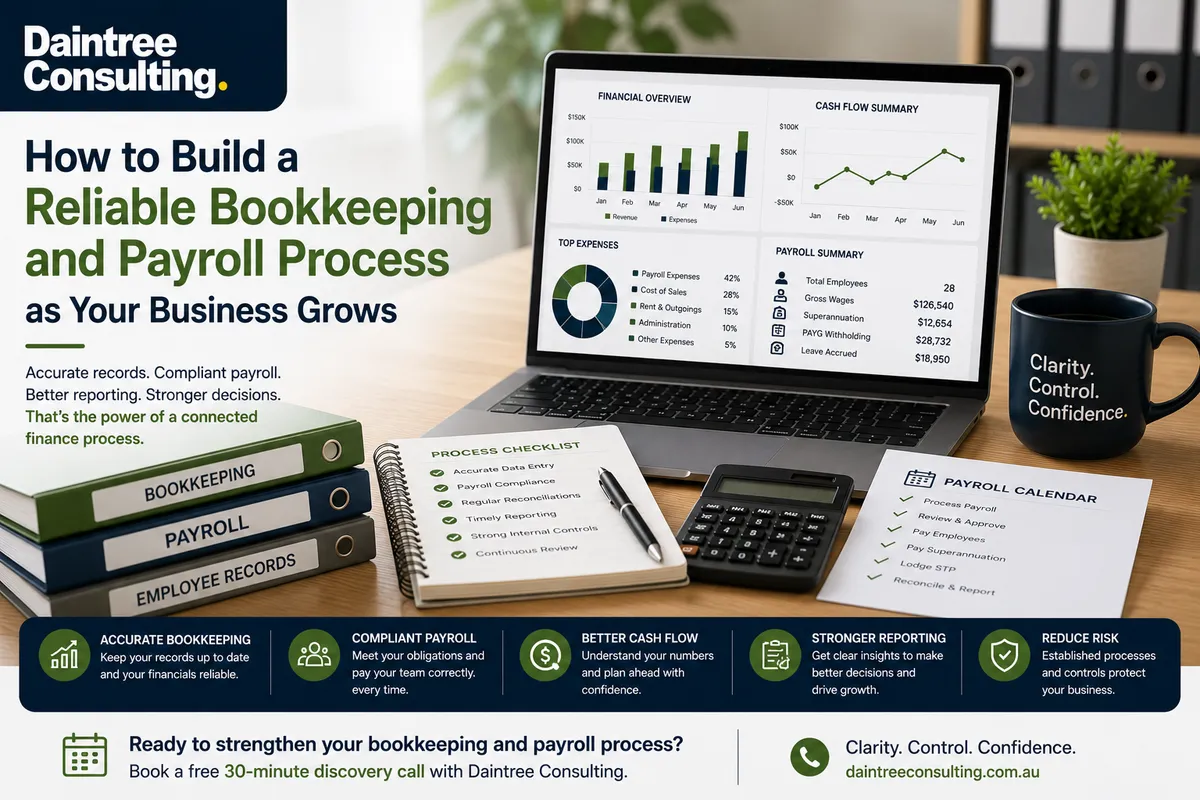
Bookkeeping and Payroll Services: A Reliable Process for Growing Businesses
Growing a business is exciting.
More customers, more employees and higher revenue are usually signs that things are moving in the right direction.
Want expert help? Daintree Consulting's accounting services can take this off your plate. Book a free consultation.
But growth also creates financial administration problems.
The bookkeeping process that worked when you had five employees and a handful of invoices may become unreliable once you have twenty employees, hundreds of transactions and multiple revenue streams.
Payroll can become particularly challenging.
You need accurate employee records, correct pay calculations, leave balances, superannuation, PAYG withholding, pay slips and reporting processes. At the same time, your bookkeeping needs to capture payroll correctly so your financial reports reflect what is actually happening in the business.
This is why bookkeeping and payroll services often become increasingly valuable as a business grows.
The goal is not simply to outsource administrative work.
It is to build a finance process where transactions are recorded accurately, employees are paid correctly, financial records stay up to date and management can rely on the numbers.
Quick Answer: How Do You Build a Reliable Bookkeeping and Payroll Process?
A reliable process usually has seven foundations:
Use appropriate accounting and payroll software
Keep bookkeeping records current
Create a consistent payroll workflow
Check awards, employee classifications and entitlements
Reconcile payroll with the accounting records
Build approval and review controls
Review the process as the business grows
The most important principle is that bookkeeping and payroll should work together without assuming they are the same function.
Payroll information needs to flow accurately into the accounting system, while employee records and payroll calculations require their own controls and review.
Why Bookkeeping and Payroll Become More Difficult as a Business Grows
A small business can sometimes manage bookkeeping and payroll with relatively simple processes.
As the business grows, however, complexity increases.
You may add:
More employees
Different employment arrangements
Multiple pay rates
Overtime
Allowances
Bonuses
Leave
More suppliers
More customers
Multiple bank accounts
Inventory
Multiple locations
New accounting systems
More frequent reporting requirements
Each additional layer creates more opportunities for errors.
For example, a payroll mistake does not necessarily stay within payroll.
An incorrect wage calculation can affect:
Payroll expenses
Superannuation
PAYG withholding
Leave balances
Cash flow
Financial reporting
Employee records
That is why a growing business needs a process rather than relying on one person remembering what needs to be done.
Bookkeeping and Payroll Are Connected — But They Are Not the Same
It is common for Australian businesses to use the same provider for bookkeeping and payroll.
That can be highly effective, but it is important to understand the distinction.
Bookkeeping
Bookkeeping generally involves recording and organising the financial transactions of the business.
This can include:
Recording sales
Recording purchases
Bank reconciliations
Credit-card reconciliations
Accounts payable
Accounts receivable
Expense coding
GST coding
Payroll journal entries
Preparing financial information for BAS and reporting
Payroll
Payroll focuses specifically on employee payments and employment-related records.
This can include:
Calculating wages
Processing overtime
Applying relevant allowances
Managing leave
PAYG withholding
Superannuation
Pay slips
Single Touch Payroll reporting
Employee changes
Terminations and final payments
A good outsourced finance provider can coordinate both functions while maintaining appropriate checks around each.
Step 1: Choose the Right Accounting and Payroll Systems
The first step is creating a reliable technology foundation.
Your accounting and payroll software should be appropriate for the size and complexity of your business.
Cloud-based systems can make it easier to:
Access records
Automate repetitive tasks
Connect payroll with accounting
Reconcile bank transactions
Produce financial reports
Maintain employee records
Manage approvals
However, software does not fix a broken process.
A sophisticated accounting system can still produce unreliable reports if transactions are incorrectly coded, accounts are not reconciled or payroll information is entered incorrectly.
The system should therefore support your process rather than replace it.
Step 2: Keep Bookkeeping Up to Date
One of the biggest problems growing businesses face is allowing bookkeeping to fall behind.
When records are only updated at the end of the month — or worse, at the end of the quarter — management can make decisions using outdated information.
Regular bookkeeping should cover areas such as:
Bank transactions
Sales
Supplier invoices
Expenses
Credit cards
Payroll
GST
Accounts receivable
Accounts payable
The frequency depends on the business.
A high-volume business may need more frequent processing, while a smaller business may be able to operate effectively with a different rhythm.
The important thing is consistency.
Step 3: Build a Standard Payroll Workflow
Payroll should follow the same basic process every pay cycle.
A typical workflow may look like:
Employee information → Timesheets/approved hours → Payroll calculation → Review → Approval → Payment → Pay slips → Payroll reporting → Accounting reconciliation
The exact workflow will depend on your software and business structure.
The advantage of having a documented process is that payroll does not depend entirely on one person's memory.
If your payroll officer is away, another authorised person should be able to understand what needs to happen.
Step 4: Check Awards and Employment Conditions
Payroll is not simply a matter of entering hours and pressing "process".
Australian employment conditions can be complex.
Depending on the employee and industry, you may need to consider:
Modern awards
Enterprise agreements
Employment contracts
Minimum rates
Overtime
Penalty rates
Allowances
Leave entitlements
Annualised wage arrangements
Casual employment conditions
Fair Work guidance confirms that employers need to keep accurate employment records, including information about pay, hours, leave and other relevant employment matters.
If your business has employees covered by an award, payroll processes should be designed around the conditions that actually apply to those employees.
Do not assume that every employee can be paid using the same rules.
Step 5: Make Payroll Approvals Clear
One of the simplest ways to reduce payroll errors is to introduce an approval process.
For example:
Employee submits hours → Manager approves → Payroll processes → Authorised person reviews → Payment released
The exact structure can vary.
The key is to avoid situations where one person can enter employee changes, calculate payroll, approve the payment and release the funds without independent review.
Appropriate separation of responsibilities becomes increasingly important as the business grows.
Step 6: Reconcile Payroll to the Accounting Records
Payroll should not operate separately from your accounting system.
After payroll is processed, the payroll figures should be checked against the accounting records.
You should be able to reconcile items such as:
Gross wages
PAYG withholding
Superannuation
Leave liabilities
Net wages
Payroll-related expenses
Payroll clearing accounts
Regular reconciliation helps identify errors before they become difficult to correct.
It also ensures management reports are based on reliable financial information.
Step 7: Keep Employee Records Properly
Payroll records are not just useful for your accountant.
They are part of your employer obligations.
The Fair Work Ombudsman states that employers must keep time and wages records for 7 years. Records must be accessible, legible and in English, and must not be false or misleading.
Records can include information relating to:
Employee details
Pay
Hours worked
Overtime
Leave
Allowances
Penalty rates
Superannuation
Termination
Relevant employment arrangements
Employees must also receive pay slips within one working day of payday, whether electronically or in hard copy.
A reliable payroll process should therefore include appropriate record storage and access controls.
Step 8: Protect Sensitive Payroll Information
Payroll contains highly sensitive employee information.
A growing business should think carefully about:
Who can access payroll
Who can change employee bank details
Who can approve pay runs
Where payroll records are stored
How employee information is shared
Whether former employees retain unnecessary system access
Access should be based on responsibilities.
For example, someone who only needs to review management reports may not need full access to employee payroll information.
Step 9: Build Regular Payroll Checks
Do not wait until the end of the financial year to discover payroll problems.
Regular checks can include:
Reviewing unusual changes in wages
Checking new employee details
Reviewing terminated employees
Checking leave balances
Reconciling payroll accounts
Reviewing superannuation records
Checking PAYG withholding
Comparing payroll to the previous pay period
Investigating unexpected changes
A simple review can catch problems before they become expensive.
Step 10: Connect Payroll to Financial Reporting
Payroll is one of the largest expenses for many Australian businesses.
That means it should be visible in management reporting.
Your monthly financial reports should help you understand:
Total payroll cost
Payroll as a percentage of revenue
Changes in headcount
Revenue per employee where relevant
Overtime costs
Leave liabilities
Superannuation costs
Changes in employment expenses
This allows management to connect workforce decisions with financial performance.
For example, hiring five additional employees may increase capacity — but management should also understand the financial impact on cash flow and profitability.
Common Bookkeeping and Payroll Problems to Avoid
1. Leaving bookkeeping until the end of the quarter
This makes it harder to understand current performance.
Better approach: establish a consistent bookkeeping cycle.
2. Treating payroll as "just data entry"
Payroll requires knowledge of employment conditions and careful checking.
Better approach: make sure whoever handles payroll has the appropriate knowledge and processes.
3. No payroll approval process
When one person controls every stage of payroll, errors and fraud can be harder to detect.
Better approach: introduce appropriate review and approval controls.
4. Not reconciling payroll
Payroll can appear correct while accounting records contain errors.
Better approach: reconcile payroll and accounting records regularly.
5. Using outdated employee information
Changes to bank accounts, employment conditions, pay rates or employee status need to be managed carefully.
Better approach: establish a documented employee-change process.
6. Ignoring award complexity
Different employees may have different entitlements.
Better approach: identify the applicable award, agreement or employment conditions before establishing payroll rules.
7. Relying entirely on one person
If your bookkeeper or payroll officer is unavailable, the business should still be able to run payroll.
Better approach: document the process and maintain appropriate backup access.
When Should You Outsource Bookkeeping and Payroll?
You do not necessarily need outsourced support from day one.
But there are several signs that your current process may no longer be sufficient.
You may want professional bookkeeping and payroll services when:
Payroll takes too much management time
Bookkeeping regularly falls behind
You have more employees than your current process comfortably handles
Payroll errors are becoming more frequent
BAS preparation becomes stressful
You are unsure whether payroll rules are being applied correctly
Financial reports are consistently delayed
Your business is adding locations or entities
The owner is still personally managing routine bookkeeping
You need more reliable management reporting
Growth is often the point where a business needs to move from an informal finance process to a properly managed finance function.
Should Bookkeeping and Payroll Be Outsourced Together?
For many small and medium-sized businesses, there can be significant advantages to using one experienced provider.
An integrated provider can potentially:
Reduce handovers
Keep payroll and bookkeeping aligned
Simplify communication
Improve financial reporting
Reduce duplicated administration
Give management one point of contact
Make it easier to scale support as the business grows
However, integration should not mean a lack of controls.
The provider should still have appropriate processes for reviewing payroll, approving changes and reconciling financial information.
What Does a Good Outsourced Bookkeeping and Payroll Service Look Like?
A good provider should offer more than simply processing transactions.
Look for a service that provides:
Accurate bookkeeping
Your accounts should be reconciled and maintained consistently.
Reliable payroll
Payroll should be processed according to the applicable employment conditions and business requirements.
Clear communication
You should know what information is required and when.
Defined responsibilities
You should understand what your provider handles and what remains your responsibility.
Regular reporting
Your financial information should be available in time to support decisions.
Appropriate controls
There should be clear approval, review and reconciliation processes.
Scalability
The service should be able to grow with your business.
How Daintree Consulting Can Help
At Daintree Consulting, bookkeeping and payroll can form part of an integrated outsourced finance function for Australian businesses.
The focus is not simply on processing transactions.
The objective is to create reliable financial foundations that support accurate reporting and better business decisions.
Depending on the business's needs, support can include:
Day-to-day bookkeeping
Bank and account reconciliations
Payroll processing
Payroll-related accounting
BAS support
Financial reporting
Management accounts
Cash-flow reporting
Budget vs actual reporting
Business advisory
Outsourced CFO support
This integrated approach means the business does not have to treat bookkeeping, payroll and financial reporting as completely separate processes.
Instead, they can work together as part of a connected finance function.
Ready to Build a More Reliable Finance Process?
If your bookkeeping and payroll process is becoming harder to manage as your business grows, it may be time to review how the system works.
The right solution is not always to hire another employee.
Sometimes the better option is to build a properly structured outsourced finance function that gives you access to bookkeeping, payroll and financial expertise without the cost and management burden of building the entire function internally.
Book a free 30-minute discovery call with Daintree Consulting to discuss your current bookkeeping and payroll setup and identify practical areas for improvement.
Frequently Asked Questions
What are bookkeeping and payroll services?
Bookkeeping and payroll services provide professional support with maintaining business financial records and managing employee payroll processes. Depending on the provider, the service may also include BAS support, reconciliations, reporting and other finance functions.
Can the same person handle bookkeeping and payroll?
Yes. Many professionals handle both functions, particularly for small businesses. However, payroll requires specific knowledge of employment conditions, payroll reporting and employee entitlements, so businesses should ensure the person handling it has the appropriate expertise.
Is payroll part of bookkeeping?
Not automatically. Payroll is closely connected to bookkeeping but is a distinct function. Some bookkeeping providers include payroll in their packages, while others offer it as a separate service.
When should a small business outsource bookkeeping?
Outsourcing can make sense when bookkeeping is taking too much owner time, records are falling behind, financial reports are delayed or the business has become too complex to manage efficiently internally.
When should a business outsource payroll?
Payroll outsourcing can be useful when the number of employees increases, payroll becomes more complex, management lacks the required expertise or the business wants a more structured and reliable payroll process.
What payroll records does an Australian employer need to keep?
Australian employers have record-keeping obligations covering areas such as employee details, pay, hours worked, leave and other employment information. Fair Work states that time and wages records generally need to be kept for seven years.
How often should bookkeeping be done?
The appropriate frequency depends on transaction volume, business complexity and reporting needs. Growing businesses often benefit from regular processing rather than allowing transactions to accumulate until BAS or year-end.
Can outsourced bookkeeping and payroll improve financial reporting?
Yes. When bookkeeping and payroll are processed consistently and reconciled correctly, management is more likely to have timely and reliable financial information for decision-making.
Important Publishing Note
Payroll, employment, superannuation, tax and record-keeping requirements can change and may depend on the business, employee, award, agreement and other circumstances. This article provides general information only and should not be treated as legal, tax, payroll or employment-law advice. Before publishing or updating this article, Daintree Consulting should confirm that any specific payroll, superannuation, Single Touch Payroll, award and compliance references remain current for the relevant financial year. Businesses should refer to the ATO, Fair Work Ombudsman and other relevant authorities or obtain professional advice for requirements that apply to their circumstances.
This note is particularly appropriate because payroll obligations can change and Fair Work guidance itself notes that requirements and penalties may be updated.
Talk to Daintree about your accounting
Our ex-Big 4 team gives clear, senior-reviewed advice so you can act with confidence.
Book a free consultation →
Or explore our accounting services.
