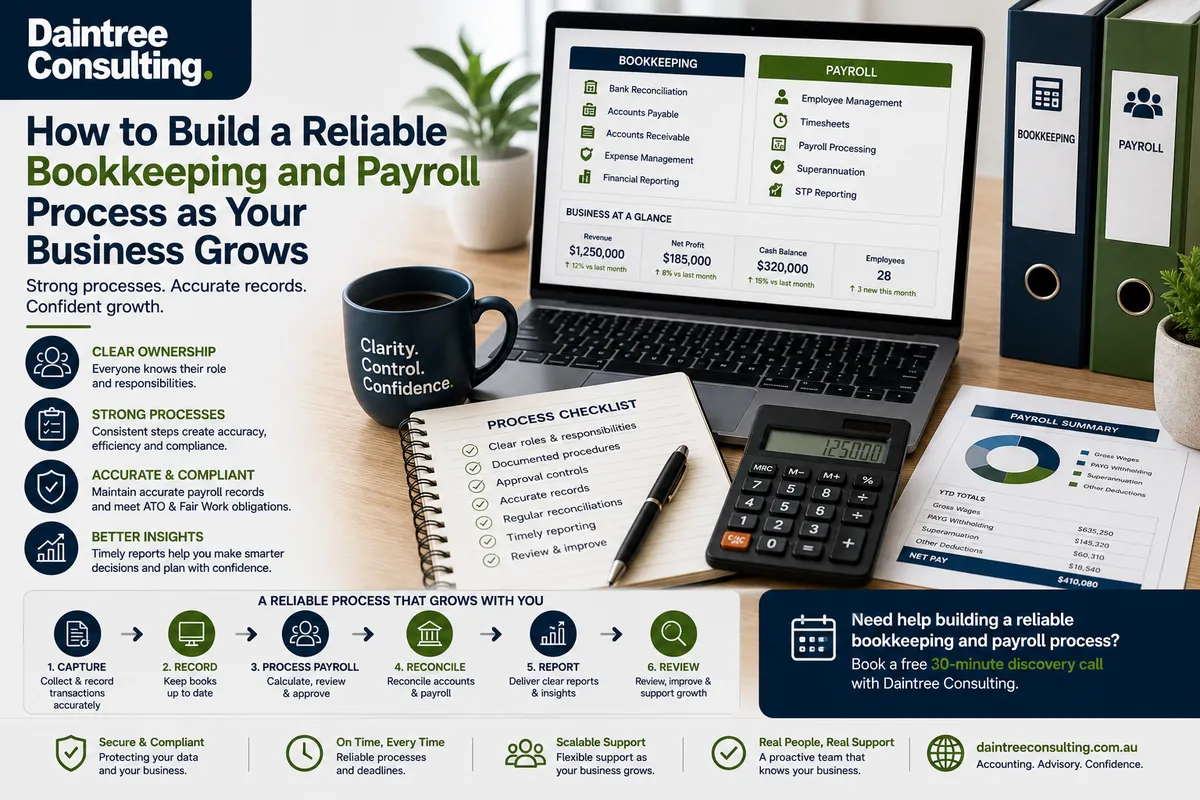
How to Build a Reliable Bookkeeping and Payroll Process as Your Business Grows
When a business is small, bookkeeping and payroll can feel relatively simple.
There may be only a handful of employees, a manageable number of invoices and expenses, and one person who knows where everything is.
Want expert help? Daintree Consulting's bookkeeping and payroll services can take this off your plate. Book a free consultation.
Then the business starts growing.
More employees join. Transactions increase. Suppliers change. Customers take longer to pay. Payroll becomes more complicated. Superannuation, leave, timesheets and employee records need closer attention. The owner starts spending hours every week checking numbers and chasing information.
Eventually, the process that once worked becomes difficult to manage.
This is a common growth problem.
The answer is not necessarily to buy more software or hire a large finance team. Often, the bigger opportunity is to build a reliable bookkeeping and payroll process with clear responsibilities, consistent procedures, appropriate controls and regular review.
For Australian businesses, this is particularly important because payroll involves more than simply paying employees. Employers have record-keeping and payslip obligations, and payroll information also connects with tax and reporting processes such as Single Touch Payroll. Fair Work requires employers to keep certain employment records for seven years and provide employees with payslips within one working day of pay day.
This guide explains how to build a bookkeeping and payroll process that can grow with your business—without creating unnecessary administrative complexity.
Quick Answer: What Makes a Reliable Bookkeeping and Payroll Process?
A reliable process should have five core characteristics:
Clear ownership — everyone knows who is responsible for each recurring task.
Consistent procedures — transactions and payroll are processed the same way each time.
Strong records — supporting documents are captured and retained.
Approval controls — important payments and payroll changes are checked before processing.
Regular reconciliation and review — errors are identified before they become bigger problems.
The process should connect:
Transactions → Bookkeeping → Payroll → Reconciliations → Reporting → Review
As the business grows, the process should become more structured, not necessarily more complicated.
Why Bookkeeping and Payroll Often Become Difficult During Growth
Growth creates more financial activity.
A business might move from:
5 employees to 25
100 monthly transactions to 1,000
one bank account to several
one business location to multiple locations
simple wages to different pay rates and employment arrangements
manual spreadsheets to integrated accounting and payroll software
Each individual change may seem manageable.
The problem is what happens when they all occur at once.
A process based around one owner checking everything personally may no longer be sustainable.
For example, the owner might previously:
Approve supplier invoices
Process payroll
Reconcile the bank
Check employee timesheets
Send invoices
Follow up overdue accounts
Review expenses
Prepare information for the accountant
As the business grows, this can become a bottleneck.
It also creates key-person risk.
If the owner is unavailable, does anyone else know what needs to happen?
A reliable bookkeeping and payroll process should reduce that dependency.
Step 1: Map Your Current Bookkeeping and Payroll Process
Before changing systems or outsourcing anything, understand how the process currently works.
Write down every recurring finance and payroll task.
This might include:
Bookkeeping
Recording sales
Recording purchases
Processing expenses
Bank reconciliations
Credit-card reconciliations
Accounts payable
Accounts receivable
Supplier payments
Customer receipts
Month-end close
BAS preparation support
Financial reporting
Payroll
Employee setup
Timesheet collection
Leave processing
Payroll calculations
Pay runs
Payslips
Superannuation processing
PAYG withholding
Single Touch Payroll reporting
Payroll reconciliations
Employee record maintenance
Then identify:
Who does each task?
When is it done?
What information is required?
Who reviews it?
What happens if the person responsible is unavailable?
This simple exercise often reveals where the process is fragile.
Step 2: Give Every Recurring Task a Clear Owner
One of the biggest problems in growing businesses is unclear responsibility.
Everyone assumes someone else is doing the task.
That is especially risky with payroll.
A reliable process should define ownership for each activity.
For example:
Timesheets: Employee / manager
Timesheet approval: Department manager
Payroll processing: Payroll administrator
Payroll review: Authorised manager
Payment approval: Authorised business owner or officer
Bookkeeping: Bookkeeper or finance team
Bank reconciliation: Bookkeeper
Month-end review: Accountant or finance lead
The exact structure will depend on the business.
The important principle is:
Every recurring financial task should have one clearly identified owner and, where appropriate, a reviewer.
Daintree Consulting's current bookkeeping and payroll service similarly focuses on clear ownership of recurring finance tasks alongside structured processing and reporting.
Step 3: Separate Processing From Approval
As a business grows, internal controls become increasingly important.
One person having unrestricted control over the entire financial process can create unnecessary risk.
Where practical, separate:
Preparing a payment
Approving a payment
Processing the payment
Reconciling the transaction
The same principle can apply to payroll.
For example, one person may prepare the payroll while another authorised person reviews and approves the final payroll before payment.
This does not mean every business needs a large finance department.
Even a small business can introduce basic controls.
For example:
Prepare → Review → Approve → Pay → Reconcile
This creates a simple audit trail and reduces the chance that an error goes unnoticed.
Step 4: Standardise Your Bookkeeping Process
Bookkeeping becomes harder to manage when every transaction is handled differently.
Create consistent procedures for:
Supplier invoices
Customer invoices
Business expenses
Employee expenses
Bank transactions
Credit-card transactions
Asset purchases
Recurring subscriptions
Refunds
Customer receipts
Supplier payments
For example, establish rules around:
Who enters the transaction?
What supporting document is required?
Which account should it be coded to?
Who reviews unusual transactions?
When should the transaction be reconciled?
Consistency makes the accounts easier to review and makes it easier for someone else to step into the process.
Step 5: Keep Bookkeeping Current
One of the most common bookkeeping problems is allowing transactions to accumulate.
The business may technically have accounting software, but the information is weeks or months behind.
That creates a major visibility problem.
If the books are not current, management may not know:
How much cash is available
Which customers owe money
Which suppliers need to be paid
Whether expenses are increasing
Whether margins are changing
Whether the business is actually tracking toward budget
Daintree's bookkeeping and payroll service specifically focuses on current, reconciled bookkeeping and month-end bookkeeping close to create better information for reporting and decisions.
A good target is not simply:
"Enter transactions eventually."
It is:
"Keep the financial records current enough to support decisions."
Step 6: Build a Reliable Payroll Checklist
Payroll should not rely on memory.
Create a repeatable checklist for every pay cycle.
Depending on the business, this may include:
Confirm employee changes.
Collect approved timesheets.
Check leave requests.
Review overtime and allowances.
Check employee classifications and pay rates.
Process payroll.
Review payroll totals.
Obtain required approval.
Process payment.
Issue payslips.
Complete required payroll reporting.
Reconcile payroll to the accounting records.
File supporting documentation.
The exact process depends on the business, employment arrangements and payroll system.
But documenting the workflow creates consistency.
It also makes training easier when another person joins the finance team.
Step 7: Treat Payroll Records as Important Business Records
Payroll records are not simply internal administration.
Australian employers have specific record-keeping and payslip obligations.
Fair Work states that employers must make and keep accurate and complete employee records, including information such as pay and hours worked, and that employment records generally need to be kept for seven years. Employees must receive payslips within one working day of pay day.
Records can include information relating to:
Employee details
Employment commencement
Employment type
Pay rates
Hours worked
Overtime
Leave
Allowances
Deductions
Gross and net pay
Other employment information
Fair Work also emphasises that employee records must be accurate, accessible and not false or misleading.
This makes reliable payroll processes important from both an operational and compliance perspective.
Step 8: Connect Payroll With Your Accounting Records
Payroll should not operate as a completely separate system from bookkeeping.
Your accounting records should allow management to understand the financial impact of payroll.
This can include:
Gross wages
PAYG withholding
Superannuation
Leave liabilities
Payroll-related expenses
Payroll taxes where applicable
Employee-related costs
At the end of each payroll cycle or reporting period, payroll should be reconciled against the accounting records.
This can help identify:
Duplicate entries
Incorrect payroll journals
Missing transactions
Incorrect classifications
Unreconciled liabilities
A payroll system can process the pay run, but the accounting records still need to tell the broader financial story.
Step 9: Make Sure Your Payroll System Supports Required Reporting
Modern payroll systems can automate much of the reporting process, but automation does not eliminate the employer's responsibility to ensure the information is accurate.
Single Touch Payroll allows employers to report salary and wage information, PAYG withholding and superannuation information to the ATO from their payroll solution.
That means payroll accuracy matters beyond the employee's payslip.
Incorrect payroll data can potentially flow into other reporting processes.
Your payroll workflow should therefore include checks before and after processing.
For example:
Employee data → Payroll calculation → Review → Payment → Reporting → Reconciliation
Step 10: Introduce a Month-End Bookkeeping Close
As a business grows, month-end becomes increasingly useful.
A month-end close provides a consistent point at which the finance team confirms that key records are up to date.
The process might include:
Bank reconciliations
Credit-card reconciliations
Accounts receivable review
Accounts payable review
Payroll reconciliation
GST/BAS-related checks
Fixed-asset updates
Accruals and prepayments where applicable
Review of unusual transactions
Management reporting
The exact checklist depends on the business.
The goal is to create a reliable financial snapshot.
Once the month is closed, management can review the numbers with greater confidence.
Step 11: Create a Finance Calendar
A growing business should not rely on someone's memory to remember every deadline.
Create a central finance calendar covering recurring activities.
This could include:
Weekly
Payroll
Bank reconciliation
Cash-flow review
Accounts receivable follow-up
Monthly
Payroll reconciliation
Bank and credit-card reconciliation
Accounts payable review
Month-end close
Management reporting
Quarterly
BAS-related activities
Deeper financial review
Budget vs actual analysis
KPI review
Annually
Year-end accounting
Financial statements
Tax-related work
Payroll year-end processes
Policy and process review
Specific tax, payroll, superannuation and reporting deadlines can vary depending on the business and circumstances, so the calendar should be built around the obligations that actually apply.
Step 12: Create an Exception-Reporting Process
A good finance process does not require management to inspect every transaction.
Instead, management should be alerted when something falls outside expectations.
For example:
Payroll increased significantly
A major supplier invoice is unusually high
A customer is significantly overdue
A bank reconciliation does not balance
A transaction is missing supporting documentation
A new employee was added
A pay rate changed
A large payment requires approval
A financial result differs materially from budget
This is where exception reporting becomes powerful.
Instead of asking management to check everything, the finance process highlights what requires attention.
Daintree's current service approach includes delivery to an agreed timetable with exception reporting, alongside defined responsibilities and approval controls.
Step 13: Review the Process as Your Business Grows
A process that worked with ten employees may not work with fifty.
Review your bookkeeping and payroll process whenever there is a major change such as:
Rapid employee growth
New locations
New accounting software
New payroll software
Acquisitions
New business entities
Significant revenue growth
New payment systems
Increased transaction volume
Expansion into new markets
Ask:
Is the process still efficient?
Are responsibilities clear?
Are approvals appropriate?
Are the records accurate?
Can management access current financial information?
What happens if the person responsible is away?
These questions can reveal weaknesses before they become operational problems.
When Should You Consider Outsourcing Bookkeeping and Payroll?
Outsourcing is not automatically the right solution for every business.
But bookkeeping and payroll services can become particularly useful when the internal process is becoming difficult to manage.
Consider professional support when:
1. The owner is still doing most of the bookkeeping
This can become an expensive use of the owner's time as the business grows.
2. Payroll deadlines create stress
If every pay cycle feels like a last-minute exercise, the process probably needs more structure.
3. Bookkeeping is consistently behind
Late books make it harder to understand the current financial position.
4. You rely on spreadsheets and manual processes
Manual work can become increasingly difficult to control as transaction volume grows.
5. There is no backup person
If one employee is the only person who understands payroll and bookkeeping, the business has a key-person dependency.
6. Financial information is unreliable
If management cannot trust the reports, the underlying bookkeeping process may need attention.
7. You are spending more time managing administration than the business
Finance operations should support the business rather than consume disproportionate management time.
Bookkeeping vs Payroll: Should They Be Managed Together?
They can be.
In some businesses, bookkeeping and payroll are separate functions.
In others, integrating them can create a more connected finance process.
There are advantages to having the functions work closely together because payroll affects:
Profit and loss
Cash flow
Balance-sheet liabilities
Employee costs
Superannuation
Tax reporting
Management reporting
However, integration does not necessarily mean one person should control everything.
The better approach is often:
Connected systems + clearly defined responsibilities + appropriate approval controls.
Daintree's current service can cover bookkeeping only, payroll only, or an integrated bookkeeping and payroll engagement depending on the business's needs.
What Does a Good Bookkeeping and Payroll Process Look Like?
A mature process should feel predictable.
Employees know where to submit timesheets.
Managers know when approvals are due.
Payroll knows what information is required.
Bookkeeping is kept current.
Payments have defined approval procedures.
Bank accounts are reconciled.
Management receives reliable financial information.
The accountant receives organised records when required.
And when someone takes leave, another person can step in without the entire process stopping.
That is the real goal.
Not complexity.
Control and continuity.
How Daintree Consulting Can Help
Daintree Consulting provides structured bookkeeping and payroll services for Australian businesses that need more reliable finance operations as they grow.
Its current service scope includes:
Bank and credit-card reconciliations
Accounts payable and accounts receivable support
Payroll processing and payroll records
Superannuation processing support
Month-end bookkeeping close
BAS-ready records
Accountant coordination
Clear ownership of recurring finance tasks
Agreed timetables and exception reporting
Daintree's approach is designed around the actual financial gap rather than forcing every business into the same package. It can work as a focused bookkeeping or payroll specialist, alongside an existing finance team, or as part of a more connected outsourced finance function.
This can be useful when:
The business has outgrown spreadsheets or ad hoc support
Payroll errors or deadlines are creating unnecessary pressure
Bookkeeping depends too heavily on the owner
Management cannot see a current financial position
An internal bookkeeper needs additional support
The business needs a controlled transition from one finance process to another
The objective is simple:
Keep the books current. Keep payroll organised. Create clearer ownership. Give management better information.
Explore Daintree Consulting's Bookkeeping & Payroll Services
Final Thoughts: Build the Process Before Growth Makes It Urgent
Growth is a good thing.
But growth also exposes weaknesses in financial processes.
The bookkeeping system that worked when the business was small can become unreliable when transaction volumes increase, more employees are hired and financial decisions become more complex.
The solution is to build structure before the process becomes a problem.
Start with clear ownership.
Document recurring tasks.
Separate preparation from approval where appropriate.
Keep bookkeeping current.
Create a repeatable payroll checklist.
Reconcile regularly.
Maintain appropriate employee records.
Connect payroll with accounting.
Use a finance calendar.
Review exceptions.
And reassess the process whenever the business changes significantly.
For some businesses, the right answer will be an internal finance hire.
For others, it may be technology improvements.
For others, professional bookkeeping and payroll services can provide the structure and continuity needed without immediately building a larger internal finance team.
The important thing is to choose a process that can support the business today and as it grows.
If your bookkeeping or payroll process is becoming harder to manage, Daintree Consulting can help you identify the gap and build a more reliable workflow.
Book a free 30-minute discovery call with Daintree Consulting
Frequently Asked Questions
What are bookkeeping and payroll services?
Bookkeeping and payroll services provide professional support for maintaining financial records and managing employee payroll processes. Depending on the engagement, services may include reconciliations, accounts payable and receivable, payroll processing, payroll records, superannuation processing support and month-end bookkeeping.
Why should bookkeeping and payroll processes be reviewed as a business grows?
Growth increases transaction volumes, employee numbers and financial complexity. A process that worked for a small business may become difficult to control or maintain as the organisation expands.
How often should bookkeeping be completed?
The appropriate frequency depends on the business. For many growing businesses, bookkeeping should be kept current throughout the month, with regular reconciliations and a structured month-end close.
How can payroll errors be reduced?
Use a documented payroll checklist, maintain accurate employee information, collect approved timesheets, review pay calculations, introduce appropriate approval controls and reconcile payroll to accounting records.
How long should employee payroll records be kept in Australia?
Fair Work states that employers generally need to keep employment records for seven years. Records need to be accurate, accessible and maintained appropriately.
Do employers need to provide payslips?
Yes. Fair Work states that employers must provide employees with a payslip within one working day of pay day.
Does payroll need to connect with accounting?
Ideally, yes. Payroll affects wages, liabilities, cash flow and financial reporting, so connecting payroll information with the accounting process can make reconciliations and reporting more reliable.
Can a business outsource payroll but keep bookkeeping in-house?
Yes. The two functions can be managed separately or together. Daintree Consulting's current service offering can cover bookkeeping only, payroll only or an integrated bookkeeping and payroll engagement.
When should a business consider outsourcing bookkeeping and payroll?
Common signs include bookkeeping falling behind, payroll deadlines becoming stressful, excessive owner involvement, reliance on spreadsheets, lack of backup coverage and management not having reliable current financial information.
Important Publishing Note
Payroll, employment, superannuation, taxation and record-keeping requirements can change and may depend on the employee's circumstances, applicable award or agreement, business structure and other factors. This article provides general business information and should not be treated as legal, employment, taxation or accounting advice. Before publishing or relying on specific payroll requirements, Daintree Consulting should confirm the current requirements with the relevant Australian authorities and the business's qualified advisers. Fair Work should be used as the primary source for workplace record-keeping and payslip obligations, while the ATO should be checked for current tax, superannuation and Single Touch Payroll requirements.
Talk to Daintree about your bookkeeping and payroll
Our ex-Big 4 team gives clear, senior-reviewed advice so you can act with confidence.
Book a free consultation →
Or explore our bookkeeping and payroll services.
