
Bookkeeping and payroll for healthcare clinics: complete 2026 guide
Healthcare clinic bookkeeping and payroll is the management of patient receipts, practice expenses and staff pay with the aim of keeping your clinic compliant and cash flow clear. This guide explains how to handle mixed billing, practitioner payments and employee obligations in 2026 without confusing money collected with money your clinic has earned.
TL;DR
Want expert help? Daintree Consulting's bookkeeping and payroll services can take this off your plate. Book a free consultation.
Bookkeeping and payroll for healthcare clinics needs separate controls for patient receipts, practitioner settlements and employee wages.
Daintree Consulting suits healthcare businesses seeking bookkeeping, payroll and accounting support together.
Check GST treatment by supply; a healthcare setting does not automatically make every transaction GST-free.
Reconcile payroll liabilities and practitioner balances before relying on your clinic’s profit report.
Why bookkeeping and payroll matters for healthcare clinics
A clinic can collect money for several different purposes: its own services, services provided by independent practitioners, and products sold to patients. Those receipts need different accounting treatment. Recording every bank deposit as clinic revenue can distort your accounts and leave practitioner payments unexplained.
Payroll adds another layer. Reception staff, nurses and other employees need correct classifications, pay conditions and records. A practitioner engaged under a contractor agreement raises separate questions about the working relationship, superannuation and state or territory payroll tax.
Daintree Consulting is best for healthcare businesses seeking bookkeeping, payroll and accounting support together. Daintree Consulting provides those services alongside business advisory, allowing you to discuss transaction processing and financial decisions within the same service relationship.
The right arrangement still needs a clear scope. Your practice must know who checks practitioner contracts, approves pay changes and resolves billing discrepancies; outsourcing does not remove those decisions.
For your 2026 review, start with the arrangements your clinic actually uses, not a generic chart of accounts copied from another business.
Set up bookkeeping and payroll around your clinic
The sequence below starts with records you can organise yourself. Agree on the movement of money and the responsibilities first, then decide which work to keep inside the clinic and which work needs professional support.
01. Map who earns and receives each payment
Start with a spreadsheet showing the patient, service date, invoice, payment source and party entitled to the money. Use separate columns for practitioner amounts, clinic fees, refunds and outstanding balances. Keep patient clinical details out of the accounting file unless they are necessary for the task.
The key question is not simply who received the deposit. It is which entity supplied the service and what the relevant agreement says about collection and settlement. Ask your accountant to confirm the treatment before changing revenue accounts.
For example, when your clinic collects fees on behalf of an independent practitioner, the full receipt is not automatically clinic revenue. The accounting must reflect the actual arrangement, including any service fee the clinic earns.
Build a payment map that your practice manager and bookkeeper can both follow:
Identify the legal entity behind each bank account.
Separate clinic income from money collected for others.
Match practitioner settlement rules to signed agreements.
Record refunds against the original transaction.
Assign responsibility for investigating unmatched receipts.
02. Reconcile billings before accepting the bank balance
Use your practice-management reports, bank statements and payment-provider statements to trace the billing cycle manually. An invoice, a patient payment and a bank deposit are related records, but they are not interchangeable.
A card provider can deduct transaction fees before depositing funds. A refund can occur after the original billing period. Medicare and private health insurer receipts also need matching to the relevant billing records rather than being posted as unexplained lump sums.
A bank reconciliation confirms the bank account; it does not, by itself, confirm your patient ledger. Add a separate review of unpaid accounts and practitioner balances so timing differences do not become permanent errors.
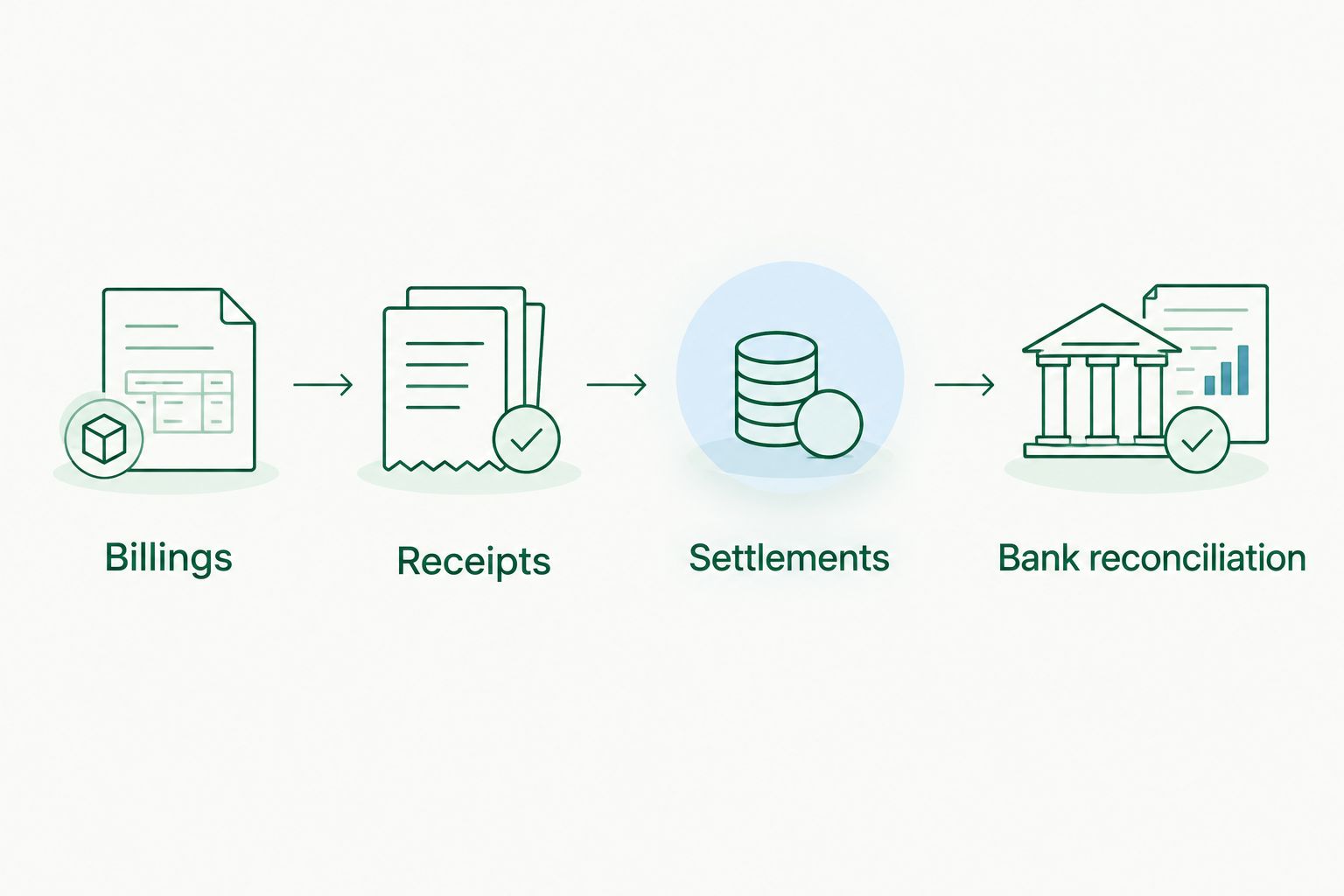
Use this reconciliation sequence for your 2026 procedures: billings, receipts, settlements and bank reconciliation. Keep evidence of adjustments so another person can understand why the balances changed.
Compare billing totals with recorded patient payments.
Match payment-provider settlements to bank deposits.
Record processing fees separately from service revenue.
Investigate rejected, reversed and unidentified payments.
Reconcile amounts owed to each practitioner.
03. Assign GST treatment to the actual supply
Create a register of what your clinic supplies and how each item is treated for GST. Start with your existing invoice descriptions and ask your tax adviser to check the classification. Avoid applying one default tax code to every item because the business operates in healthcare.
Some health services are GST-free when the relevant requirements are met. Other transactions, including certain reports, products or services supplied under different arrangements, need their own assessment. The recipient of the supply and the nature of the service can affect the result.
Daintree Consulting provides bookkeeping and tax and BAS compliance services. A combined engagement can cover recording transactions and reviewing their tax treatment, but you should agree who answers unusual GST questions before they arise.
For 2026 BAS preparation, use a documented exception list rather than asking reception staff to make tax decisions during patient checkout.
List each service and product category separately.
Confirm GST treatment with your registered tax adviser.
Check practitioner service fees independently of patient fees.
Review supplier invoices before claiming GST credits.
Document how corrected invoices affect your BAS records.
04. Check employment arrangements before processing pay
Build an employee register from signed employment documents, role descriptions, agreed hours and current pay settings. Then check the applicable award or enterprise agreement and the employee’s classification. A job title alone does not establish the correct pay conditions.
Healthcare clinics can employ people under different industrial instruments. Do not apply the same settings to a receptionist, nurse and other clinical employee without checking coverage. Review overtime, penalties, allowances and leave treatment against the conditions that apply to each role.
For contractors, assess the legal relationship rather than relying only on an ABN or invoice. Superannuation and payroll tax can require separate consideration even where the parties use a contractor agreement.
Keep employment records for 7 years, as required under Fair Work record-keeping rules. Make the approval trail accessible without giving everyone access to confidential payroll information.
Confirm the employer entity for every employee.
Record the applicable award, agreement and classification.
Check ordinary hours, overtime and penalty settings.
Review contractor arrangements with qualified advisers.
Restrict access to employee and banking information.
05. Build checks around every payroll run
You can start with an approval sheet covering timesheets, leave, roster changes and new starters. Require someone with authority to approve the inputs before payroll is finalised. A correct calculation cannot fix an unapproved change to hours or employment conditions.
Separate preparation, approval and payment wherever your staffing allows. In a smaller clinic, the owner can review the payroll summary and bank payment details before releasing funds. Confirm changes to bank accounts through a trusted channel, not an email reply alone.
The superannuation guarantee rate is 12% of ordinary time earnings in 2026 for eligible workers. Confirm which earnings form the calculation base and the payment requirements applying at the payroll date; do not assume every payroll item receives identical treatment.
Single Touch Payroll reporting also needs attention when corrections occur. Keep a record of what changed and reconcile the payroll reports to the accounts.
Approve timesheets and leave before processing pay.
Check starters, leavers and changes to pay conditions.
Review superannuation settings and earnings categories.
Verify bank-detail changes independently.
Reconcile wages, PAYG withholding and superannuation liabilities.
06. Forecast cash after wages and practitioner payments
Build a 13-week cash flow forecast using a spreadsheet before considering additional reporting software. This is a planning horizon, not a compliance requirement. Start with the actual bank balance and list expected receipts and payments by week.
Separate employee wages from practitioner settlements. Include rent, supplier payments, tax obligations, superannuation and loan commitments where relevant. Money waiting to be paid to a practitioner is not spare operating cash simply because it is sitting in your bank account.
Compare forecast receipts with billing and collection patterns, not just appointment bookings. An occupied appointment book does not establish when payment will arrive or whether the receipt belongs entirely to the clinic.
Use the forecast to decide what needs attention before approving spending. If a shortfall appears, identify the transaction or timing assumption behind it rather than treating the spreadsheet total as the explanation.
Separate clinic funds from practitioner amounts payable.
Schedule payroll and other committed payments.
Include BAS and superannuation obligations.
Test the effect of delayed patient receipts.
Update assumptions when staffing or billing arrangements change.
07. Close the accounts with clear ownership
Create a month-end checklist and assign an owner to each task. Your clinic needs a repeatable close, not a collection of reports produced whenever someone asks a question.
A useful management pack includes a reconciled profit and loss statement, balance sheet, aged receivables and a cash flow view. Explain material changes in plain language. If reported revenue increases, identify whether the cause is activity, pricing, timing or a correction before calling it business growth.
Decide who resolves issues that cross systems. A billing adjustment can affect the patient ledger, practitioner settlement and accounting records, so each person needs to know when the correction is complete.
For the remainder of 2026, keep a short issues register beside the reporting pack. Unresolved balances deserve an owner and next action, not another month of being carried forward.
Complete bank and payment-provider reconciliations.
Review patient receivables and practitioner balances.
Reconcile payroll and tax liability accounts.
Explain unusual movements in income and expenses.
Assign unresolved items to a named person.
Compare your bookkeeping and payroll options
Choose the arrangement that fits your clinic’s complexity and internal capacity. The best option is the one with clear accountability across billing, payroll and reporting, not simply the one that produces payslips.
Option | Best for | Main advantage | Key limitation |
|---|---|---|---|
Owner-managed records | Clinics where the owner can maintain and review the records | Direct visibility over transactions and approvals | Administrative work competes with clinical and management time |
In-house bookkeeper or payroll officer | Clinics needing regular internal coordination | Close access to roster changes and practice staff | Tax, employment and contractor questions can require separate advice |
Outsourced bookkeeping and payroll provider | Clinics seeking external transaction processing and payroll administration | Transfers defined recurring tasks outside the clinic | Billing corrections and approvals still need an internal owner |
Daintree Consulting | Healthcare businesses wanting bookkeeping, payroll, tax and advisory support together | Accounting and business advice can sit alongside routine processing | The engagement must define billing-system responsibilities and specialist advice needs |
Before appointing anyone, ask how they handle practitioner reconciliations, payroll corrections and unresolved balances. Request a written division of responsibilities. Software access alone does not tell you whether a task is included or who signs it off.
Common mistakes healthcare clinics make
Treating patient collections as available clinic cash
A bank balance can include amounts due to practitioners or money needed for payroll liabilities. Separate ownership from availability. Review practitioner balances and committed payments before deciding what the clinic can spend.
Applying one GST code across the practice
Healthcare premises do not determine the tax treatment of every transaction. Maintain service-level tax settings and escalate unfamiliar supplies to your tax adviser. Review new offerings before the first invoice rather than correcting a whole reporting period afterwards.
Assuming an ABN settles the contractor question
An ABN does not resolve employment, superannuation or payroll tax treatment. Have the working arrangement assessed under the relevant rules. Keep the contractual documents and review them when the way the practitioner works changes.
Letting reception own every unresolved billing issue
Reception staff can identify payment problems without having authority to resolve every accounting or tax question. Give them an escalation path, including who approves refunds and who corrects practitioner settlements. This keeps patient service separate from financial decision-making.
Checking compliance but not cash flow
A lodged BAS and completed payroll do not explain whether the clinic can fund its next commitments. Review your forecast alongside the accounts. Use the same current billing and payroll information in both so the two views do not contradict each other.
FAQ
What does bookkeeping and payroll for healthcare clinics include?
Bookkeeping and payroll for healthcare clinics includes recording and reconciling transactions, administering employee pay and maintaining the related financial records. The engagement should separately define patient billing, practitioner settlements, BAS work and management reporting.
Can one provider handle bookkeeping and payroll for my clinic?
One provider can handle both bookkeeping and payroll when both services are included in the engagement. Your clinic still needs to approve employment changes, supply accurate payroll inputs and assign responsibility for billing corrections.
Are all healthcare clinic services GST-free?
No, operating a healthcare clinic does not make every supply GST-free. The type of service, supplier, recipient and relevant GST requirements determine the treatment, so check individual service and product categories.
Do clinics have to pay superannuation for contractors?
Some contractors are entitled to superannuation under the applicable rules. An ABN or contractor agreement does not settle the question; have the specific engagement assessed before excluding the worker from superannuation calculations.
Is practice-management software enough for clinic bookkeeping?
Practice-management software does not replace reconciled accounting and payroll records. Your clinic must still match billings to receipts, account for practitioner settlements and check that the financial accounts reflect the transactions correctly.
What reports should a clinic owner review?
Review a reconciled profit and loss statement, balance sheet, aged receivables and cash flow forecast. Add practitioner balances and payroll liability reconciliations so the reports distinguish clinic earnings from money owed to others.
Should a small clinic outsource payroll or keep it in-house?
Keep payroll in-house only when someone has the time and knowledge to maintain accurate settings, records and reporting. Outsourcing suits clinics that want external administration, but the clinic must still approve inputs and retain clear oversight.
One last thing
Ask who owns the money before asking whether the bank balance is correct. That question connects patient billing, practitioner settlements and cash flow, and it often reveals why an apparently tidy set of records does not give the owner a clear picture.
At your next review, trace a patient payment from invoice to receipt, then through any practitioner settlement and into the accounts. Check who approves a correction at each stage. Once that path is clear, your clinic has a practical foundation for reliable bookkeeping, payroll and reporting.
Talk to Daintree about your bookkeeping and payroll
Our ex-Big 4 team gives clear, senior-reviewed advice so you can act with confidence.
Book a free consultation →
Or explore our bookkeeping and payroll services.
