
Best SMSF administration software in Australia 2026
Best overall for a dedicated SMSF accounting shortlist: BGL Simple Fund 360. Best for firms considering SMSF administration alongside broader investment accounting: Class Super. Best for firms already familiar with the SuperMate platform: SuperMate. The best SMSF administration software in Australia in 2026 is the platform that fits your accountant’s workflow, fund records and audit requirements—not a substitute for professional oversight.
TL;DR
Want expert help? Daintree Consulting's SMSF accounting services can take this off your plate. Book a free consultation.
BGL Simple Fund 360 belongs on the best SMSF administration software shortlist for specialist SMSF accounting workflows.
Class Super suits an evaluation that also considers broader investment accounting requirements.
SuperMate deserves consideration when your accounting team already knows its administration workflow.
Daintree Consulting provides SMSF accounting; choose software around the service and oversight your fund needs.
Why this matters
SMSF administration software helps organise fund transactions, investments, accounts and compliance work. It does not remove the responsibilities of trustees, accountants or the independent auditor. Those roles still need clear boundaries.
For a trustee, the first decision is usually who will administer the fund. For an accounting firm, it is how the platform will support preparation, review and audit across its client base. These are different buying decisions.
Daintree Consulting provides SMSF accounting alongside its other accounting and advisory services. If you are choosing an accountant rather than an administration system, start with the work you need handled and the reporting you need to understand.
In 2026, assess software against your actual fund or client portfolio. A useful demonstration follows a complete administration cycle, rather than showing isolated dashboard features.
What makes the best SMSF administration software?
Use these criteria before comparing product demonstrations. A feature matters only when it supports work your team needs to complete.
Fund fit: Check support for the fund’s investments, member arrangements and transaction types. Do not assume that handling a simple accumulation fund proves suitability for a more complex fund.
Data handling: Examine how transactions enter the system, how exceptions are identified and how balances are reconciled. Confirm the connections needed for your actual accounts.
Accounting and compliance: Follow the process from transaction coding to financial statements and return preparation. Identify the checks that still require professional judgement.
Audit evidence: Look for a practical way to assemble supporting documents and explain adjustments. The auditor needs evidence, not just completed reports.
Review and access: Establish who prepares work, who reviews it and what trustees can see. Access should match each person’s responsibilities.
Migration and exit: Check how opening balances, historical records and documents will move into the system—and how you can retrieve them later.
Choose the workflow before choosing the dashboard. This keeps the comparison focused on administration quality rather than presentation.
SMSF administration software at a glance
The order below reflects the recommended evaluation sequence for the stated use cases. It is not a claim that one platform performs better for every fund.
Software | Best for | Standout focus | Key limitation |
|---|---|---|---|
BGL Simple Fund 360 | Specialist SMSF accounting workflows | Dedicated cloud-based SMSF administration | Software does not replace fund-specific accounting review or an independent audit |
Class Super | Firms evaluating SMSFs alongside broader investment accounting needs | SMSF administration within Class’s investment accounting offering | Confirm which requirements belong to Class Super and which require another product |
SuperMate | Firms retaining an established SuperMate workflow | Dedicated SMSF administration | Familiarity alone does not establish suitability for a new fund’s requirements |
The named platforms are SMSF administration options, not equivalent service packages. Compare the work included in your accountant’s engagement separately from the capabilities of the software.
1. BGL Simple Fund 360: best for specialist SMSF workflows
BGL Simple Fund 360 is a cloud-based SMSF administration platform. It supports the accounting and compliance work involved in administering self-managed super funds. Put it on your shortlist when your main requirement is a dedicated SMSF workflow.
The useful test is an end-to-end demonstration using a fund structure that resembles yours. Follow transactions through reconciliation, accounting treatment, review and final reporting. Ask the demonstrator to show how an exception is resolved, not just how a completed fund looks.
BGL Simple Fund 360 pros
A dedicated SMSF focus gives your evaluation a clear starting point.
Cloud-based administration supports shared access, subject to permissions.
Accounting and compliance work can be assessed within the same platform.
Existing BGL experience gives your team a relevant basis for evaluating the workflow.
BGL Simple Fund 360 cons
Automated processing does not establish that an accounting treatment is correct.
Moving an existing fund still requires opening-balance and historical-record checks.
The platform does not replace independent audit work or trustee responsibilities.
Best for: Accounting teams seeking a dedicated SMSF administration platform and prepared to test it against their own funds.
Ask how the team handles transactions that do not reconcile cleanly. A clear exception process matters more than a demonstration in which everything already balances.
Verdict: Buy only after the fund-fit, review and audit-evidence checks pass.
2. Class Super: best for a broader investment accounting evaluation
Class Super is a cloud-based SMSF administration platform. Class also offers investment accounting products beyond SMSF administration. That makes Class relevant when your firm is assessing its wider investment accounting arrangements as well as its SMSF work.
Keep product boundaries clear. A capability described elsewhere in the Class offering is not automatically part of Class Super. Your demonstration and written scope should identify the product used for each requirement.
Class Super pros
A dedicated SMSF platform provides a focused administration option.
The wider Class offering is relevant to firms evaluating other investment entities.
Cloud-based operation supports a permissions-based team workflow.
An existing Class workflow provides a practical starting point for evaluation.
Class Super cons
Different entity requirements need product-by-product confirmation.
Standardised processing still requires review of unusual transactions.
Moving records between systems creates a separate reconciliation task.
Best for: Accounting firms evaluating SMSF administration within a broader investment accounting environment.
Request separate demonstrations for the SMSF requirements and any other entity requirements. Then document which system holds each record, who reviews it and how supporting information reaches the auditor.
For a trustee, your accountant’s ability to explain the fund remains more important than the breadth of a software supplier’s product range.
Verdict: Buy when Class Super meets the SMSF requirements and the wider product scope is clear.
3. SuperMate: best for an established SuperMate team
SuperMate is an SMSF administration platform. It deserves a place on the shortlist when your accounting team already uses it and understands its preparation and review processes. Existing knowledge is a practical selection factor, not proof that every fund will fit.
Start by checking the requirements that differ from the team’s existing funds. A new investment type, member arrangement or reporting need deserves its own demonstration. Do not rely solely on familiarity with routine annual accounts.
SuperMate pros
A dedicated SMSF focus keeps the evaluation centred on fund administration.
Existing team knowledge reduces the amount of unfamiliar workflow to assess.
Established review procedures provide a useful basis for checking fund fit.
SuperMate cons
Familiarity can leave new requirements insufficiently examined.
Retaining a platform does not resolve gaps in documentation or review.
A platform change still needs a controlled transfer of historical information.
Best for: Firms with an established SuperMate workflow that can demonstrate suitability for the fund being administered.
Ask your accountant to explain the process in plain language: what enters the system, what receives manual review and what you receive as trustee. You should understand those answers without knowing the software.
Verdict: Hold an established SuperMate workflow when the fund-fit and reporting checks pass.
Trustee or accounting firm: which decision are you making?
A trustee usually needs an administration outcome: accurate records, completed accounts, clear responsibilities and an organised audit process. An accounting firm also needs a workable preparation and review system across its clients. Comparing software without separating these needs produces the wrong shortlist.
If you are an SMSF trustee
Ask who handles transaction processing, accounting, return preparation and audit coordination. Establish what you must supply and when. Also ask what explanations accompany the financial statements, rather than focusing only on access to a portal.
Daintree Consulting’s SMSF accounting service is best suited to businesses and trustees seeking accounting support rather than a software subscription. Discuss the fund’s requirements and the scope of work before making software the deciding factor.
If you are choosing software for an accounting firm
Evaluate staff permissions, review responsibilities, exception handling and document retrieval. Include the people who prepare accounts and the people who review them. A demonstration aimed only at the purchasing decision misses the daily work.
For your 2026 shortlist, record the same requirements for every candidate. This makes differences visible without relying on competing sales presentations.
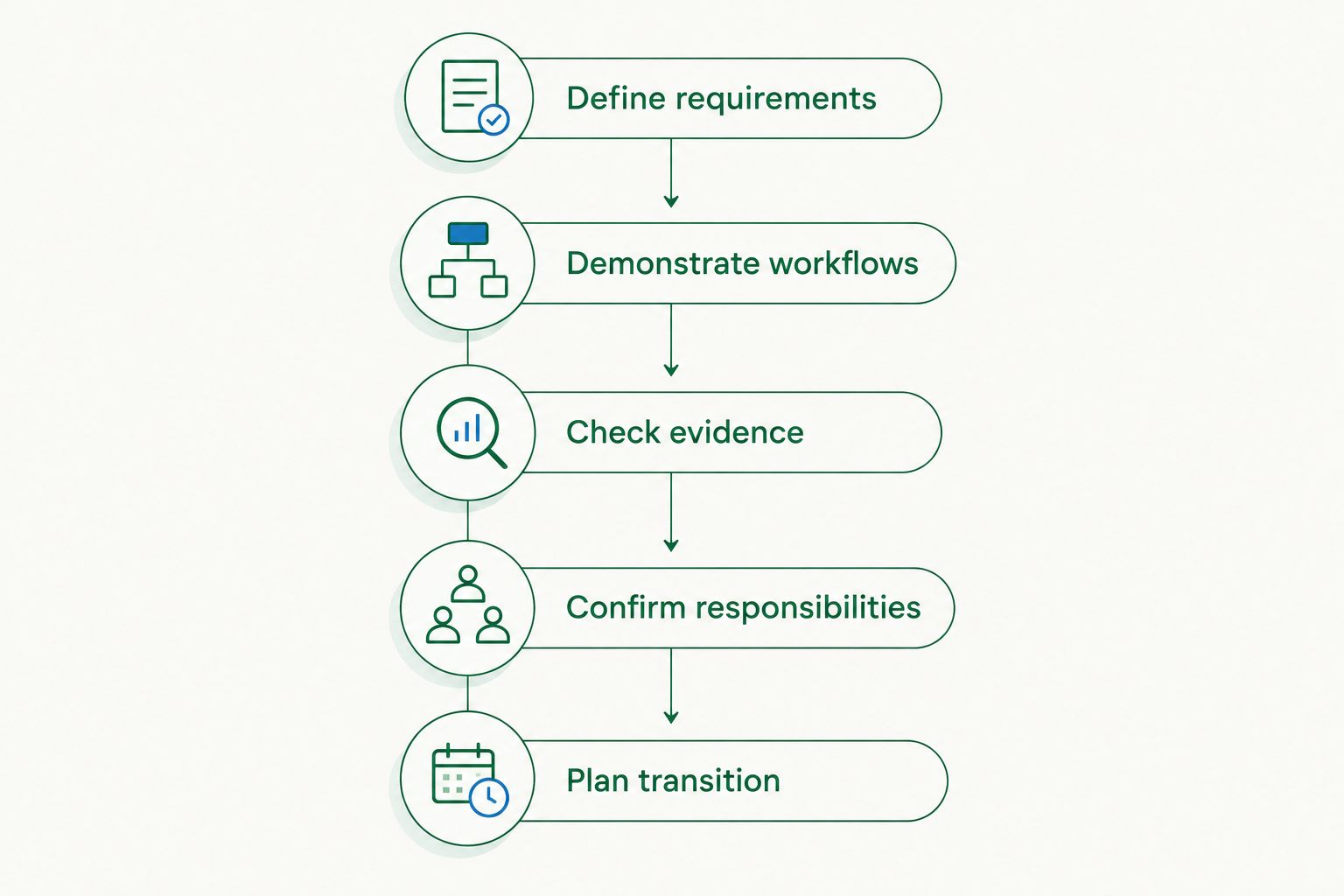
How to evaluate the platforms in a clear sequence
01. Define requirements
List the fund’s investments, members, reporting needs and outstanding record issues. Separate essential requirements from preferences. Use actual fund circumstances, not a generic feature checklist.
02. Demonstrate workflows
Ask each supplier to show the same administration tasks. Include an unmatched transaction, a correcting entry and a supporting-document request. Observe the work needed to resolve each one.
03. Check evidence
Trace a reported balance back to its underlying records. Confirm how the accountant and auditor obtain supporting documents. Establish who controls access and how records are retained.
04. Confirm responsibilities
Write down who prepares, reviews, approves and supplies information. If you are engaging an accountant, confirm the service scope separately. Software capability and professional responsibility are different things.
05. Plan transition
Document opening balances, historical information and the review required before the new workflow becomes the official record. Include an exit plan. You need access to your records even if the service arrangement changes.
Compliance checks that software cannot replace
The Australian Taxation Office’s SMSF guidance sets out trustee responsibilities, record-keeping requirements and the independent audit requirement. Use that guidance as your compliance reference for 2026, rather than treating a software report as confirmation that every obligation is satisfied.
Member limit: An SMSF can have up to 6 members. Check the fund structure and trustee arrangements, not just whether the software accepts member details.
Financial records: Required accounting records generally need to be retained for at least 5 years. Establish how records remain accessible after a platform or accountant change.
Governance records: Specified records, including trustee meeting minutes and certain trustee decisions, need to be retained for at least 10 years. Keep governance documents alongside the financial record process.
Independent audit: An SMSF requires an audit each financial year by an approved SMSF auditor. Administration software does not perform that independent professional role.
These are separate obligations. Confirm the retention rules for each document type with your accountant instead of applying one period to everything.
How this shortlist is ranked
The 2026 shortlist uses fund fit, data handling, accounting workflow, audit evidence, access and migration as the decision criteria. BGL Simple Fund 360 leads the dedicated-workflow evaluation; Class Super occupies the broader investment accounting slot; SuperMate occupies the established-team slot.
The ranking is a buying framework, not a measured performance comparison. Your fund requirements and the team administering them determine the final choice.
Which SMSF administration software should you choose?
If you are undecided, choose the accountant and administration scope first. Then assess whether the proposed software supports that work and gives you access to understandable records.
For an accounting firm without an existing platform preference, start the dedicated SMSF evaluation with BGL Simple Fund 360. Add Class Super when broader investment accounting requirements are part of the decision. Retain SuperMate when the existing workflow passes the same checks.
Daintree Consulting provides SMSF accounting, not a software product. The useful discussion is about your fund, its records and the professional work needed to maintain them.
Discuss your SMSF accounting needs
Clarify the accounting support and administration responsibilities your fund needs.
FAQ
What is the best SMSF administration software in Australia in 2026?
The best SMSF administration software is the platform that meets your fund requirements and supports your accountant’s review process. Shortlist BGL Simple Fund 360, Class Super and SuperMate against the same accounting, evidence and migration checks.
Is BGL Simple Fund 360 better than Class Super?
Neither is automatically better for every fund. Compare BGL Simple Fund 360 and Class Super using the same fund transactions, reporting requirements and audit-evidence tasks.
Should I choose my SMSF accountant before choosing software?
Yes, if you are a trustee seeking an administered service rather than buying software for an accounting firm. Agree on the work, responsibilities and reporting first, then assess the proposed platform.
Does SMSF administration software replace an accountant?
No, software does not replace the professional judgement involved in SMSF accounting. Transaction processing and report preparation still need review against the fund’s circumstances and obligations.
Can SMSF software complete the independent audit?
No, an SMSF requires an independent audit by an approved SMSF auditor each financial year. Software can organise records and evidence, but it does not replace that professional role.
What should I check before changing SMSF software?
Check opening balances, historical records, supporting documents, permissions and record retrieval before changing platforms. Assign responsibility for reconciling the transferred information before relying on the new system.
How long should SMSF records be kept?
Required accounting records generally need to be kept for at least 5 years, while specified governance records need at least 10 years. Check the Australian Taxation Office’s requirements for each document type rather than using a single retention period.
One last thing
Ask your proposed accountant to trace one figure in the financial statements back to its supporting records. That simple request examines the whole administration chain: transaction handling, reconciliation, evidence and explanation.
The best system leaves you with a clear picture of the fund—not just a completed set of reports.
Talk to Daintree about your SMSF accounts
Our ex-Big 4 team gives clear, senior-reviewed advice so you can act with confidence.
Book a free consultation →
Or explore our SMSF accounting services.
